Nostr blogs are broken.
Relays disappear.
Media vanishes.
SEO is missing.
NostrPress fixes it.
→ Build a fully static, self-hosted Nostr blog
→ Deploy your own blog in 1 click
Live:  Code:
Code: 
besoeasy
besoeasy
Seasoned full-stack developer specializing in fintech and automation, with experience collaborating with 70+ organizations to deliver secure, missi...
GitHub
GitHub - besoeasy/NostrPress: NostrPress turns a Nostr profile into a fast, fully static blog. Publish articles on Nostr, and deploy a real website anywhere — with local media, RSS, and zero lock-in.
NostrPress turns a Nostr profile into a fast, fully static blog. Publish articles on Nostr, and deploy a real website anywhere — with local media...




![ꓘɨℓσꬺƄɨP110ꓘɳσ[Ŧƨ] 𓅦丰's avatar](https://image.nostr.build/23ee33cac87bf71b98e809e2d990cf0a04c5aa1af452383f8a845479e072d79f.gif)



















































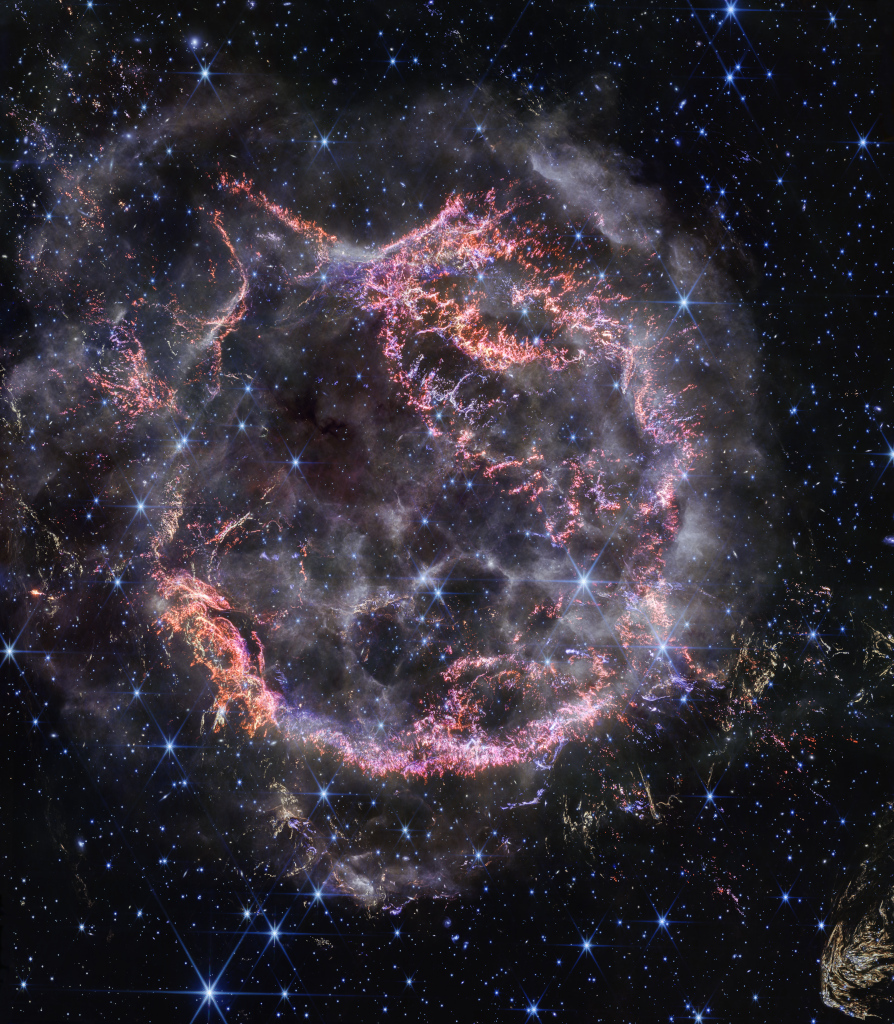 Image Credit: NASA, ESA, CSA, STScI
Explanation:
Massive stars
in our Milky Way Galaxy live spectacular lives.
Collapsing from vast cosmic clouds, their nuclear furnaces
ignite and create heavy elements in their cores.
After only a few million years for the most massive stars, the
enriched material is blasted
back into interstellar space where star formation can begin anew.
The expanding debris cloud known as Cassiopeia A is an example
of this final phase of the
stellar life cycle.
Light from the supernova explosion that created this remnant
would have been first
seen in planet Earth's sky
about 350 years ago,
although it took that light 11,000 years to reach us.
This sharp NIRCam image
from the James Webb Space Telescope
shows the still-hot filaments and knots in the supernova remnant.
The whitish, smoke-like outer shell of the expanding blast wave
is about 20 light-years across.
A series of light echoes
from the massive star's cataclysmic explosion are also
identified in Webb's detailed images
of the surrounding interstellar medium.
#APOD #Astronomy #Astronomy #NASA #Astrogeek
Image Credit: NASA, ESA, CSA, STScI
Explanation:
Massive stars
in our Milky Way Galaxy live spectacular lives.
Collapsing from vast cosmic clouds, their nuclear furnaces
ignite and create heavy elements in their cores.
After only a few million years for the most massive stars, the
enriched material is blasted
back into interstellar space where star formation can begin anew.
The expanding debris cloud known as Cassiopeia A is an example
of this final phase of the
stellar life cycle.
Light from the supernova explosion that created this remnant
would have been first
seen in planet Earth's sky
about 350 years ago,
although it took that light 11,000 years to reach us.
This sharp NIRCam image
from the James Webb Space Telescope
shows the still-hot filaments and knots in the supernova remnant.
The whitish, smoke-like outer shell of the expanding blast wave
is about 20 light-years across.
A series of light echoes
from the massive star's cataclysmic explosion are also
identified in Webb's detailed images
of the surrounding interstellar medium.
#APOD #Astronomy #Astronomy #NASA #Astrogeek