
**Astronomy Picture of the Day**
07 February 2026
**Supernova Remnant Cassiopeia A**
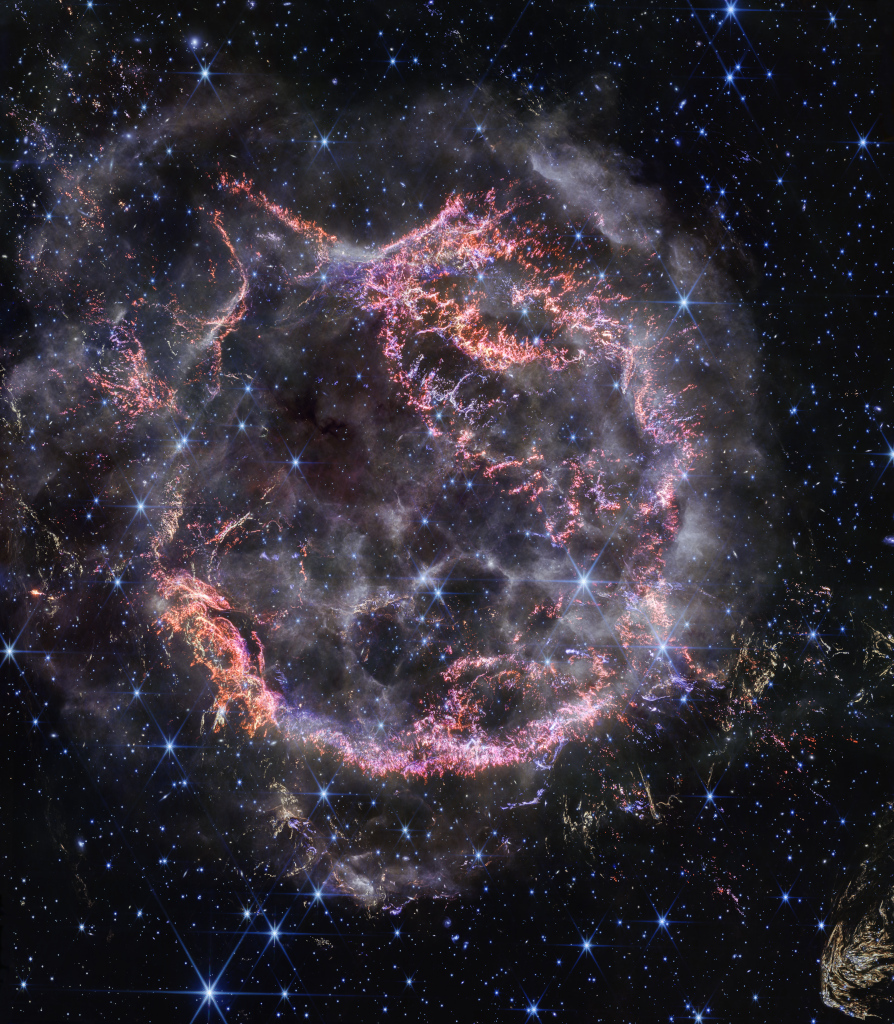 Image Credit: NASA, ESA, CSA, STScI
Explanation:
Massive stars
in our Milky Way Galaxy live spectacular lives.
Collapsing from vast cosmic clouds, their nuclear furnaces
ignite and create heavy elements in their cores.
After only a few million years for the most massive stars, the
enriched material is blasted
back into interstellar space where star formation can begin anew.
The expanding debris cloud known as Cassiopeia A is an example
of this final phase of the
stellar life cycle.
Light from the supernova explosion that created this remnant
would have been first
seen in planet Earth's sky
about 350 years ago,
although it took that light 11,000 years to reach us.
This sharp NIRCam image
from the James Webb Space Telescope
shows the still-hot filaments and knots in the supernova remnant.
The whitish, smoke-like outer shell of the expanding blast wave
is about 20 light-years across.
A series of light echoes
from the massive star's cataclysmic explosion are also
identified in Webb's detailed images
of the surrounding interstellar medium.
#APOD #Astronomy #Astronomy #NASA #Astrogeek
Image Credit: NASA, ESA, CSA, STScI
Explanation:
Massive stars
in our Milky Way Galaxy live spectacular lives.
Collapsing from vast cosmic clouds, their nuclear furnaces
ignite and create heavy elements in their cores.
After only a few million years for the most massive stars, the
enriched material is blasted
back into interstellar space where star formation can begin anew.
The expanding debris cloud known as Cassiopeia A is an example
of this final phase of the
stellar life cycle.
Light from the supernova explosion that created this remnant
would have been first
seen in planet Earth's sky
about 350 years ago,
although it took that light 11,000 years to reach us.
This sharp NIRCam image
from the James Webb Space Telescope
shows the still-hot filaments and knots in the supernova remnant.
The whitish, smoke-like outer shell of the expanding blast wave
is about 20 light-years across.
A series of light echoes
from the massive star's cataclysmic explosion are also
identified in Webb's detailed images
of the surrounding interstellar medium.
#APOD #Astronomy #Astronomy #NASA #Astrogeek
Image Credit: NASA, ESA, CSA, STScI
Explanation:
Massive stars
in our Milky Way Galaxy live spectacular lives.
Collapsing from vast cosmic clouds, their nuclear furnaces
ignite and create heavy elements in their cores.
After only a few million years for the most massive stars, the
enriched material is blasted
back into interstellar space where star formation can begin anew.
The expanding debris cloud known as Cassiopeia A is an example
of this final phase of the
stellar life cycle.
Light from the supernova explosion that created this remnant
would have been first
seen in planet Earth's sky
about 350 years ago,
although it took that light 11,000 years to reach us.
This sharp NIRCam image
from the James Webb Space Telescope
shows the still-hot filaments and knots in the supernova remnant.
The whitish, smoke-like outer shell of the expanding blast wave
is about 20 light-years across.
A series of light echoes
from the massive star's cataclysmic explosion are also
identified in Webb's detailed images
of the surrounding interstellar medium.
#APOD #Astronomy #Astronomy #NASA #Astrogeek
APOD: 2026 February 6 - Supernova Remnant Cassiopeia A
A different astronomy and space science
related image is featured each day, along with a brief explanation.
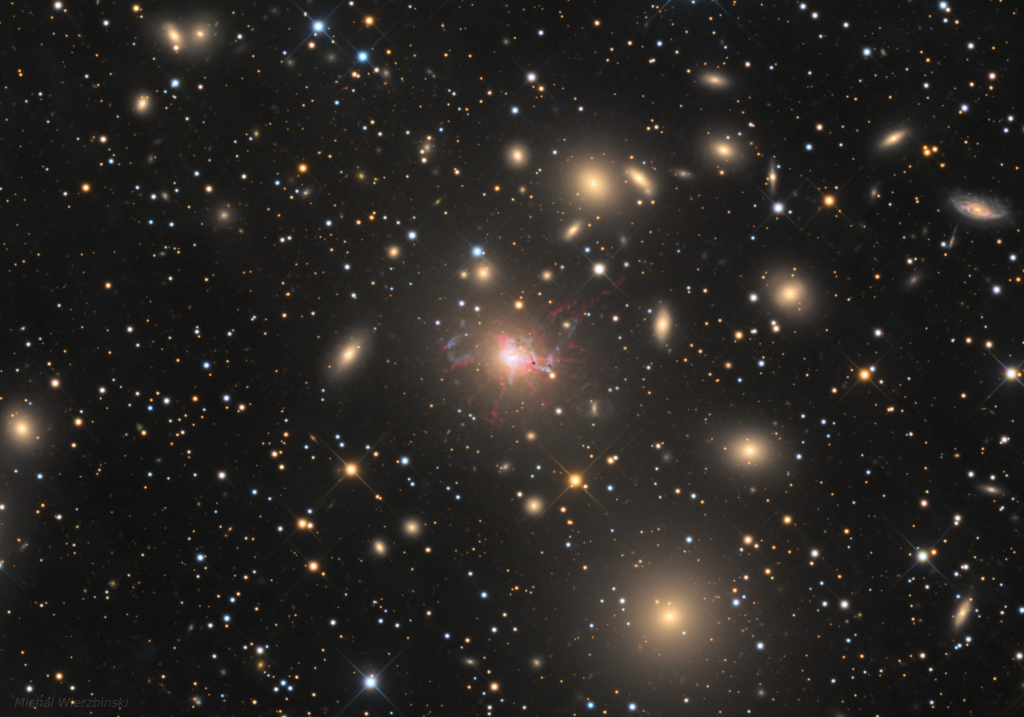 Image Credit: Michal Wierzbinski, Hellas-Sky
Explanation:
Active galaxy
NGC 1275 is the central, dominant member of the large and
relatively nearby
Perseus Cluster of Galaxies.
Wild-looking at visible wavelengths, the active galaxy is also a
prodigious source of
x-rays
and
radio
emission.
NGC 1275 accretes matter as entire galaxies fall into it, ultimately
feeding a supermassive black hole at the galaxy's core.
Narrowband image data used in this sharp telescopic image
highlights the resulting
galactic debris
and filaments of glowing gas,
some up to 20,000 light-years long.
The filaments persist
in NGC 1275, even though
the turmoil of galactic collisions should destroy them.
What keeps the filaments together?
Observations
indicate that the structures, pushed out
from the galaxy's center by the black hole's activity, are
held together by magnetic fields.
Also known as Perseus A,
NGC 1275 itself spans over 100,000 light years and
lies about 230 million light years away.
#APOD #Universe #Space #Astrophoto Astrophotography
Image Credit: Michal Wierzbinski, Hellas-Sky
Explanation:
Active galaxy
NGC 1275 is the central, dominant member of the large and
relatively nearby
Perseus Cluster of Galaxies.
Wild-looking at visible wavelengths, the active galaxy is also a
prodigious source of
x-rays
and
radio
emission.
NGC 1275 accretes matter as entire galaxies fall into it, ultimately
feeding a supermassive black hole at the galaxy's core.
Narrowband image data used in this sharp telescopic image
highlights the resulting
galactic debris
and filaments of glowing gas,
some up to 20,000 light-years long.
The filaments persist
in NGC 1275, even though
the turmoil of galactic collisions should destroy them.
What keeps the filaments together?
Observations
indicate that the structures, pushed out
from the galaxy's center by the black hole's activity, are
held together by magnetic fields.
Also known as Perseus A,
NGC 1275 itself spans over 100,000 light years and
lies about 230 million light years away.
#APOD #Universe #Space #Astrophoto Astrophotography
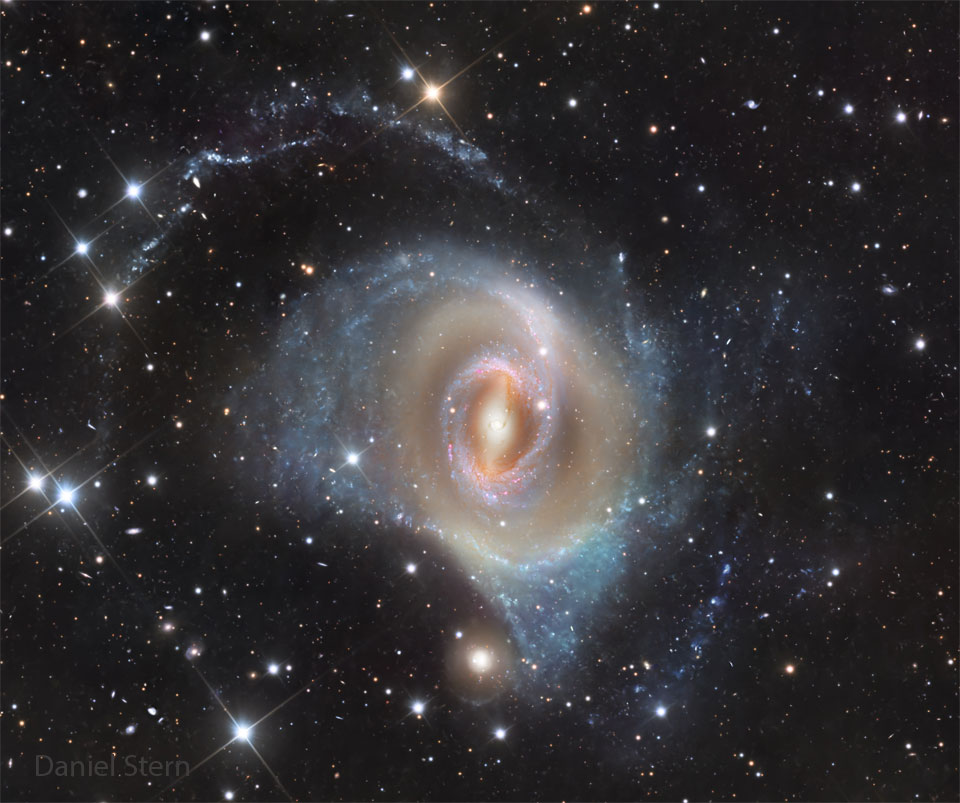 Image Credit: Daniel Stern
Explanation:
Most galaxies don't have any rings -- why does this galaxy have three?
To begin, a ring that's near
NGC 1512's center --
and so hard to see here -- is the
nuclear ring
which glows brightly with recently formed
stars.
Next out is a ring of stars and
dust appearing both red and blue, called,
counter-intuitively, the inner ring.
This inner ring connects ends of a diffuse
central bar
of stars that runs horizontally across the galaxy.
Farthest out in this wide field image is a
ragged structure that might be considered an outer ring.
This outer ring appears spiral-like and is dotted with
clusters of bright blue stars.
All these ring structures are thought to be affected by
NGC 1512's own gravitational asymmetries in a drawn-out process called
secular
evolution.
The featured image was captured last month from a telescope at
Deep Sky Chile in
Chile.
#APOD #NASA #NASAInspires #Astrophoto #Astronomy
Image Credit: Daniel Stern
Explanation:
Most galaxies don't have any rings -- why does this galaxy have three?
To begin, a ring that's near
NGC 1512's center --
and so hard to see here -- is the
nuclear ring
which glows brightly with recently formed
stars.
Next out is a ring of stars and
dust appearing both red and blue, called,
counter-intuitively, the inner ring.
This inner ring connects ends of a diffuse
central bar
of stars that runs horizontally across the galaxy.
Farthest out in this wide field image is a
ragged structure that might be considered an outer ring.
This outer ring appears spiral-like and is dotted with
clusters of bright blue stars.
All these ring structures are thought to be affected by
NGC 1512's own gravitational asymmetries in a drawn-out process called
secular
evolution.
The featured image was captured last month from a telescope at
Deep Sky Chile in
Chile.
#APOD #NASA #NASAInspires #Astrophoto #Astronomy