
This reminds me of a book I tried reading but found too boring.
==
summarise 'the illusion of free markets' by bernard harcourt
"The Illusion of Free Markets" by Bernard Harcourt challenges the widely held belief that markets are naturally free, efficient, and self-regulating. Harcourt traces the idea of natural order in markets back to eighteenth-century economic thought and shows how it evolved through the Chicago School of economics, leading to the modern myth that competitive markets operate independently of coercion or regulation. He argues that the notion of "free markets" is an illusion because all markets are regulated in some way, often through legal and state mechanisms that shape outcomes rather than letting them emerge naturally.
Harcourt further explains that the belief in free markets is closely tied to a contrasting faith in a strong punitive state that handles law and order. This paradox—government incompetence in economic regulation but competence in policing and punishment—has contributed to the expansion of the penal system, especially mass incarceration. The ideological elevation of markets obscures how political decisions and state power determine economic and social inequalities. Harcourt calls this relationship the "neoliberal penality," where state enforcement and free-market ideology work together to produce social order and economic outcomes that appear natural but are deeply governed by regulation and coercion.
Essentially, Harcourt's thesis dismantles the idea that markets operate free of external influence. Instead, he reveals that the "freedom" of markets is constructed and maintained by state power and legal authority, which paradoxically also fosters extensive control and punishment in society. The book combines economic history, legal theory, and social critique to show how these myths about natural order in both markets and punishment have shaped contemporary American political and social realities, including the rise of mass incarceration.
This work emphasizes two major lessons: first, no market is truly free, only differently regulated; and second, devotion to free markets goes hand in hand with state coercion in policing and punishment—a combination having profound implications for democracy, inequality, and justice.
These points summarize the core arguments and impact of Harcourt's "The Illusion of Free Markets" [1][2][3][5][7].
Citations:
[1] The Illusion of Free Markets: Punishment and the Myth of Natural Order
[2] The Illusion of Free Markets: Punishment and the Myth o… 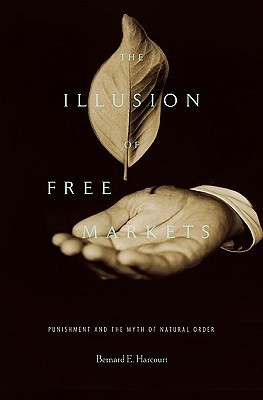 [3] THE ILLUSION OF FREE MARKETS: PUNISHMENT AND ...
  [4] Illusion of Free Markets .pdf
[5] The Illusion of Free Markets — Harvard University Press
[4] Illusion of Free Markets .pdf
[5] The Illusion of Free Markets — Harvard University Press  [6] Bernard E. Harcourt, The Illusion of Free Markets
  [7] "The Illusion of Free Markets: Punishment and the Myth ...
  [8] The Illusion of Free Markets: Punishment and the Myth of
  [9] The Illusion of Free Markets: Six Questions for Bernard Harcourt
  [10] Bernard Harcourt "The Illusion of Free Markets"
The Illusion of Free Markets: Punishment and the Myth of Natural Order – EH.net
Goodreads
The Illusion of Free Markets: Punishment and the Myth o…
It is widely believed today that the free market is th…
THE ILLUSION OF FREE MARKETS: PUNISHMENT AND THE MYTH OF OF NATURAL ORDER
by Bernard E. Harcourt. Cambridge, Mass.: Harvard University Press, 2011. 336 pages. Hardcover $29.95. ISBN 9780674057265. reviewed by Mich...
Harvard University Press
The Illusion of Free Markets — Harvard University Press
It is widely believed today that the free market is the best mechanism ever invented to efficiently allocate resources in society. Just as fundamen...
Bernard E. Harcourt, The Illusion of Free Markets: Punishment and t...
Bernard Harcourt fait figure de chercheur un peu à part dans la sociologie pénale contemporaine. Tour à tour nominaliste et économiste, engagé...
Scholarship Archive
The Illusion of Free Markets: Punishment and the Myth of Natural Order
It is widely believed today that the free market is the best mechanism ever invented to efficiently allocate resources in society. Just as fundamen...
Criminal Law and Criminal Justice Book Reviews
The Illusion of Free Markets: Punishment and the Myth of Natural Order - Criminal Law and Criminal Justice Book Reviews
Author: Bernard E. HarcourtCambridge, MA: Harvard University Press, 2011. 336p.Reviewer: Íñigo Ortiz de Urbina Gimeno | January 2012
Harper's Magazine
The Illusion of Free Markets: Six Questions for Bernard Harcourt, by Scott Horton
University of Chicago professor Bernard Harcourt is a student, but not a follower, of the Chicago School, an academic movement that has had a profound
