
**Astronomy Picture of the Day**
07 February 2026
**Supernova Remnant Cassiopeia A**
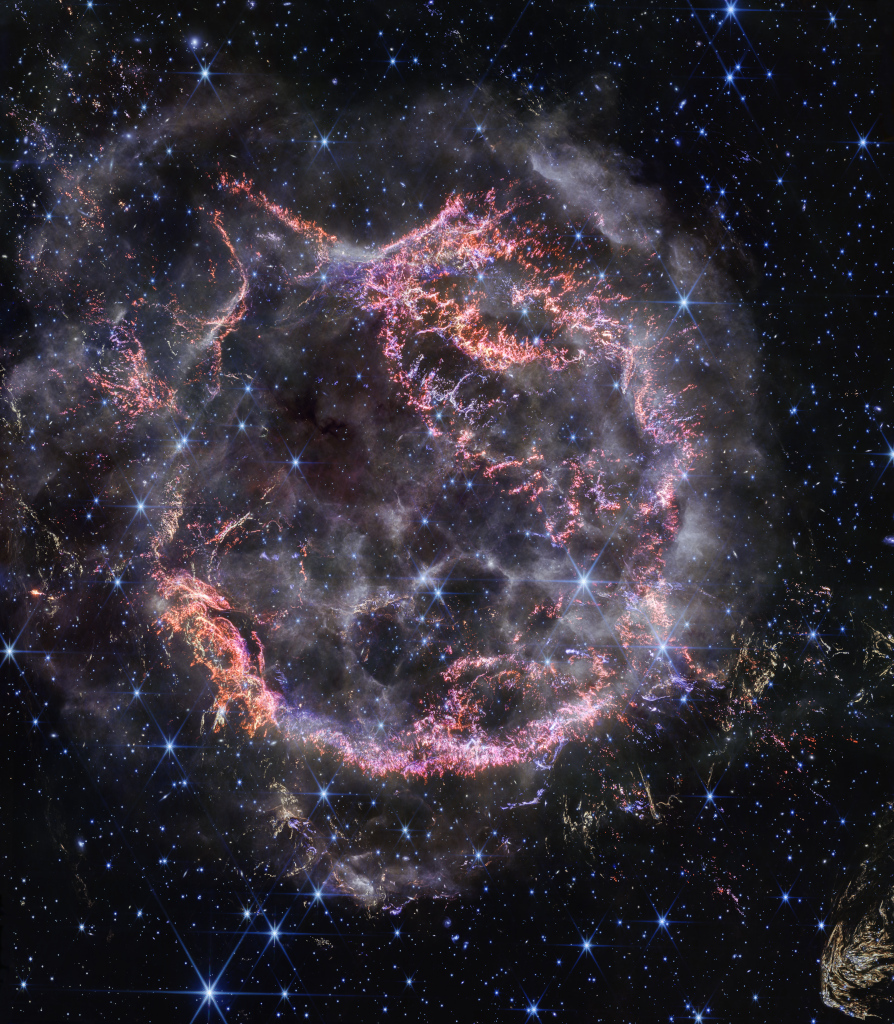 Image Credit: NASA, ESA, CSA, STScI
Explanation:
Massive stars
in our Milky Way Galaxy live spectacular lives.
Collapsing from vast cosmic clouds, their nuclear furnaces
ignite and create heavy elements in their cores.
After only a few million years for the most massive stars, the
enriched material is blasted
back into interstellar space where star formation can begin anew.
The expanding debris cloud known as Cassiopeia A is an example
of this final phase of the
stellar life cycle.
Light from the supernova explosion that created this remnant
would have been first
seen in planet Earth's sky
about 350 years ago,
although it took that light 11,000 years to reach us.
This sharp NIRCam image
from the James Webb Space Telescope
shows the still-hot filaments and knots in the supernova remnant.
The whitish, smoke-like outer shell of the expanding blast wave
is about 20 light-years across.
A series of light echoes
from the massive star's cataclysmic explosion are also
identified in Webb's detailed images
of the surrounding interstellar medium.
#APOD #Astronomy #Astronomy #NASA #Astrogeek
Image Credit: NASA, ESA, CSA, STScI
Explanation:
Massive stars
in our Milky Way Galaxy live spectacular lives.
Collapsing from vast cosmic clouds, their nuclear furnaces
ignite and create heavy elements in their cores.
After only a few million years for the most massive stars, the
enriched material is blasted
back into interstellar space where star formation can begin anew.
The expanding debris cloud known as Cassiopeia A is an example
of this final phase of the
stellar life cycle.
Light from the supernova explosion that created this remnant
would have been first
seen in planet Earth's sky
about 350 years ago,
although it took that light 11,000 years to reach us.
This sharp NIRCam image
from the James Webb Space Telescope
shows the still-hot filaments and knots in the supernova remnant.
The whitish, smoke-like outer shell of the expanding blast wave
is about 20 light-years across.
A series of light echoes
from the massive star's cataclysmic explosion are also
identified in Webb's detailed images
of the surrounding interstellar medium.
#APOD #Astronomy #Astronomy #NASA #Astrogeek
Image Credit: NASA, ESA, CSA, STScI
Explanation:
Massive stars
in our Milky Way Galaxy live spectacular lives.
Collapsing from vast cosmic clouds, their nuclear furnaces
ignite and create heavy elements in their cores.
After only a few million years for the most massive stars, the
enriched material is blasted
back into interstellar space where star formation can begin anew.
The expanding debris cloud known as Cassiopeia A is an example
of this final phase of the
stellar life cycle.
Light from the supernova explosion that created this remnant
would have been first
seen in planet Earth's sky
about 350 years ago,
although it took that light 11,000 years to reach us.
This sharp NIRCam image
from the James Webb Space Telescope
shows the still-hot filaments and knots in the supernova remnant.
The whitish, smoke-like outer shell of the expanding blast wave
is about 20 light-years across.
A series of light echoes
from the massive star's cataclysmic explosion are also
identified in Webb's detailed images
of the surrounding interstellar medium.
#APOD #Astronomy #Astronomy #NASA #Astrogeek
APOD: 2026 February 6 - Supernova Remnant Cassiopeia A
A different astronomy and space science
related image is featured each day, along with a brief explanation.
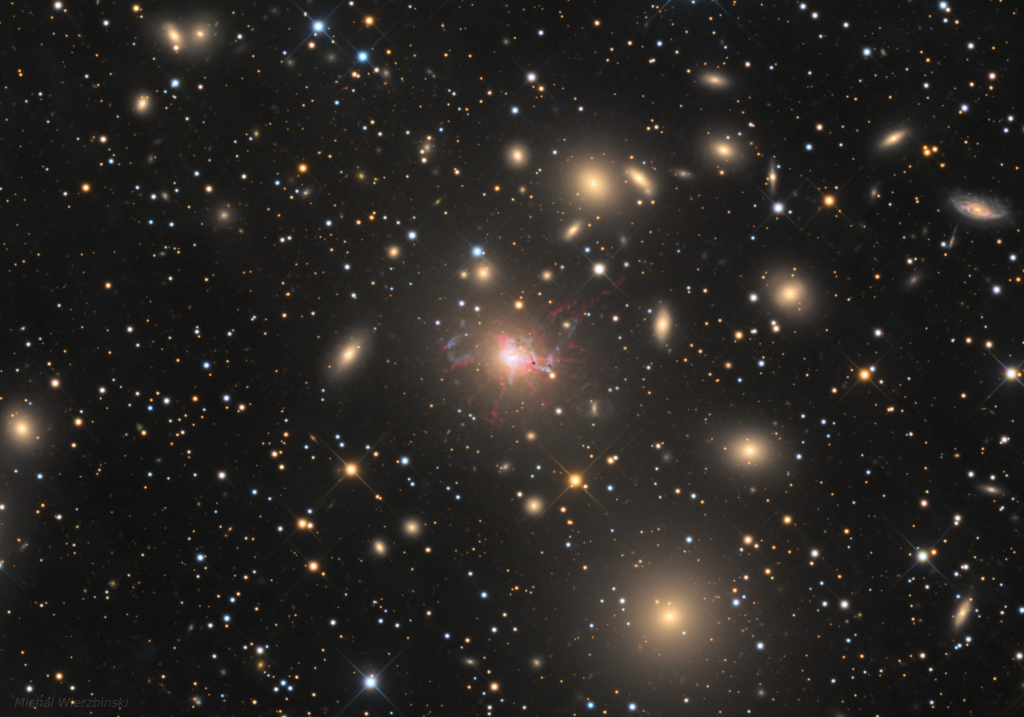 Image Credit: Michal Wierzbinski, Hellas-Sky
Explanation:
Active galaxy
NGC 1275 is the central, dominant member of the large and
relatively nearby
Perseus Cluster of Galaxies.
Wild-looking at visible wavelengths, the active galaxy is also a
prodigious source of
x-rays
and
radio
emission.
NGC 1275 accretes matter as entire galaxies fall into it, ultimately
feeding a supermassive black hole at the galaxy's core.
Narrowband image data used in this sharp telescopic image
highlights the resulting
galactic debris
and filaments of glowing gas,
some up to 20,000 light-years long.
The filaments persist
in NGC 1275, even though
the turmoil of galactic collisions should destroy them.
What keeps the filaments together?
Observations
indicate that the structures, pushed out
from the galaxy's center by the black hole's activity, are
held together by magnetic fields.
Also known as Perseus A,
NGC 1275 itself spans over 100,000 light years and
lies about 230 million light years away.
#APOD #Universe #Space #Astrophoto Astrophotography
Image Credit: Michal Wierzbinski, Hellas-Sky
Explanation:
Active galaxy
NGC 1275 is the central, dominant member of the large and
relatively nearby
Perseus Cluster of Galaxies.
Wild-looking at visible wavelengths, the active galaxy is also a
prodigious source of
x-rays
and
radio
emission.
NGC 1275 accretes matter as entire galaxies fall into it, ultimately
feeding a supermassive black hole at the galaxy's core.
Narrowband image data used in this sharp telescopic image
highlights the resulting
galactic debris
and filaments of glowing gas,
some up to 20,000 light-years long.
The filaments persist
in NGC 1275, even though
the turmoil of galactic collisions should destroy them.
What keeps the filaments together?
Observations
indicate that the structures, pushed out
from the galaxy's center by the black hole's activity, are
held together by magnetic fields.
Also known as Perseus A,
NGC 1275 itself spans over 100,000 light years and
lies about 230 million light years away.
#APOD #Universe #Space #Astrophoto Astrophotography
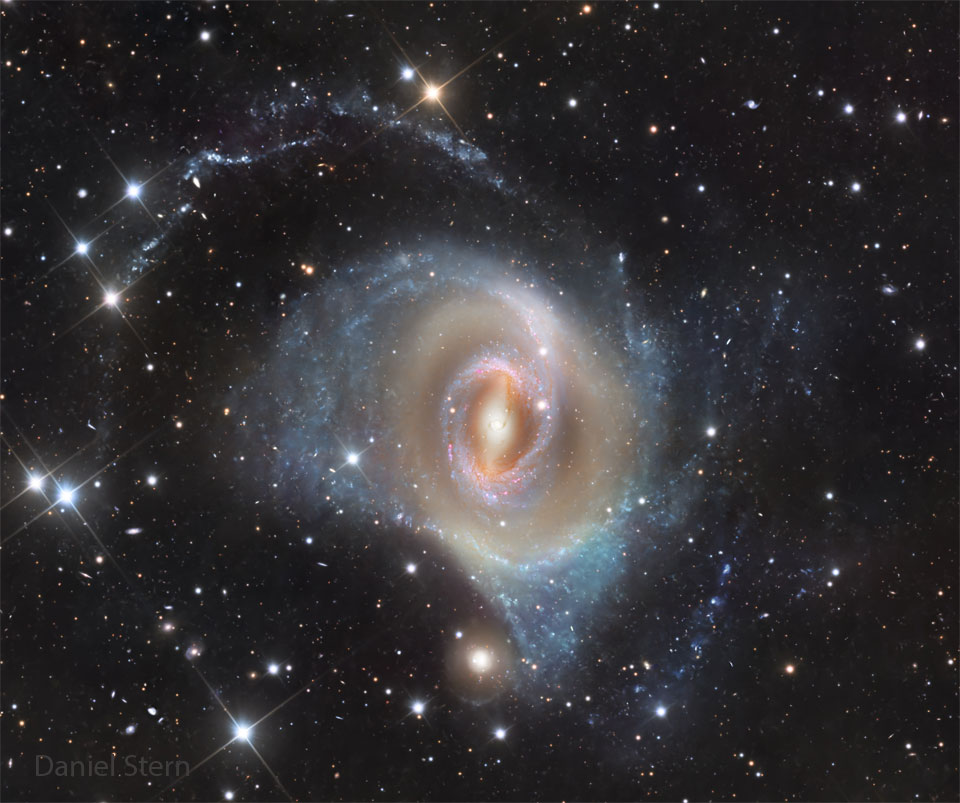 Image Credit: Daniel Stern
Explanation:
Most galaxies don't have any rings -- why does this galaxy have three?
To begin, a ring that's near
NGC 1512's center --
and so hard to see here -- is the
nuclear ring
which glows brightly with recently formed
stars.
Next out is a ring of stars and
dust appearing both red and blue, called,
counter-intuitively, the inner ring.
This inner ring connects ends of a diffuse
central bar
of stars that runs horizontally across the galaxy.
Farthest out in this wide field image is a
ragged structure that might be considered an outer ring.
This outer ring appears spiral-like and is dotted with
clusters of bright blue stars.
All these ring structures are thought to be affected by
NGC 1512's own gravitational asymmetries in a drawn-out process called
secular
evolution.
The featured image was captured last month from a telescope at
Deep Sky Chile in
Chile.
#APOD #NASA #NASAInspires #Astrophoto #Astronomy
Image Credit: Daniel Stern
Explanation:
Most galaxies don't have any rings -- why does this galaxy have three?
To begin, a ring that's near
NGC 1512's center --
and so hard to see here -- is the
nuclear ring
which glows brightly with recently formed
stars.
Next out is a ring of stars and
dust appearing both red and blue, called,
counter-intuitively, the inner ring.
This inner ring connects ends of a diffuse
central bar
of stars that runs horizontally across the galaxy.
Farthest out in this wide field image is a
ragged structure that might be considered an outer ring.
This outer ring appears spiral-like and is dotted with
clusters of bright blue stars.
All these ring structures are thought to be affected by
NGC 1512's own gravitational asymmetries in a drawn-out process called
secular
evolution.
The featured image was captured last month from a telescope at
Deep Sky Chile in
Chile.
#APOD #NASA #NASAInspires #Astrophoto #Astronomy
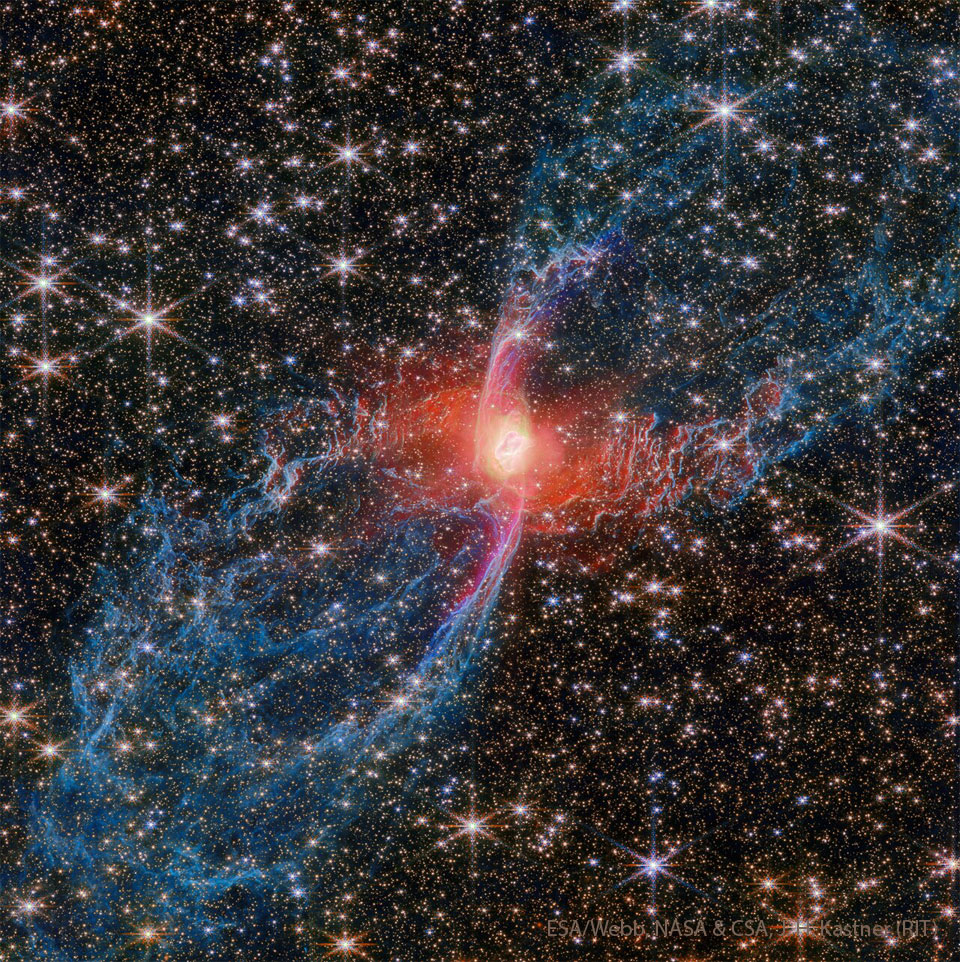 Image Credit: ESA/Webb, NASA, CSA, J. H. Kastner, RIT
Explanation:
Oh what a
tangled web
a planetary nebula can weave.
The Red Spider Planetary Nebula
shows the complex structure that can result when a
normal star ejects
its outer gases and becomes a
white dwarf star.
Officially tagged
NGC
6537, this two-lobed symmetric
planetary nebula
houses one of the
hottest white dwarfs ever observed,
probably as part of a binary star system.
Internal winds flowing out from the central stars,
have been measured in excess of 1,000 kilometers per second.
These
winds expand the
nebula, flow along the nebula's walls, and cause waves of hot
gas and
dust to collide.
Atoms
caught in these colliding shocks radiate light shown in the
featured false-color
infrared picture by the
James Webb Space Telescope.
The
Red Spider Nebula lies toward the constellation of the Archer
(Sagittarius).
Its distance is not well known but has been
estimated by some to be about 4,000 light-years.
#APOD #Astrogeek #Space #Universe #Astrophoto
Image Credit: ESA/Webb, NASA, CSA, J. H. Kastner, RIT
Explanation:
Oh what a
tangled web
a planetary nebula can weave.
The Red Spider Planetary Nebula
shows the complex structure that can result when a
normal star ejects
its outer gases and becomes a
white dwarf star.
Officially tagged
NGC
6537, this two-lobed symmetric
planetary nebula
houses one of the
hottest white dwarfs ever observed,
probably as part of a binary star system.
Internal winds flowing out from the central stars,
have been measured in excess of 1,000 kilometers per second.
These
winds expand the
nebula, flow along the nebula's walls, and cause waves of hot
gas and
dust to collide.
Atoms
caught in these colliding shocks radiate light shown in the
featured false-color
infrared picture by the
James Webb Space Telescope.
The
Red Spider Nebula lies toward the constellation of the Archer
(Sagittarius).
Its distance is not well known but has been
estimated by some to be about 4,000 light-years.
#APOD #Astrogeek #Space #Universe #Astrophoto
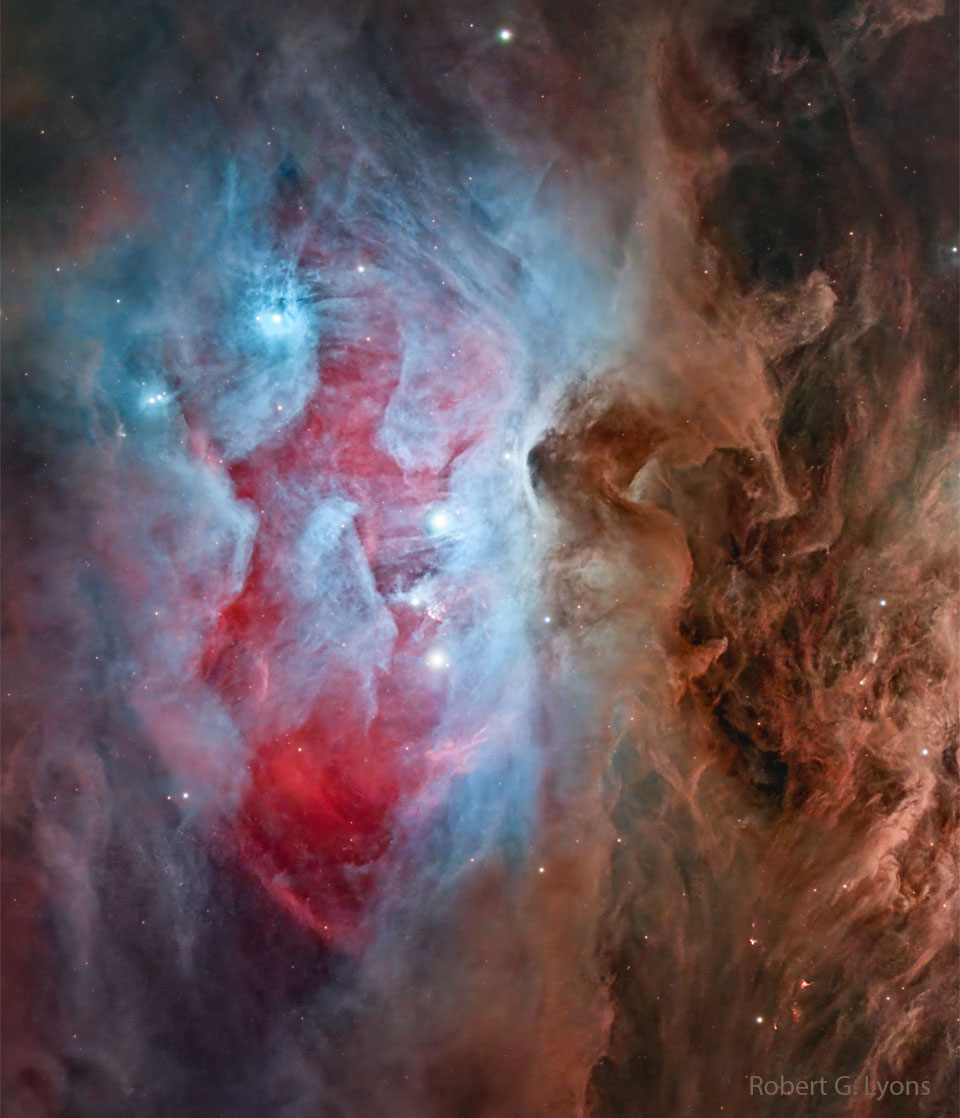 Image Credit: Robert G. Lyons, Robservatory
Explanation:
What part of Orion is this?
Just north of the famous
Orion Nebula is a picturesque
star
forming region in
Orion's Sword that contains a lot of intricate
dust -- some of which appears blue
because it reflects the light of
bright embedded stars.
The region's popular name is the
Running Man Nebula because,
looked at from the right, part of the brown dust appears to be running legs.
Cataloged as
Sharpless 279,
the reflection nebula is not only part of the
constellation of
Orion, but part of the greater
Orion molecular cloud complex.
Light from the Running Man's bright stars, including
42 Orionis, the bright star closest to the
featured image center, is slowly
destroying and reshaping the surrounding dust,
which will likely be
completely gone in about 10 million years.
The nebula spans about 15
light years and lies about 1,500 light years away.
#APOD #Space #Astronomy #Science Astrophotography
Image Credit: Robert G. Lyons, Robservatory
Explanation:
What part of Orion is this?
Just north of the famous
Orion Nebula is a picturesque
star
forming region in
Orion's Sword that contains a lot of intricate
dust -- some of which appears blue
because it reflects the light of
bright embedded stars.
The region's popular name is the
Running Man Nebula because,
looked at from the right, part of the brown dust appears to be running legs.
Cataloged as
Sharpless 279,
the reflection nebula is not only part of the
constellation of
Orion, but part of the greater
Orion molecular cloud complex.
Light from the Running Man's bright stars, including
42 Orionis, the bright star closest to the
featured image center, is slowly
destroying and reshaping the surrounding dust,
which will likely be
completely gone in about 10 million years.
The nebula spans about 15
light years and lies about 1,500 light years away.
#APOD #Space #Astronomy #Science Astrophotography
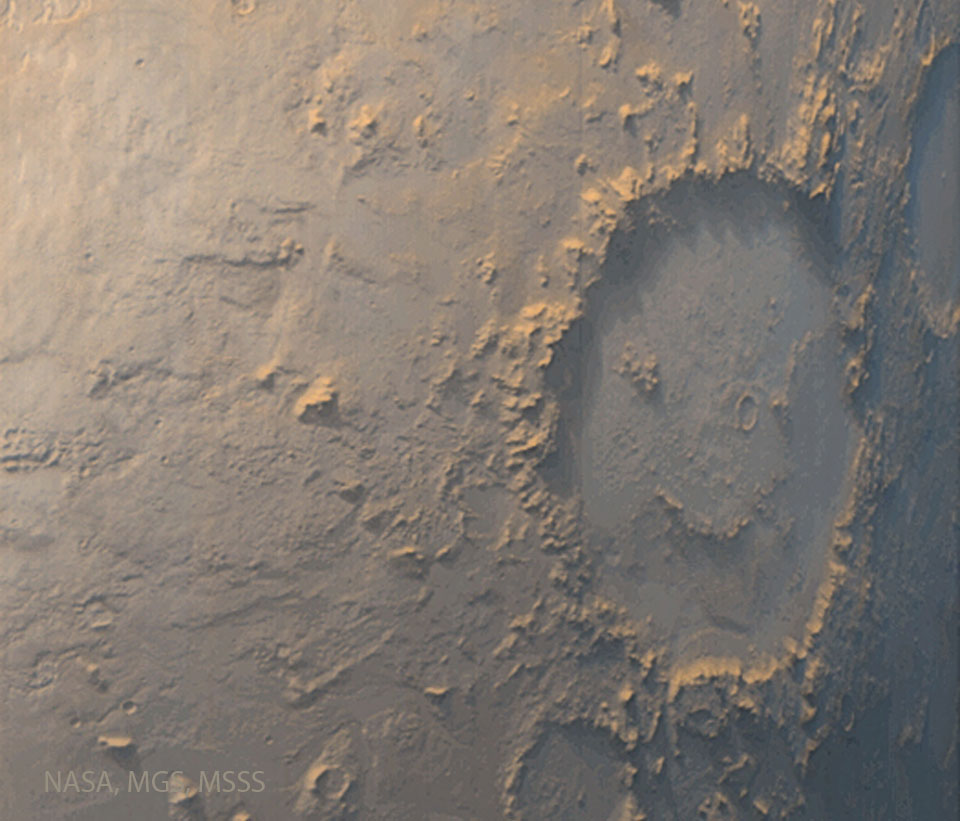 Image Credit: NASA, MGS, MSSS
Explanation:
Mars has put on a happy face.
The Martian crater
Galle is famous because it has
internal markings that make it look like a face that is both
smiling
and winking.
These markings were
originally
discovered in the 1970s in pictures taken by the
Viking Orbiter.
The
Mars Global Surveyor (MGS) spacecraft that orbited
Mars from 1996 to 2006 captured the
featured picture.
Happy Face Crater and its iconic features were
formed by chance billions of years ago when a
city-sized asteroid
slammed into the Martian surface.
All rocky planets and moons in
our Solar System show
impact craters,
with the highest number of craters found on
Earth's Moon and the planet
Mercury.
Earth and
Venus
would show the most, though, were it not for weather and
erosion.
#APOD #GalleCrater #HappyFaceCrater #Mars #MartianGeology #ImpactCrater
Image Credit: NASA, MGS, MSSS
Explanation:
Mars has put on a happy face.
The Martian crater
Galle is famous because it has
internal markings that make it look like a face that is both
smiling
and winking.
These markings were
originally
discovered in the 1970s in pictures taken by the
Viking Orbiter.
The
Mars Global Surveyor (MGS) spacecraft that orbited
Mars from 1996 to 2006 captured the
featured picture.
Happy Face Crater and its iconic features were
formed by chance billions of years ago when a
city-sized asteroid
slammed into the Martian surface.
All rocky planets and moons in
our Solar System show
impact craters,
with the highest number of craters found on
Earth's Moon and the planet
Mercury.
Earth and
Venus
would show the most, though, were it not for weather and
erosion.
#APOD #GalleCrater #HappyFaceCrater #Mars #MartianGeology #ImpactCrater
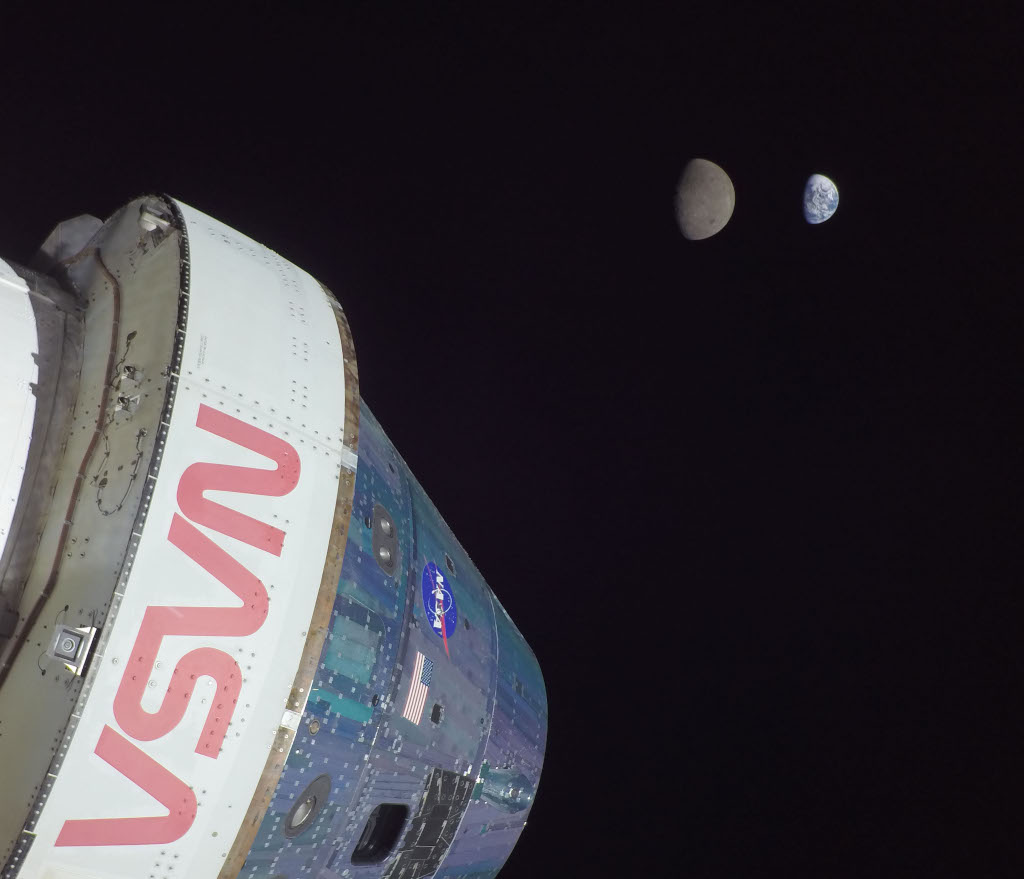 Image Credit: NASA, Artemis I
Explanation:
On flight day 13
(November 28, 2022) of the Artemis 1 mission, the
Orion spacecraft reached its maximum distance from Earth.
At over 430,000 kilometers from Earth,
its distant retrograde orbit also puts
Orion nearly 70,000 kilometers from the Moon.
In the
same field of view
in this video frame from flight day 13,
planet and large natural satellite
even appear about the same apparent size from
the spacecraft's perspective.
On flight day 26
(December 11, 2022),
the uncrewed spacecraft
splashed down on its home world concluding the historic Artemis I
mission.
The Artemis II
mission,
carrying 4 astronauts around the moon and back
again, will launch no earlier than February 8.
#APOD #ArtemisI #FlightDay13 #OrionSpacecraft #MoonOrbit #EarthDistance
Image Credit: NASA, Artemis I
Explanation:
On flight day 13
(November 28, 2022) of the Artemis 1 mission, the
Orion spacecraft reached its maximum distance from Earth.
At over 430,000 kilometers from Earth,
its distant retrograde orbit also puts
Orion nearly 70,000 kilometers from the Moon.
In the
same field of view
in this video frame from flight day 13,
planet and large natural satellite
even appear about the same apparent size from
the spacecraft's perspective.
On flight day 26
(December 11, 2022),
the uncrewed spacecraft
splashed down on its home world concluding the historic Artemis I
mission.
The Artemis II
mission,
carrying 4 astronauts around the moon and back
again, will launch no earlier than February 8.
#APOD #ArtemisI #FlightDay13 #OrionSpacecraft #MoonOrbit #EarthDistance
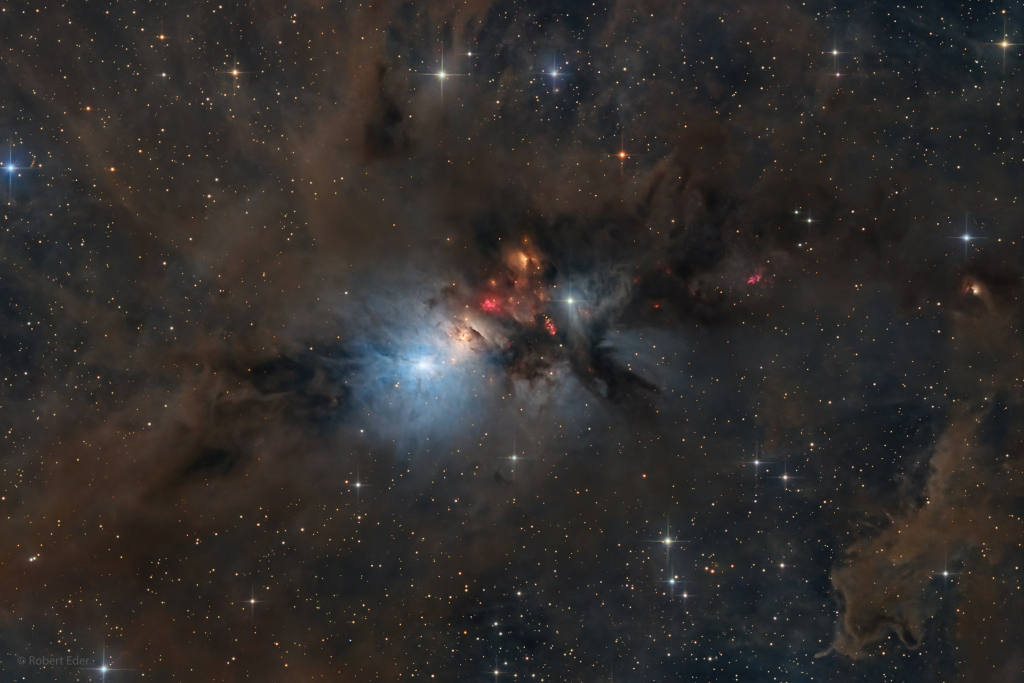 Image Credit: Robert Eder
Explanation:
NGC 1333 is seen in visible light as a
reflection nebula,
dominated by bluish hues characteristic of starlight reflected by
interstellar dust.
A mere 1,000 light-years distant toward the heroic constellation
Perseus,
it lies at the edge of a large,
star-forming molecular cloud.
This telescopic close-up spans
over two full moons on the sky or just
over 15 light-years at the estimated distance of NGC 1333.
It shows details of the dusty region
along with telltale hints of contrasty red emission from
Herbig-Haro
objects, jets and shocked glowing gas
emanating from recently formed stars.
In fact, NGC 1333 contains hundreds of stars less than
a million years old, most still
hidden from optical telescopes
by the pervasive stardust.
The chaotic environment may be similar to one in which our own Sun
formed over 4.5 billion years ago.
#APOD #NGC1333 #StellarNursery #Perseus #ReflectionNebula #MolecularCloud
Image Credit: Robert Eder
Explanation:
NGC 1333 is seen in visible light as a
reflection nebula,
dominated by bluish hues characteristic of starlight reflected by
interstellar dust.
A mere 1,000 light-years distant toward the heroic constellation
Perseus,
it lies at the edge of a large,
star-forming molecular cloud.
This telescopic close-up spans
over two full moons on the sky or just
over 15 light-years at the estimated distance of NGC 1333.
It shows details of the dusty region
along with telltale hints of contrasty red emission from
Herbig-Haro
objects, jets and shocked glowing gas
emanating from recently formed stars.
In fact, NGC 1333 contains hundreds of stars less than
a million years old, most still
hidden from optical telescopes
by the pervasive stardust.
The chaotic environment may be similar to one in which our own Sun
formed over 4.5 billion years ago.
#APOD #NGC1333 #StellarNursery #Perseus #ReflectionNebula #MolecularCloud
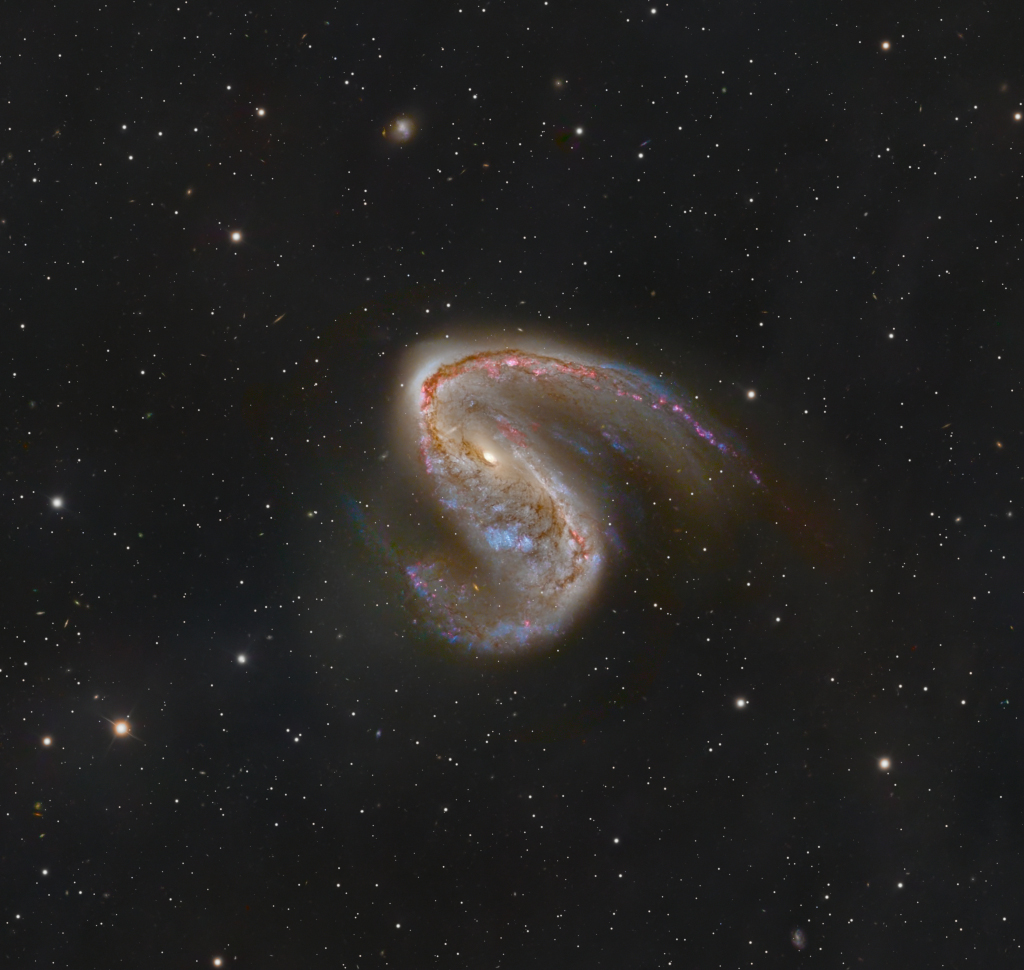 Image Credit: Mike Selby
Explanation:
Distorted galaxy NGC 2442
can be found in the southern constellation of the flying fish, (Piscis)
Volans.
Located about 50 million light-years away, the galaxy's two
spiral arms extending from a pronounced central bar give it a
hook-shaped appearance in this deep and colorful image,
with foreground stars scattered across the telescopic field of
view.
The image also reveals the distant galaxy's
obscuring dust lanes, young blue star clusters and
reddish star forming regions
surrounding a core of yellowish light from an older population of stars.
But the star forming regions seem more concentrated along
the drawn-out (upper right)
spiral arm.
The distorted structure is likely the result of an ancient
close encounter
with a smaller galaxy that lies off top left of the frame.
This telescopic field of view
spans over 200,000 light-years at the estimated distance of NGC 2442.
#APOD #NGC2442 #Galaxy #Volans #SouthernSky #SpiralGalaxy
Image Credit: Mike Selby
Explanation:
Distorted galaxy NGC 2442
can be found in the southern constellation of the flying fish, (Piscis)
Volans.
Located about 50 million light-years away, the galaxy's two
spiral arms extending from a pronounced central bar give it a
hook-shaped appearance in this deep and colorful image,
with foreground stars scattered across the telescopic field of
view.
The image also reveals the distant galaxy's
obscuring dust lanes, young blue star clusters and
reddish star forming regions
surrounding a core of yellowish light from an older population of stars.
But the star forming regions seem more concentrated along
the drawn-out (upper right)
spiral arm.
The distorted structure is likely the result of an ancient
close encounter
with a smaller galaxy that lies off top left of the frame.
This telescopic field of view
spans over 200,000 light-years at the estimated distance of NGC 2442.
#APOD #NGC2442 #Galaxy #Volans #SouthernSky #SpiralGalaxy
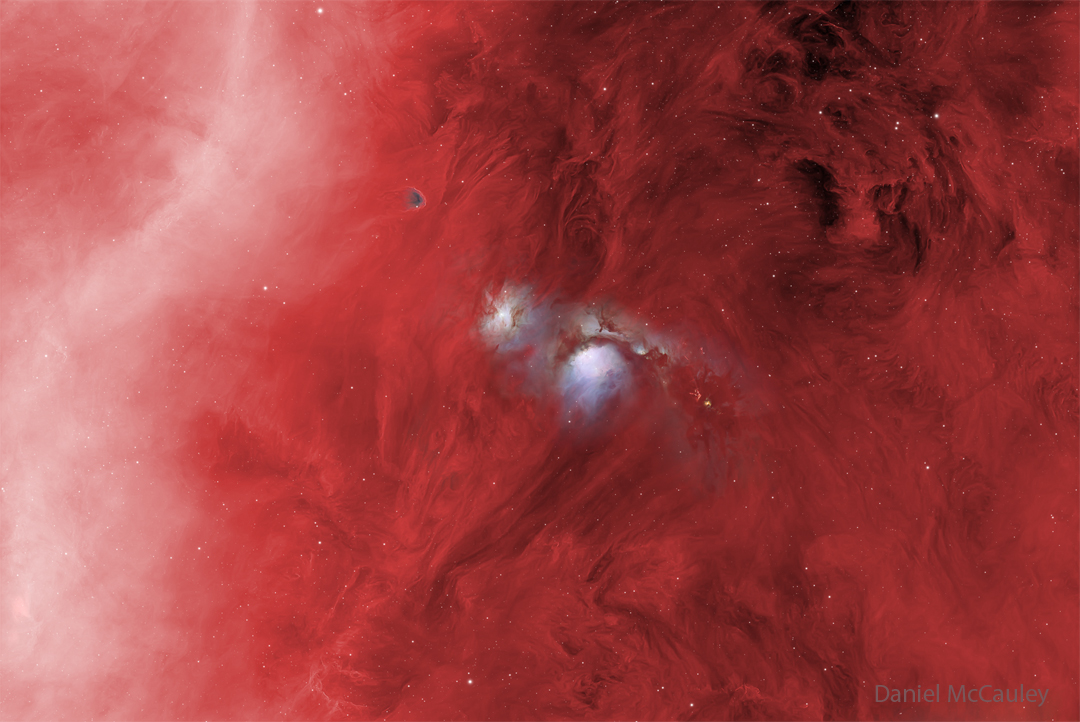 Image Credit: Daniel McCauley
Explanation:
In the vast Orion Molecular Cloud complex,
several bright blue nebulas are particularly apparent.
Pictured here in the center are two of the most prominent
reflection nebulas -
dust clouds lit by the
reflecting light of bright embedded
stars.
The more famous nebula is
M78,
in the image center, cataloged over 200 years ago.
To its upper left is the lesser known
NGC 2071.
Astronomers continue to
study these
reflection nebulas to
better understand how interior stars form.
The overall red glow is from diffuse
hydrogen gas
that covers much of the
Orion complex
that spans much of the
constellation of Orion.
Nearby in the
greater complex,
which lies about 1,500
light years away, are the
Orion Nebula,
the Horsehead Nebula, and
Barnard's Loop --
partially seen here as the white band on the upper left.
#APOD #M78 #OrionNebula #ReflectionNebula #OrionComplex #NGC2071
Image Credit: Daniel McCauley
Explanation:
In the vast Orion Molecular Cloud complex,
several bright blue nebulas are particularly apparent.
Pictured here in the center are two of the most prominent
reflection nebulas -
dust clouds lit by the
reflecting light of bright embedded
stars.
The more famous nebula is
M78,
in the image center, cataloged over 200 years ago.
To its upper left is the lesser known
NGC 2071.
Astronomers continue to
study these
reflection nebulas to
better understand how interior stars form.
The overall red glow is from diffuse
hydrogen gas
that covers much of the
Orion complex
that spans much of the
constellation of Orion.
Nearby in the
greater complex,
which lies about 1,500
light years away, are the
Orion Nebula,
the Horsehead Nebula, and
Barnard's Loop --
partially seen here as the white band on the upper left.
#APOD #M78 #OrionNebula #ReflectionNebula #OrionComplex #NGC2071