
Here is an article by Bob Kendall on 11/17/2025.
Special Report! "Will Bitcoin Evolve into what it Feared?"
The Unexpected Consequences of Legitimacy and Adoption!
INTRODUCTION
What if everything you thought you knew about Bitcoin was wrong?
What if the story you were sold—the decentralization, the scarcity, the immunity from Wall Street, the belief that long-term holders controlled the future—was never true in the first place?
This article exposes the uncomfortable reality that once Bitcoin entered the ETF era, the market structure shifted forever. Price is no longer determined by ideology or adoption; it is determined by the tiny fraction of the float controlled by custodians, arbitrage desks, ETF market makers, and the institutional machinery that now owns Bitcoin’s price discovery. In seven parts, we walk through how Bitcoin was integrated into the global liquidity grid, how professionals dominated the float, how the narrative diverged from reality, and how the asset intended to replace the system quietly became a product of it.
Quote from Tom Lee “Michael Saylor is changing the reality of the stock market and the reason is is that he probably will end up being the largest potentially the largest company in the stock market OK especially if Bitcoin goes to 1,000,000 yet he doesn’t generate gap net income to justify it he’s based solely on the value of his balance sheet and but that that’s not new to history because when I graduated college the biggest stock in the S&P a top five name was ExxonMobil and it was top five for 28 years 30 years like an entire generation graduated worked on Wall Street the top five name was a company that was only valued on the value of its oil not on its net income so like MicroStrategy is like replacing Exxon in lower cause you know for a whole generation people said Exxon is based company but you don’t value on earnings well Mike strategy could be one of the biggest companies in the world and it’s valued on its Bitcoin If I look at everything since October 10th because that was the most significant liquidation in the history of crypto like bigger than FTR yeah it was like a almost a miniature rupture like tsunami we’re only a couple weeks from that so I think the market is consolidating but if I look at fundamentals like let’s like etherium stable coin volumes have been exploding application revenues at all time highs so right now fundamentals are leading price in crypto so I think eventually we consolidate and then we rally into your end too 01/15 ohh yeah i think we can still get to 152 hundred for bitcoin and then something like 7000 for Eithereum.”
Chapter 1
“The Day Bitcoin Invited Wall Street In — And Lost Control of Its Own Price”
I’ve been warning since the very first day talk began about “legitimizing” Bitcoin that the entire push was a trap. The entire foundation of cryptocurrency was built on decentralization—getting away from governments, intermediaries, and Wall Street’s influence. But the crypto evangelists insisted that legitimacy required the exact opposite: government oversight, regulatory blessing, and institutional adoption that would supposedly draw in trillions of new dollars. They convinced themselves that scarcity alone guaranteed higher prices. They told themselves that once the SEC approved ETFs, Bitcoin would become safer, more stable, and on its way to six figures.
And from the first day of the ETF on The Kendall Report, I said the opposite. I said that once Bitcoin became a Wall Street instrument, the game was over. I said that the moment the ETF structure plugged into Bitcoin’s plumbing, the people who would ultimately control the price would be the same professionals who dominate every other market—arbitrage desks, high-frequency traders, ETF market makers, and proprietary shops that live and breathe microstructure. These are the “Bad Guys,” as I’ve called them, not because they’re unethical but because they’re ruthlessly efficient. They exploit every inefficiency, exploit every thin order book, and exploit every edge. Their job isn’t to believe in Bitcoin. Their job is to extract profit from it.
Now we’re living in that reality. And the strange part is, the crypto community still doesn’t understand what happened.
To fully understand why Bitcoin now behaves the way it does—and why the float matters more than the total supply—we need to talk about something most people fundamentally misunderstand: price discovery. People think volume moves price. It doesn’t. Aggression moves the price. The willingness to cross the spread, to lift offers, to hit bids—those are the forces that drive markets. And in a thin market, they can drive them violently.
Back in the floor-trading days, when you could look another trader in the eyes, you learned very quickly that volume by itself meant nothing. What mattered was whether buyers or sellers were pressing the issue. A million shares could trade in a tight four-cent range if both sides were patient. But a hundred thousand shares could move a stock two points if one side were determined. Aggression, not volume, is what makes prices jump.
This Substack is reader-supported. To receive new posts and support my work, consider becoming a free or paid subscriber.
Subscribed
I’ll provide an example I’ve used for decades, as it illustrates the principle clearly. Imagine I’ve got a million shares to buy. The trader across from me has a million to sell. If I bid 1/2 and he offers at 5/8, nothing happens until someone becomes the aggressor. If I decide I want them badly enough, I’ll pay his 5/8 and take his entire offer. Just like that, the price moves—not because a million shares traded, but because I took the initiative.
Now imagine a scenario where neither of us shows our full size of the order. I bid $100,000 at 1/2. He offers at 5/8. Once again, I take the offer, it’s about aggression. If I keep lifting him, he starts raising his offer. He wants to sell at the highest price possible. I want to buy regardless. So we dance the spread. He goes to 3/4, I take it. He goes to a 1 even, I take it. In just a few trades—one hundred thousand shares, two hundred thousand, four hundred thousand—the price has moved dramatically higher. Not because of the total volume, but because one side is aggressive.
Before long, the whole crowd sees what’s happening. On a trading floor, you could literally feel the energy shift. Today, in digital markets, you see it on Level II screens as the bids start chasing the offers. When multiple aggressive buyers enter the market simultaneously, the price can surge upward in seconds. And on the downside, it’s even worse. Buyers disappear, bids evaporate, and the first aggressive seller can trigger a cascade that feeds on itself. This is how panic moves begin—not from volume, but from an imbalance of aggression.
“This is the essence of price discovery, and this is why Bitcoin is now so vulnerable.”
Because the people who control the aggression in Bitcoin today are not the long-term holders. They’re not the retail investors who “believe in the future of money.” They’re not the podcasts, influencers, or crypto Twitter personas who’ve built entire brands around the mythology of decentralization. The aggressors are the ETF market makers, the arbitrage desks, the derivatives quants, and the high-frequency firms who now dominate the float.
The total Bitcoin supply—about twenty million coins—is meaningless in this context. The price is determined by the float, which is only a fraction of the total supply. And when that float gets concentrated in the hands of professionals who know how to move thin markets, price becomes a function of their aggression, not the ideology of long-term holders.
Most Bitcoin is locked away—lost coins, deep cold storage, untouchable long-term holdings, and permanent hoards that never hit an order book. Only about twenty-five to thirty percent of the supply actually trades. That tiny float is the entire market. And now, thanks to ETFs, that float is even more centralized.
“This creates a situation where Bitcoin’s price is now steered by a tiny professional community that:
removes liquidity at will
forces the market to cross wide spreads
targets weak hands
sweeps order books
pins price where they want it
engineers rallies and collapses
and controls the exact moments when aggression flips from buy-side to sell-side.”
This is normal behavior in equities and futures. But Bitcoin was never built to handle this level of professionalization. It was built on the belief that decentralization insulated it from such tactics. That delusion is now being shattered.
And this leads us to the critical level of seventy-four thousand. That price has become the structural hinge point. If Bitcoin breaks decisively below it, the aggression will flip violently. ETF redemptions will hit the market. Derivatives positions will unwind. Margin calls will trigger forced selling. Systematic strategies will fire off sell orders. The thin float will become thinner. Liquidity will vanish. And the same professionals who drove the market up will drive it down, accelerating every move.
“The long-term holders—who think they determine Bitcoin’s future—will experience their first true psychological stress test. It’s easy to “never sell” when the price is rising or gently correcting. It’s another thing entirely when cascading liquidations slam through the chart and no bids appear for hundreds or even thousands of dollars below the last print. Professional players will remove liquidity, step out of the way, let gravity work, and then re-enter at the bottom with size. That’s how they’ve operated in every market I’ve ever seen.”
I’ve lived through these cycles for 46 years. I’ve seen institutions bid up markets to sell them at a higher price. I’ve seen them sell markets just to buy them lower. I’ve seen panic crashes, engineered squeezes, flash events, and liquidity holes that made no sense to the public but were evident to anyone on the inside. I watched crude oil go negative during the pandemic—something no one thought was possible. I’ve seen soybean markets lock limit for days. I’ve watched S&P futures drop faster than anyone could type an order. Nothing surprises me anymore.
However, what surprises me is how few people in the cryptocurrency world understand that these forces now govern Bitcoin. They still cling to the myth that scarcity protects them. They still believe long-term holders control the narrative. They still believe decentralization is intact. None of that is true. The float is what matters. The aggression within the float is what moves the price. And the float is now controlled by the smallest, most professionalized group of traders Bitcoin has ever seen.
This is why I’ve been warning about the ETFs since the moment the first application hit the SEC’s desk. The professionalization of price discovery is the real threat—not regulation, not governments, not bans. The threat is that Bitcoin now trades like every other instrument that professionals dominate. And when seventy-four thousand breaks, the market will discover very quickly who is actually in control.
“It won’t be the long-term holders. It won’t be the influencers. It won’t be the believers. It will be the professionals.”
Chapter 2
Inside the Machine: How ETF Arbitrage, Custodians, and Professional Desks Now Control Bitcoin’s Price.
Now that the Bitcoin float has been effectively absorbed into the ETF ecosystem, it’s time to explain how the mechanics actually work—because this is where most people still have no clue what’s really happening behind the curtain. The public thinks of ETFs as simple wrappers. You buy the ETF, and the ETF buys Bitcoin. That’s the elementary-school version. The real machinery is far more complex, and it places immense power in the hands of a tiny number of professionals who now dictate Bitcoin’s price discovery.
The average retail investor imagines an ETF like a static vault holding coins on behalf of millions of owners. But the ETF isn’t the leading actor in this drama. The real power lies with the authorized participants—APs, as they’re known on Wall Street. These are the firms allowed to create or redeem ETF shares. They sit at the center of a continuous arbitrage engine, constantly scanning for tiny discrepancies between the ETF price and the underlying Bitcoin markets across dozens of exchanges and derivatives platforms.
When I say these firms are professionals, I don’t mean they’re “experienced.” I mean, they are the Navy SEALs of market efficiency. They don’t care about ideology, scarcity, or decentralization. They care about basis points. If they can buy spot Bitcoin for one-tenth of a percent cheaper than the ETF value, they’ll purchase spot Bitcoin instantly and deliver it to the ETF in exchange for newly created ETF shares. Then they’ll flip those ETF shares in the open market for that fractional profit. The reverse happens when the ETF trades below spot: they’ll redeem ETF shares to the issuer, receive Bitcoin, and sell that Bitcoin for a tiny premium.
This is the beating heart of ETF arbitrage. It runs non-stop. It never sleeps. It monitors every exchange simultaneously. It hunts for inefficiencies measured in tenths of a cent. And this entire process centralizes Bitcoin’s float into the hands of the same firms that dominate ETF flows across equities, commodities, and even currencies.
Most Bitcoin investors are unaware of the profound impact this dynamic has. They believe that long-term holders determine the future. They believe the ETFs hold their coins in cold storage and that the price is driven by organic demand.
However, the people who ultimately determine prices are those running the arbitrage engines. They know exactly how much ETF demand exists, how much liquidity is available across spot markets, how derivatives are priced, where the stop clusters are located, and how to manipulate spreads to widen or compress to their advantage.
Because the ETFs hold such large pools of Bitcoin, the custodians—primarily a small number of massive institutions—now function as gravity wells in the Bitcoin ecosystem. They decide how to allocate inventory across their internal books. They decide how much liquidity to make visible. They decide when to rotate inventory from one desk to another. They decide whether to draw down reserves from cold storage or allow market makers to source liquidity elsewhere. These decisions are not ideological—they’re strategic.
If a custodian anticipates heavy ETF inflows, they may preemptively accumulate liquidity during quiet hours at advantageous prices. If they expect outflows, they may lighten inventory and force the market to absorb selling pressure in thin conditions. Inventory rotation isn’t random; it’s a coordinated process based on forecasting, market structure, liquidity needs, and arbitrage opportunities.
This is where the concept of engineered liquidity vacuums comes into play. A liquidity vacuum occurs when market makers intentionally remove depth from the order book. They widen spreads. They step back. They force anyone who wants to trade to cross the market at the worst prices. When aggressive sellers appear in a vacuum, the price can drop violently downward because no one is standing in front of them with bids.
On the screen, it appears as a sudden crash. In reality, it’s a controlled withdrawal of liquidity.
Professionals create these vacuums deliberately. They use them to test the market. They use them to shake weak hands. They use them to find real buyers after the panic. And yes—they use them to accumulate. This is how it works in every professionally dominated market, and now Bitcoin is no exception.
The public perceives Bitcoin as a vehicle for some grand ideological battle. In truth, it trades on microstructure dynamics no different from any other thin market. ETF market makers can create selling pressure by simply stepping aside. They can make upward pressure by aggressively lifting offers during periods of low liquidity. They can use derivatives to push futures premiums or discounts that force spot markets to respond. They can close their books and let volatility expand. They can tighten spreads and compress volatility when it benefits their exposures. Bitcoin is now fully integrated into the same infrastructure that has been steering equities and commodities for decades.
And here’s where the centralization becomes stark. In the early days of Bitcoin—before ETFs, before deep custodianship, before institutional liquidity—the market was messy and unpredictable, but it was at least decentralized in its chaos. Now, with ETFs controlling a massive share of the active float, the actual pricing engine operates based on the intentions of a handful of authorized participants and custodians. These firms coordinate inventory management, arbitrage execution, and liquidity provision across dozens of interconnected platforms.
This is why Bitcoin’s price can suddenly move in ways that make no sense to the retail crowd. It’s not driven by adoption or belief. It’s not driven by new wallets or on-chain activity. It’s driven by inventory rotation across AP desks, derivative hedging flows, and intentional liquidity engineering. When these firms want to push the market lower, they stop providing liquidity at key levels and let gravity do the rest. When they want to push it higher, they aggressively lift offers in thin conditions, creating a stampede of momentum-chasing.
None of this requires malice. It’s just the system doing what it was built to do: maximize efficiency and profitability for the participants who control the microstructure.
And this brings us back to the biggest misconception of all—the idea that scarcity alone determines Bitcoin’s price. Scarcity means nothing if you don’t control the float. The float is what determines price. And the float is now concentrated in the hands of the people who control ETF arbitrage, custodial flows, and the liquidity landscape itself.
“The long-term holders still think they matter.
They don’t!
They believe they’re in control because they have the majority of coins.
They aren’t!
Price is set at the margins, not in the deep freezer. And the margins now belong entirely to the professionals.”
This is the new era of Bitcoin. The decentralization myth is over. The pricing mechanism has been captured. And unless people understand how ETF arbitrage, custodial rotation, and engineered liquidity shape the market, they will continue to believe that ideology drives prices.
It doesn’t!
Price is now driven by the same machine that drives every other asset class dominated by institutions.
And that machine has no allegiance to Bitcoin’s founding principles. Its only allegiance is to profit.
Chapter 3
— The Ideological Shockwave: What Happens When Bitcoin Believers Realize They Aren’t in Control!
For more than a decade, the Bitcoin community has been driven by one of the most powerful collective beliefs the financial world has ever seen. It wasn’t just the belief that Bitcoin would rise over time. It wasn’t even the belief that it was the future of money or a hedge against corrupt governments. The real foundation of the ideology—the central pillar—was the conviction that Bitcoin was decentralized in a way no other asset had ever been. Holders believed that because supply was fixed and long-term believers held a large number of coins, the market could never be controlled by a small group of actors.
‘They believed they were the market.
They believed they were immune to Wall Street.
They believed they had built something that could not be co-opted, manipulated, or overtaken by the traditional financial machine.”
That belief is about to meet reality.
Consequences of Adoption
Once Bitcoin became an ETF structure, the ideology was already on borrowed time. People didn’t understand what they had opened the door to. They thought the ETFs were simply a bridge for new buyers. They thought institutions would simply accumulate coins and hold them. They thought Wall Street would become another group of long-term holders who would validate the narrative. They completely misunderstood what professional traders actually do for a living.
Professionals do not “buy and hold.” They do not “believe.” They execute. They exploit. They rotate risk, manage inventory, arbitrage inefficiencies, and hunt for structural vulnerabilities. They don’t care about the story behind Bitcoin any more than they care about the story behind crude oil or soybeans or the S&P 500. To them, Bitcoin is just another product—another vehicle to capture spread, volatility, and mispricing.
The ideological core of Bitcoin convinced itself that it didn’t matter how Wall Street behaved because long-term holders controlled the majority of coins. What they didn’t understand is that markets don’t move based on who holds the most; they move based on who controls the float. The float is now largely dominated by ETFs, market makers, arbitrage desks, and internal custodial networks.
When the next structural decline hits—especially if it reaches the seventy-four-thousand level—the ideological shock will be unlike anything the Bitcoin world has ever experienced. People who have held for years will watch prices fall not because of some macro event or government attack, but because professionals remove liquidity and let the market collapse under its own weight. They will watch stop cascades trigger in places they never expected. They will see gaps form where bids once existed. They will feel, for the first time, what it means to be on the wrong side of institutional price discovery.
And this is where the psychological break begins.
For so long, the community has believed that Bitcoin was immune to manipulation. They believed whales were mythic creatures, not systematic traders. They believed ETF custodians were just vaults, not active participants controlling the movement of inventory. They believed that because Satoshi’s coins weren’t moving, the supply was somehow shielded. They believed scarcity alone was a defense mechanism.
But once they see the market plunge through engineered liquidity vacuums, it won’t be a chart pattern that breaks—it will be the ideology itself. Long-term holders will suddenly question whether their conviction holds any value if professionals can drive the price wherever they choose. The hardest part won’t be the price decline; the hardest part will be the realization that the people who set up Bitcoin to overthrow the system unintentionally delivered it into the hands of the system’s most advanced operators.
This psychological rupture won’t happen instantly. It will start quietly. A few voices who once claimed they would “never sell” will begin rationalizing why they have to “protect capital.” Others will start asking why Bitcoin is behaving like a heavily traded tech stock, rather than a decentralized alternative currency. Influencers will search for excuses—blaming the Fed, blaming macro conditions, blaming the media, blaming anything except the truth: the price of Bitcoin is now a function of the very market-makers it was designed to escape.
Then comes the next stage—the anger. People will feel betrayed, not by Bitcoin itself, but by the narrative they were sold. They’ll feel disillusioned when they realize that decentralization at the protocol level doesn’t guarantee decentralization at the price level. They’ll blame the ETFs, the institutions, the regulators, the exchanges, anyone except themselves for not understanding how markets truly work. They’ll lash out at the idea that Bitcoin’s fate is now tied to the behavior of a small circle of authorized participants and custodians who rotate inventory like any other asset.
Financial ideology always feels strongest before it breaks, because that’s when the cognitive dissonance is highest. And right now, Bitcoin’s strongest believers are already sensing something is wrong. They see the price behaving differently. They notice movements that don’t align with adoption trends or fundamental narratives. They see the influence of derivatives. They see ETF flows acting as the new meta-driver of market direction. They don’t want to admit it, but they feel that something fundamental has shifted.
When the next major decline comes—and it will—the realization will hit with full force: long-term holders are not the ones setting the price. They never were. They only controlled the ideological majority, not the structural mechanism. The structural mechanism now belongs to the professionals. And once the market truly sees that, the myth of Bitcoin’s decentralization dies—not in code, but in price discovery.
And here’s the final twist…
Even after the ideology breaks, the professionals will still be there. They’ll still control the float. They’ll still run the arbitrage engines. They’ll still dictate liquidity. And they’ll buy whatever panic selling the ideological collapse produces. The long-term holders who always imagined themselves buying the dip will be the ones creating the dip, while the same ETF market makers they once celebrated quietly accumulate every coin they forced into circulation.
This is the part of the story Bitcoin’s creators never envisioned. The technology was decentralized. The ownership was decentralized. But the moment the price was handed to Wall Street, decentralization ended. The market has not yet fully realized it.
Part Four—if you want it—will go into the aftermath: how Bitcoin behaves once the ideology breaks, what a professionalized price regime actually looks like, and why the new era won’t resemble anything the Bitcoin faithful expect.
Chapter 4
After the Myth: Life in a Fully Professionalized Bitcoin Market
Once the ideology breaks—and it will—the Bitcoin market enters an entirely different era, one that bears little resemblance to the utopian narratives the early adopters still romanticize. The shift won’t be subtle. It won’t be gradual. It will be structural. And once the structural regime changes, it never goes back.
People often assume that when a conviction-based community disintegrates, its assets collapse. But that’s not what happens. The asset doesn’t disappear; it transforms. It becomes something different—something more predictable to professionals, more exploitable to institutions, and more detached from the philosophical movement that carried it through its first decade.
“This is the world Bitcoin is heading toward: a market governed not by believers, but by operators.”
The first major change comes in the elimination of emotional elasticity. For years, Bitcoin holders have reacted to every pullback with the same mantra: “Buy the Dip.” That mentality worked in the early years because the market was thin, unstructured, and driven by the influx of new participants. Emotional buying made sense when the entire market was retail-driven and the supply available for trading was tiny. Retail investors could push the price around because there were so few aggressive, professional players with deeper pockets and faster reflexes.
But after the ideology breaks, the psychological safety net that created those persistent rebound rallies disappears. The same people who once proudly bought every drop will hesitate. They’ll examine ETF outflows, derivatives pressure, and liquidity gaps, and second-guess what used to be an automatic response. They’ll worry about being front-run by market makers. They’ll fear deeper cascades. They’ll wait—just long enough for professionals to control the entire structure.
The second major change is that Bitcoin’s volatility becomes cleaner, more mechanical, and more in line with traditional leveraged asset classes. That doesn’t mean volatility goes away; in fact, it may increase. But it becomes organized volatility. It becomes the kind of moves that exist to clear out liquidity pockets, facilitate inventory rotation, and reset risk models. You’ll see fewer emotional blowoffs and more calculated expansions. You’ll see fewer retail-driven moonshots and more systematically engineered squeezes, both up and down.
Bitcoin will begin to resemble the behavior of assets like crude oil, gold, and the Nasdaq futures—instruments heavily influenced by macro players, hedging flows, and systematic desks. The wild swings will still happen, but they won’t be organic expressions of a tribal community anymore. They’ll be the byproduct of positioning imbalances that professionals intentionally exploit.
The third major evolution takes place in the cycle structure. Bitcoin’s mythology has always been tied to its halving cycles. Every four years, the community expects a massive bull run. It’s treated like a financial destiny. But that pattern existed only because the early market was immature. A halving event could significantly alter the available supply, and retail buying interest surged in waves. Those factors created self-reinforcing cycles.
Professionals don’t believe in halving cycles. They believe in liquidity cycles, macro risk regimes, volatility harvesting, and spread exploitation. Once the market is fully professionalized, the halving becomes little more than a headline—an excuse for influencers to pump narratives, but ultimately just another day in the life of ETF flows and arbitrage engines. Bitcoin’s cycle cadence becomes synchronized with traditional risk cycles: liquidity conditions, credit stress, monetary policy shifts, systematic rebalancing windows, and quarterly ETF creation and redemption patterns.
“The asset begins to reflect the behavior of the system into which it was absorbed.”
Another shift happens in the way bottoms and tops form. Early Bitcoin tops were blow-offs—rapid, emotional melt-ups created by retail frenzy. Bottoms were despair-driven collapses followed by ideological recommitment. But in a professionalized regime, tops are engineered through inventory distribution, not mania. Professionals sell into strength slowly, methodically, concealing intent behind layered liquidity, synthetic hedges, and cross-market offsets. You don’t get the euphoric parabolic peaks; you get controlled tops designed to move large inventory without alerting the crowd.
Bottoms, too, become mechanical. They form at points of maximum forced liquidation—points where systematic sellers have exhausted themselves, leveraged positions have been cleared, and ETF redemption pressure has stabilized. Instead of being belief-driven, bottoms are simply places where professionals decide the selling is done and shift into accumulation mode. This is how crude oil bottoms. This is how an equity index futures bottom occurs. This is how gold bottoms. And that’s how Bitcoin will bottom going forward.
Bitcoin’s identity changes on a deeper level as well. The old narrative—“store of value,” “digital gold,” “freedom from the system”—loses its potency once the price becomes tethered to the very mechanisms Bitcoin was created to escape. You cannot claim decentralization while price discovery is centralized. You cannot claim immunity from Wall Street while Wall Street controls your float. You cannot claim inevitability while your supply is trapped inside ETF structures that respond mechanically to macro liquidity.
Bitcoin will still attract speculation. It will still attract volatility traders. It may even attract long-term institutional allocators. But it will no longer attract true believers in the same way. The spiritual energy that built the early ecosystem fades once the market reveals that ideology never controlled price.
“And here lies the most crucial realization: once Bitcoin becomes a fully professionalized market, long-term holders will no longer serve as a structural pillar. They become spectators. Their supply is irrelevant because it’s not part of the float. Their conviction is irrelevant because it doesn’t influence price. Their ideology is irrelevant because the market no longer responds to belief.
What they once thought was strength—the refusal to sell—becomes weakness. It becomes a passive supply that professionals can work around. It becomes static inventory that sits outside the price engine. Believers become background noise.”
This isn’t the death of Bitcoin. Far from it. It’s the death of the Bitcoin myth.
The asset will survive. It may even thrive. However, it will thrive as a product of the system, rather than a rebellion against it.
This transformation has happened before. Gold went through it when ETFs turned it from a decentralization narrative into a professionally arbitraged asset. Oil went through it when electronic trading replaced open-outcry pits. Equities underwent a significant shift when high-frequency trading altered price discovery forever. Bitcoin is simply the latest to be absorbed.
Chapter 5
The New Macro Era: Bitcoin After Absorption Into the Global Liquidity Grid
Once Bitcoin’s ideology shatters and the market realizes it has been absorbed into the same ecosystem it once tried to escape, the next phase begins. This is the true long-term transformation—the point at which Bitcoin stops living in the world of crypto mythology and starts operating within the global liquidity grid, just like every other professionally managed asset. And the biggest shock to people who still cling to the early Bitcoin dream is that macro forces, not crypto forces, govern this new version of Bitcoin. Liquidity, not ideology. Risk models, not scarcity. Professional flows, not retail conviction.
In this new regime, Bitcoin becomes deeply sensitive to everything that happens in the global financial system. “This has already occurred.” When liquidity expands, Bitcoin rises. When liquidity contracts, Bitcoin falls. But the reasons behind those moves are no longer rooted in the old narratives. They’re rooted in the machinery of institutional positioning—fund flows, hedging requirements, ETF creations and redemptions, derivative basis structures, cross-market correlations, and volatility targeting programs.
This is the exact opposite of what Bitcoin’s early builders imagined. They thought they were creating something that lived outside the macro system, immune to government manipulation, immune to central banks, immune to risk cycles. However, the ETF era permanently rewired Bitcoin. Once the asset became part of portfolios, desk flows, and liquidity models, it lost the insulation it once had—because it now sits inside the very bloodstream of global finance.
The truth is that Bitcoin’s new identity is not revolutionary at all. It is simply another high-beta risk asset, responding to the same liquidity tides that drive equities, credit spreads, and commodities. The difference is that Bitcoin has a thinner float, which means it exaggerates these movements. When liquidity is plentiful, Bitcoin tends to overshoot to the upside. When it dries up, Bitcoin collapses faster than most assets, because the tradable float is far smaller and far more sensitive to selling pressure than most investors realize.
Once Bitcoin behaves consistently in this manner, institutions begin to treat it accordingly. They model it. They hedge it. They place it inside volatility frameworks. They compare it with growth stocks. They anchor it to the liquidity cycle. They treat it like something they understand—not a mystery, not a rebellion, not a philosophical experiment. It becomes one more tool in the macro tool chest, something that can be added or removed from a portfolio depending on how the credit markets look, how the dollar behaves, how the Fed positions, and how global yields shift.
“The irony is painful: Bitcoin becomes more critical, more traded, and more globally integrated—not because of decentralization, but because it now behaves like everything else that institutions already dominate.”
Over time, this behavior locks in. The old halving cycles lose their predictive power. The bull markets no longer start because “the schedule says so.” They start when liquidity expands, when macroeconomic conditions turn risk-on, and when positioning shifts. The crypto community eventually realizes that the halving, which once defined Bitcoin’s entire mythology, is now just a footnote in a larger macro equation. The market stops caring that supply issuance dropped. What matters is whether ETF inflows increase, whether funded traders are net long or net short, and whether institutional books are risk-seeking or risk-averse.
Once that transformation takes hold, Bitcoin’s price becomes remarkably consistent. Its wild swings are no longer random—they follow the same risk-on/risk-off patterns you see in every professionalized asset. Its corrections are formulaic. Its squeezes are engineered. It’s rallies track liquidity expansion. Its declines track liquidity withdrawal. And over time, this new rhythm becomes accepted as usual.
Eventually, Bitcoin becomes an asset that institutions feel comfortable modeling on a long-term basis, not because its future is certain, but because its behavior finally makes sense to them. They know how Bitcoin will react when the Fed opens the floodgates. They know how it will react when global liquidity dries up. They are aware of the significant leverage available in the system through futures, ETFs, and basis trades. And once they understand these concepts, they can manage Bitcoin in the same way they manage everything else: through calculated risk exposure, structured positioning, and tactical allocation.
“Meanwhile, the ideological community—which once believed it was shaping Bitcoin’s future—finds itself marginalized. Their supply sits dormant, irrelevant to the float. Their conviction doesn’t move the price. Their narratives don’t drive flows. Their hope doesn’t shape the chart. Bitcoin has outgrown them, leaving them behind in a world where belief no longer matters.”
At this stage, Bitcoin behaves like a liquidity capacitor. When global liquidity expands, capital rushes into Bitcoin because it is volatile, scarce in float, and responsive. When liquidity contracts, Bitcoin drains faster than almost anything else. It becomes a barometer of institutional appetite, a gauge of speculative demand, a reflection of macro policy shifts. The more institutions rely on Bitcoin as a volatility tool, the more synchronized it becomes with the rest of the world’s financial apparatus.
“It’s not that Bitcoin fails. It succeeds—but not in the way its early believers imagined. It becomes a professional asset, not a philosophical one. It becomes an institutional instrument, not a decentralized revolution. It becomes important not because it stands apart from the financial system, but because it has been so completely absorbed into it that it now moves in harmony with forces far larger than itself.”
Part 6
The Endgame: When Bitcoin Becomes a Captive Asset of the Global Financial Machine
In the final stage of Bitcoin’s evolution—the stage nobody in the early community ever imagined—the market reaches a point where nearly all of the actively traded float sits inside ETF wrappers, custodial accounts, derivative structures, and institutional inventory cycles. This is the point where Bitcoin’s ideological origin story becomes irrelevant to its price discovery, where belief plays no role in liquidity, and where the asset’s fate is governed entirely by the machinery of global finance.
By the time this stage arrives, long-term holders control an enormous percentage of the total supply, but their coins are effectively dormant. They sit motionless. They don’t move on-chain. They don’t participate in the market. They aren’t part of order flow. And because markets price assets based on the marginal unit—not the majority held in deep storage—the LTH supply becomes symbolic rather than structural. The float becomes the entire universe of price action, and that float is now controlled by the ETF ecosystem.
What emerges is a two-tiered market. At the top, a professionally managed float that behaves like every other macro asset: responsive, liquid, levered, arbitraged, and integrated. At the bottom, a dormant, mostly immobile mass of long-term supply that has no influence on anything except on-chain metrics and social media narratives. It becomes a bizarre disconnect—millions of coins held by believers who have no impact, and a much smaller pool of coins controlled by professional desks who determine everything about the price.
In this endgame, custodians become the new power centers. They don’t set policy like central banks, but they play a role that is eerily similar. They control inventory. They manage liquidity. They balance inflows and outflows across multiple ETF products. They coordinate with market makers on availability, borrowing arrangements, and conversion timing. They decide when to shift coins from deep cold storage into hot liquidity pools and when to withdraw them. They choose how inventory is sequenced across redemption cycles. And all of this activity happens behind the scenes—visible only to the desks that operate in that world.
These custodians are not intentionally manipulating Bitcoin; they are simply optimizing the flow. However, optimization on this scale appears to be controlled. It behaves like a control. It functions like control. And once enough of the float is inside their system, it effectively is controlled. They determine where liquidity is abundant and where it is scarce. They determine how quickly supply can be mobilized. They determine the friction of movement. And in a thin-float asset, these decisions shape volatility, influence trend formation, and guide the speed of declines and recoveries.
In this final stage, Bitcoin begins to resemble a hybrid between a commodity ETF and a synthetic macro derivative. Price becomes a reflection of risk flows, not an expression of ideological conviction. It responds to the same policy shocks that move Treasury yields. It reacts to the same liquidity expansions that lift equity indices. It sells off when credit spreads widen. It rallies when central banks turn dovish. Its sensitivity to macro data becomes as predictable as gold, oil, or the Nasdaq futures. Bitcoin stops being an outsider and becomes a leveraged display of risk appetite.
And yet, paradoxically, this professionalization gives Bitcoin a new type of legitimacy—just not the one early believers hoped for. Institutions treat it seriously. Macroeconomic models include it. Volatility-targeting systems allocate to it. Hedge funds use it as a cross-asset expression of liquidity conditions. Pension funds treat it like a growth proxy. Global allocators view it as digital beta rather than digital gold.
But in this new structure, the part that dies is the myth that Bitcoin is controlled by its holders. Once ETF penetration reaches critical mass—say, when fifty to seventy percent of the active float lives inside institutional structures—the market enters a state of permanent professional dominance. Retail sentiment becomes noise. On-chain analysis becomes almost irrelevant. The halving becomes a curiosity instead of a catalyst. Bitcoin’s price becomes a side effect of ETF flows, hedging activity, and macro positioning.
“The LTH community will try to resist this realization. They’ll talk about decentralization. They’ll talk about fixed supply. They’ll talk about scarcity. However, none of these factors matter in a market where the only coins that influence price are those moving through ETF creation baskets, market-maker inventories, and cross-exchange arbitrage rails.”
“Scarcity means nothing unless it affects liquidity. And when the vast majority of scarce supply sits dormant outside the float, it becomes a psychological artifact instead of an economic force.”
At this final stage, even Bitcoin’s volatility—once heralded as proof of its independence—stabilizes into a rhythm dictated by institutional preference. The market becomes smoother in some periods, more explosive in others, but always in ways connected to measurable external conditions: rate cycles, liquidity injections, leverage resets, rebalancing windows. What once looked like chaos becomes a kind of engineered turbulence designed by the strategies that trade it.
“In the end, Bitcoin survives. It persists. It grows. But it becomes something entirely different from what was originally promised. It becomes a pillar of the financial system, rather than an escape from it. It becomes a tradable expression of global liquidity, rather than a decentralized revolution. It becomes another instrument—important, volatile, heavily used, deeply integrated—but no longer free.”
“And the final realization for long-term holders is the hardest one:
Bitcoin didn’t get captured because institutions forced their way in.
Bitcoin was captured because the community begged for legitimacy, celebrated ETFs, cheered institutional adoption, and mistook the centralization of the float for global acceptance.”
The system they thought Bitcoin would overthrow absorbed it, digested it, and turned it into something that fits neatly inside its architecture.
Part 7
“Final Chapter — The Two Bitcoins: The Market That Exists and the Myth That Remains.”
In the final phase of Bitcoin’s evolution, something unusual happens—not in the price, not in the ETF flows, not in the liquidity grid, but in the psychology of the participants. The market itself becomes permanently divided into two separate realities. One is the Bitcoin that actually exists—the professionally dominated, thin-float, macro-synchronized asset now embedded in the global financial system. The other is Bitcoin, which lives on in the minds of its earliest adopters—the myth, the rebellion, the dream of decentralization that the market long ago left behind.
“These two Bitcoins coexist, but they no longer interact. They no longer influence one another. They no longer behave as parts of the same story.”
On one side, the real Bitcoin becomes a polished component of institutional architecture. Its price is governed by ETF mechanics, arbitrage flows, macro liquidity cycles, and risk models. It moves in tune with monetary conditions, not ideological conviction. It rises when liquidity expands, collapses when liquidity contracts, and settles into patterns that professionals can trade, hedge, and model. It becomes a mature asset—still volatile, still opportunistic, still powerful, but no longer wild or inscrutable. Its behavior is not mysterious; it’s predictable. It’s measurable. It’s systemic.
In this world, Bitcoin has value because it fits into the system—not because it stands outside it. It becomes a permanent fixture of risk portfolios, a volatile instrument for liquidity absorption, a tradable proxy for global speculative appetite. It becomes useful, not spiritual.
But the other Bitcoin—the mythic Bitcoin—does not die. It retreats into the minds of those who lived through its early days. It lives on in forums, in podcasts, in nostalgic retellings of the era before ETFs, before custodial concentration, before the price became tethered to the machinery of global liquidity. These believers still talk about decentralization. They still talk about the monetary revolution. They still discuss scarcity as if it determines price. But by this stage, the world has moved on without them.
Their Bitcoin is no longer the one being traded. Their Bitcoin is no longer the one setting the price. Their Bitcoin exists only as a philosophy, not a market.
And that is the final, most dramatic shift of all:
Bitcoin splits into two narratives permanently—one that drives price, and one that drives belief.
When this bifurcation becomes undeniable, the ideological community undergoes its final transformation. Some cling harder to the myth, refusing to acknowledge that the market structure they imagined has been replaced. Others drift away quietly, realizing that Bitcoin no longer represents the ideal they attached themselves to. A smaller group adapts, recognizing that while Bitcoin no longer matches their original dream, it still has a purpose—just a different one than they once believed.
Meanwhile, professionals continue doing what they always do. They manage liquidity. They arbitrage spreads. They rotate inventory. They engineer volatility. They don’t care how the philosophical community feels about the asset. They care only about the part of Bitcoin that actually trades—the part that can be priced, hedged, and exploited. They operate in a world of structure and incentives, not dreams and metaphors.
“This final divergence creates a historical irony:
Bitcoin accomplishes the opposite of what it set out to do, yet it still becomes successful.
It never overthrows the financial system.
It becomes part of it.
It never escapes Wall Street.
It becomes a creature of it.
It never decentralizes price.
It witnesses that the few recapture the privilege.
It never eliminates intermediaries.
It becomes governed by custodians, ETFs, and institutional rails.
But despite all that, Bitcoin achieves a different kind of victory—one that the early believers never expected. It survives. It endures. It evolves. It becomes one of the most important modern financial instruments, not because of ideology, but because it efficiently moves liquidity, absorbs speculative energy, and provides volatility that institutions demand.
It becomes indispensable, not revolutionary.”
And in the end, that is the real story of Bitcoin—the story that will be written in financial history books decades from now. Not the myth of decentralization, but the reality of integration. Not the fantasy of overthrowing the system, but the truth of being absorbed into it. Not the dream of changing finance forever, but the quiet, anticlimactic reality of becoming another cog in its machinery.
“The final chapter of Bitcoin is not about rebellion.
It’s about transformation.
People who believe in the myth will always tell their version of the story. They’ll remember the early days, the chaos, the freedom, the promise. They’ll tell others what Bitcoin meant, long after what Bitcoin is has become something different. And that’s fine. Every great movement leaves behind a mythology that outlives its mechanics.
But the market—the real market—moved on a long time ago.
Bitcoin didn’t fail.”
”It just evolved into something the original believers never wanted it to be.”
Robert Kendall
Chief Analyst


 View quoted note →






 In the time before Rome, when the land that would be Wales was divided by tribe and hill, the **Silures** held the south-east: from the low, wet vales of Usk and Taff up to the moor-crowned ridges of what we now call Rhondda and Rhigos.
Each summer, as the valleys grew warm and close, they climbed. Families and herds wound upward along old trackways — routes that later would become pilgrim roads. They drove cattle and sheep toward the high commons, **hafod** pastures, where air was clean and enemies few.
In the time before Rome, when the land that would be Wales was divided by tribe and hill, the **Silures** held the south-east: from the low, wet vales of Usk and Taff up to the moor-crowned ridges of what we now call Rhondda and Rhigos.
Each summer, as the valleys grew warm and close, they climbed. Families and herds wound upward along old trackways — routes that later would become pilgrim roads. They drove cattle and sheep toward the high commons, **hafod** pastures, where air was clean and enemies few.
 Their movement was more than seasonal; it was ritual. The ascent from **lowland to highland** marked the turning of the year. At certain crossing-places — the **pen-rhis**, the headland ridge — they paused. Springs and wells there were honored as *living mouths of the earth*. Offerings were left: carved wood, beads, bone pins, small bronze blades.
 At night, beneath the ridge stars, they gathered around the **sacred well**, consuming the gifts of the land — honeyed mead, psylocibin fungi that grew after rain, liberty caps. The world softened, the ancestors drew close, and visions came: of hills moving like beasts, of rivers speaking, of light beneath the water.
 When dawn came, they rose renewed, following the ridgeline west toward the **great lake — Llyn Fawr** — to cast offerings into its dark water. Bronze, amber, food, song: the price and promise of prosperity.
 Then, when summer waned, they descended again to their lowland settlements, leaving behind the high camp — the smoke circles, the well, the quiet stones.
The Romans would later call them fierce, intractable, lovers of freedom. But to the Silures themselves, this yearly journey was not rebellion, but belonging — a covenant between people, hill, and spirit.
Their paths are still there, buried under heather and tarmac. And sometimes, on misted days, the wind over Penrhys still carries the breath of those who climbed before.
#silures #wales #ironage #history #nostr #bitcoin #freepalestine 🇵🇸
Then, when summer waned, they descended again to their lowland settlements, leaving behind the high camp — the smoke circles, the well, the quiet stones.
The Romans would later call them fierce, intractable, lovers of freedom. But to the Silures themselves, this yearly journey was not rebellion, but belonging — a covenant between people, hill, and spirit.
Their paths are still there, buried under heather and tarmac. And sometimes, on misted days, the wind over Penrhys still carries the breath of those who climbed before.
#silures #wales #ironage #history #nostr #bitcoin #freepalestine 🇵🇸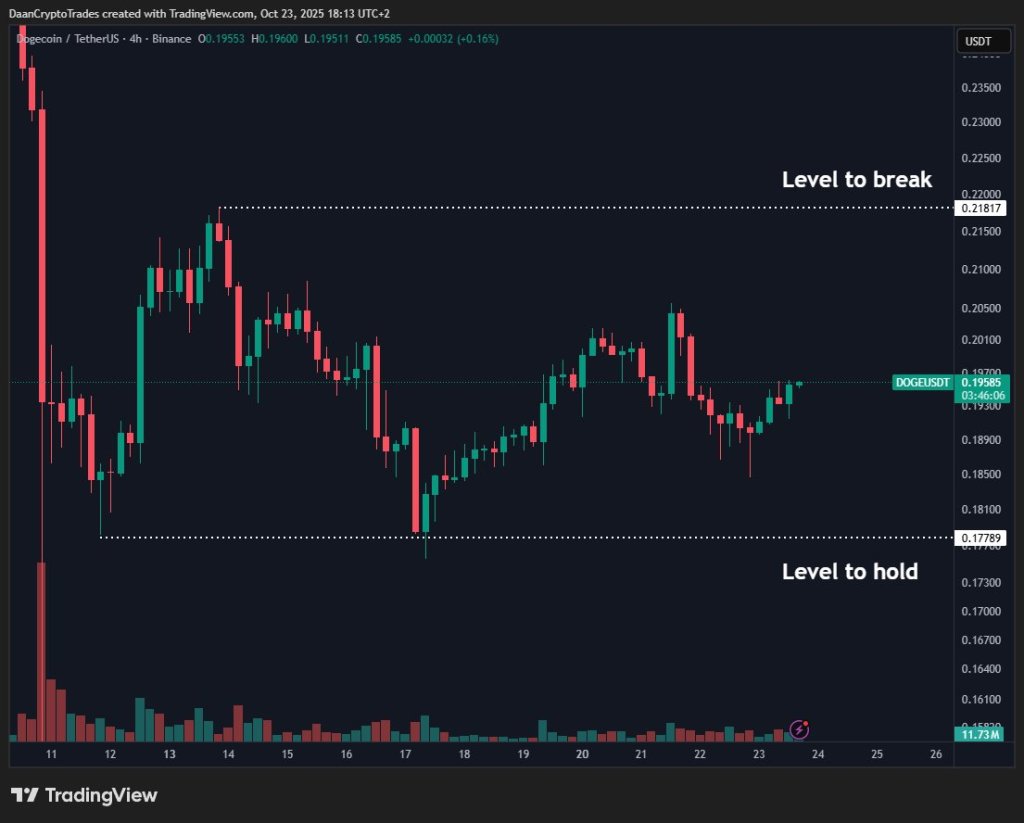 Dogecoin sits on a knife-edge defined by a tight 4h range and a larger weekly triangle—two structures that now bracket the next volatility expansion. Two Dogecoin Price Levels Are Crucial Now (4H Chart) On the intraday chart shared by Daan Crypto Trades (@DaanCrypto), DOGE trades near $0.19585 with a clearly marked “level to break” at $0.21817 and a “level to hold” at $0.17789. Price is orbiting the range’s mid-zone after a post-flush rebound, while the higher low carved last Friday remains the pivotal defense that keeps the structure constructive. As Daan put it, “DOGE Gives a good overview of the state of the market. Since the big flush, we had an initial bounce. Not many coins are trading at that area but instead formed a range. Higher lows were made last Friday and prices are now right in the middle of it all.” Related Reading: Dogecoin Awaits Risk-On Ignition As 2021 Pattern Repeats Daan’s trigger is unambiguous and explicitly cross-asset. “Breaking above that local high, which corresponds with $BTC ~$116K, would mark a new higher high locally and likely an end to this consolidation for some time.” By contrast, his risk line is equally crisp: “Breaking below last Friday’s low and losing the range, would not be a good look in the short-mid term. Right now, most coins (including Bitcoin) are right in the middle.” Tactically, that pins DOGE’s bull/bear resolution to a close through $0.21817 on the upside or a clean violation of the $0.17789 shelf on the downside, with the local higher-low from Friday serving as the market’s fail-safe. How DOGE Could Hit $3 The weekly Wyckoff schematic from Hov (@HovWaves) situates the same battle inside a macro triangle labeled (a)–(e), with the current sequence working through (c)–(e) before a terminal thrust higher. Hov notes the character of the bounce and the depth of the retracement that preceded it: “Well we were right. DOGE was corrective off the low and sold off for over 50% (threaded). Like I mentioned in the last update, the macro triangle was the higher probability outcome.” The downside test “didn’t quite make it into our lower support level,” he adds, and “so far the move off the low is pretty corrective looking,” before concluding, “We’ll need to watch how this develops over the next week or so to see if our C wave is in.” Those levels are visible on the chart. The macro demand box spans roughly $0.06–$0.09, bracketed by a deeper Fibonacci contingency at 0.5 ≈ $0.04206 and 0.618 ≈ $0.02142, while the descending triangle cap tracks toward the mid-$0.30s into 2025. Related Reading: Dogecoin RSI Breakout Shows Main Target, Why $1 Is Still Possible A horizontal supply band around the high-$0.17s to low-$0.21s aligns precisely with Daan’s intraday gates—$0.17789 to hold and $0.21817 to break—underscoring why the current standoff at ~$0.196 carries outsized signaling value. Hov’s terminal projection box sits in the $2.20–$3.00 area, with a measured extension annotated at −0.236 ≈ $2.826, marking the heart of the upside target range if the triangle resolves impulsively into a wave (v). The path to that upper box requires sequential confirmation. First, DOGE needs a decisive break and hold above $0.21817 to print a local higher high and exit the 4h range. Second, it must convert that reclaimed band into support on retest while working through overhead supply toward the weekly triangle’s descending trendline in the ~$0.30–$0.35 corridor. Only a clean breach of that macro lid—with price action transitioning from corrective to impulsive—opens sustained travel toward the $2.20-$3.00 objective cluster. Failure to defend the micro base at $0.17789 would flip the script, risking a drive back into the weekly demand zone at $0.090–$0.06 and, in an extremely bearish scenario, probing the deeper Fibonacci rails at ~$0.042 and ~$0.021. At press time, DOGE traded at $0.196. Featured image created with DALL.E, chart from TradingView.com
https://www.newsbtc.com/news/dogecoin/volatility-loading-dogecoin-explosive-path-to-3/
Dogecoin sits on a knife-edge defined by a tight 4h range and a larger weekly triangle—two structures that now bracket the next volatility expansion. Two Dogecoin Price Levels Are Crucial Now (4H Chart) On the intraday chart shared by Daan Crypto Trades (@DaanCrypto), DOGE trades near $0.19585 with a clearly marked “level to break” at $0.21817 and a “level to hold” at $0.17789. Price is orbiting the range’s mid-zone after a post-flush rebound, while the higher low carved last Friday remains the pivotal defense that keeps the structure constructive. As Daan put it, “DOGE Gives a good overview of the state of the market. Since the big flush, we had an initial bounce. Not many coins are trading at that area but instead formed a range. Higher lows were made last Friday and prices are now right in the middle of it all.” Related Reading: Dogecoin Awaits Risk-On Ignition As 2021 Pattern Repeats Daan’s trigger is unambiguous and explicitly cross-asset. “Breaking above that local high, which corresponds with $BTC ~$116K, would mark a new higher high locally and likely an end to this consolidation for some time.” By contrast, his risk line is equally crisp: “Breaking below last Friday’s low and losing the range, would not be a good look in the short-mid term. Right now, most coins (including Bitcoin) are right in the middle.” Tactically, that pins DOGE’s bull/bear resolution to a close through $0.21817 on the upside or a clean violation of the $0.17789 shelf on the downside, with the local higher-low from Friday serving as the market’s fail-safe. How DOGE Could Hit $3 The weekly Wyckoff schematic from Hov (@HovWaves) situates the same battle inside a macro triangle labeled (a)–(e), with the current sequence working through (c)–(e) before a terminal thrust higher. Hov notes the character of the bounce and the depth of the retracement that preceded it: “Well we were right. DOGE was corrective off the low and sold off for over 50% (threaded). Like I mentioned in the last update, the macro triangle was the higher probability outcome.” The downside test “didn’t quite make it into our lower support level,” he adds, and “so far the move off the low is pretty corrective looking,” before concluding, “We’ll need to watch how this develops over the next week or so to see if our C wave is in.” Those levels are visible on the chart. The macro demand box spans roughly $0.06–$0.09, bracketed by a deeper Fibonacci contingency at 0.5 ≈ $0.04206 and 0.618 ≈ $0.02142, while the descending triangle cap tracks toward the mid-$0.30s into 2025. Related Reading: Dogecoin RSI Breakout Shows Main Target, Why $1 Is Still Possible A horizontal supply band around the high-$0.17s to low-$0.21s aligns precisely with Daan’s intraday gates—$0.17789 to hold and $0.21817 to break—underscoring why the current standoff at ~$0.196 carries outsized signaling value. Hov’s terminal projection box sits in the $2.20–$3.00 area, with a measured extension annotated at −0.236 ≈ $2.826, marking the heart of the upside target range if the triangle resolves impulsively into a wave (v). The path to that upper box requires sequential confirmation. First, DOGE needs a decisive break and hold above $0.21817 to print a local higher high and exit the 4h range. Second, it must convert that reclaimed band into support on retest while working through overhead supply toward the weekly triangle’s descending trendline in the ~$0.30–$0.35 corridor. Only a clean breach of that macro lid—with price action transitioning from corrective to impulsive—opens sustained travel toward the $2.20-$3.00 objective cluster. Failure to defend the micro base at $0.17789 would flip the script, risking a drive back into the weekly demand zone at $0.090–$0.06 and, in an extremely bearish scenario, probing the deeper Fibonacci rails at ~$0.042 and ~$0.021. At press time, DOGE traded at $0.196. Featured image created with DALL.E, chart from TradingView.com
https://www.newsbtc.com/news/dogecoin/volatility-loading-dogecoin-explosive-path-to-3/