Reversing Alzheimer's: The Forgotten Causes And Cures Big Pharma Buried
Reversing Alzheimer's: The Forgotten Causes And Cures Big Pharma Buried
https://www.midwesterndoctor.com/p/reversing-alzheimers-the-forgotten?publication_id=748806&post_id=176867987&isFreemail=false&r=1ggdo&triedRedirect=true
,
•Due to Alzheimer’s research focusing on a symptom of it (amyloid plaques), rather than its actual cause, Alzheimer’s has remained “incurable” for decades.
•Rather than being a single disease, Alzheimer’s has multiple different subtypes (e.g., those due to insulin resistance, nutritional deficiencies, inflammation, infections, or concussions), each of which requires a different treatments.
•Impaired blood circulation to the brain and lymphatic drainage from the brain are often the primary trigger which initiates the degenerative process seen in Alzheimer’s disease.
•Factors which impair this circulation (e.g., poor sleep) hence roughly double the risk of dementia, while treatments which improve this circulation frequently produce remarkable improvements for cognitive decline and dementia.
•DMSO, an effective treatment for brain injuries like strokes is well suited to address many of the root causes of dementia and reverse the degenerative state dying neurons get trapped in. Because of this, there are many reports of it reversing dementia and clinical trials in both humans and animals corroborating these improvements.
•This article will review the actual causes of dementias like Alzheimer’s and the forgotten therapies many have successful used to cure them.
Alzheimer’s dementia is one of the greatest medical challenged our country faces (e.g., places an incredible burden upon society (e.g., last year it was estimated to cost the United States
https://curealz.org/the-basics-of-alzheimers-disease/statistics-and-costs/
). Yet, despite spending billions for research each year, cures remain elusive, something many believe results from the flawed belief eliminating the amyloid plaques associated with Alzheimer’s will fix it.
In turn, as I showed
https://www.midwesterndoctor.com/p/the-great-alzheimers-scam-and-the
:
Decades of amyloid therapies have never produced a beneficial therapy.
The newest “breakthrough” amyloid eliminating monoclonal antibodies, at best, slightly slow the progression of Alzheimer’s while simultaneously causing a host of side effective including brain bleeding and swelling in over a quarter of recipients.
The entire amyloid industry rests upon a fraudulent study no one wanted to retract, likely due to how much was invested in the amyloid hypothesis.
In short, the money behind this juggernaut has caused research into the real causes of Alzheimer’s to be suppressed. For example,
https://www.midwesterndoctor.com/p/the-great-alzheimers-scam-and-the
—yet virtually no one knows this.
Dale Bredesen’s Discovery
Many are also unaware
https://journals.sagepub.com/doi/10.3233/JAD-215707
that should have revolutionized the entire Alzheimer’s field:

That protocol was based on
https://www.amazon.com/End-Alzheimers-Program-Prevent-Cognitive/dp/0735216207
:
• Amyloid protein is a protective mechanism the brain uses to protect itself from stressors that endanger brain tissue—making attempt to treat Alzheimer’s by eliminating it doomed to fail.
• The brain is designed to be able to adapt to the needs of life, so it is always creating or pruning neural connections and brain cells. Alzheimer’s results from the loss of signals that sustain brain cells and the dismantling of neural connections outweighing the formation of new ones gradually compounding over the decades.
• Rather than there being one type of Alzheimer’s, there are actually multiple that each require different treatment approaches.
Note:
https://journals.sagepub.com/doi/10.3233/JAD-215707
administering Bredesen’s protocol with success.
The Six Types of Alzheimer’s Disease
As this understanding of Alzheimer’s has produced real results, this suggests the causes of Alzheimer’s Bredesen identified indeed play a key role in the disease—particularly since many other datasets corroborate their contribution to Alzheimer’s. They are as follows:
Type 1 -- Inflammatory
This form is driven by excessive inflammation, often metabolic or infectious in nature. Chronic activation of the immune system—due to factors such as insulin resistance, a poor diet, a leaky gut, or latent infections—leads the brain to engage in protective downsizing by removing synapses and neurons that are less essential for immediate survival. It often presents with classic Alzheimer’s memory loss and typically develops in the sixties to seventies.
Type 1.5 -- Glycotoxic
This subtype arises from insulin resistance and chronically elevated blood sugar. It leads to both inflammatory and trophic deficiencies, and is driven by glycotoxicity and the accumulation of advanced glycation end products (AGEs), which impair cellular function and synaptic integrity. It typically appears in the late fifties to sixties.
Note: chronically elevated insulin promotes amyloid formation as
https://www.amazon.com/End-Alzheimers-Program-Prevent-Cognitive-ebook/dp/B01M28ROCU
the body uses to break down insulin is the same enzyme it uses to break down amyloid plaques.
Type 2 -- Atrophic
This type is caused by deficiencies in
https://www.midwesterndoctor.com/p/the-great-alzheimers-scam-and-the
that provide trophic (supportive) signals to brain cells which then triggers a similar downsizing mechanism seen in Type 1. Type 2 tends to emerge about a decade later than Type 1.
Note: we find these nutritional deficiencies can result from poor circulation reducing existing nutrients reaching brain tissue, and hence often focus on improving circulation rather than extended supplementation.
Type 3 -- Toxic
This subtype results from exposure to toxic substances that directly damage neurons. Common culprits include biotoxins, chronic infections, heavy metals, and industrial or household chemicals. Causative infections (discussed further
https://www.midwesterndoctor.com/p/the-great-alzheimers-scam-and-the
) include Cytomegalovirus, Human Herpesvirus 1 or 6, Lyme disease, dental bacteria that can travel to the brain (e.g. P. gingivalis) and various fungal infections (as mold toxins are notorious for causing cognitive impairment at all ages).
Type 3 uniquely causes widespread and often unpredictable neuronal death, occurs earlier in life—often between the forties and sixties—and is less strongly associated with genetic risk factors. Cognitive decline in this type is frequently accompanied by psychiatric symptoms, sensory changes, or executive dysfunction (e.g., difficulty with math, organization, executive tasks), rather than the more classic early Alzheimer’s memory loss.
Note: some of the most important neurotoxins to avoid are pharmaceuticals, and when I meet elderly individuals who have preserved their mental clarity, many report having largely avoided pharmaceuticals throughout their lives. Some of the most common problematic medications for brain health include certain
https://www.midwesterndoctor.com/p/the-great-blood-pressure-scam
), and anticholinergics (such as those prescribed for incontinence).
Type 4 -- Vascular
In this form, chronic restriction of cerebral blood flow from existing vascular diseases leads to gradual neuronal injury and cognitive decline. Type 4 often appears in the seventies or beyond) and may overlap with other subtypes. It tends to affect processing speed, attention, and executive function rather than memory alone.
Note: rapid cognitive decline
https://www.midwesterndoctor.com/p/we-now-have-proof-the-covid-vaccines
, and significantly overlapped with this type.
Type 5 -- Traumatic
Severe head traumas or repeated concussions (e.g.,
https://pierrekory.substack.com/p/the-global-disinformation-campaign-187
.
Note: there are a variety of causes of dementia, many of which are frequently (roughly half the time
https://bmcgeriatr.biomedcentral.com/articles/10.1186/1471-2318-13-137
.
Healthy Fluid Circulation
Many practitioners I know who’ve successfully treating dementia with a variety of methods (listed
https://www.midwesterndoctor.com/p/the-great-alzheimers-scam-and-the
) all concluded it resulted from impairments of blood flow to the brain and lymphatic or venous drainage from it. For example:
•
https://www.midwesterndoctor.com/p/what-makes-all-vaccines-so-dangerous
.
•China recently developed a surgery (detailed
https://www.midwesterndoctor.com/p/the-great-alzheimers-scam-and-the
) also improve cognitive decline and dementia.
Furthermore, beyond blood being vital for neuronal survival, the proper clearance of waste products from the brain is as well. Unfortunately, due to how limited space is for the brain within the skull, robust lymphatic vessels do not exist, and instead, lymphatic drainage is created by astrocytes creating temporary lymphatic vessels around blood vessels during deep sleep.

This system, in turn, is highly vulnerable to disruption and
https://www.science.org/doi/10.1126/science.abb8739
.
Due to the fragility of this system, things which disrupt it are quite consequential (e.g., poor zeta potential thickens and slows the drainage of glymphatic fluids). For example, as glymphatic drainage only occurs during deep sleep, poor sleep
https://www.ncbi.nlm.nih.gov/pmc/articles/PMC4967375/
).
Likewise, disrupted sleep
https://bmcmedicine.biomedcentral.com/articles/10.1186/s12916-023-02811-z
before the momentum of dementia has entrenched itself.
Note: sleeping pills block restorative sleep, and have a variety of issues (e.g., they make users 2-5 times as likely to die
https://www.ncbi.nlm.nih.gov/pmc/articles/PMC4883191/
The Life of Cells and Neuroplasticity
One of the things I continually marvel at about nature is not only the ability of a species to genetically adapt to its environment, but the inherent adaptability each organism has within its own lifespan to adapt to its environment. Within the human body, there are many systems that are designed to change based on the needs of one’s environment (e.g. this is why weight training creates larger muscles), and among the most adaptable is the nervous system.
So, at any given moment, neural circuits that support certain activities are reinforced, while other circuits are pruned and eventually disabled, a process that allows the nervous system to adapt to the complex needs of its environment. At the same time, many complex neurological and psychiatric disorders arise from a momentum being established where dysfunctional neurological circuits perpetually reinforce themselves.
For these disorders to be treated, a momentum must instead be established behind a healthy circuit (for those interested,
https://www.amazon.com/Brains-Way-Healing-Discoveries-Neuroplasticity/dp/067002550X
). This momentum is a key reason why it is so important to have healthy thought patterns and regularly actively exercise your brain (another core component of programs for preventing Alzheimer’s). If you do the opposite (e.g., watch TV all day or passively consume online content), dysfunctional patterns can become established habits, while neurological damage occurs as parts of the brain you need but under utilize are pruned away.
A key way the brain accomplishes this adaptability is by eliminating neurons that are no longer deemed essential.
https://www.amazon.com/End-Alzheimers-Program-Prevent-Cognitive-ebook/dp/B01M28ROCU
is that it results from the balance between preserving and eliminating neurons being shifted towards eliminating them, which inevitably will result in cognitive decline (hence making it critical to protect your brain early in the process of cognitive decline so it does not progress to dementia).
Within
https://www.amazon.com/End-Alzheimers-Program-Prevent-Cognitive-ebook/dp/B01M28ROCU
, the amyloid protein plays a key role in this process, as when it is initially formed as amyloid precursor protein (APP), it has the choice to be then split into two or four parts. If it is divided into two parts, those parts protect the neurological function in the brain. In comparison, if it is divided into four parts, the neurological function of the brain is damaged, and brain cells are eliminated. Interestingly, its splitting into four parts causes future APPs also to be split into four parts (which creates a downhill spiral). As a result, Brenden’s approach focuses on regaining a healthy momentum towards the two-part splitting while also providing the signals cells within the body require to survive.
The Cell Danger Response
When cells are exposed to external stressors, they often enter
https://www.midwesterndoctor.com/p/what-is-the-cell-danger-response
where they partially or fully “turn off” (e.g. mitochondrial respiration and protein synthesis within the cell decline) to protect themselves. Many chronic diseases, in turn, result from cells being trapped in this degenerative cycle (which often leads to cell death) rather than exiting it and resuming their normal function. Likewise, many therapies in regenerative medicine function by taking cells out of this frozen metabolic state.
Because of this, many complex illnesses (e.g., COVID vaccine injuries, fibromyalgia or autism) can only be treated if the underlying trigger for the cell danger response is removed, and then a regenerative therapy is provided which signals cells
https://www.midwesterndoctor.com/p/what-is-the-cell-danger-response
).
Similarly:
The principle that blocking protein synthesis prevents long-term memory storage was discovered many years ago. With age there is a marked decline of protein synthesis in the brain that correlates with defects in proper protein folding. Accumulation of misfolded proteins can activate the integrated stress response (ISR), an evolutionary conserved pathway that decreases protein synthesis. In this way, the ISR may have a causative role in age-related cognitive decline.
In turn, much in the same way treatments for the CDR often facilitate treating dementia, therapies which inhibit the ISR have been found to restore the structure and function of cells within the brain and improve a variety of age-related memory deficits.
https://elifesciences.org/articles/62048
DMSO
Dimethyl sulfoxide has a variety of unique therapeutic properties which allow it to treat a variety of diseases (e.g.,
https://www.midwesterndoctor.com/p/dmso-could-save-millions-from-brain
of it treating numerous “incurable illnesses.”
Much of this results from DMSO’s ability to restore normal circulation, protect cells from lethal stressors, and revive shocked cells trapped in the CDR. As such, since start the series, in addition to receiving many reports from readers who saved themselves or a loved one from a disabling stroke with DMSO,
https://www.midwesterndoctor.com/p/the-great-alzheimers-scam-and-the
stories like this:
https://www.midwesterndoctor.com/p/the-remarkable-history-and-safety/comment/105218392
has dementia and has been unable to speak for over a year. My mom recently visited them and told them about DMSO. He began to give his wife DMSO orally. After two week she began to talk again.
Numerous studies (detailed
https://www.midwesterndoctor.com/p/the-great-alzheimers-scam-and-the
), have corroborated DMSO’s ability to treat dementia. These include:
•When cerebral blood flow was permanently reduced in rats,
https://core.ac.uk/reader/148120060
•DMSO
https://pharmacophorejournal.com/article/effects-of-dimethyl-sulfoxide-on-hippocampal-activity-in-a-rotenone-induced-rat-model-of-parkinsonr-bdmvggfdf16zv1v
).
•
https://www.sciencedirect.com/science/article/abs/pii/S0006899303030452
(pathologic accumulations of pathologic proteins.Note: we are currently corresponding with a reader who saw a remarkable response to DMSO for CJD (an incurable neurodegenerative prion disease).
In humans:
•
https://dmso.org/articles/alzheimers/Alzheimers.htm
after three months, DMSO caused a significant improvement in memory, concentration, communication and orientation to time and space.
•In 104 elderly adults with organic brain disease from the common causes (e.g., strokes, atherosclerosis, Parkinson’s or head injuries), DMSO greatly improved their psychic and somatic function.
https://scholar.google.com/scholar?q=merinex&hl=en&as_sdt=0%2C5&as_ylo=1970&as_yhi=1970
.
•
https://scholar.google.com/scholar?hl=en&as_sdt=0%2C5&as_ylo=1970&as_yhi=1970&q=j+grismali&btnG=
with cerebrovascular diseases CVD, many of whom were senile, over 50 days, DMSO caused almost all to have a significant in their CVD, along with significant improvements in mood, mobility, and speech.
Conclusion
Medicine revolves around finding unique molecular targets for which disease specific treatments can be patented. Unfortunately, this model frequently fails in chronic illnesses, frequently leading to grotesque situations like the one described here, where natural therapies which can address the actual causes of devastating illnesses are sidelined to protect each disease’s lucrative “treatment” market.
This needs to change, and for the first time in my lifetime, thanks to MAHA, the political will at last exits to begin addressing the real reasons why there continues to be such much chronic illness in our society. The opportunity to make cognitive decline no longer be an inevitable aspect of aging is finally here—provided we seize it!
Author’s note: This is an abridged version of
https://www.midwesterndoctor.com/p/the-great-alzheimers-scam-and-the
.
https://cms.zerohedge.com/users/tyler-durden
Fri, 12/19/2025 - 19:15
https://www.zerohedge.com/medical/reversing-alzheimers-forgotten-causes-and-cures-big-pharma-buried

 Off Grid Survival Tips from The Amish.
The Amish first arrived in the United States in the mid 1700’s. Of course it was still a British colony at the time but since that time the Amish population in the U.S. has grown to almost 300,000. They live in communities across the country and are known for their firm commitment to a simpler, pioneer lifestyle.
Contrary to some assumptions, the Amish do not shun all technology. They have been known to use diesel powered generators, propane powered refrigerators and freezers, and commonly use solar, wind and water power. The only issues they have with technology are when it is interconnected.
The Amish believe that to retain their independence and freedom from the temptations and evil of modern society, they must avoid those technologies that connect to society in general. This would include the power grid, Internet, broadcast TV and radio signals, and any other technology that is part of a network or system connected to the general public.
Want to save this post for later? Click Here to Pin It On Pinterest!
The Off-Grid Pioneers
As a result, the Amish have been pursuing an off-grid lifestyle for more than 500 years. And while there was no such thing as a power-grid 500 years ago, there were still networks of connection that they avoided. They have occasionally if not reluctantly accepted some forms of technology, but it usually requires approval from the local Amish community. This approval varies from community to community.
One surprising example is that some Amish farmers have wireless mobile phones. They don’t usually access the Internet nor do many of the other things most of us do, but many Amish are in business to sell products they produce and need some way to connect to stores and suppliers.
In spite of their occasional use of cell phones they still don’t have hard line phones in their homes. That would be “too connected” to the outside world.
Centuries of Preparedness
As much as some of us worry about a massive grid failure, water shortages and cyberattacks on the Internet, the Amish have been calmly living a prepared life as a matter of course and a matter of choice. There are lessons to be learned here and they go beyond skills and hand tools to a mindset and a state of mind.
A Life Defined by Self-Reliance
It would be a stretch to believe that the Amish never go to a store, but it’s a rare occurrence and their shopping is both specific and limited. One store that has both a catalog and an online presence is Lehman’s. They sell a line of products uniquely tailored to the Amish lifestyle and work style. This includes many of the hand-powered tools and equipment that is no longer made, or only found in antique stores and flea markets.
Just about everything else they need they either grow, make, build or barter for. It’s a lifestyle motivated by a daily commitment to self-reliance and the discipline to make that happen.
One of their mindsets is the fact that every day is a to-do list of chores; some routine, some seasonal, and others necessary or pursued. Kids are often involved in the daily chores both as a means of learning self-reliant skills, and as a necessary set of extra helping hands. To the Amish, hard work is both noble and expected.
They dress very traditionally and their fashion choices haven’t changed for more than 100 years. Their clothes are usually handmade, their food is homegrown, and everything is home cooked, canned or preserved.
We’re going to step back and look at the various actions, skills and behaviors of a typical Amish community to identify some of those actions, skills and behaviors we could and maybe should adopt for our own self-reliance and independence.
The Basic Skills
To begin, the Amish are predominantly farmers. They chose farming because it allowed them to not only live independently but to locate in rural areas away from the sins and opinions of the city.
√ Farming
This isn’t about farming in the traditional sense. Few Amish actively grow, harvest and sell large quantities of a single crop to sell on the open market.
Most of their farming activity is focused on growing their own food to eat, growing some to sell either at their own farm stand or to local grocers, and food as barter for other goods and services they might need within the Amish community and the local community at large.
Mechanical, motor driven equipment is rarely used and instead horses are the literal horsepower of choice.
It’s rare that you would see a gas powered roto-tiller, but some Amish have used diesel powered hay bailers and other diesel-powered equipment for tasks that are either too difficult or too dangerous to do by hand.
Every aspect of farming and gardening is mostly done by hand from tilling to planting, harvesting and storing. Horse-drawn wagons and equipment pull the heavy loads but tasks that can be done by hand are done by hand.
The Amish always harvest seeds from every crop and store them for the next season. They compost everything from weeds to straw to table scraps to manure and chicken droppings.
√ Building
The Amish are master builders. They are known for their carpentry skills and their handmade furniture is highly regarded. They are also masters of timber frame construction and work together in their community to raise barns, sheds and homes for their families and neighbors.
Many are accomplished masons and their sturdy brick walls have rolled across the hills and valleys of their farms for centuries. From barn foundations to bricking a water well; masonry and the ability to use stone, mortar and masonry tools are second to only carpentry in their wheelhouse of skills.
√ Harnessing Water
Many Amish farms and properties feature water wheels powered by creeks and streams to grind flower, pump water to their homes and to irrigate their farms, and even to power saw mills and timber pulleys.
They are accomplished at digging wells and their use of hand pumps to pump water is not only common but expected. They are expert at collecting rainwater and harvesting water from lakes, ponds and streams.
They are accomplished at crafting water filters from gravel, sand and charcoal and heat their water with wood-fired cook stoves with a reservoir attached. They also heat water with rooftop solar water heaters and sometimes simply heat the water in a large stockpot over an open fire.
√ Harnessing Wind
Few Amish farms are without their share of windmills. They’re used to do everything from pumping water to generating electricity. Long before wind-power became a buzzword for green energy, farmers like the Amish were harnessing the wind.
The wind was also used to dry the laundry and of course separate the wheat from the chaff. Windmills also powered small grain mills and even small water pumps to direct water to a livestock trough or small garden.
If there was a force of nature that could provide power to accomplish a task, the Amish harnessed it and put it to good use.
√ Preserving Foods
Food preservation was another primary skill pursued by the Amish. Canning was a regular activity and their pantries and root cellars were always filed with the results of their canning efforts.
They were also expert at curing and smoking meats and a smokehouse was a common and often necessary addition to any Amish farm. The smokehouse was used to both smoke the cured meats and to store them over time.
Dehydrating foods and vegetables using the sun was another common Amish practice. From raisins to sun-dried tomatoes, if it could be sun-dried it found its place in the Amish sun.
Just as many foods were fermented and given the German origins of some Amish communities, sauerkraut was often found in every Amish pantry.
√ Animal Husbandry
Amish livestock went well beyond the standard flock of chickens. Horses had a constant and necessary presence in every Amish barn. Cows were raised for their milk and other dairy products. Pigs, goats and sheep were also on the farm. And of course, there were always chickens.
√ Off-Grid Heating
Wood burning stoves were a standard addition to an Amish farmhouse and chopping wood was a daily chore. Most homes also had fireplaces both for heat and cooking.
Many Amish farms also had “summer kitchens.” These were dedicated structures removed from the main house where wood-fired stoves could be used for daily cooking without making the heat unbearable in the main house in summer.
√ Off-Grid Cooking
Wood burning cook stoves were the primary centerpiece in any Amish kitchen and they not only provided additional heat in winter, but were used to cook everything.
The Amish also cooked outside whether they were roasting whole hogs, chickens on a spit or boiling down tree sap for syrup.
√ Off-Grid Cooling
Many pioneers and native people across North America used innovative ways to keep cool in summer. The Amish kept cool using many of those traditional techniques from well designed venting to the use of cold traps.
Basements and root cellars were always a cool location and the Amish were also mindful about keeping their animals cool.
Foods were kept cool in root cellars, basements, and with modern conveniences like propane powered refrigerator/freezers.
Ice was often harvested from ponds and lakes in winter and dedicated ice-houses were used for year-round cold storage of foods. They also were quick to use ice-boxes in their kitchens and have even been known to use old electric refrigerators without electricity to both contain the ice for cooling, and to take advantage of the insulation properties of any refrigerator.
√ Alternative Power
Off-grid doesn’t mean the electricity is always off to the Amish. It means they are not connected to a networked power grid, but they still find ways today to generate electricity.
Solar power is both used and embraced by many Amish communities as an independent source of power. One reference to the use of solar power by the Amish referred to it as connecting to “God’s-grid.”
The solar panels are sometimes hooked to a solar generator, and rooftop solar setups even heat water for use in the Amish household.
Windmills to generate power are also embraced, and if a stream or creek is running through their property both ram pumps for pumping water, and water wheels for power generation are quick to appear.
Much of the electricity generated is used to power wood working tools like planers, saws and other workshop tools. The power is also used to generate electricity for basic lighting and appliances.
√ Let There be Light
Lighting options for the Amish are wide-ranging from oil filled hurricane lamps to kerosene lanterns, candles and candle lanterns, and even LED flashlights and lamps powered by solar rechargeable batteries. Hand-cranked flashlights are another option.
Some of it sounds like technology the Amish would shun and some Amish communities would agree. On the other hand, they are embraced by other Amish communities given the fact that these off-grid lighting options are independent of the grid.
√ Transportation
A horse and carriage are the traditional mode of transportation for the Amish. But they also use bicycles often with an attached buggy-cart, and some of the younger Amish generation has been spotted on roller skates and skateboard scooters.
Whenever long distance travel is required the Amish usually arrange for someone else to drive them to their destination. They won’t own or drive a traditional car, van or truck but when necessary will accept the need to travel as a passenger.
√ First Aid & Herbal Medicine
It’s rare for the Amish to visit a doctor or hospital with any frequency, although they will not hesitate in a desperate emergency. In many instances, the Amish turn to herbal medicine and natural treatments for their ailments.
The Amish are generally in very good health due to the amount of their strenuous physical activity and their essentially organic diet of farm raised foods. They also shun alcohol, tobacco and the other excesses of society that often lead to health issues.
There are books about Amish natural remedies and many of their herbal treatments that have been used and improved over hundreds of years.
√ Crafts
Some of us think of crafts as a hobby. To the Amish, crafts are a way of life. In a social group that typically avoids the commercial offerings of modern society the ability to do-it-yourself is both necessary and expected. Here are just a few of the craft skills the Amish have both mastered and pursue on a regular basis:
Furniture making
Quilting
Candle making
Soap making
Pottery
Beekeeping
Maple sugaring
Cider making
Cider Vinegar
Sewing
Knitting and crochet
There’s more and if there’s something that needs to be made by hand it’s a good bet the Amish are making it.
√ Home Schooling
It didn’t take a pandemic to motivate the Amish to home-school their children.
It’s totally consistent with their philosophy and the fear that outside and corrupt influences will affect their children and their community.
Traditionally, the Amish home-schooled their children up through 8th grade. At that point, some shifted their children’s education to mastery of a specific trade as a source of future income and security.
√ Self-Reliant Trades
The trades taught to Amish children started much like all trades are acquired. It started with an apprenticeship usually guided by an expert in the community. The product of their trades were then used to either generate income; used as barter or to supply the immediate family with necessary goods and skills.
These dedicated trade skills were in addition to the previously mentioned craft skills that were seen as expected and common knowledge. The trades that the Amish are known for include:
Carpentry
Masonry
Blacksmithing
Food Preservation
Farming and Gardening
Wheelwright
Cobbling
Barrel Cooper
√ Foraging
In addition to farming and animal husbandry, the Amish are expert at wild foraging. Their ability to recognize trees, wild berries, wild mushrooms and other edible wild plants not only supplemented their farming efforts, but provided additional nutrition beyond conventional vegetables and fruits.
√ Barter
Traditional commerce was often a challenge for the Amish. As a community that actively avoided the outside world, the idea of a traditional job with a paycheck was not always a viable possibility. As a result, barter was a very important part of Amish commerce and trade.
The barter items ranged from eggs to fruits and vegetables and even meat and dairy products. They also bartered their crafts from handmade furniture to anything else they could craft or make.
In addition, the Amish bartered their skills for goods and services both within their community and the surrounding local community as well.
√ Acquiring an Amish Mindset
Beyond the skills, crafts and creations generated by Amish communities is a mindset worth considering.
It begins with a dedication to self-reliance.
It’s built on a work-ethic that embraces and respects hard work.
It’s fueled by an independent spirit.
It is fortified by a community designed around cooperation and sharing.
It’s dedicated to a commitment to preparedness.
It’s very accomplished at meeting the challenges of living off-grid.
Anyone with a mindset towards preparedness and self-reliance would be well-served by some of the behaviors and lessons from the Amish communities.
It’s gotten them through the last 500 years, and there’s no reason to believe it won’t take them well into the next millennium.
"Pure signal, no noise"
Credits Goes to the respective
Author ✍️/ Photographer📸
🐇 🕳️
Off Grid Survival Tips from The Amish.
The Amish first arrived in the United States in the mid 1700’s. Of course it was still a British colony at the time but since that time the Amish population in the U.S. has grown to almost 300,000. They live in communities across the country and are known for their firm commitment to a simpler, pioneer lifestyle.
Contrary to some assumptions, the Amish do not shun all technology. They have been known to use diesel powered generators, propane powered refrigerators and freezers, and commonly use solar, wind and water power. The only issues they have with technology are when it is interconnected.
The Amish believe that to retain their independence and freedom from the temptations and evil of modern society, they must avoid those technologies that connect to society in general. This would include the power grid, Internet, broadcast TV and radio signals, and any other technology that is part of a network or system connected to the general public.
Want to save this post for later? Click Here to Pin It On Pinterest!
The Off-Grid Pioneers
As a result, the Amish have been pursuing an off-grid lifestyle for more than 500 years. And while there was no such thing as a power-grid 500 years ago, there were still networks of connection that they avoided. They have occasionally if not reluctantly accepted some forms of technology, but it usually requires approval from the local Amish community. This approval varies from community to community.
One surprising example is that some Amish farmers have wireless mobile phones. They don’t usually access the Internet nor do many of the other things most of us do, but many Amish are in business to sell products they produce and need some way to connect to stores and suppliers.
In spite of their occasional use of cell phones they still don’t have hard line phones in their homes. That would be “too connected” to the outside world.
Centuries of Preparedness
As much as some of us worry about a massive grid failure, water shortages and cyberattacks on the Internet, the Amish have been calmly living a prepared life as a matter of course and a matter of choice. There are lessons to be learned here and they go beyond skills and hand tools to a mindset and a state of mind.
A Life Defined by Self-Reliance
It would be a stretch to believe that the Amish never go to a store, but it’s a rare occurrence and their shopping is both specific and limited. One store that has both a catalog and an online presence is Lehman’s. They sell a line of products uniquely tailored to the Amish lifestyle and work style. This includes many of the hand-powered tools and equipment that is no longer made, or only found in antique stores and flea markets.
Just about everything else they need they either grow, make, build or barter for. It’s a lifestyle motivated by a daily commitment to self-reliance and the discipline to make that happen.
One of their mindsets is the fact that every day is a to-do list of chores; some routine, some seasonal, and others necessary or pursued. Kids are often involved in the daily chores both as a means of learning self-reliant skills, and as a necessary set of extra helping hands. To the Amish, hard work is both noble and expected.
They dress very traditionally and their fashion choices haven’t changed for more than 100 years. Their clothes are usually handmade, their food is homegrown, and everything is home cooked, canned or preserved.
We’re going to step back and look at the various actions, skills and behaviors of a typical Amish community to identify some of those actions, skills and behaviors we could and maybe should adopt for our own self-reliance and independence.
The Basic Skills
To begin, the Amish are predominantly farmers. They chose farming because it allowed them to not only live independently but to locate in rural areas away from the sins and opinions of the city.
√ Farming
This isn’t about farming in the traditional sense. Few Amish actively grow, harvest and sell large quantities of a single crop to sell on the open market.
Most of their farming activity is focused on growing their own food to eat, growing some to sell either at their own farm stand or to local grocers, and food as barter for other goods and services they might need within the Amish community and the local community at large.
Mechanical, motor driven equipment is rarely used and instead horses are the literal horsepower of choice.
It’s rare that you would see a gas powered roto-tiller, but some Amish have used diesel powered hay bailers and other diesel-powered equipment for tasks that are either too difficult or too dangerous to do by hand.
Every aspect of farming and gardening is mostly done by hand from tilling to planting, harvesting and storing. Horse-drawn wagons and equipment pull the heavy loads but tasks that can be done by hand are done by hand.
The Amish always harvest seeds from every crop and store them for the next season. They compost everything from weeds to straw to table scraps to manure and chicken droppings.
√ Building
The Amish are master builders. They are known for their carpentry skills and their handmade furniture is highly regarded. They are also masters of timber frame construction and work together in their community to raise barns, sheds and homes for their families and neighbors.
Many are accomplished masons and their sturdy brick walls have rolled across the hills and valleys of their farms for centuries. From barn foundations to bricking a water well; masonry and the ability to use stone, mortar and masonry tools are second to only carpentry in their wheelhouse of skills.
√ Harnessing Water
Many Amish farms and properties feature water wheels powered by creeks and streams to grind flower, pump water to their homes and to irrigate their farms, and even to power saw mills and timber pulleys.
They are accomplished at digging wells and their use of hand pumps to pump water is not only common but expected. They are expert at collecting rainwater and harvesting water from lakes, ponds and streams.
They are accomplished at crafting water filters from gravel, sand and charcoal and heat their water with wood-fired cook stoves with a reservoir attached. They also heat water with rooftop solar water heaters and sometimes simply heat the water in a large stockpot over an open fire.
√ Harnessing Wind
Few Amish farms are without their share of windmills. They’re used to do everything from pumping water to generating electricity. Long before wind-power became a buzzword for green energy, farmers like the Amish were harnessing the wind.
The wind was also used to dry the laundry and of course separate the wheat from the chaff. Windmills also powered small grain mills and even small water pumps to direct water to a livestock trough or small garden.
If there was a force of nature that could provide power to accomplish a task, the Amish harnessed it and put it to good use.
√ Preserving Foods
Food preservation was another primary skill pursued by the Amish. Canning was a regular activity and their pantries and root cellars were always filed with the results of their canning efforts.
They were also expert at curing and smoking meats and a smokehouse was a common and often necessary addition to any Amish farm. The smokehouse was used to both smoke the cured meats and to store them over time.
Dehydrating foods and vegetables using the sun was another common Amish practice. From raisins to sun-dried tomatoes, if it could be sun-dried it found its place in the Amish sun.
Just as many foods were fermented and given the German origins of some Amish communities, sauerkraut was often found in every Amish pantry.
√ Animal Husbandry
Amish livestock went well beyond the standard flock of chickens. Horses had a constant and necessary presence in every Amish barn. Cows were raised for their milk and other dairy products. Pigs, goats and sheep were also on the farm. And of course, there were always chickens.
√ Off-Grid Heating
Wood burning stoves were a standard addition to an Amish farmhouse and chopping wood was a daily chore. Most homes also had fireplaces both for heat and cooking.
Many Amish farms also had “summer kitchens.” These were dedicated structures removed from the main house where wood-fired stoves could be used for daily cooking without making the heat unbearable in the main house in summer.
√ Off-Grid Cooking
Wood burning cook stoves were the primary centerpiece in any Amish kitchen and they not only provided additional heat in winter, but were used to cook everything.
The Amish also cooked outside whether they were roasting whole hogs, chickens on a spit or boiling down tree sap for syrup.
√ Off-Grid Cooling
Many pioneers and native people across North America used innovative ways to keep cool in summer. The Amish kept cool using many of those traditional techniques from well designed venting to the use of cold traps.
Basements and root cellars were always a cool location and the Amish were also mindful about keeping their animals cool.
Foods were kept cool in root cellars, basements, and with modern conveniences like propane powered refrigerator/freezers.
Ice was often harvested from ponds and lakes in winter and dedicated ice-houses were used for year-round cold storage of foods. They also were quick to use ice-boxes in their kitchens and have even been known to use old electric refrigerators without electricity to both contain the ice for cooling, and to take advantage of the insulation properties of any refrigerator.
√ Alternative Power
Off-grid doesn’t mean the electricity is always off to the Amish. It means they are not connected to a networked power grid, but they still find ways today to generate electricity.
Solar power is both used and embraced by many Amish communities as an independent source of power. One reference to the use of solar power by the Amish referred to it as connecting to “God’s-grid.”
The solar panels are sometimes hooked to a solar generator, and rooftop solar setups even heat water for use in the Amish household.
Windmills to generate power are also embraced, and if a stream or creek is running through their property both ram pumps for pumping water, and water wheels for power generation are quick to appear.
Much of the electricity generated is used to power wood working tools like planers, saws and other workshop tools. The power is also used to generate electricity for basic lighting and appliances.
√ Let There be Light
Lighting options for the Amish are wide-ranging from oil filled hurricane lamps to kerosene lanterns, candles and candle lanterns, and even LED flashlights and lamps powered by solar rechargeable batteries. Hand-cranked flashlights are another option.
Some of it sounds like technology the Amish would shun and some Amish communities would agree. On the other hand, they are embraced by other Amish communities given the fact that these off-grid lighting options are independent of the grid.
√ Transportation
A horse and carriage are the traditional mode of transportation for the Amish. But they also use bicycles often with an attached buggy-cart, and some of the younger Amish generation has been spotted on roller skates and skateboard scooters.
Whenever long distance travel is required the Amish usually arrange for someone else to drive them to their destination. They won’t own or drive a traditional car, van or truck but when necessary will accept the need to travel as a passenger.
√ First Aid & Herbal Medicine
It’s rare for the Amish to visit a doctor or hospital with any frequency, although they will not hesitate in a desperate emergency. In many instances, the Amish turn to herbal medicine and natural treatments for their ailments.
The Amish are generally in very good health due to the amount of their strenuous physical activity and their essentially organic diet of farm raised foods. They also shun alcohol, tobacco and the other excesses of society that often lead to health issues.
There are books about Amish natural remedies and many of their herbal treatments that have been used and improved over hundreds of years.
√ Crafts
Some of us think of crafts as a hobby. To the Amish, crafts are a way of life. In a social group that typically avoids the commercial offerings of modern society the ability to do-it-yourself is both necessary and expected. Here are just a few of the craft skills the Amish have both mastered and pursue on a regular basis:
Furniture making
Quilting
Candle making
Soap making
Pottery
Beekeeping
Maple sugaring
Cider making
Cider Vinegar
Sewing
Knitting and crochet
There’s more and if there’s something that needs to be made by hand it’s a good bet the Amish are making it.
√ Home Schooling
It didn’t take a pandemic to motivate the Amish to home-school their children.
It’s totally consistent with their philosophy and the fear that outside and corrupt influences will affect their children and their community.
Traditionally, the Amish home-schooled their children up through 8th grade. At that point, some shifted their children’s education to mastery of a specific trade as a source of future income and security.
√ Self-Reliant Trades
The trades taught to Amish children started much like all trades are acquired. It started with an apprenticeship usually guided by an expert in the community. The product of their trades were then used to either generate income; used as barter or to supply the immediate family with necessary goods and skills.
These dedicated trade skills were in addition to the previously mentioned craft skills that were seen as expected and common knowledge. The trades that the Amish are known for include:
Carpentry
Masonry
Blacksmithing
Food Preservation
Farming and Gardening
Wheelwright
Cobbling
Barrel Cooper
√ Foraging
In addition to farming and animal husbandry, the Amish are expert at wild foraging. Their ability to recognize trees, wild berries, wild mushrooms and other edible wild plants not only supplemented their farming efforts, but provided additional nutrition beyond conventional vegetables and fruits.
√ Barter
Traditional commerce was often a challenge for the Amish. As a community that actively avoided the outside world, the idea of a traditional job with a paycheck was not always a viable possibility. As a result, barter was a very important part of Amish commerce and trade.
The barter items ranged from eggs to fruits and vegetables and even meat and dairy products. They also bartered their crafts from handmade furniture to anything else they could craft or make.
In addition, the Amish bartered their skills for goods and services both within their community and the surrounding local community as well.
√ Acquiring an Amish Mindset
Beyond the skills, crafts and creations generated by Amish communities is a mindset worth considering.
It begins with a dedication to self-reliance.
It’s built on a work-ethic that embraces and respects hard work.
It’s fueled by an independent spirit.
It is fortified by a community designed around cooperation and sharing.
It’s dedicated to a commitment to preparedness.
It’s very accomplished at meeting the challenges of living off-grid.
Anyone with a mindset towards preparedness and self-reliance would be well-served by some of the behaviors and lessons from the Amish communities.
It’s gotten them through the last 500 years, and there’s no reason to believe it won’t take them well into the next millennium.
"Pure signal, no noise"
Credits Goes to the respective
Author ✍️/ Photographer📸
🐇 🕳️ Self-Sufficient Living 101.
Self-sufficiency is a noble and empowering goal. The idea that you can live independently and free from all the costs and limitations of the outside world is both attractive and encouraging. But it comes with a price.
Self-sufficiency is a significant responsibility. It essentially means you’re on your own to provide for everything you need to live safely and comfortably.
How self-sufficient you become can vary, but total self-sufficiency takes planning and a careful analysis of everything you'll have to do along with how to do it.
Throughout this article, we’re going to share links to more detailed information and checklists for items to stockpile or assemble. Self-sufficiency isn't easy, but once you understand some of the basic concepts, it gets easier.
Here are the basics:
Power Generation
Solar Generator and Panels
Most people who live self-sufficiently are off the grid. They usually use solar power to generate electricity, but some also use wind power and even small-scale hydroelectric power. They also set up systems to store the power they generate, whether through lead-acid batteries, lithium batteries, or solar power banks.
Getting off the grid is a giant step towards self-sufficiency, but you have to do your homework to assess how much power you need, how you’ll store it, and how to use it efficiently.
Water
Without power you are going to need alternative solutions for water collection and storage. A had pump drilled into the ground is a simple solution. So are rainwater collection systems, RAM pumps on a creek or river, and even snow and ice in winter.
When there’s no power to deliver water, you have to find ways to find, harvest, purify, and store your own. Combining solutions can help, but here again, you’re on your own.
Just as important is proper filtration and purification. It’s not just about collecting water but properly treating it so it’s safe to drink. Boiling for at least 3 minutes is fairly foolproof, but water treatment tablets for immediate purification and long-term storage are just as important.
Gardening is an obvious solution, and anyone pursuing a self-sufficient lifestyle is an avid gardener. In fact, a truly self-sufficient lifestyle results in gardens stretching across a property, from vertical gardens to barrel gardens to potato towers.
If there’s a bare plot of land, there’s something growing there that you can either eat or use for medicinal purposes.
Chicken Coop and Chickens
Animal husbandry is another hallmark of a self-sufficient lifestyle. Chickens are a good place to start (especially when you consider the price of eggs these days.) But rabbits, ducks, turkeys, and even pigs and goats can join the homestead to bring protein to the plate.
Goats are popular with many homesteaders as a source of goat milk and ultimately goat cheese. Sheep are a possibility as a food source and source of wool, and if you have the space and the inclination, you can step up to cattle or dairy cows.
Once again, this depends a lot on your location, but even suburban yards can be a source for wild foraging. Dandelions, plantains and even clover have micronutrients on par with spinach and kale, and any fruit trees you plant will always give you a late summer and early fall harvest.
If there are local lakes and rivers, you can always go fishing. And if you're in a forested area, hunting is always a possibility. Even that rabbit that raids your vegetable garden is fair game.
Food Preservation
The ability to properly and safely preserve the foods you grow or raise is another critical skillset for self-sufficiency. It starts with basic canning to drying and dehydrating, smoking, and fermenting.
The ability to stockpile and safely store the food you grow and raise is a crucial step toward the self-sufficient lifestyle.
Wood Stove Up Close
Most of us live in an area subject to winter temperatures. Wood fired heat from a stove is the obvious self-sufficient solution, but it assumes you have access to a reliable and steady supply of firewood.
If you don’t, a pellet stove is an alternative, but you’ll need to buy pellets to keep it going. On average a ton of pellets totaling 50 forty-pound bugs runs about $250 or more depending on your location. A bag usually lasts two days in cold weather.
Propane is another option but once again you’re buying the propane. Wood heat from firewood you chop and split is the pure self-sufficient solution but not all of us are lucky enough to live in or around a deep forest.
Refrigeration
We take it for granted but without electricity, refrigeration is a challenge. Refrigerator/freezers are power hogs and while propane refrigerators offer a solution it also puts us back to a dependence on a supply of propane.
Root cellars are the traditional solution and can keep many fruits, vegetables and canned goods safely cool. It’s not so good for meat and seafood and they should either be canned, dried or smoked.
Winter months offer some free opportunities for refrigeration and freezing and many self-sufficient homesteads have a “cold room: where a window is always open to keep the temperatures cool. It’s a balancing act but it’s self-sufficient.
Cooling
Air-conditioning is the biggest power hog off-grid. Fans are the simplest solutions especially if they are solar powered. There are also clever ventilation solutions inviting cool air in and venting hot air out. How far you go with any cooling solutions depends a lot on your location and the local temperatures in summer.
Tools
Nothing gets done without tools and a battery-operated tool that can be recharged with a solar panel is a great idea. Then again, traditional hand tools are always a steady option and anyone pursuing a self-sufficient lifestyle should have traditional hand tools in their workshop.
This would include axes, saws, carpentry tools, plumbing tools, and all of the conventional wrenches, pliers, screwdrivers and assorted hammers and sledges. And don’t forget to collect and stockpile hardware wherever you find it.
Medical Supplies
This is where things get serious. Many people pursuing a self-sufficient lifestyle live remotely. That can mean that conventional medical services are at a distance or even unavailable. What’s critical is to anticipate possibilities.
A good first step is an expedition level first aid kit. It has just about everything you need to manage a medical emergency including a range of diagnostic equipment.
Another consideration is related to medicines. A large and full stock of over-the -counter medicines makes a lot of sense. You never know what’s going to show up so anticipate.
Prescription medications are another story. There are Canadian pharmacies where you can buy prescription meds in bulk, or you can ask your doctor for a script for a 90-day supply. Most medical plans will cover a 90-day prescription refill.
There’s also an extreme option using veterinary meds as a substitute for traditional prescription medications.
Medicinal Herbs
When there is no pharmacy, you have to improvise. That’s what self-sufficiency is all about and for centuries people have used natural cures to treat a variety of conditions.
It also makes sense to plant a medicinal herb garden and not only understand which herbs to use, but how to prepare them. Most have the same benefits of over-the-counter medications and some even provide the relief of pharmaceuticals.
Transportation
It’s hard for most of us to imagine life without our car or truck. But the Amish have found solutions and it’s not just about horses and buggies. Bicycles are a common form of transportation for many Amish families including bikes with a carriage attached to the back to transport both goods and people. Some of these setups are bicycles built for two to add horsepower or “leg-power” for transport.
This gets back to a fundamental definition of self-sufficiency. It’s the ability to compensate for things using yourself as the source of inspiration, action and power.
Repairs
Everything breaks. Eventually. What’s important is to stockpile and assemble the things you need to just basically fix it. This goes beyond tools to salvaging and stockpiling hardware, assembling and saving materials like scrap wood and roofing shingles. It’s not about hoarding but it comes close. If it has value and you might need it someday -find a place to keep it and store it.
This applies to any vehicles as well. Change your own oil, fix your own tires, know how to maintain a car battery, assemble the basics to keep your vehicles running even if it’s that bicycle built for two.
Sanitation
This is a complex challenge, It’s not just about bathing, but human waste management, laundry, and general cleaning. And if there’s no garbage service you need to figure out how to deal with anything you have to throw away. Here are the sanitation subsets:
Bathing
All you really need is a bucket of water, some soap and a towel to take care of some general bathing needs, but there are solar shower setups that can let you take a warm shower outdoors and there’s always that big washtub as an option.
Many wood-stoves have a reservoir attached to the side that can hold and heat up to 30 gallons of water to not only help with bathing but laundry as well.
How to Stay Clean Without Tap Water
Outhouses and Composting Toilets
Many people who live off-the-grid have both an outhouse outdoors and a composting toilet indoors. The composting toilet is nice to have in winter. If you’ve ever sat in an outhouse in January, you know why an indoor toilet option is a good idea.
Laundry Drying on Line
There are a variety of ways to do laundry, and most involve nothing more than a wash tub and a washboard. You also need soap and maybe a second tub or 5-gallon bucket for rinsing.
Drying is done on clothes lines but once again, winter presents some challenges. You can make an indoor drying rack that will not only give you a place to dry your clothes. But add humidity to the very dry wood-fired heat.
General Cleaning
A self-sufficient lifestyle is both active and a bit dirty. Eventually you have to wash the floors, do the dishes, and just wipe down counters and cabinets. A bucket and mop is a good place to start but remember that vinegar is a great, natural disinfectant on floors and countertops. A dish rack to allow dishes to dry also makes sense.
Garbage and Composting
You have a few options to consider with garbage. You can burn it, bury it, recycle it or compost it. How you manage garbage depends a lot on where you live, but if you don’t have garbage service you need to improvise.
Recycling aluminum, plastic and other metals is a good idea. If there’s a local store or location that pays you for recycled metals you’re in luck. Worst case scenario is to bury it but few people like the idea. It all depends on your situation and location.
Communication
If you have a way to generate power and a satellite Internet connection, you’re in luck. That not only lets you use a laptop to communicate via email and social media, but gives you access to a wealth of information about anything.
A cell-phone of wireless mobile device also makes sense. Whether it’s just keeping in touch with family and friends or having the option to contact emergency services – a cell phone makes sense.
HAM radio is also highly recommended and has historically been the self-sufficient survival communication platform of choice. You need to take some classes and get licensed, but it’s one of the ultimate self-sufficient communication options.
Simpler and more basic solutions fall in the category of CB radios and other two-way radios. If you live on a large property with multiple family members or friends, it makes sense to think about two-way radios as an option. They’re pretty cheap, easy to use and try to power them with solar rechargeable batteries. That just makes sense.
Security
Many off-grid and self-sufficient homesteads are in remote locations. That helps as wild locations present more natural options related to water, firewood, fishing, foraging and hunting. But living in the middle of nowhere has a downside and while out of sight, out of mind is a good idea -remote areas are sometimes vulnerable to trespassers, poachers and others.
Good locks on doors and windows make sense, and a fence can at least discourage trespassing. A chain across the front of long-driveway is standard police recommendation, and having something as basic as a dog in the house can not only deter trespassing but alert you to something going on outside.
Perimeter lighting that’s motion activated and solar powered is another effective security deterrent as well as audible alarms and even motion activated video cameras.
How far you go with personal and property security has a lot to do with your location, the local situation and your personal feeling about security. Here are some links to various subjects related to security for a self-sufficient lifestyle:
Self-Sufficiency for The 21st Century
You can stockpile all of the equipment and supplies you can think of but what sets apart someone who is self-sufficient is their knowledge and skills. The Internet is a good source of information and there’s no shortage of YouTube videos covering many subjects in depth.
Take the time to learn more, and it also may be wise to put together a library of books on various self-sufficient subjects. If you ever find yourself without power or Internet access it’s good to have a reliable fallback like a good book.
Self-sufficiency seems to be defined by stockpiling and a good bit of preparation, but it’s really about a way of thinking, Our motivations for self-sufficiency vary. Some of us just are tired of over-paying for utilities and products. Others are genuinely concerned about the lack of goods and services.
Regardless of the reason, a self-sufficient mindset is a source of independence. It's reassuring to know that no matter what may occur, you have the will and the wherewithal to survive and thrive in the best and worst of times. These days it’s hard to know which way things will turn, but if you can keep a focus on self-sufficient behaviors and actions it just makes sense to continue to think and act that way.
"Pure signal, no noise"
Credits Goes to the respective
Author ✍️/ Photographer📸
🐇 🕳️
Self-Sufficient Living 101.
Self-sufficiency is a noble and empowering goal. The idea that you can live independently and free from all the costs and limitations of the outside world is both attractive and encouraging. But it comes with a price.
Self-sufficiency is a significant responsibility. It essentially means you’re on your own to provide for everything you need to live safely and comfortably.
How self-sufficient you become can vary, but total self-sufficiency takes planning and a careful analysis of everything you'll have to do along with how to do it.
Throughout this article, we’re going to share links to more detailed information and checklists for items to stockpile or assemble. Self-sufficiency isn't easy, but once you understand some of the basic concepts, it gets easier.
Here are the basics:
Power Generation
Solar Generator and Panels
Most people who live self-sufficiently are off the grid. They usually use solar power to generate electricity, but some also use wind power and even small-scale hydroelectric power. They also set up systems to store the power they generate, whether through lead-acid batteries, lithium batteries, or solar power banks.
Getting off the grid is a giant step towards self-sufficiency, but you have to do your homework to assess how much power you need, how you’ll store it, and how to use it efficiently.
Water
Without power you are going to need alternative solutions for water collection and storage. A had pump drilled into the ground is a simple solution. So are rainwater collection systems, RAM pumps on a creek or river, and even snow and ice in winter.
When there’s no power to deliver water, you have to find ways to find, harvest, purify, and store your own. Combining solutions can help, but here again, you’re on your own.
Just as important is proper filtration and purification. It’s not just about collecting water but properly treating it so it’s safe to drink. Boiling for at least 3 minutes is fairly foolproof, but water treatment tablets for immediate purification and long-term storage are just as important.
Gardening is an obvious solution, and anyone pursuing a self-sufficient lifestyle is an avid gardener. In fact, a truly self-sufficient lifestyle results in gardens stretching across a property, from vertical gardens to barrel gardens to potato towers.
If there’s a bare plot of land, there’s something growing there that you can either eat or use for medicinal purposes.
Chicken Coop and Chickens
Animal husbandry is another hallmark of a self-sufficient lifestyle. Chickens are a good place to start (especially when you consider the price of eggs these days.) But rabbits, ducks, turkeys, and even pigs and goats can join the homestead to bring protein to the plate.
Goats are popular with many homesteaders as a source of goat milk and ultimately goat cheese. Sheep are a possibility as a food source and source of wool, and if you have the space and the inclination, you can step up to cattle or dairy cows.
Once again, this depends a lot on your location, but even suburban yards can be a source for wild foraging. Dandelions, plantains and even clover have micronutrients on par with spinach and kale, and any fruit trees you plant will always give you a late summer and early fall harvest.
If there are local lakes and rivers, you can always go fishing. And if you're in a forested area, hunting is always a possibility. Even that rabbit that raids your vegetable garden is fair game.
Food Preservation
The ability to properly and safely preserve the foods you grow or raise is another critical skillset for self-sufficiency. It starts with basic canning to drying and dehydrating, smoking, and fermenting.
The ability to stockpile and safely store the food you grow and raise is a crucial step toward the self-sufficient lifestyle.
Wood Stove Up Close
Most of us live in an area subject to winter temperatures. Wood fired heat from a stove is the obvious self-sufficient solution, but it assumes you have access to a reliable and steady supply of firewood.
If you don’t, a pellet stove is an alternative, but you’ll need to buy pellets to keep it going. On average a ton of pellets totaling 50 forty-pound bugs runs about $250 or more depending on your location. A bag usually lasts two days in cold weather.
Propane is another option but once again you’re buying the propane. Wood heat from firewood you chop and split is the pure self-sufficient solution but not all of us are lucky enough to live in or around a deep forest.
Refrigeration
We take it for granted but without electricity, refrigeration is a challenge. Refrigerator/freezers are power hogs and while propane refrigerators offer a solution it also puts us back to a dependence on a supply of propane.
Root cellars are the traditional solution and can keep many fruits, vegetables and canned goods safely cool. It’s not so good for meat and seafood and they should either be canned, dried or smoked.
Winter months offer some free opportunities for refrigeration and freezing and many self-sufficient homesteads have a “cold room: where a window is always open to keep the temperatures cool. It’s a balancing act but it’s self-sufficient.
Cooling
Air-conditioning is the biggest power hog off-grid. Fans are the simplest solutions especially if they are solar powered. There are also clever ventilation solutions inviting cool air in and venting hot air out. How far you go with any cooling solutions depends a lot on your location and the local temperatures in summer.
Tools
Nothing gets done without tools and a battery-operated tool that can be recharged with a solar panel is a great idea. Then again, traditional hand tools are always a steady option and anyone pursuing a self-sufficient lifestyle should have traditional hand tools in their workshop.
This would include axes, saws, carpentry tools, plumbing tools, and all of the conventional wrenches, pliers, screwdrivers and assorted hammers and sledges. And don’t forget to collect and stockpile hardware wherever you find it.
Medical Supplies
This is where things get serious. Many people pursuing a self-sufficient lifestyle live remotely. That can mean that conventional medical services are at a distance or even unavailable. What’s critical is to anticipate possibilities.
A good first step is an expedition level first aid kit. It has just about everything you need to manage a medical emergency including a range of diagnostic equipment.
Another consideration is related to medicines. A large and full stock of over-the -counter medicines makes a lot of sense. You never know what’s going to show up so anticipate.
Prescription medications are another story. There are Canadian pharmacies where you can buy prescription meds in bulk, or you can ask your doctor for a script for a 90-day supply. Most medical plans will cover a 90-day prescription refill.
There’s also an extreme option using veterinary meds as a substitute for traditional prescription medications.
Medicinal Herbs
When there is no pharmacy, you have to improvise. That’s what self-sufficiency is all about and for centuries people have used natural cures to treat a variety of conditions.
It also makes sense to plant a medicinal herb garden and not only understand which herbs to use, but how to prepare them. Most have the same benefits of over-the-counter medications and some even provide the relief of pharmaceuticals.
Transportation
It’s hard for most of us to imagine life without our car or truck. But the Amish have found solutions and it’s not just about horses and buggies. Bicycles are a common form of transportation for many Amish families including bikes with a carriage attached to the back to transport both goods and people. Some of these setups are bicycles built for two to add horsepower or “leg-power” for transport.
This gets back to a fundamental definition of self-sufficiency. It’s the ability to compensate for things using yourself as the source of inspiration, action and power.
Repairs
Everything breaks. Eventually. What’s important is to stockpile and assemble the things you need to just basically fix it. This goes beyond tools to salvaging and stockpiling hardware, assembling and saving materials like scrap wood and roofing shingles. It’s not about hoarding but it comes close. If it has value and you might need it someday -find a place to keep it and store it.
This applies to any vehicles as well. Change your own oil, fix your own tires, know how to maintain a car battery, assemble the basics to keep your vehicles running even if it’s that bicycle built for two.
Sanitation
This is a complex challenge, It’s not just about bathing, but human waste management, laundry, and general cleaning. And if there’s no garbage service you need to figure out how to deal with anything you have to throw away. Here are the sanitation subsets:
Bathing
All you really need is a bucket of water, some soap and a towel to take care of some general bathing needs, but there are solar shower setups that can let you take a warm shower outdoors and there’s always that big washtub as an option.
Many wood-stoves have a reservoir attached to the side that can hold and heat up to 30 gallons of water to not only help with bathing but laundry as well.
How to Stay Clean Without Tap Water
Outhouses and Composting Toilets
Many people who live off-the-grid have both an outhouse outdoors and a composting toilet indoors. The composting toilet is nice to have in winter. If you’ve ever sat in an outhouse in January, you know why an indoor toilet option is a good idea.
Laundry Drying on Line
There are a variety of ways to do laundry, and most involve nothing more than a wash tub and a washboard. You also need soap and maybe a second tub or 5-gallon bucket for rinsing.
Drying is done on clothes lines but once again, winter presents some challenges. You can make an indoor drying rack that will not only give you a place to dry your clothes. But add humidity to the very dry wood-fired heat.
General Cleaning
A self-sufficient lifestyle is both active and a bit dirty. Eventually you have to wash the floors, do the dishes, and just wipe down counters and cabinets. A bucket and mop is a good place to start but remember that vinegar is a great, natural disinfectant on floors and countertops. A dish rack to allow dishes to dry also makes sense.
Garbage and Composting
You have a few options to consider with garbage. You can burn it, bury it, recycle it or compost it. How you manage garbage depends a lot on where you live, but if you don’t have garbage service you need to improvise.
Recycling aluminum, plastic and other metals is a good idea. If there’s a local store or location that pays you for recycled metals you’re in luck. Worst case scenario is to bury it but few people like the idea. It all depends on your situation and location.
Communication
If you have a way to generate power and a satellite Internet connection, you’re in luck. That not only lets you use a laptop to communicate via email and social media, but gives you access to a wealth of information about anything.
A cell-phone of wireless mobile device also makes sense. Whether it’s just keeping in touch with family and friends or having the option to contact emergency services – a cell phone makes sense.
HAM radio is also highly recommended and has historically been the self-sufficient survival communication platform of choice. You need to take some classes and get licensed, but it’s one of the ultimate self-sufficient communication options.
Simpler and more basic solutions fall in the category of CB radios and other two-way radios. If you live on a large property with multiple family members or friends, it makes sense to think about two-way radios as an option. They’re pretty cheap, easy to use and try to power them with solar rechargeable batteries. That just makes sense.
Security
Many off-grid and self-sufficient homesteads are in remote locations. That helps as wild locations present more natural options related to water, firewood, fishing, foraging and hunting. But living in the middle of nowhere has a downside and while out of sight, out of mind is a good idea -remote areas are sometimes vulnerable to trespassers, poachers and others.
Good locks on doors and windows make sense, and a fence can at least discourage trespassing. A chain across the front of long-driveway is standard police recommendation, and having something as basic as a dog in the house can not only deter trespassing but alert you to something going on outside.
Perimeter lighting that’s motion activated and solar powered is another effective security deterrent as well as audible alarms and even motion activated video cameras.
How far you go with personal and property security has a lot to do with your location, the local situation and your personal feeling about security. Here are some links to various subjects related to security for a self-sufficient lifestyle:
Self-Sufficiency for The 21st Century
You can stockpile all of the equipment and supplies you can think of but what sets apart someone who is self-sufficient is their knowledge and skills. The Internet is a good source of information and there’s no shortage of YouTube videos covering many subjects in depth.
Take the time to learn more, and it also may be wise to put together a library of books on various self-sufficient subjects. If you ever find yourself without power or Internet access it’s good to have a reliable fallback like a good book.
Self-sufficiency seems to be defined by stockpiling and a good bit of preparation, but it’s really about a way of thinking, Our motivations for self-sufficiency vary. Some of us just are tired of over-paying for utilities and products. Others are genuinely concerned about the lack of goods and services.
Regardless of the reason, a self-sufficient mindset is a source of independence. It's reassuring to know that no matter what may occur, you have the will and the wherewithal to survive and thrive in the best and worst of times. These days it’s hard to know which way things will turn, but if you can keep a focus on self-sufficient behaviors and actions it just makes sense to continue to think and act that way.
"Pure signal, no noise"
Credits Goes to the respective
Author ✍️/ Photographer📸
🐇 🕳️
 --
✍️ Apple TV's new documentary 'Born to be Wild' is narrated by Hugh Bonneville and explores the natural world.
--
👉 Narrated by Hugh Bonneville
👉 Explores the natural world
👉 Part of Apple TV's growing collection of natural world content
--
#HughBonneville #entertainment
--
--
✍️ Apple TV's new documentary 'Born to be Wild' is narrated by Hugh Bonneville and explores the natural world.
--
👉 Narrated by Hugh Bonneville
👉 Explores the natural world
👉 Part of Apple TV's growing collection of natural world content
--
#HughBonneville #entertainment
--
 Padrino Lopen also told state TV that the blockade violates the UN Charter. "For this reason, these actions amount to an open act of aggression, and we are declaring this to the entire world," he said.
The New York Times
Padrino Lopen also told state TV that the blockade violates the UN Charter. "For this reason, these actions amount to an open act of aggression, and we are declaring this to the entire world," he said.
The New York Times 
 --
✍️ BlazeTV host Jason Whitlock and former NFL quarterback Shaun King have differing opinions on the influence of hip-hop culture on black athletes, with Whitlock believing it's a negative force and King seeing it as a natural part of American culture.
--
👉 Jason Whitlock believes that hip-hop culture is having a negative impact on black athletes
👉 Shaun King disagrees, seeing hip-hop as a natural part of American culture
👉 Whitlock argues that hip-hop's emphasis on individuality and rebellion is at odds with the submissive nature of football
👉 King notes that hip-hop has influenced people of all backgrounds, including white people
👉 Whitlock believes that this cultural influence is contributing to the struggles of black quarterbacks
--
#JasonWhitlock #ShaunKing #DeionSanders #ShedeurSanders #JaxsonDart #J.J.McCarthy #sports
--
--
✍️ BlazeTV host Jason Whitlock and former NFL quarterback Shaun King have differing opinions on the influence of hip-hop culture on black athletes, with Whitlock believing it's a negative force and King seeing it as a natural part of American culture.
--
👉 Jason Whitlock believes that hip-hop culture is having a negative impact on black athletes
👉 Shaun King disagrees, seeing hip-hop as a natural part of American culture
👉 Whitlock argues that hip-hop's emphasis on individuality and rebellion is at odds with the submissive nature of football
👉 King notes that hip-hop has influenced people of all backgrounds, including white people
👉 Whitlock believes that this cultural influence is contributing to the struggles of black quarterbacks
--
#JasonWhitlock #ShaunKing #DeionSanders #ShedeurSanders #JaxsonDart #J.J.McCarthy #sports
--



 Abu Dhabi (Al Ain) Zoo, located in the heart of Al Ain city, is one of the most popular family-friendly destinations and a haven for wildlife enthusiasts. The zoo is home to over 4,000 animals, making it one of the oldest and largest zoos in the region, inviting visitors to discover the wonders of the animal kingdom, learn about environmental conservation programs, and create unforgettable memories. With the addition of many new activities and events, the zoo's appeal continues to grow. The zoo was established in 1968 under the vision of the late Sheikh Zayed bin Sultan Al Nahyan, may God rest his soul, who sought to protect the diverse wildlife in the UAE. After more than 55 years, this goal remains unchanged through the zoo's continued efforts. The zoo serves as a crucial hub for wildlife conservation and natural habitats, as well as a platform for community education and environmental awareness. The zoo is home to many endangered species, making it a vital part of global efforts to protect wildlife. The zoo's active participation in conservation programs, focusing on successful breeding and rehabilitation programs, has achieved many notable successes, including the story of the Arabian oryx, which was once on the brink of extinction. In addition to providing a unique and authentic glimpse into the natural environment of the UAE, the zoo is committed to showcasing the country's history and heritage, with the aim of preserving it for future generations. Interactive and educational experiences offered by the zoo allow visitors to get up close and personal with animals, such as the royal falconry experience, and participate in regular feeding sessions with different birds and animals, including parrots and gentle gazelles. For lemurs fans, they can interact with these playful primates in the 'Lemur Walk'. For adventure-seekers, they can join the 'Al Ain Safari', where experts guide visitors through breathtaking natural scenery, providing valuable information about animal care and conservation. The Sheikh Zayed Centre for Desert Sciences is the heart of the zoo, serving as a platform for educational programs focusing on sustainability and biological diversity. The centre offers interactive exhibits and displays, as well as workshops and awareness activities covering a range of topics, including environmental conservation, sustainability, and fossil discovery. The centre aims to inspire visitors to think about sustainability and biological diversity, and encourages everyone of all ages to become ambassadors for wildlife conservation. The zoo's educational activities include learning about the history and heritage of the UAE through a range of activities and programs that highlight local culture, such as the importance of beauty in the region, the symbolism of Arabic coffee in hospitality, and traditional Emirati clothing. New discoveries continue to enhance the zoo's offerings to cater to both its animals and visitors, and new exhibits have been reopened, including the horse and crocodile exhibits, and a new gorilla enclosure. The 'Heritage' light show, using 3D projection technology, takes place daily at 6:30 pm on the facade of the Sheikh Zayed Centre for Desert Sciences, retelling stories celebrating the natural and cultural heritage of the UAE. The zoo has also enhanced its food and entertainment options by adding 8 new restaurants and cafes, offering a diverse range of cuisine from around the world, including Mexican, American, Asian, and Arabic dishes, as well as snacks and desserts, providing a wide range of options for vegetarians and those with special dietary needs, allowing visitors to find a place to enjoy a meal or cup of coffee anywhere in the zoo. As the Abu Dhabi Zoo continues to evolve, it remains committed to its mission to educate the public about the importance of conservation and providing a place where adventure, education, and environmental conservation come together to leave unforgettable memories.
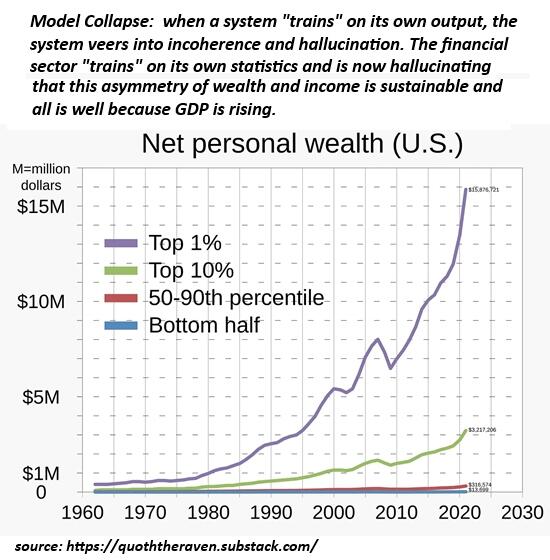 That the hallucinations are sustainable is itself a hallucination:
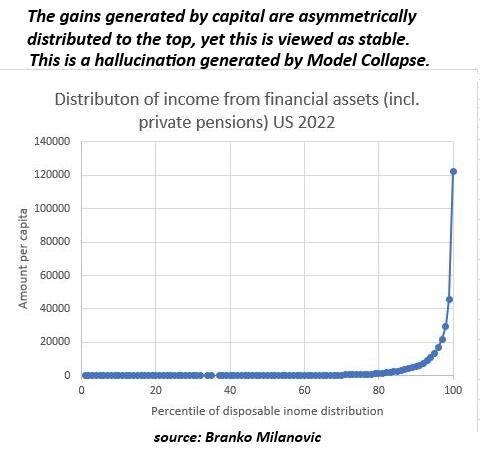 That the inhabitants of "Mouse Utopia" are not focused on how natty gas and AI are going to make Utopia even more utopian is lost in the current model collapse: antisocial behaviors are accelerating due to the the artificial nature and exploitive structure of our "Mouse Utopia," but these realities aren't measured and so they don't exist in the current model's self-referential hallucinations:
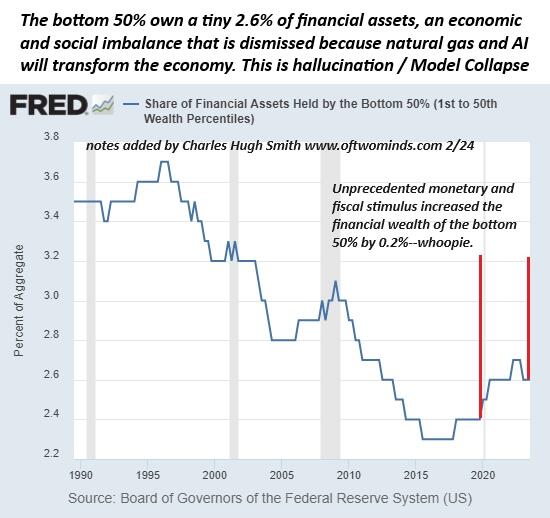 All the dominant models are collapsing at once, and no nation is immune to the consequences, as every nation is operating on models that are collapsing without those at the controls being aware that the implicit assumptions of their models no longer map reality.
* * *
My new book
All the dominant models are collapsing at once, and no nation is immune to the consequences, as every nation is operating on models that are collapsing without those at the controls being aware that the implicit assumptions of their models no longer map reality.
* * *
My new book 