
Trust is not an absolute quantity, it's always relative, it's a deeply personal and contextual phenomenon. In centralized systems, we’ve become accustomed to trust being imposed upon us by platforms and institutions. But this model misunderstands the nature of trust itself. As explored in "Trust Is a Scaling Solution," trust is the fundamental mechanism that reduces friction in complex systems, allowing us to cooperate beyond our immediate relationships.
However, traditional systems have applied this principle with a flaw: they have attempted to create one-size-fits-all metrics or impose their own model of trust to determine what is trustworthy. We are pleased to introduce Relatr, our approach to decentralized trust. It is built on a fundamentally different philosophy. Relatr is a decentralized service to compute trust in decentralized networks like Nostr, that embraces the relative, dynamic, and layered nature of trust, empowering individuals to define what trust means to them.
The Engine of Trust: A Transparent Algorithm
Relatr computes trust from a specific source public key perspective which every instance should configure (if not configured it will default to nostr:npub1dergggklka99wwrs92yz8wdjs952h2ux2ha2ed598ngwu9w7a6fsh9xzpc public key). At its core, it uses a simple yet meaningful algorithm to compute trust scores by combining multiple factors into a single, weighted score:
Trust Score = Σ(wᵢ × vᵢ) / Σ(wᵢ)
Here, wᵢ represents the weight you assign to a metric, and vᵢ is its normalized value, allowing for deep personalization. This formula is inspired by the "Qualitative Thumb System" (QTS) outlined by arkinox
The system analyzes two primary types of signals:
-
Social Graph Proximity: Reflecting the idea that trust diminishes across social connections, Relatr measures social distance between the source public key and a target public key, using Martti Malmi's
nostr-social-graphlibrary. Direct relationships between the source and the target public key carry the most weight, while trust decays exponentially as distance grows, capturing the essence of "I trust you, so I can extend a degree of trust to those you trust." -
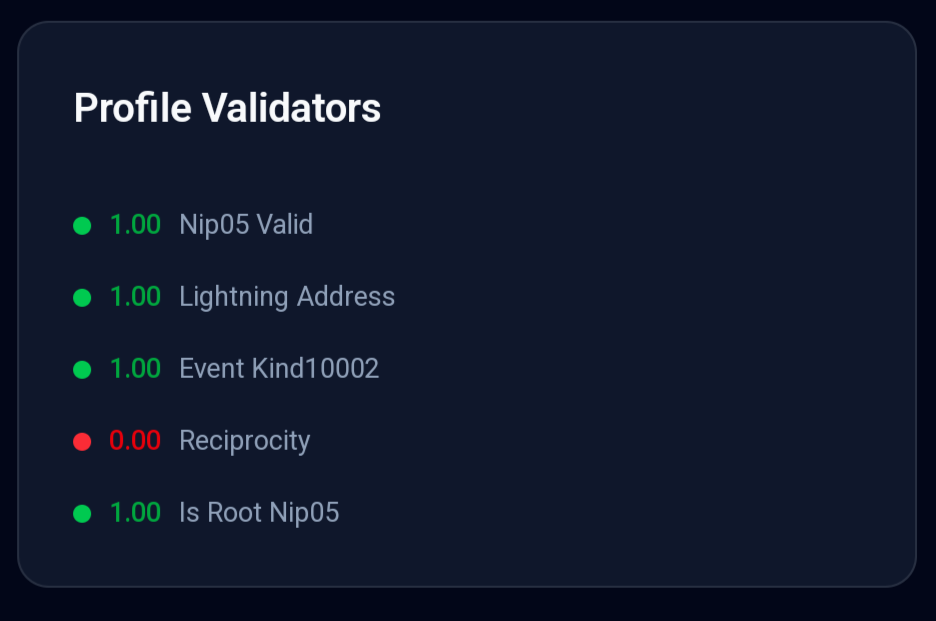
Objetive Profile Validations: Beyond social ties, Relatr incorporates objective, verifiable data. This includes metrics like NIP-05 domain validation, Lightning Network address, and other proofs. The framework is designed to be extensible, allowing new validation plugins to be added over time to assess factors like user activity or zap interactions.
Decentralized and Accessible: Relatr on ContextVM
Relatr's architecture embodies its principles. It is not a centralized service but a protocol that anyone can run. This is made possible by ContextVM, a decentralized protocol that enables services to communicate over the Nostr network.
Running Relatr as a ContextVM service makes it incredibly accessible. Anyone can deploy their own trust engine from source or a Docker container in environments like Umbrel or Start9, often with a one-click install. This turns any internet-connected device into a personal trust server without complex networking or hosting costs.
Each Relatr instance is identified by the public key of its ContextVM server. The relatr.xyz website demonstrates this. While it defaults to a public server we are running, it allows any user to paste in the public key of another Relatr instance. Whether it’s their own, a friend’s, or one run by a community they trust. This guarantees no vendor lock-in; you are always free to choose your provider.
Seamless Integration: Empowering Developers with CtxCn
The benefits of ContextVM extend to developers. Integrating Relatr into clients is remarkably simple, thanks to a tool called CtxCn (We introduced it last week). It’s a command-line utility that generates a fully-typed Relatr client directly into an application's codebase. Simple as running a single command.
npx @contextvm/ctxcn add <relatr-server-pubkey>
Instead of wrestling with an opaque library, developers get clean, readable source code they can own and adapt, and it's easy to maintain. This empowers anyone to easily integrate Relatr, allowing users to configure their own trust server and plug a powerful, personalized reputation system directly into their user experience.
From Centralized Authority to Individual Sovereignty
Relatr represents a fundamental departure from the black-box algorithms of traditional platforms. Where centralized systems impose universal standards, Relatr delivers transparency and control. Trust carries costs and risks, making it a valuable and vulnerable resource. The principle of "don't trust, verify" is key, but realizing that verification itself is relative to the observer's point of view. Relatr enables this by allowing you to fine-tune your own criteria, creating a resilient ecosystem resistant to censorship.
The open-source algorithm and the ability to run your own instance mean you can always understand and audit how scores are computed, giving you true sovereignty over your trust decisions.
Getting Started with Relatr
Relatr is designed to be lightweight and should run on almost any device. The easiest way to get started is with the official Docker image. For detailed instructions, follow the readme in the repository.
Conclusion
Relatr is more than a technical tool; it’s a philosophical statement. It argues that in a decentralized world, trust cannot be outsourced. It must be cultivated, calculated, and claimed as our own.
Its existence is also part of a broader conversation within the Nostr ecosystem, inspired by projects like Vertex, which first introduced advanced trust computation concepts. It's a testament to the idea that there is no single right way to compute trust. The more models we have to explore, the healthier the ecosystem becomes. By placing powerful, transparent tools in the hands of individuals and developers, Relatr paves the way for a more a sovereign digital future where power is distributed and systems serve human agency.
Get Involved
Explore this and get involved with the Relatr project.
- Website: https://relatr.xyz
- GitHub Repository: https://github.com/contextvm/relatr