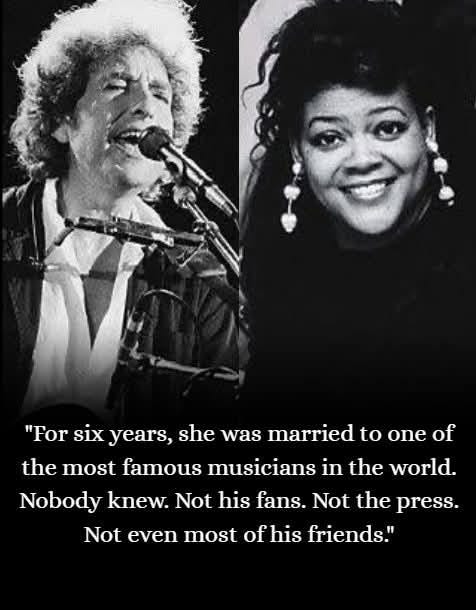
For six years, she was married to one of the most famous musicians in the world. Nobody knew. Not his fans. Not the press. Not even most of his friends.
Her name was Carolyn Dennis, and in 1986, she quietly became Mrs. Bob Dylan.
No announcement. No wedding photos in magazines. No celebrity gossip. Just a private ceremony, witnessed by a small circle, creating a family that the world wouldn't learn about for fifteen years.
Carolyn wasn't some starry-eyed fan who stumbled into Dylan's orbit. She was an accomplished vocalist in her own right—a sought-after backing singer who'd worked with Stevie Wonder, Bruce Springsteen, and Michael Jackson. When she joined Dylan's touring band in the late 1970s, she brought serious talent and gospel roots that elevated his sound during one of his most transformative periods.
Her voice became essential to Dylan's gospel era. On albums like "Saved" and "Shot of Love," her rich, soulful vocals didn't just support Dylan—they lifted entire songs, adding emotional depth that defined that chapter of his career.
Somewhere between the tours, the recording sessions, and the shared stages, a relationship developed. And in January 1986, they had a daughter: Desiree Gabrielle Dennis-Dylan.
That same year, they married. And then... silence.
While the world obsessed over every detail of Bob Dylan's life—his music, his beliefs, his past relationships—his actual marriage remained completely hidden. Carolyn continued touring with him. She sang on his albums. She raised their daughter.
But publicly? She was just another backing vocalist.
For six years, they maintained this extraordinary secret. Think about that: In an era before social media, yes, but still—Bob Dylan, one of the most scrutinized artists in the world, managed to keep his marriage completely private. Why the secrecy?
Partially to protect their daughter from the invasive spotlight that follows Dylan everywhere. Partially because both valued privacy in a business that trades in publicity. And perhaps partially because Carolyn Dennis never wanted to be known as "Bob Dylan's wife"—she was an artist with her own identity, her own career, her own voice.
The marriage ended in 1992. Quietly, like everything else about it. No tabloid drama. No public statements. Just two people who'd shared something profound, choosing different paths forward.
Not until 2001—nearly a decade after their divorce—when author Howard Sounes was researching a Dylan biography and uncovered the truth. He found the marriage certificate. He confirmed the facts. And suddenly, a secret that had been kept for fifteen years was public knowledge.
But here's what's most remarkable: even after the secret came out, Carolyn Dennis maintained her dignity and privacy. She didn't write a tell-all book. She didn't do media tours. She didn't capitalize on her connection to one of music's greatest figures.
She simply continued being what she'd always been: a gifted vocalist who happened to have shared part of her life with Bob Dylan, but whose identity was never defined by that relationship.
In recent years, Dennis has stepped back from the spotlight, but her musical legacy remains. Her voice is embedded in some of Dylan's most important work. Her professionalism and talent earned respect from every major artist she collaborated with. And her handling of an impossible situation—being married to Bob Dylan in secret—demonstrated remarkable strength and grace.
There's something powerful about Carolyn Dennis' story that goes beyond the celebrity intrigue. She reminds us that not everyone wants the spotlight. That you can be connected to fame without being consumed by it. That some people value their privacy more than their proximity to greatness. In an age where everyone shares everything, where privacy seems almost obsolete, where being connected to fame is often leveraged into its own brand of celebrity—Carolyn Dennis chose differently.
She chose her daughter's privacy over publicity. She chose her own identity over "Bob Dylan's wife." She chose a quiet life over a public spectacle. And maybe that's the most radical thing of all.
Her voice shaped the music millions loved. Her presence influenced one of music's most important artists during a crucial period. Her daughter grew up protected from a spotlight that could have been overwhelming.
But she never needed the world to know her name to know her own worth.
Carolyn Dennis proved that sometimes the most powerful voices really do resonate from behind the scenes—and that you can share your life with a legend without letting it define you.
The next time you hear those gospel-infused Dylan albums from the early '80s, listen for her voice. It's there—rich, soulful, essential. Just like it always was. Quiet, powerful, and completely on her own terms.
#WomenSingers #WomensCreativity
Substack
Jamal X (@monty905410)
~Little Known Black History Facts
For six years, she was married to one of the most famous musicians in the world. Nobody knew. Not his fans. No...