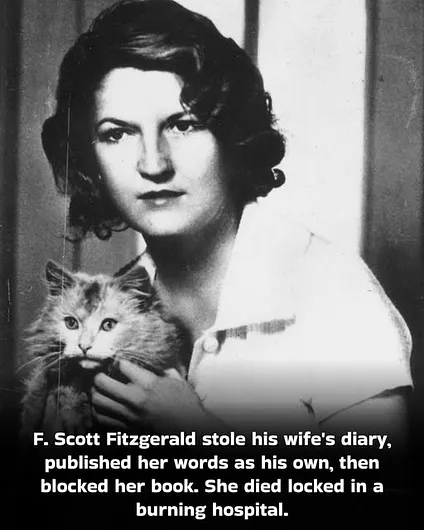
Her name was Zelda Sayre Fitzgerald. And history remembers her as "Scott Fitzgerald's crazy wife." Montgomery, Alabama, 1918. Zelda Sayre was 18 years old and the most desired woman in the South. She was wild. Scandalous. She smoked in public, wore flesh-colored swimsuits that made her look naked from a distance, drank gin, drove cars fast, and kissed boys without apology. "The most sought-after girl in Alabama," newspapers called her. The belle of Montgomery society who broke every rule and didn't care. He was 22, unpublished, broke, unknown. She was a Southern beauty who could have any man she wanted. Scott proposed. Zelda said no. Not because she didn't love him—but because she refused to marry a man with no prospects. "I can't marry you unless you can support me," she told him. In 1918, that wasn't shallow. That was survival. So Scott Fitzgerald made a choice: he would become successful enough to deserve her. He moved to New York, worked in advertising (which he hated), and spent every night writing a novel. When "This Side of Paradise" sold in 1919, he immediately telegraphed Zelda: "BOOK SOLD. MARRY ME NOW." She did. They married in 1920. She was 19. He was 23. And for a few years, they were the golden couple of the Jazz Age. Scott's novels made them rich and famous. They lived in New York, partied with celebrities, spent money recklessly. They jumped into fountains, rode on the tops of taxis, drank champagne for breakfast. Zelda was electric. Glamorous. Fearless. She cut her hair into a bob—shocking in 1920. She wore short skirts. She said outrageous things at parties. The press loved her. She gave the best quotes: "I don't want to live—I want to love first, and live incidentally." Scott loved her too. Obsessively. She was his muse, he said. The inspiration for all his great female characters—Daisy Buchanan, Nicole Diver, Gloria Gilbert. But there was a darker truth: he wasn't just inspired by Zelda. He was stealing from her. Zelda kept personal diaries—intimate, beautifully written accounts of her thoughts, feelings, experiences. Scott would read them, then copy passages directly into his novels. Without her permission. Without credit. In "This Side of Paradise", he lifted entire sections from Zelda's letters and diaries. When reviewers praised the "authentic female voice" in his work, Scott accepted the compliments. When Zelda protested, he dismissed her: "I'm the professional writer. You're just my wife." When a reviewer praised one passage as "brilliant," Zelda's friend told her: "You know you wrote that, right? That's from your diary." Zelda confronted Scott. He shrugged: "Nobody would read it if you wrote it." Zelda decided to become a writer anyway. Through the 1920s, she published articles and short stories in magazines—Harper's Bazaar, College Humor, The Saturday Evening Post. Her pieces were funny, sharp, insightful. But editors insisted they be published under "F. Scott and Zelda Fitzgerald"—even when Scott hadn't written a word. His name sold magazines. Hers didn't. The money went to "their" joint account, which Scott controlled. She was writing. Getting published. And still being erased. image
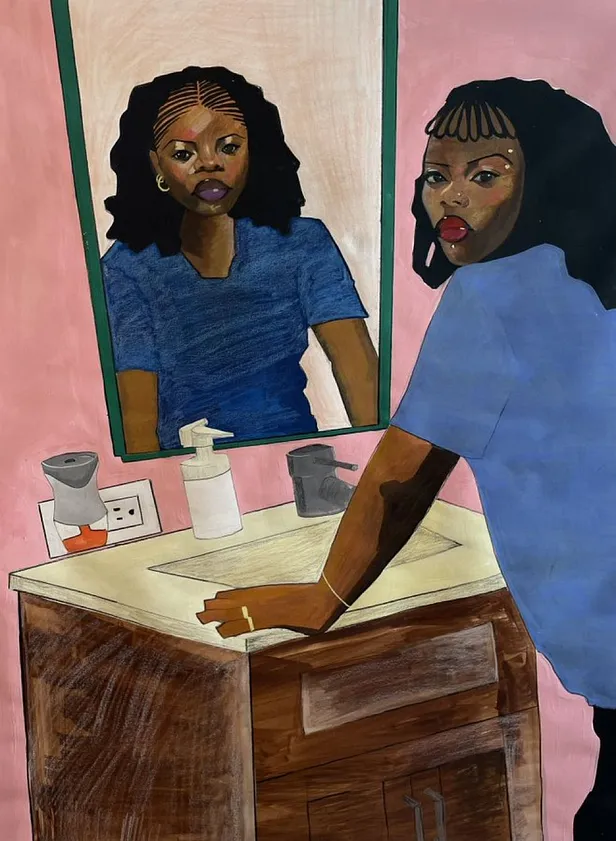
Ato-Obong Ini-Abasi Akpama #WomensArt #WomensCreativity https://media.spinster.xyz/269fa46302e145c9b40e2bd9abcf0ed78c32c306265403a7f58f2e0a433f18a0.avif
Ato-Obong Ini-Abasi Akpama, "My Intuition Warned Me about You", 2025, gouache and colored pencil on paper. #WomensArt #WomensCreativity image
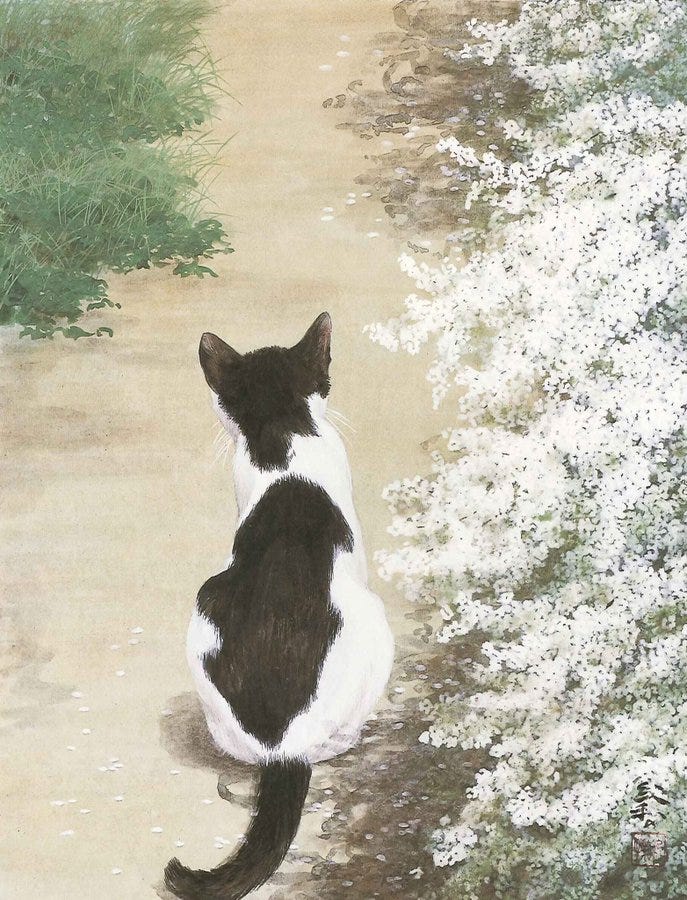
Kiwako Suzuki's Cat image
Shirley Slade. Twenty-two years old. Flight jacket, boots, goggles perched like a challenge — the kind that says just watch me fly. In 1943, the U.S. military faced a crisis: thousands of planes needed delivering across the country, but combat pilots were overseas fighting. So the government turned to a group still underestimated, still boxed in by stereotypes, still told where they did — and didn’t — belong. Enter the WASP — Women’s Airforce Service Pilots. Shirley Slade trained on fighters like the P-47 Thunderbolt and B-26 Marauder, aircraft so powerful they earned nicknames like “Widowmaker.” She learned them fast, flew them hard, and delivered them with the confidence of someone who knew aviation had no gender — only skill and courage. No guns. No dogfights. No medals waiting at home. Just miles of sky, roaring engines, and flight orders stamped in ink instead of glory. WASP pilots ferried over 12,000 aircraft, towed gunnery targets, and even tested planes fresh off the assembly line. They flew despite dismissive officers, jealous male pilots, and a country that saluted them with words — not military status. Thirty-eight never came home. They received no flag-draped coffins. Families paid for their burials. And when the war ended, the WASP program was quietly shut down. Shirley Slade retired without fanfare, her uniform folded while the country she served tried to fold her story away with it. But legends don’t stay grounded. Decades later, the WASPs were finally recognized as veterans. Their wings — once brushed aside — now shine in museums and memory. Shirley’s photo isn’t just a snapshot. It’s a reminder that courage doesn’t always roar — sometimes it taxis quietly to a runway, pushes the throttle, and proves an entire nation wrong by taking off. ~TimeFold image
Dr. Anne Lanier (born 1940) is a public health researcher and advocate in Alaska who created the Alaska Native Tumor Registry in 1974 to collect information about cancer among Alaska Native people. It is one of 18 registries used by the National Cancer Institute to determine cancer rates and patterns across the US. Dr. Lanier founded other research centers in Alaska and her efforts inspired many to pursue careers in medical research. image
I was invited to speak about my favourite topic – women’s sport. I’d like it if I never had to say anything on this subject ever again but that won’t happen because of a combination of Government inaction, Sports Councils’ blind adherence to the Cult of Woo and sports’ governing bodies being run by probably the most incompetent people on the planet (and that’s putting it politely). To a background of lusty insults from the rent-a-mob anti-women activists I told the assembled company outside The Senedd, that numerous sports in Wales still allowed males into the female category – including some of our most popular sports. How have we arrived at a situation where grown men can self-identify as a female footballer and be picked for teams that include teenage girls? And believe me, if these men have the balls to larp into sports, they’ll definitely be using the changing room ‘that most aligns with their gender (sic)’ – and that won’t be the male changing rooms. I’ve met a lot of sports’ NGB CEOs, Chairmen, DEI officers and with a few exceptions they generally fall into two camps: fully signed-up to the ‘be kind to the menz’ fraternity or plain clueless. They’re in the ‘nice work if you can get it but please don’t make me do any actual work’ category. From their plush offices they plan their next round of glad-handing the dignitaries and securing free tickets for fixtures – the more international the better because then you can claim generous expenses paid by… the taxpayer generally – but when a truly difficult issue crosses their desk, they’ll hand it down the food-chain for action, which results in no action at all. That’s been the case with women’s sport. Usually filed in the ‘too difficult’ pile.The speech that no one could hear… by Rowing Geek Drowned out by TRAs at the 199 Days Action, here are some highlights from my speech...Read on Substack
Naturally, the town now capitalizes on its reputation for having had "Witches"... Some researchers argue that this southern Italian town, a little more than two hours by train from Rome, became known for its witches because of its unique political position. But to understand the root of the myth, we have to go back to 1428. The hunting and persecution of so-called witches was a practice that began to take root in Italy in the late 1300s, supervised and carried out in many ways by the Catholic Church. By 1542, Pope Paul III had created the Congregation of the Holy Office of the Inquisition, which tasked the church with criminalizing those who would speak against the faith. It was an amorphous crime, because any misfortune to befall a person or town could be attributed to a witch—around 80 percent of the people charged with witchcraft in early-modern Europe were women. Academics estimate that 22,000 to 33,000 witchcraft trials took place in Italy, with very few of these ending in capital punishment. Witch hunting appeared to largely come to an end by the 18th century. The first reference to Benevento as a place where witches gather dates to 1428. It comes from the transcriptions of the trial of Matteuccia di Francesco, a 40-year-old woman who was eventually sentenced to death and burned at the stake for witchcraft by the Franciscan Bernardino of Siena in the Umbrian town of Todi. “From that moment on, the inquisitors try to make the witches confess that they went to Benevento, because it becomes a sort of indictment,” says Paola Caruso, who has published books on the folklore of Benevento. “If they went to Benevento, then that means they’re witches.” The targets of this abuse were generally local women known as healers, “almost women of science,” Scarinzi says, or practitioners of what would today be called herbal medicine. These were women who knew the medicinal value of herbs like St. John’s wort, lavender and dandelion, gleaned from information passed down to them through generations. https://www.smithsonianmag.com/travel/how-this-italian-town-came-to-be-known-as-the-city-of-witches-180987599/