
GM ☀️ Your word of the day is!
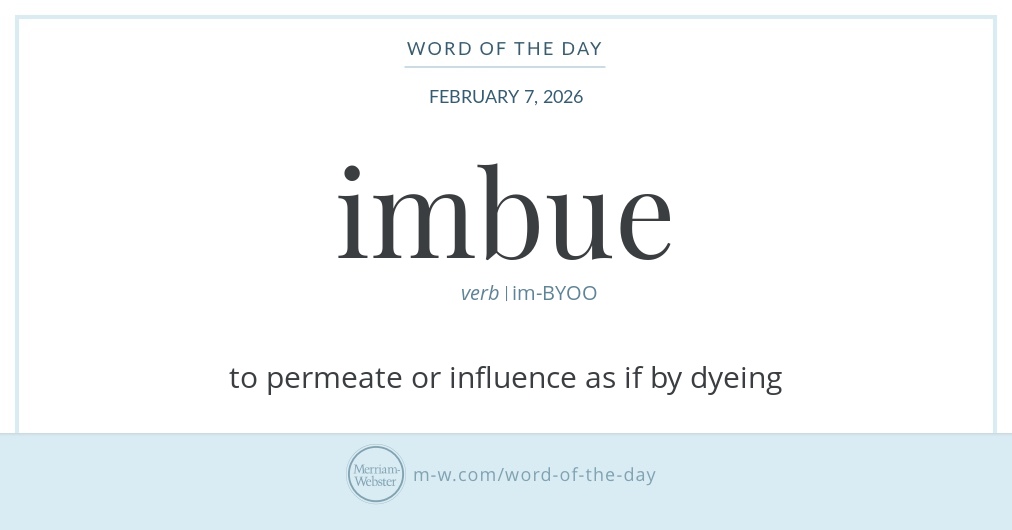
🔤 Imbue [im-BYOO]
📖 What It Means:
Imbue has two common meanings: "to permeate or influence as if by dyeing" and "to provide with something freely or naturally." In the second use it is usually used with with.
📰 Example:
A deep sense of history imbues the artist's work.
💬 In Context:
"Aged cachaça, like fine whiskey, derives its complexity from the barrels it's matured in. There are dozens of different Brazilian woods cachaça can be aged in, and each imbues the spirit with its distinct flavor, resulting in varieties that are more floral or herbal, nutty or woody, savory or spiced." — Rebekah Peppler, The New York Times, 5 Dec. 2025
💡 Did You Know?
Like its synonym infuse, imbue implies the introduction of one thing into another so as to affect it throughout. Someone's voice can be imbued with pride, for example, or a photograph might be imbued with a sense of melancholy. In the past imbue was also used synonymously with imbrue, an obscure word meaning "to drench or stain," but the two words are likely unrelated. Imbue comes from the Latin verb imbuere, meaning "to dye, wet, or moisten," while imbrue has been traced back through Anglo-French and Old French to the Latin verb bibere, meaning "to drink."
🔗  #WordOfTheDay #Nostr #Dictionary #Learning
Word of the Day: Imbue
Like its synonym infuse, imbue implies the introduction of one thing into another so as to affect it throughout. Someone