How did an intelligence agency end up publishing the algorithm that #Satoshi used to secure #Bitcoin?
This is the story of SHA-256.
If the #Cypherpunks had a mortal enemy, it was the #NSA.
On one side you had people like Tim May, Eric Hughes, and John Gilmore – fighting for a future where #cryptography protects ordinary people.
On the other side you had the NSA – an agency specialising in surveillance, data collection, and monitoring global communications. For decades, it tried to control the spread of strong cryptography.
But here’s the twist:
The NSA also created one of the most important tools that Cypherpunk projects – and later Bitcoin – would rely on.
The agency designed the SHA family of cryptographic hash functions, the foundations that would eventually power systems like Hashcash and, ultimately, Bitcoin.
A hash takes any data and transforms it into a fixed string of numbers. Change even a single comma in a book and the resulting hash is completely different.
Crucially, hashing only works one way.
You can go from data → hash, but not from hash → data.
That makes it perfect for security and integrity checks.
The NSA released SHA-0 in 1993, replaced it with SHA-1 after flaws were discovered, and then moved again when researchers found “collisions” – different inputs that produced the same hash.
Their solution was the SHA-2 family, published in 2001 under a royalty-free licence.
That included SHA-256 – the workhorse that went on to secure modern internet protocols and, later, Bitcoin’s Proof-of-Work.
SHA-256 is unpredictable. There is no shortcut.
The only way to find a “valid” hash is trial and error – swapping in new numbers until one fits.
That property made it ideal for proof-of-work systems like Hashcash, and later for Satoshi’s Bitcoin mining.
So even as Cypherpunks were fighting for digital privacy against agencies like the NSA, they still borrowed NSA-designed tools.
Electronic cash was not built in isolation. It was built on top of primitives created by the very adversary privacy advocates were trying to resist.
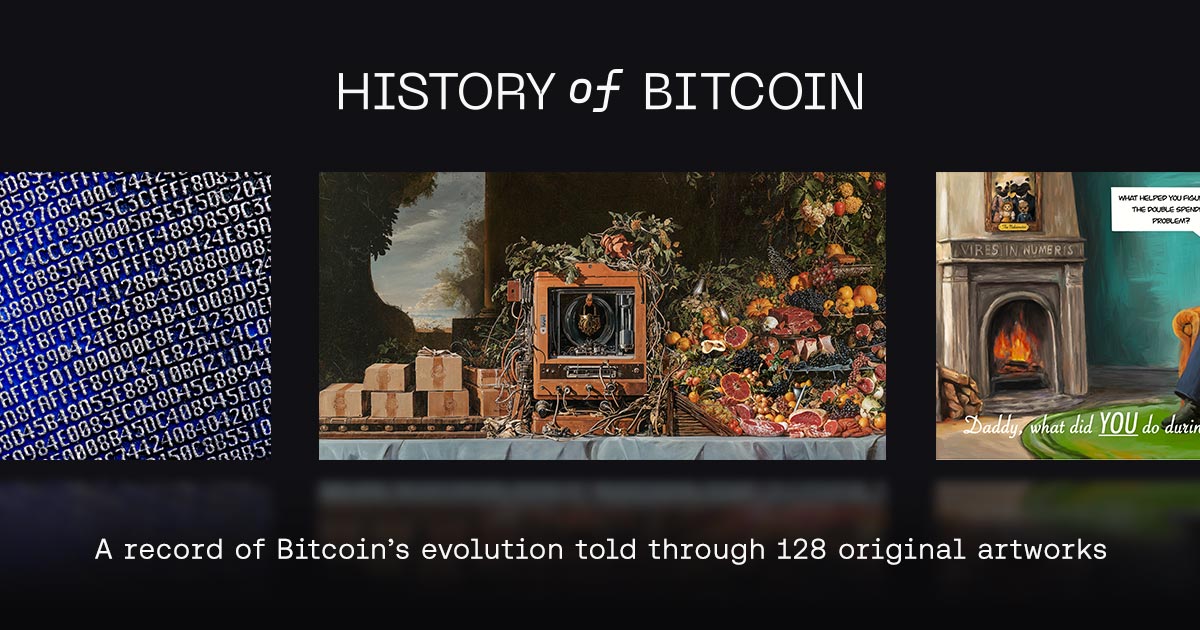
We’ve captured this chapter in “The History of Bitcoin by Smashtoshi” with the artwork:
“MAKING A HASH OF IT” by Hannes Hummel (@hanneshummel on X).
It appears in the History of Bitcoin Collector’s Book and on our interactive timeline.
You can read the full article by Aaron van Wirdum here:

History of Bitcoin
Making a Hash of it
SHA-256, developed by the NSA, predates Bitcoin but became its backbone. This secure hashing algorithm enables mining, transaction verification, an...