Susie Violet

Susie Violet's avatar
Susie Violet
npub1hwgw0uznr49t4gullpgfz4m5xnakl5a0l88m3k382xv7ys0tfmlsd503sg
npub1hwgw...03sg
Bitcoin Journalist
Gemini has announced it is leaving the UK, alongside exits from Europe and Australia, and is refocusing on the US and Singapore. I discussed exactly this risk at the Financial Times Digital Assets Summit last May. This is what happens when compliance becomes cumbersome and prohibitively expensive. Smaller companies are pushed out first. Over time large and established businesses reassess whether it makes sense to continue operating in an environment where regulatory uncertainty, cost and process complexity keep increasing. Gemini is not a small startup, it is one of the largest regulated exchanges to have operated in the UK. When firms of this size choose to concentrate activity in jurisdictions they view as more business friendly, it reflects how growth conditions, capital allocation, and long term viability are being weighed. What we are seeing is business leaving the UK, reduced competition, slower growth, and fewer companies choosing to build here. This is an important moment for policymakers and regulators to reflect on how current frameworks are affecting business confidence, competition, and growth in the UK.
Digital ID was debated in Parliament, in a Westminster Hall debate opened by Robbie Moore MP on behalf of the Petitions Committee and triggered by a petition signed by nearly three million people. The response from MPs across parties was overwhelmingly NO. Across all parties, Conservatives, Labour backbenchers, Liberal Democrats, Greens, the SNP, Reform and Independents raised the same core concerns: • Moves Britain toward a surveillance state • Irreversible centralisation of personal data • Major cyber security risk • Serious risk of mission creep• Not in the manifesto and no democratic mandate • Constituents do not want it • Would become mandatory in practice • Harms the most vulnerable and the digitally excluded • Creates a two tier society Reading from a constituent's message, Jeremy Corbyn, an independent MP, said: "Digital ID is a deeply illiberal idea that threatens privacy, autonomy and the open access we should be standing for. It risks creating a two tier Britain where access to basic services, healthcare, housing, employment, even voting, depends on whether someone has the right app, paperwork or digital trail." Reflecting the vast cross party consensus in the debate, Corbyn endorsed an intervention from Andrew Griffith MP warning about civil liberties, the presumption of innocence and surveillance concerns, saying "he's making an important point," before going on to warn that digital ID is "being pushed by commercial interests" and urging Parliament to "say no to the government, as we have said no before." In the debate, opposition to the proposals spanned both the political right and left. Speaker after speaker warned that once this infrastructure exists, it will expand into work, housing, banking, benefits and public services, regardless of today's assurances. What this debate showed very clearly is that left versus right is no longer the most meaningful divide. The real divide is libertarian versus authoritarian. MPs from across the political spectrum lined up on the liberty side. That matters, particularly in a country with a growing reputation for restricting free speech and quietly sleepwalking into authoritarianism. It also raises uncomfortable questions ... If no one wants this, and Parliament agrees it is dangerous, why is it being pushed so hard? Jeremy Corbyn was clear about the role of commercial interests, a concern reinforced by policy advocacy from groups such as the Tony Blair Institute and Visa, which has openly argued for the introduction of digital ID's. Others also raised concerns about lobbying, infrastructure vendors, payments firms, and ID adjacent technology providers. This petition and debate offered a rare moment of reassurance in our parliamentary system. MPs listened, understood the risks, and spoke up.
Is Saylor building his own central bank? His Bitcoin MENA keynote mapped out something far bigger than balance sheet accumulation. He described a full monetary engine built on bitcoin reserves, corporate credit and synthetic digital dollars. Here is how it works and why it matters in my latest Forbes piece. https://www.forbes.com/sites/digital-assets/2025/12/11/saylors-plan-to-build-a-bitcoin-powered-shadow-central-bank/
One year ago today, I became CEO of Bitcoin Policy UK. Since then, our small team of volunteers has achieved what most well funded organisations struggle to do, in one of the toughest environments for UK businesses. Individuals and companies are leaving the country at a record pace, and the policy space is dominated by pay to play dynamics and crypto lobbying money. Despite that, we have delivered. What we have accomplished together: - Helped secure Bitcoin’s recognition as property in UK law. - Responded to government consultations, submitted detailed policy papers, and held constructive conversations with MPs, Lords, regulators, and civil-service teams. - Launched our new website - Distributed our 2025 Manifesto to all 650 MPs and expanded our research across energy, tax, financial inclusion, and infrastructure. - Hosted events on Human Rights, Bitcoin in Business, and Bitcoin for Institutions. - Had a presence and a main hall stall at the 2025 Labour Party Conference, opening new Bitcoin conversations. - Partnered with 11 organisations and hosted multiple BPUK events that connected the bitcoin industry with policymakers, energy experts, and regulators. - Appeared in multiple podcasts, interviews, and media articles -Set up mining proof of concepts -Launch our 'On the Record' podcast. - Spoke at industry events around the world. - Designed and delivered the ‘Contact My MP’ App, helping supporters reach their representatives directly and raising the bar for political engagement in the Bitcoin space. All of this has been achieved by a team of outstanding volunteers with no full time staff, very modest funding, and no compromise to our values. We have been pushing uphill in a system where influence is usually bought. We have moved the dial and proven that the UK does have a place in Bitcoin’s future, provided we continue to fight for it. Year one was foundations. Year two is where we build strength and momentum. Thank you to everyone who has supported us, shared our work, and contributed time, expertise, or energy. BPUK exists because the community wants it to. Here’s to the next chapter. A special thanks to my amazing team: Freddie New Dr Cristina Llamas-Rey Russell Rukin Nick Bowick Jeremy Cline Juniper Jason Jason Sami Shams and others who prefer to stay behind the scenes. @Bitcoin Policy UK @fnew @Jace @jeremycline
The cracks in the fiat system are becoming impossible to ignore. I spoke with Archie from @Bitcoin Archive about why governments can’t print trust, how central banks are panicking as debt spirals deepen, and why Bitcoin is becoming the escape hatch for a world losing faith in money. We also disussed the new global order, hyperinflation, and the end of monetary privacy, and why Bitcoiners saw this collapse coming.... With a special guest appearance from Ozzy. Watch the full conversation on @Roxom TV. image
Had an amazing time in Prague and got to visit SatoshiLabs, home of Trezor and @vexl 😎 . Recorded a brilliant pod with Marcel about Bitcoin Dada, Grafton about Vexl, and Efrat about her ‘You’re The Voice’ podcast. Always great hanging out with Isabella, a phenomenal freedom fighter and educator for Get Based, as dedicated as ever. It was a lovely surprise bumping into Nick Anthony from the Cato Institute. All these incredible people had one thing in common: Bitcoin as freedom money. Thank you to the Trezor team for being so welcoming and awesome. @Efrat Fenigson @Grafton @ Vexl @Isa ⚡️
Harvard economist Matthew Ferranti has published a peer reviewed study showing that central banks preparing for sanctions risk should hold more than just gold. His model demonstrates that adding Bitcoin to reserves strengthens resilience when access to traditional assets is threatened. For the first time, a peer reviewed economics journal is treating Bitcoin as a credible reserve asset rather than speculation. What took them so long? A reminder that money can be weaponised, while Bitcoin remains neutral, borderless, and open to everyone. At the Financial Times Digital Asset Summit, the UK’s Economic Secretary to the Treasury, Emma Reynolds said Bitcoin “isn’t for us.” Ferranti’s study shows why the government must start researching Bitcoin’s role in reserves. This is the kind of research @Bitcoin Policy UK has consistently urged the Treasury and Parliament to conduct. Read the full paper: https://www.sciencedirect.com/science/article/pii/S0261560625001688 image
Runaway US debt is on target to hit $40T by Christmas. In the UK, the Office for Budget Responsibility flags us as one of the most indebted advanced economies. As Reuters put it: “Britain’s economic problems are home-grown and a solution looks a long way off.” Inflation saves the state, Bitcoin saves you. https://www.reuters.com/commentary/breakingviews/britains-economic-woes-are-sadly-home-grown-2025-09-05/ image
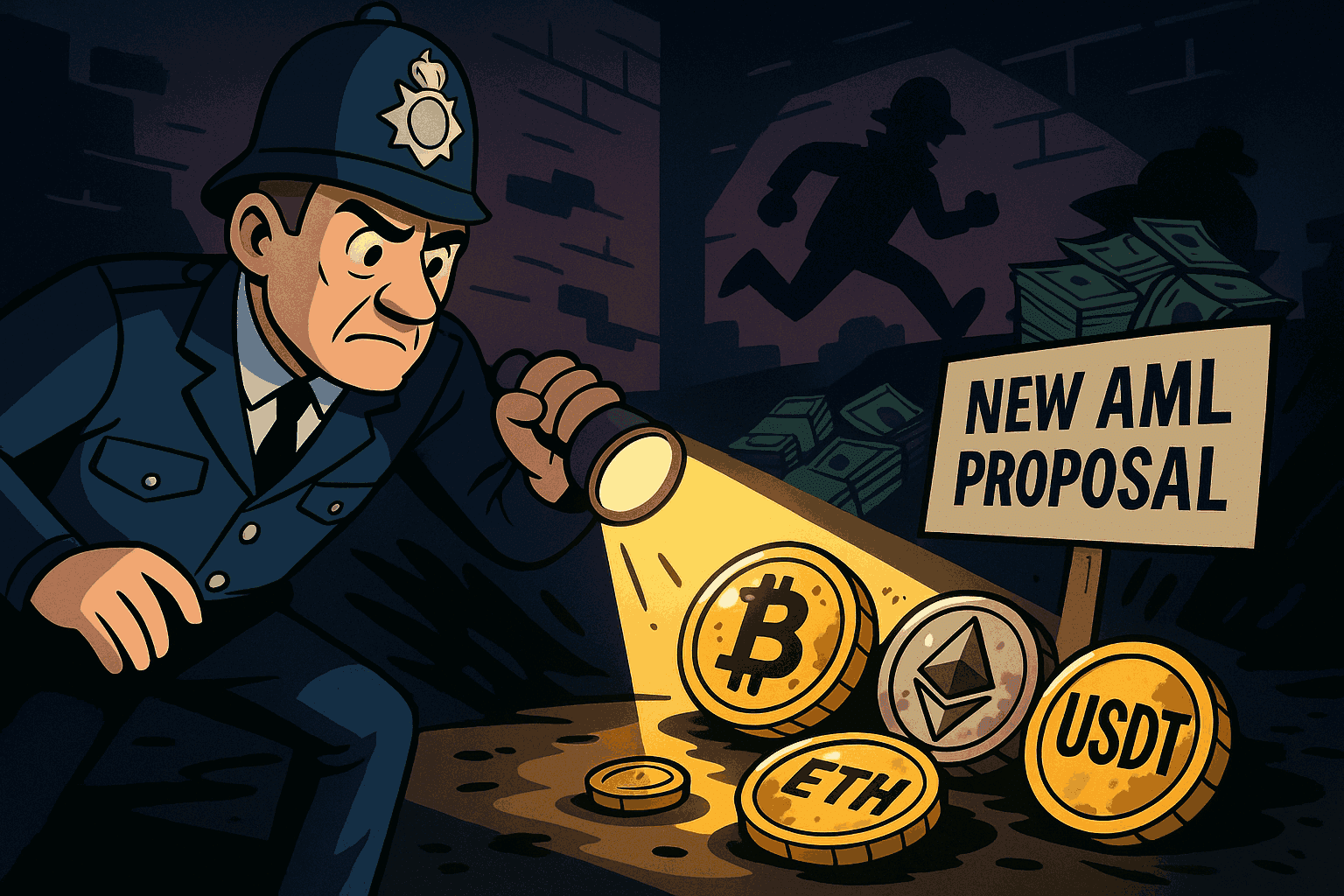
Is this how freedom ends in the UK? The UK’s latest “crypto AML rules” slash ownership disclosures from 25% to 10%, pulling more people into disclosure regimes and expanding banking surveillance. These measures are framed as fighting crime. But similar rules in tradfi have existed for years and haven’t stopped fraud or money laundering. What they do create are honeypots of personal data, risks for law-abiding people, and deeper state oversight. This is about normalising authoritarian tools, not AML or safety. Decades of KYC and financial surveillance show how control creeps in rule by rule. That same authoritarian logic already governs speech, from the Online Safety Bill to Graham Linehan’s Heathrow detention over tweets. And now digital IDs are back on the table, linking finance, identity and turning everyday access into a system of control. Add in programmable money and street surveillance, and you have a panopticon, a 1984 scenario darker than Orwell imagined. The UK has offically sleepwalked into authoritarianism.