Danie

Danie's avatar
Danie
npub1g2jp...yjj6
Testing out new wallet
Google's Project Genie lets you conjure entire interactive worlds and step into them “While I'd love to give this a try myself, it's only currently open to Google AI Ultra subscribers in the United States. Just in case you weren't aware, that's Google's top-tier plan that costs $250/month. So, as you can imagine, access to this feature will be a bit limited for now.” It does look pretty good from the video in the linked article. The thing though, with this type of functionality and realism, is you're not going to be able to run this on your home server. It costs money to host services like these, so for the foreseeable future this will likely be a paid service of some sort (unless your virtual world can have lots of advertising billboards in it!). But nice to see it is already technically possible. See #technology #virtualworlds
Microsoft handed encryption keys for customer data to the government “The FBI went to Microsoft last year with a warrant, asking them to hand over keys to unlock encrypted data stored on three laptops as part of an investigation into potential fraud involving the COVID unemployment assistance program in Guam — and Microsoft complied.” Two issues are of concern here: 1. Microsoft does indeed have their own encryption keys to your data. Unlike some companies that do not have encryptions keys at all e.g. Proton, and they will only hand over available metadata (such as IP address, connection times, etc) that they have access to when receiving a valid warrant. Microsoft can be legally compelled as it is now known they have keys to decrypt customer data in their cloud. 2. The legal warrant is only going to be a requirement for accessing US citizen or US corporate data. It is not needed for accessing global citizen data or data stored outside the USA, thanks to the CLOUD and PATRIOT Acts. The same will apply for governments with questionable human rights records (or privacy protection) who may also issue legal warrants to access private data from Microsoft. I can only imagine both the issues above are part of what is driving the EU to have their own cloud services based in the EU where only they control the encryption keys. See #technology #privacy #cloud
Suunto’s New Route Planner Is Free and Awesome "Something you don't see every day: a sports tech company actually giving away premium features for free. Suunto's route-planning tool lets you create and download GPX files without even creating an account. No paywall, no trial period—just open the page and start planning routes. And the tool itself works great." This is a great tool for planning hikes, cycling, trail running, running, mountaineering, and similar activities. It could also work well for 4x4 trails as it does seem to have all the minor tracks and trails routable, along with ascent and descent numbers. Another nice touch is being able to toggle on/off heat maps of routes most used. I tested it on a route I know well over Table Mountain in Cape Town, it did choose the best elevation route, not the shortest route. See or the route planning site at #technology #navigation #mapping #routes
Stop scrolling through Google's AI junk: Startpage's "classic" search engine is better "So I chose Startpage, a privacy-focused search engine that gets its results from Google, Bing, and a range of other sources, but doesn't have any of the tracking. With little of the added junk that I neither want nor need, it seemed like it could be the ideal middle ground, bringing the best bits of Google wrapped in a more classic search experience. I loaded it up on my laptop and phone to find out." Having a quick look at it though, it does look quite a bit like the open source SearXNG search engine. It's a similar look and feel, with a nice clean look. Sadly the map search using Mapquest was a disaster (I searched for restaurants in Cape Town and was shown restaurants in the USA). But I think that issue is with Mapquest, as choosing the Google Maps option then worked fine (but defeated the object of the exercise). Still, it is another option to try. They are headquartered in The Netherlands so are EU based under the GDPR. They do state: "Every search performed on Startpage is processed through our proprietary personal data protection technology" so it is not open source software. See or their website at #technology #search #privacy
Meet Roomy: An Open-Source Discord Alternative for the Decentralised Web “Roomy is an open-source Discord alternative built on the AT Protocol (ATProto), the same protocol that powers Bluesky, with ActivityPub (the protocol behind Mastodon, Pixelfed, Pleroma, and others) planned for the near future. Currently in alpha, it sits somewhere between Matrix and Discord in terms of its practical position in the broader chat ecosystem.” It is built on open protocols (no lock-in) and right now you can sign into the web interface using an existing Bluesky login, to be followed soon by any ActivityPub based ID (Mastodon, Pixelfed, Pleroma, etc). Interestingly, it will be bridging many diverse and decentralised networks. From what I understand of it, posts that each person makes to this service, physically go to their own registered servers (decentralised) with Roomy providing the merged view. It seems there are quite a few features still to be implemented such as Fediverse login, moderation regarding removing of users from a room, encryption, self-hosting of Roomy, desktop/mobile apps, and more. Right now Bluesky users can use their login to test it out. See and Roomy at #technology #opensource #socialnetworks #decentralised
French government announces move from US based video conferencing to open source Visio Visio is based on the open source project La Suite Meet powered by LiveKit. It seems that the government will be opting to use the French hosted version, instead of hosting it in-house themselves. It is time though that countries started taking their digital sovereignty more seriously and evaluated their over reliance on foreign country cloud services. Generally moving to someone else's cloud service, means not only your data is locked in there, but there is a tendency for the users to lose their own in-house IT skills, and for funds to just move offshore. See #technology #opensource #digitalsovereignty #France
TikTokers are heading to UpScrolled following US takeover “TikTok’s takeover in the US has prompted users to join an alternative social platform called UpScrolled. The app, which is available on Android and iOS, currently holds the 12th spot in Apple’s App Store, and it’s struggling to keep up with an influx of new traffic.” Yes, it's not the first alternative to TikTok as we've seen RedNote and also Loops (a decentralised Fediverse alternative) as well as others. UpScrolled is still a centralised hosting service hosted in Dublin, Ireland, and owned by an Australian company using private funding. So, it is a step better than US ownership and hosting like nearly all the major centralised social media platforms are. TikTok's secret sauce is its algorithm though, but the downside of that algorithm is that it can be manipulated, which like with Facebook, has the power to change minds and influence users. With UpScrolled, and Loops, you don't get this sort of manipulative algorithm. This may also result in less addictive doom-scrolling. Do we have enough social media platforms yet? Well clearly not, as many new ones are starting up and only time will tell how they survive into the future. There is currently no advertising on UpScrolled, but they are probably going to have ads in future for the platform to be sustainable. They do state though: “But they’ll be designed and managed by us. No Google Ads. No third-party tracking. No targeting based on personal data.” On privacy, they state: “UpScrolled will never share your data with third parties for marketing, profiling, or commercial gain. We only disclose user data as required by Australian law — such as in response to a valid court order or lawful request — and always in accordance with our privacy policy.” It is available on Android and iOS right now, and their future plans include desktop versions. See or their website at #technology #socialnetworks #alternativeto #TikTok
Sony returns to vinyl with two new Bluetooth wireless decks “Sony is jumping back into the vinyl game for the first time since 2019 with the introduction of two new Bluetooth-enabled turntables. The PS-LX3BT and the PS-LX5BT make the analogue experience much more accessible by baking in modern wireless audio technology. Both models also include a built-in phono equaliser that you can switch between phono and line-level output.” This feels so like a 1970s advert, except then we did not have Bluetooth. It's good to see it has analogue audio cables to connect to older receivers. But wow $500 is not a 1970s price! Makes me wonder what my genuine 1970s turntable is worth today. Vinyl of course is more than just about the sound. You own the vinyl, without monthly subscriptions, and it does not get arbitrarily deleted by someone either. See #technology #retro #music
Satellite is helping the internet to slip beyond authoritarian control “A recent Reuters report on Iran’s escalating battle with Starlink highlights why that playbook is starting to fray. Tehran has spent years perfecting censorship and surveillance, yet it now finds itself struggling to contain a satellite-based internet service designed explicitly to bypass terrestrial controls.” I suppose it is more correct to say foreign satellite services, as a service based inside one's own country can still be switched off by decree. Many telecoms licenses are granted with certain conditions attached, so quite often these telecoms providers are duty bound to shut down or otherwise censor services (including age verification, blocking undesirable sites, etc). And this most certainly includes First World countries as well. Our freedoms are mostly taken for granted, but actually they are attached to threads that can be pulled for various reasons. But it is true that satellite connectivity has been a new frontier as it becomes more commercial. It not only grants connectivity to those who were denied (including for reasons of living in remote areas) but it also is a commercial opportunity for those countries providing it, and yes, even for reasons of spying as well. But technology is evolving and with phones also now being able to connect to satellite services, the world is pretty well much being lit up. We just have to bear in mind that there may be plenty of advantages, but we've also seen from Facebook's early forays into some countries, that technology can have all sorts of unintended consequences as well. Satellite is only one of many advances though, as we are also seeing the rise in use of peer-to-peer communication, I2P networks, Tor browser traffic being obscured, etc. Satellite's big advantage is that it communicates over a very broad area, so attempts to block it are usually very localised only. I hope that more connectivity will encourage States to rather uplift their people instead of trying to oppress them. Whether we like it not, the era is changing, just like landlines, video rentals, dial-up modems, pagers, and many other technologies that found themselves superseded. This is not about the speed of downloads, but more the breaking of the shackles of control and suppression. On a lighter note, we've actually had the means for over 100 years for one home to chat or message another home 10,000 kms away. I was text messaging someone in Europe not so long ago, using a direct link that passes through no gateway, no undersea cable, at all. Amateur Radio is still around, and going quite strong in the digital era. In fact, we should know that satellites are themselves just radio repeater high sites. It is all still radio! The difference with satellites is the cost of the end user device is a lot cheaper now. See #technology #censorship #satellites

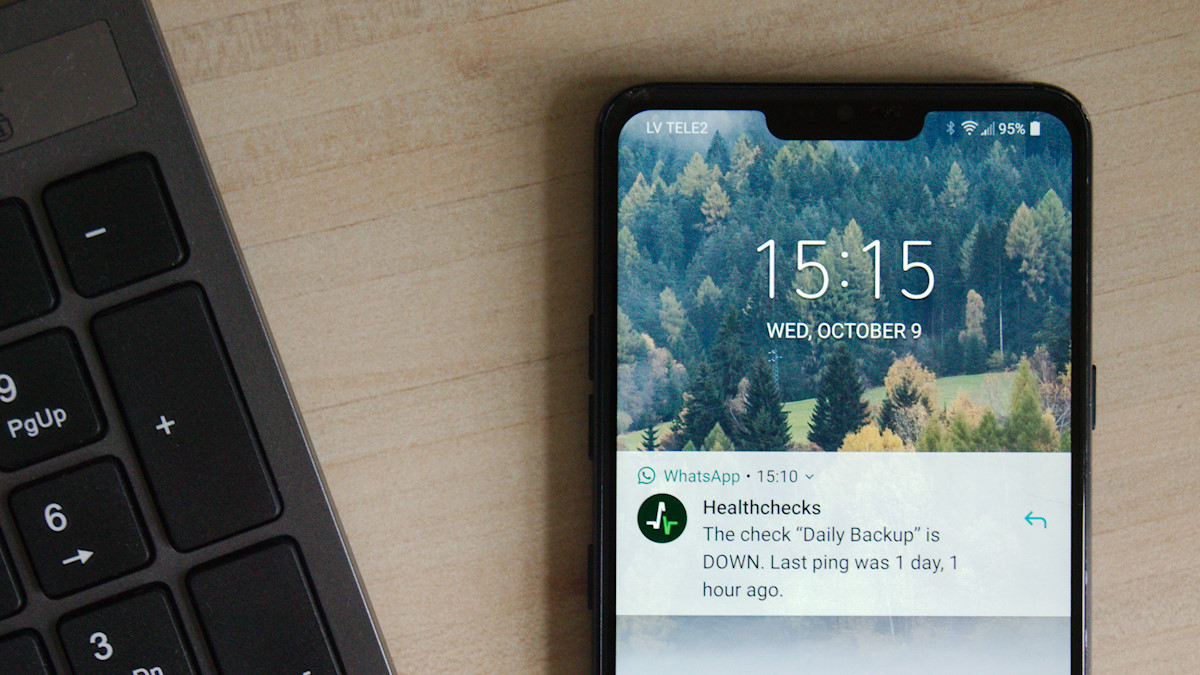
Healthchecks.io emails me when my automation jobs don't run We all “should” have scheduled backups running, and sometimes other automated tasks as well. In some cases you may see an error popup, but often it is just an e-mail to say the task has run. The problem is often we don't bother to check that daily e-mail properly, or we don't miss one of the e-mails out of the five that arrive daily for different tasks. This is where open source Healthchecks.io comes in. It is an online service for monitoring regularly running tasks such as cron jobs. It uses the Dead man's switch technique: the monitored system must “check in” with Healthchecks.io at regular, configurable time intervals. When Healthchecks.io detects a missed check-in, it sends out alerts. Whilst you can self-host it with unlimited functionality, it can be a concern if your own hosting goes offline. They do have a generous 20 checks plan which you can use for free though to monitor from outside your services. It is as simple as creating a check, getting the unique link for that check, and appending a command string at the end of any cron commands, or in a bash script you may be running. I'm still in the process of tweaking mine, but I'm hoping to move away from the 5 daily mails I get after cron jobs have run, and rather now only receive a mail when there is a problem to be looked at. Healthchecks.io can now classify HTTP pings from clients as start, success, or failure signals by looking for specific keywords or phrases in the HTTP request body. They've been going for 10 years now, with over 40,200 free accounts, and just under 51 million pings per day. Luckily they have paid accounts bringing in over US$18,300 monthly to sustain the business (hosting costs real money). See or their site at #technology #opensource #monitoring