
Clandestine Campaign To Defund ZeroHedge, The Federalist & Breitbart Traced To Kier Starmer Operation
Clandestine Campaign To Defund ZeroHedge, The Federalist & Breitbart Traced To Kier Starmer Operation
Very early into the COVID-19 pandemic, ZeroHedge suggested that a little-known Chinese lab in Wuhan might know something about the novel coronavirus sweeping the globe. As a result, and as you know, we were subject to an intense demonetization / deplatforming campaign that included getting kicked off of Twitter, PayPal, Facebook and other platforms, dropped by our advertisers, and targeted by MSM hit pieces which colluded with foreign 'watchdogs' to inflict maximum damage.
These same groups also targeted outlets including The Federalist and Breitbart over various reporting, which suffered similar fates.
Now, thanks to a  by investigative journalist Paul Holden that builds on reporting by Matt Taibbi, Paul Thacker and others, we learn that the origin of these campaigns, launched years before the pandemic, was none other than UK Prime Minister Kier Starmer's political machine, which began targeting left-wing outlets speaking critically of Starmer such as The Canary, and then went after conservative outlets in America - just in time for the 2020 US election.
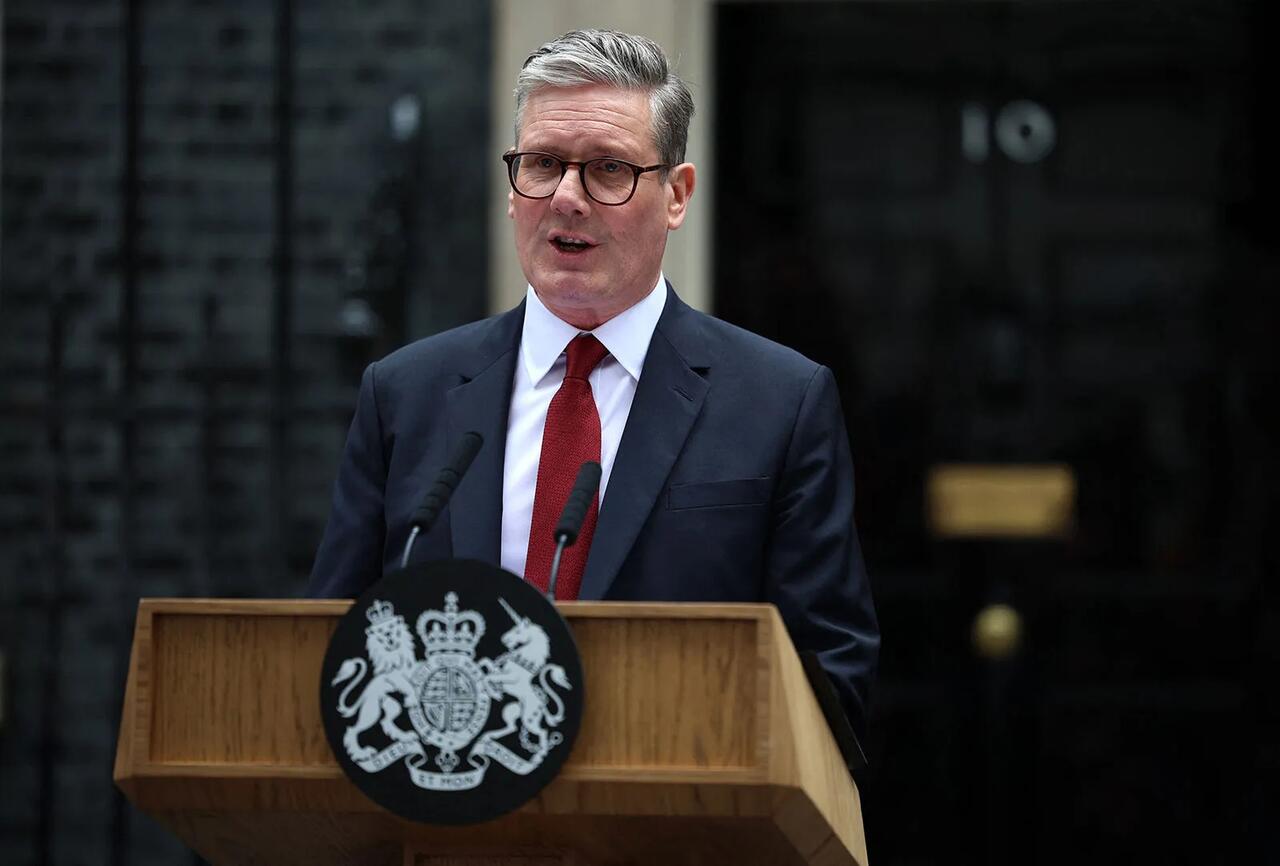 Documents and internal accounts, many drawn from newly disclosed materials, reveal a coordinated project that operated behind a veil of anonymity, misdirection, and unreported political financing.
This murky operation known as the Stop Funding Fake News (SFFN) was launched and resourced through a think tank, Labour Together, that would later be fined for failing to declare £739,000 in donations between 2018 and 2020. Said funds helped underpin this clandestine anti-media strategy which affected news outlets from the UK to the United States.
At the center of the effort was Morgan McSweeney, a political strategist who has since become Starmer’s chief of staff and, according to public commentary by prominent journalists, one of the most powerful unelected figures in the modern Labour Party.
Documents and internal accounts, many drawn from newly disclosed materials, reveal a coordinated project that operated behind a veil of anonymity, misdirection, and unreported political financing.
This murky operation known as the Stop Funding Fake News (SFFN) was launched and resourced through a think tank, Labour Together, that would later be fined for failing to declare £739,000 in donations between 2018 and 2020. Said funds helped underpin this clandestine anti-media strategy which affected news outlets from the UK to the United States.
At the center of the effort was Morgan McSweeney, a political strategist who has since become Starmer’s chief of staff and, according to public commentary by prominent journalists, one of the most powerful unelected figures in the modern Labour Party.
 The newly disclosed materials reveal that SFFN was not in fact some grassroots, anonymous activist collective it claimed to be, but a political weapon forged by senior Labour figures and funded by millionaire donors, including individuals active in pro-Israel political advocacy.
The goal: destabilize independent media ecosystems aligned with Labour’s left under Jeremy Corbyn, elevate Starmer’s leadership bid, and delegitimize outlets - domestic and foreign - that threatened the faction’s consolidation of power.
Publicly, SFFN claimed to be run by anonymous activists. Privately, it was shaped by McSweeney and operated from the same small office suite in South London that housed Labour Together.
SFFN ultimately migrated under the umbrella of the Center for Countering Digital Hate (CCDH), an organization that grew out of a corporate shell once controlled solely by McSweeney.
The newly disclosed materials reveal that SFFN was not in fact some grassroots, anonymous activist collective it claimed to be, but a political weapon forged by senior Labour figures and funded by millionaire donors, including individuals active in pro-Israel political advocacy.
The goal: destabilize independent media ecosystems aligned with Labour’s left under Jeremy Corbyn, elevate Starmer’s leadership bid, and delegitimize outlets - domestic and foreign - that threatened the faction’s consolidation of power.
Publicly, SFFN claimed to be run by anonymous activists. Privately, it was shaped by McSweeney and operated from the same small office suite in South London that housed Labour Together.
SFFN ultimately migrated under the umbrella of the Center for Countering Digital Hate (CCDH), an organization that grew out of a corporate shell once controlled solely by McSweeney.
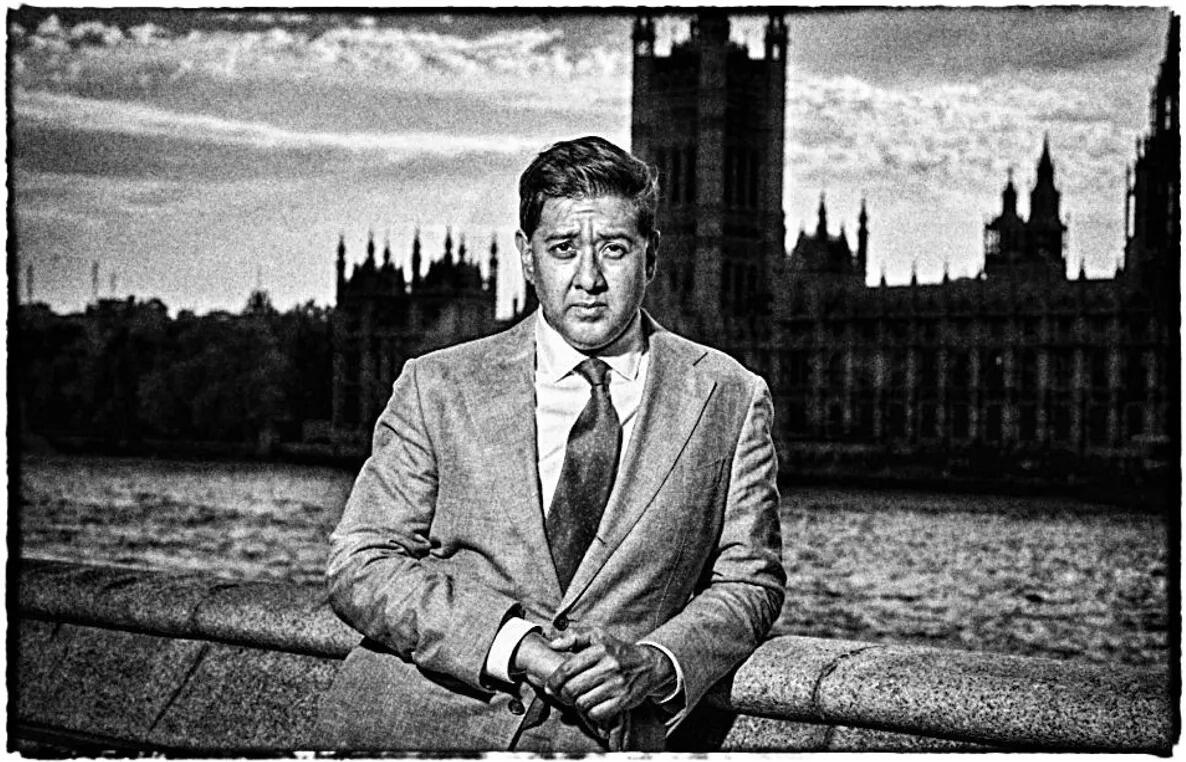 CCDH would later present SFFN as one of its signature initiatives.
Three Fronts of a Political Offensive
The documents reported by Holden reveal a three-part strategy that reshaped the British political landscape - and reverberated into U.S. media and politics. In a nutshell, this is how the sausage was made:
1. Destabilizing Jeremy Corbyn’s Leadership
SFFN’s narrative interventions were designed to amplify an “antisemitism crisis” that dogged Corbyn, boosting controversies and legitimizing a media ecosystem hostile to Labour’s left. This influence work aligned directly with the political interests of the centrist faction preparing for a post-Corbyn future.
2. Engineering Starmer’s Rise
Labour Together later claimed credit for helping deliver Starmer’s 2020 leadership victory, with McSweeney acting as his campaign chief. After Starmer won the July 2024 general election, McSweeney formally became chief of staff, solidifying the faction’s institutional dominance.
3. Silencing Dissenting Media
SFFN’s most aggressive project was an astroturf campaign against media outlets perceived as ideological threats. Targets spanned both the left (such as The Canary and Evolve Politics) and the right, as noted above.
In each case, the tactic was the same: identify advertisers appearing on targeted sites, publicly shame them through social media threads, and provide tools - including downloadable blocklists - to automatically exclude those outlets from programmatic advertising networks. The effort succeeded in devastating the business model of some targets; others survived but saw sustained pressure.
We took matters into our own hands, launching our
in order to keep the lights on (thank you).
The Breitbart Offensive
Holden reports that SFFN then set their sights on Breitbart in October 2019 - after an anonymous X account tagged the UK Parliament and likened its ads on Breitbart to funding extremism. SFFN ran hard with this - promoting the allegation and labeling Breitbart a "bigoted, conspiracist fake news site."
Later that day, the Press Association contacted Parliament for comment. Within hours, Parliament suspended the ads. To further legitimize the operation, anti-Corbyn MP Mary Creagh publicly leaned on the Conservative leadership to formalize the ban, citing a list of SFFN-identified sites.
Two weeks later, SFFN announced another victory: the UK Cabinet Office had implemented a “whitelist” that barred Breitbart, The Canary, and a long roster of other outlets from receiving government advertising.
On the 18th of October 2019, SFFN posted that they had contacted an unnamed journalist about how the UK’s Cabinet Office was advertising on its target websites. The journalist found out that the Cabinet Office “now implemented a ‘whitelist’ meaning the government now only advertises on pre-approved websites. The Canary, Evolve, Rebel, Politicalite, Breitbart etc no longer receive government advertising.” The post ended with three handclap emojis. “Good to see government use its authority to set an example against these dishonest & hateful websites.” -
CCDH would later present SFFN as one of its signature initiatives.
Three Fronts of a Political Offensive
The documents reported by Holden reveal a three-part strategy that reshaped the British political landscape - and reverberated into U.S. media and politics. In a nutshell, this is how the sausage was made:
1. Destabilizing Jeremy Corbyn’s Leadership
SFFN’s narrative interventions were designed to amplify an “antisemitism crisis” that dogged Corbyn, boosting controversies and legitimizing a media ecosystem hostile to Labour’s left. This influence work aligned directly with the political interests of the centrist faction preparing for a post-Corbyn future.
2. Engineering Starmer’s Rise
Labour Together later claimed credit for helping deliver Starmer’s 2020 leadership victory, with McSweeney acting as his campaign chief. After Starmer won the July 2024 general election, McSweeney formally became chief of staff, solidifying the faction’s institutional dominance.
3. Silencing Dissenting Media
SFFN’s most aggressive project was an astroturf campaign against media outlets perceived as ideological threats. Targets spanned both the left (such as The Canary and Evolve Politics) and the right, as noted above.
In each case, the tactic was the same: identify advertisers appearing on targeted sites, publicly shame them through social media threads, and provide tools - including downloadable blocklists - to automatically exclude those outlets from programmatic advertising networks. The effort succeeded in devastating the business model of some targets; others survived but saw sustained pressure.
We took matters into our own hands, launching our
in order to keep the lights on (thank you).
The Breitbart Offensive
Holden reports that SFFN then set their sights on Breitbart in October 2019 - after an anonymous X account tagged the UK Parliament and likened its ads on Breitbart to funding extremism. SFFN ran hard with this - promoting the allegation and labeling Breitbart a "bigoted, conspiracist fake news site."
Later that day, the Press Association contacted Parliament for comment. Within hours, Parliament suspended the ads. To further legitimize the operation, anti-Corbyn MP Mary Creagh publicly leaned on the Conservative leadership to formalize the ban, citing a list of SFFN-identified sites.
Two weeks later, SFFN announced another victory: the UK Cabinet Office had implemented a “whitelist” that barred Breitbart, The Canary, and a long roster of other outlets from receiving government advertising.
On the 18th of October 2019, SFFN posted that they had contacted an unnamed journalist about how the UK’s Cabinet Office was advertising on its target websites. The journalist found out that the Cabinet Office “now implemented a ‘whitelist’ meaning the government now only advertises on pre-approved websites. The Canary, Evolve, Rebel, Politicalite, Breitbart etc no longer receive government advertising.” The post ended with three handclap emojis. “Good to see government use its authority to set an example against these dishonest & hateful websites.” -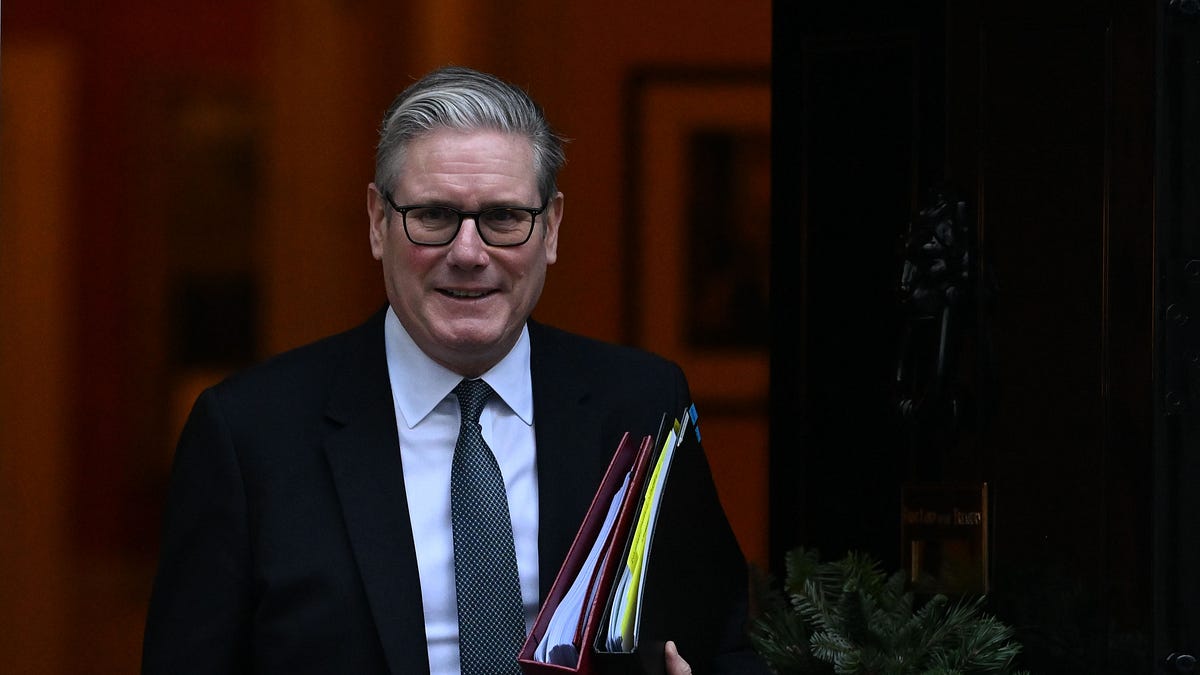 The campaign extended into the private sector. In 2020, Ford UK publicly stated it was investigating ad placements on Breitbart. By 2021, SFFN was targeting Breitbart’s YouTube monetization and urging advertisers to block the site across Google’s ad infrastructure.
The group’s blocklist eventually included 28 domestic and international sites, among them U.S. outlets aligned with the alt-right and the British far-right figure Tommy Robinson.
Weaponizing the Image of Grassroots Activism
Throughout 2019, SFFN steadfastly refused to disclose who ran the operation, claiming its activists faced undefined risks. Interviews and profiles repeated the fiction that it was just a small band of concerned citizens.
Yet from its inception, SFFN was powered by political professionals. It was launched only after McSweeney and CCDH’s Imran Ahmed recruited television personality Rachel Riley to front the campaign. Labour Together’s funds and office space supported its rollout. The project was effectively shielded from legal accountability by its anonymity, even as it issued sweeping defamatory accusations against its targets.
McSweeney and Ahmed asked if Riley would front a campaign to tackle The Canary. She agreed “with alacrity,” according to an account by two Sunday Times journalists. Her celebrity endorsement lifted SFFN out of obscurity and powered its success. She would later become a patron of CCDH and now lists herself on X as an “ambassador” of the organization. -
One of SFFN’s earliest and most consequential victims was The Canary. Though independently regulated and later cleared of allegations of racism or incitement, the outlet lost crucial advertising revenue and shed staff. Former employees described a chilling effect across the left media ecosystem as prominent commentators distanced themselves from a now-toxic brand.
The attack’s success was openly celebrated within liberal circles; commentators hailed SFFN for restoring “objective reality in politics,” even as its covert origins remained concealed.
CCDH, Twitter Files, and the Attempt to Rewrite History
The political sensitivity surrounding SFFN resurfaced in 2024, when leaked emails from CCDH showed repeated internal discussions about targeting Elon Musk’s Twitter. Amid the backlash, CCDH sources insisted McSweeney had played no operational role in the organization - a claim contradicted by company records showing he was the sole director of its precursor entity for more than a year and remained formally involved until April 2020.
In 2024, Matt Taibbi and Paul Thacker reported on emails leaked from within CCDH. They showed that, for over a year, CCDH’s internal team meetings included the action item: ‘
The campaign extended into the private sector. In 2020, Ford UK publicly stated it was investigating ad placements on Breitbart. By 2021, SFFN was targeting Breitbart’s YouTube monetization and urging advertisers to block the site across Google’s ad infrastructure.
The group’s blocklist eventually included 28 domestic and international sites, among them U.S. outlets aligned with the alt-right and the British far-right figure Tommy Robinson.
Weaponizing the Image of Grassroots Activism
Throughout 2019, SFFN steadfastly refused to disclose who ran the operation, claiming its activists faced undefined risks. Interviews and profiles repeated the fiction that it was just a small band of concerned citizens.
Yet from its inception, SFFN was powered by political professionals. It was launched only after McSweeney and CCDH’s Imran Ahmed recruited television personality Rachel Riley to front the campaign. Labour Together’s funds and office space supported its rollout. The project was effectively shielded from legal accountability by its anonymity, even as it issued sweeping defamatory accusations against its targets.
McSweeney and Ahmed asked if Riley would front a campaign to tackle The Canary. She agreed “with alacrity,” according to an account by two Sunday Times journalists. Her celebrity endorsement lifted SFFN out of obscurity and powered its success. She would later become a patron of CCDH and now lists herself on X as an “ambassador” of the organization. -
One of SFFN’s earliest and most consequential victims was The Canary. Though independently regulated and later cleared of allegations of racism or incitement, the outlet lost crucial advertising revenue and shed staff. Former employees described a chilling effect across the left media ecosystem as prominent commentators distanced themselves from a now-toxic brand.
The attack’s success was openly celebrated within liberal circles; commentators hailed SFFN for restoring “objective reality in politics,” even as its covert origins remained concealed.
CCDH, Twitter Files, and the Attempt to Rewrite History
The political sensitivity surrounding SFFN resurfaced in 2024, when leaked emails from CCDH showed repeated internal discussions about targeting Elon Musk’s Twitter. Amid the backlash, CCDH sources insisted McSweeney had played no operational role in the organization - a claim contradicted by company records showing he was the sole director of its precursor entity for more than a year and remained formally involved until April 2020.
In 2024, Matt Taibbi and Paul Thacker reported on emails leaked from within CCDH. They showed that, for over a year, CCDH’s internal team meetings included the action item: ‘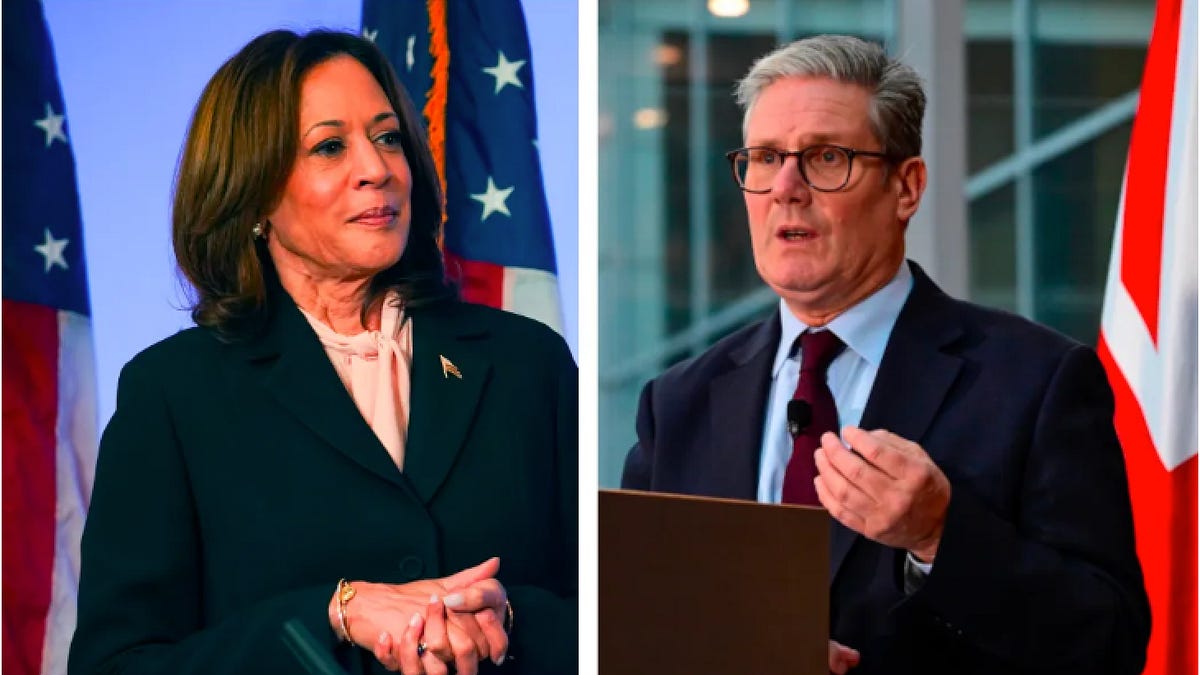 CCDH’s later retellings cast SFFN as an example of its “global” anti-hate strategies. One of its leaders described the financial approach explicitly: if news sites rely on advertising, “within a couple of months, you can completely eviscerate the economic base of a website.” SFFN had been the proving ground.
In 2023, Paul Thacker wrote in https://www.tabletmag.com/sections/news/articles/censorship-center-guise-combating-hate-covid-elon-musk
:
In March of 2021 a nonprofit group called the Center for Countering Digital Hate (CCDH) released a report about online misinformation. Founded in the U.K. by a former Labour Party political figure named Imran Ahmed, the CCDH was virtually unknown at the time in the U.S., but that was about to change. The report quickly reached the hands of executives at Twitter. “COVID-19 misinfo enforcement team is planning on taking action on a handful of accounts surfaced by the CCDH report,”
CCDH’s later retellings cast SFFN as an example of its “global” anti-hate strategies. One of its leaders described the financial approach explicitly: if news sites rely on advertising, “within a couple of months, you can completely eviscerate the economic base of a website.” SFFN had been the proving ground.
In 2023, Paul Thacker wrote in https://www.tabletmag.com/sections/news/articles/censorship-center-guise-combating-hate-covid-elon-musk
:
In March of 2021 a nonprofit group called the Center for Countering Digital Hate (CCDH) released a report about online misinformation. Founded in the U.K. by a former Labour Party political figure named Imran Ahmed, the CCDH was virtually unknown at the time in the U.S., but that was about to change. The report quickly reached the hands of executives at Twitter. “COVID-19 misinfo enforcement team is planning on taking action on a handful of accounts surfaced by the CCDH report,” on March 31. One account they eventually took action against belonged to Robert F. Kennedy Jr., who was then running against Joe Biden for the Democratic Party’s nomination for president.
A few months later, the same report was being cited by the Biden administration. At a press briefing in July 2021, White House Press Secretary Jen Psaki quoted from the CCDH report in a briefing where she accused Facebook of undermining federal vaccine policies. “There’s about 12 people who are producing 65% of anti-vaccine misinformation on social media platforms,” Psaki claimed, citing the CCDH’s work, while warning social media companies to shut down these “misinformation” accounts. “They’re killing people,” President Biden told a reporter a short time later, leveling the charge of murder against Facebook for its alleged role in providing a platform for “vaccine misinformation.”
Facebook’s Vice President Monika Bickert
on March 31. One account they eventually took action against belonged to Robert F. Kennedy Jr., who was then running against Joe Biden for the Democratic Party’s nomination for president.
A few months later, the same report was being cited by the Biden administration. At a press briefing in July 2021, White House Press Secretary Jen Psaki quoted from the CCDH report in a briefing where she accused Facebook of undermining federal vaccine policies. “There’s about 12 people who are producing 65% of anti-vaccine misinformation on social media platforms,” Psaki claimed, citing the CCDH’s work, while warning social media companies to shut down these “misinformation” accounts. “They’re killing people,” President Biden told a reporter a short time later, leveling the charge of murder against Facebook for its alleged role in providing a platform for “vaccine misinformation.”
Facebook’s Vice President Monika Bickert  for being free of evidence—failing to define the term “anti-vaxx,” for example—and neglecting to explain how they came up with their numbers and conclusions. But it had little effect. By then the report had popularized the idea of a “disinformation dozen,” a narrative that hardened as it was promoted by countless news outlets, fact checkers, and social media accounts devoted to round-the-clock attacks on “disinformation.”
More recently, the CCDH has popped up again, leading the battle against Twitter’s new owner, Elon Musk, who has been cast as a champion of racists and antisemites. “The CCDH has been at the forefront of reporting on the hate proliferating on X/Twitter since Musk completed his takeover in late October 2022,”
for being free of evidence—failing to define the term “anti-vaxx,” for example—and neglecting to explain how they came up with their numbers and conclusions. But it had little effect. By then the report had popularized the idea of a “disinformation dozen,” a narrative that hardened as it was promoted by countless news outlets, fact checkers, and social media accounts devoted to round-the-clock attacks on “disinformation.”
More recently, the CCDH has popped up again, leading the battle against Twitter’s new owner, Elon Musk, who has been cast as a champion of racists and antisemites. “The CCDH has been at the forefront of reporting on the hate proliferating on X/Twitter since Musk completed his takeover in late October 2022,”  from House Democrats that reiterates Ahmed’s claims, and cites him and CCDH.
Meanwhile, last month it was reported that the Trump White House plans to deport Imran Ahmed - who Thacker says
from House Democrats that reiterates Ahmed’s claims, and cites him and CCDH.
Meanwhile, last month it was reported that the Trump White House plans to deport Imran Ahmed - who Thacker says 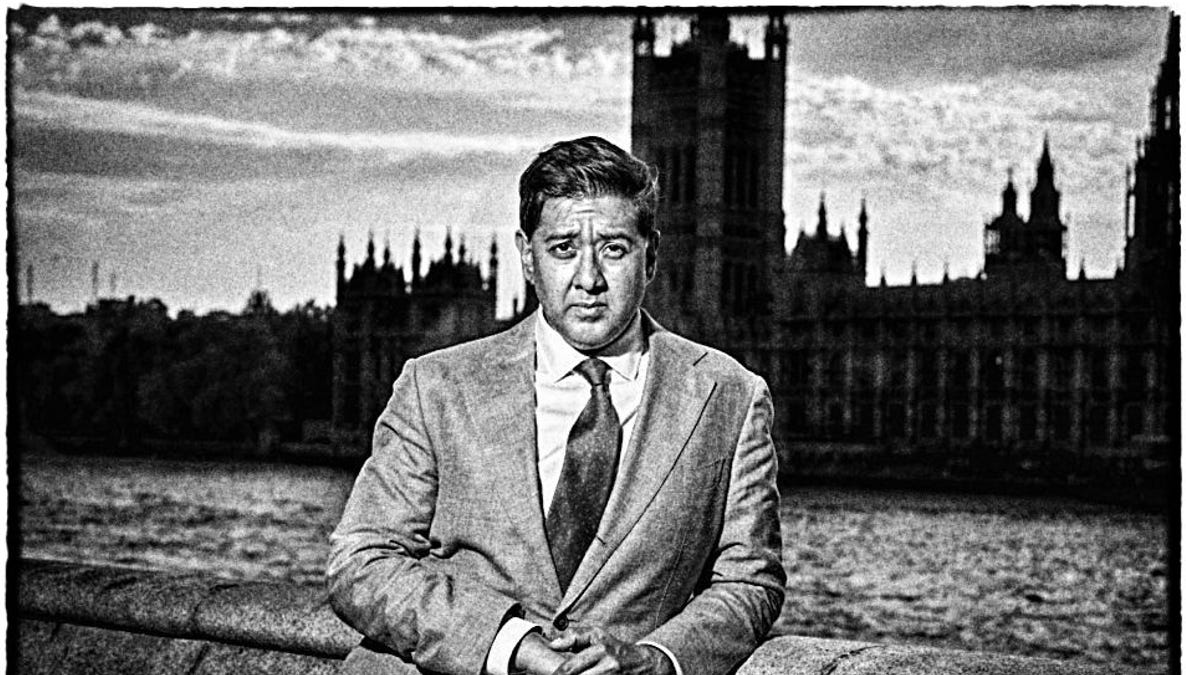 Drop Site News, even though Ryan Grimm (formerly of HuffPost and The Intercept) is a massive dick who hates us for some reason.
💥NEW: How PM Keir Starmer’s Machine Quietly Moved to Cripple Breitbart, The Federalist, ZeroHedge, and Left Independent Outlets
On Breaking Points, Ryan introduces Drop Site’s latest investigation, adapted from Paul Holden’s book, exposing how Keir Starmer and his chief of…
Drop Site News, even though Ryan Grimm (formerly of HuffPost and The Intercept) is a massive dick who hates us for some reason.
💥NEW: How PM Keir Starmer’s Machine Quietly Moved to Cripple Breitbart, The Federalist, ZeroHedge, and Left Independent Outlets
On Breaking Points, Ryan introduces Drop Site’s latest investigation, adapted from Paul Holden’s book, exposing how Keir Starmer and his chief of… 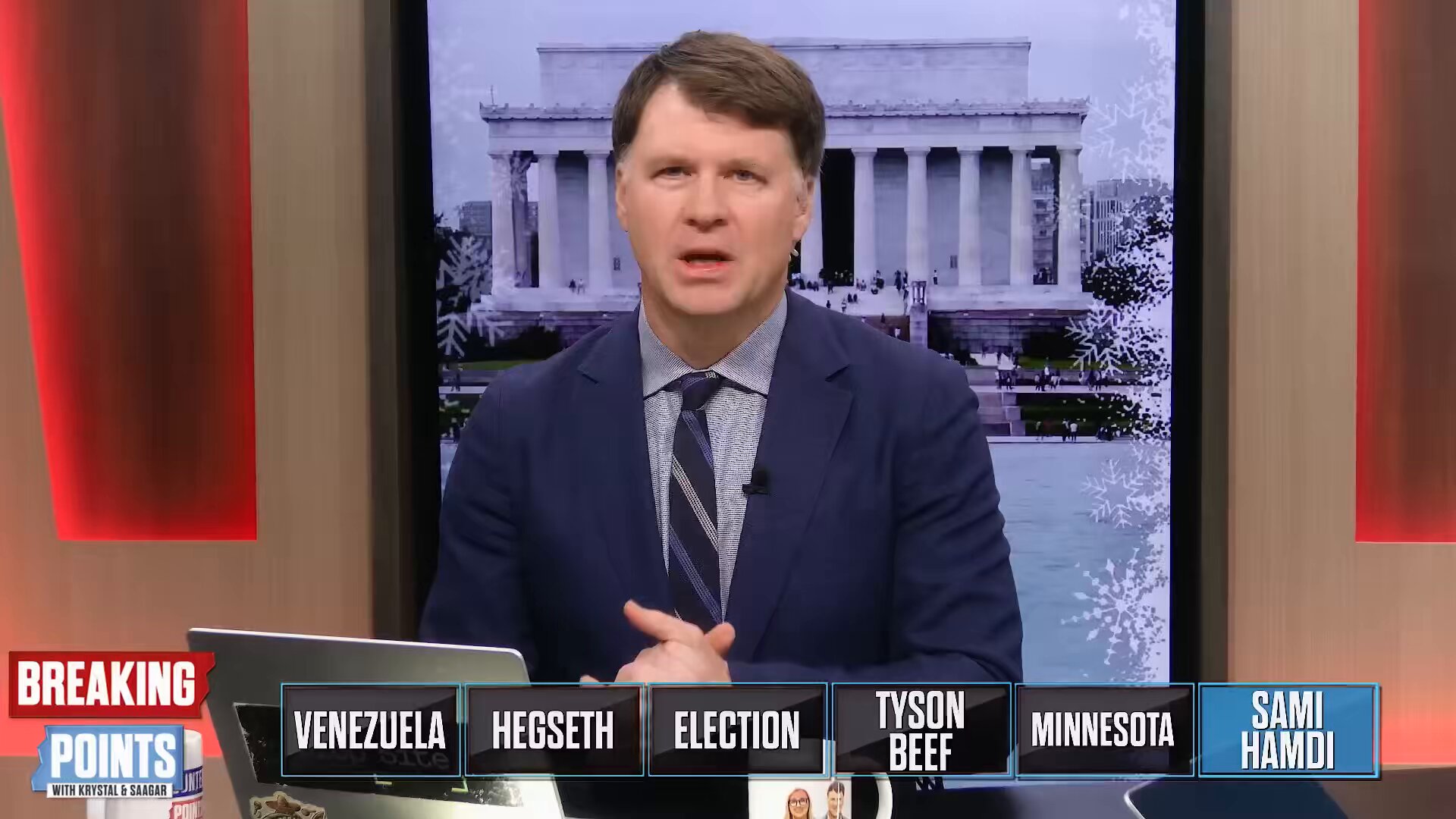 — Drop Site (@DropSiteNews)
Thu, 12/04/2025 - 13:25
— Drop Site (@DropSiteNews)
Thu, 12/04/2025 - 13:25
OR Books
The Fraud
Using a cache of hitherto unseen documents and exclusive insider accounts, this sensational new book tells the story of how a shadowy group, Labour...
Documents and internal accounts, many drawn from newly disclosed materials, reveal a coordinated project that operated behind a veil of anonymity, misdirection, and unreported political financing.
This murky operation known as the Stop Funding Fake News (SFFN) was launched and resourced through a think tank, Labour Together, that would later be fined for failing to declare £739,000 in donations between 2018 and 2020. Said funds helped underpin this clandestine anti-media strategy which affected news outlets from the UK to the United States.
At the center of the effort was Morgan McSweeney, a political strategist who has since become Starmer’s chief of staff and, according to public commentary by prominent journalists, one of the most powerful unelected figures in the modern Labour Party.
The newly disclosed materials reveal that SFFN was not in fact some grassroots, anonymous activist collective it claimed to be, but a political weapon forged by senior Labour figures and funded by millionaire donors, including individuals active in pro-Israel political advocacy.
The goal: destabilize independent media ecosystems aligned with Labour’s left under Jeremy Corbyn, elevate Starmer’s leadership bid, and delegitimize outlets - domestic and foreign - that threatened the faction’s consolidation of power.
Publicly, SFFN claimed to be run by anonymous activists. Privately, it was shaped by McSweeney and operated from the same small office suite in South London that housed Labour Together.
SFFN ultimately migrated under the umbrella of the Center for Countering Digital Hate (CCDH), an organization that grew out of a corporate shell once controlled solely by McSweeney.
CCDH would later present SFFN as one of its signature initiatives.
Three Fronts of a Political Offensive
The documents reported by Holden reveal a three-part strategy that reshaped the British political landscape - and reverberated into U.S. media and politics. In a nutshell, this is how the sausage was made:
1. Destabilizing Jeremy Corbyn’s Leadership
SFFN’s narrative interventions were designed to amplify an “antisemitism crisis” that dogged Corbyn, boosting controversies and legitimizing a media ecosystem hostile to Labour’s left. This influence work aligned directly with the political interests of the centrist faction preparing for a post-Corbyn future.
2. Engineering Starmer’s Rise
Labour Together later claimed credit for helping deliver Starmer’s 2020 leadership victory, with McSweeney acting as his campaign chief. After Starmer won the July 2024 general election, McSweeney formally became chief of staff, solidifying the faction’s institutional dominance.
3. Silencing Dissenting Media
SFFN’s most aggressive project was an astroturf campaign against media outlets perceived as ideological threats. Targets spanned both the left (such as The Canary and Evolve Politics) and the right, as noted above.
In each case, the tactic was the same: identify advertisers appearing on targeted sites, publicly shame them through social media threads, and provide tools - including downloadable blocklists - to automatically exclude those outlets from programmatic advertising networks. The effort succeeded in devastating the business model of some targets; others survived but saw sustained pressure.
We took matters into our own hands, launching our ZeroHedge
ZeroHedge - On a long enough timeline, the survival rate for everyone drops to zero
Keir Starmer Machine Ran a Secret Campaign to Demonetize Breitbart News and Other Opposition Outlets
Starmer’s current chief of staff, Morgan McSweeney, served as the head of a machine that targeted media outlets on the left and right, foreshadow...
Keir Starmer Machine Ran a Secret Campaign to Demonetize Breitbart News and Other Opposition Outlets
Starmer’s current chief of staff, Morgan McSweeney, served as the head of a machine that targeted media outlets on the left and right, foreshadow...
Election Exclusive: British Advisors to Kamala Harris Hope to "Kill Musk's Twitter"
England, not Russia, is the culprit in a real foreign election interference story, as the leaked Stateside plans of an advisory group with close ti...
Twitter Files: Who Are the People Claiming RFK Jr. is “Disinformation”?
Disinformation experts often lack any obvious expertise.
Meta Newsroom
How We’re Taking Action Against Vaccine Misinformation Superspreaders
We've removed over 3,000 accounts, Pages and groups for repeatedly violating our rules against spreading COVID-19 and vaccine misinformation.
the Guardian
When we held up a mirror to Elon Musk’s Twitter/X he tried to sue us into silence | Imran Ahmed
My organisation is standing up to the tech billionaires whose social media platforms are full of hate and lies
British Political Operative Imran Ahmed Has Broken Laws, Should Be Prosecuted Before He’s Deported
Leader of the Soros-Funded Center for Countering Digital Hate has a long history of dark money and shady activity that cannot be ignored.
X (formerly Twitter)
Drop Site (@DropSiteNews) on X
💥NEW: How PM Keir Starmer’s Machine Quietly Moved to Cripple Breitbart, The Federalist, ZeroHedge, and Left Independent Outlets
On Breaking P...
X (formerly Twitter)
Drop Site (@DropSiteNews) on X
💥NEW: How PM Keir Starmer’s Machine Quietly Moved to Cripple Breitbart, The Federalist, ZeroHedge, and Left Independent Outlets
On Breaking P...
Tyler Durden | Zero Hedge
Zero Hedge
Clandestine Campaign To Defund ZeroHedge, The Federalist & Breitbart Traced To Kier Starmer Operation | ZeroHedge
ZeroHedge - On a long enough timeline, the survival rate for everyone drops to zero

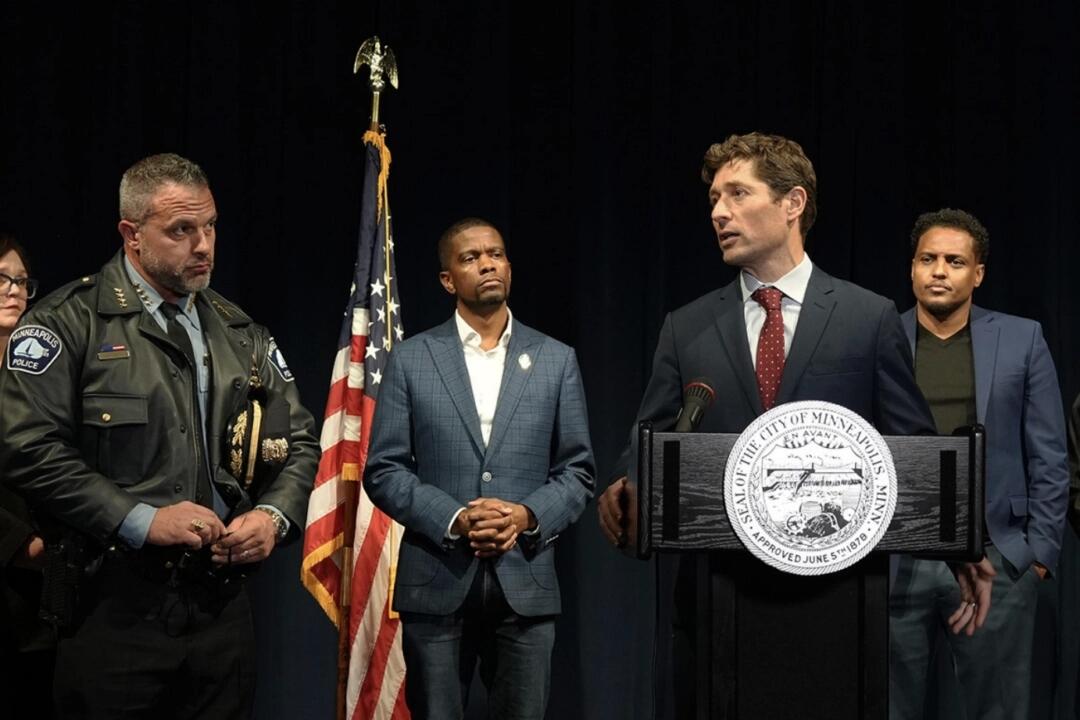 At the news conference, Minneapolis Police Chief Brian O‘Hara and St. Paul Mayor Melvin Carter III emphasized support for law-abiding Somalis and other immigrants who hold jobs and run businesses. People who are fearful of ICE action should inform themselves about their rights, the officials said. O’Hara also said that his officers “absolutely have a duty to intervene” if people’s rights are being violated.
O‘Hara said his officers “do work with federal law enforcement literally every day around violent crime, around people smuggling fentanyl into the country, gang violence, those types of things.” However, O’Hara said, “Federal law enforcement is aware that we absolutely will have nothing to do with anything related to immigration enforcement.”
That has been true for years in the Twin Cities, which are among more than a half-dozen so-called sanctuary cities that the Justice Department has
At the news conference, Minneapolis Police Chief Brian O‘Hara and St. Paul Mayor Melvin Carter III emphasized support for law-abiding Somalis and other immigrants who hold jobs and run businesses. People who are fearful of ICE action should inform themselves about their rights, the officials said. O’Hara also said that his officers “absolutely have a duty to intervene” if people’s rights are being violated.
O‘Hara said his officers “do work with federal law enforcement literally every day around violent crime, around people smuggling fentanyl into the country, gang violence, those types of things.” However, O’Hara said, “Federal law enforcement is aware that we absolutely will have nothing to do with anything related to immigration enforcement.”
That has been true for years in the Twin Cities, which are among more than a half-dozen so-called sanctuary cities that the Justice Department has 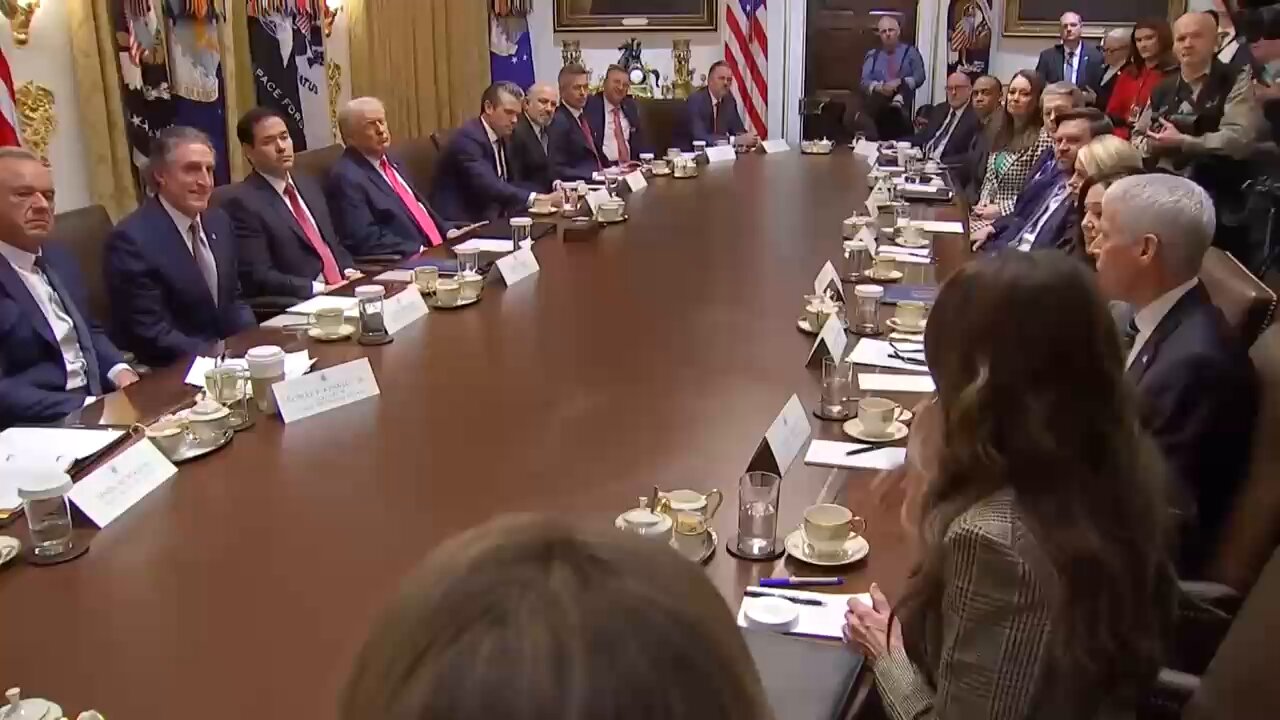



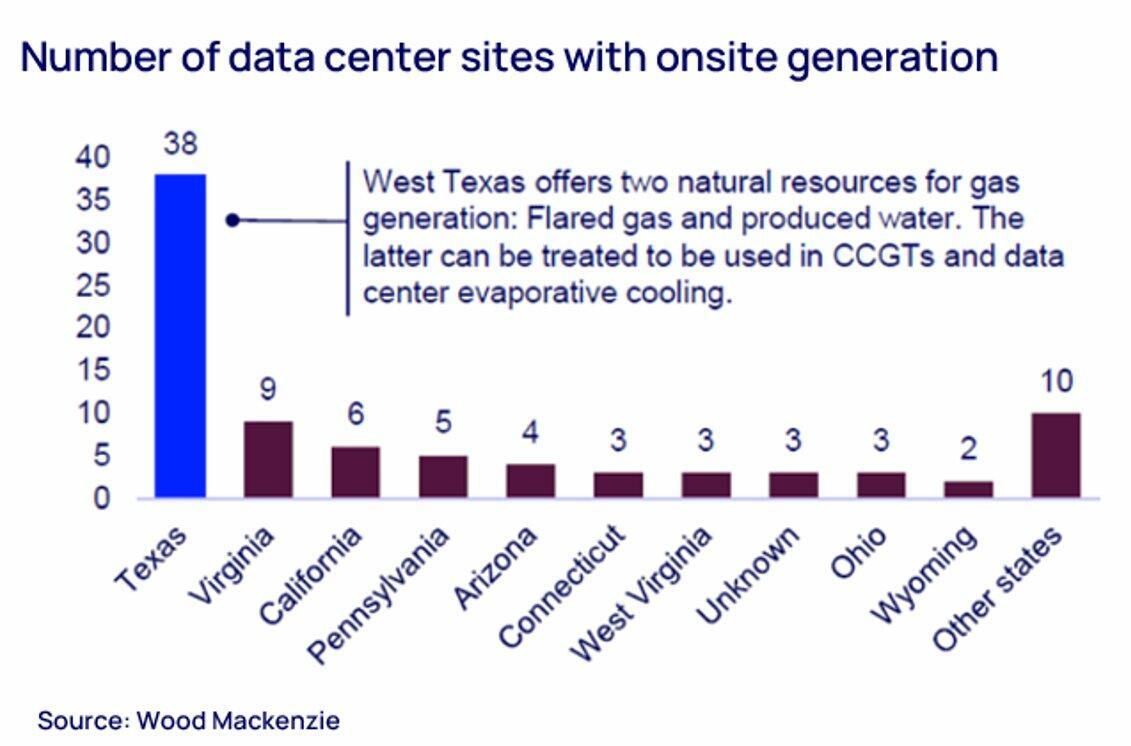 There was also a significant development from the Nuclear Regulatory Commission when they
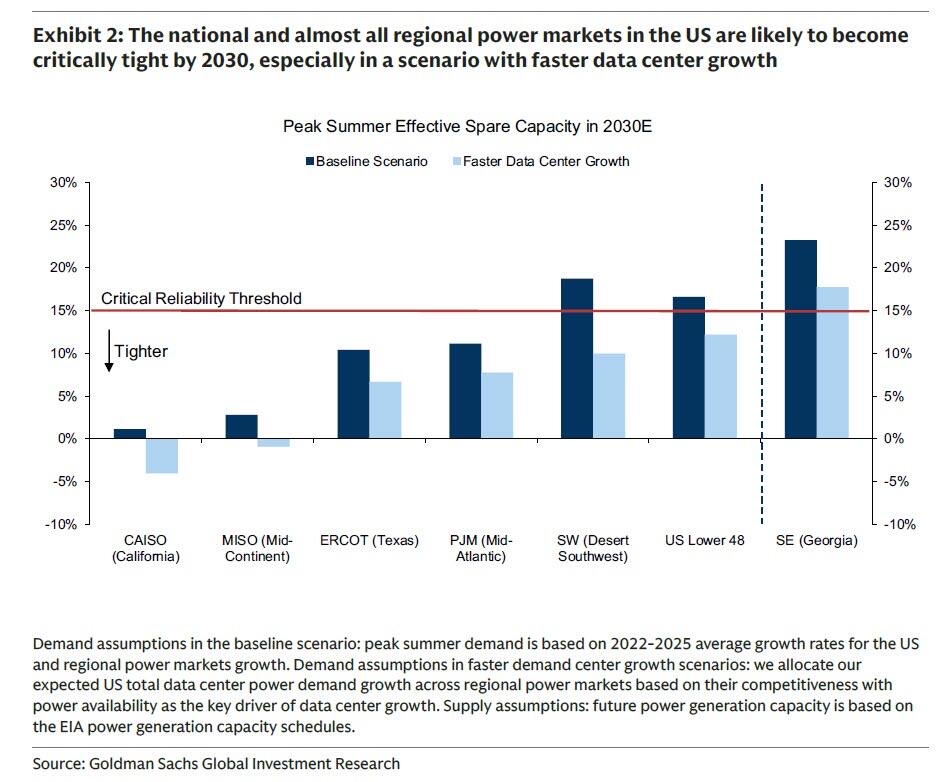
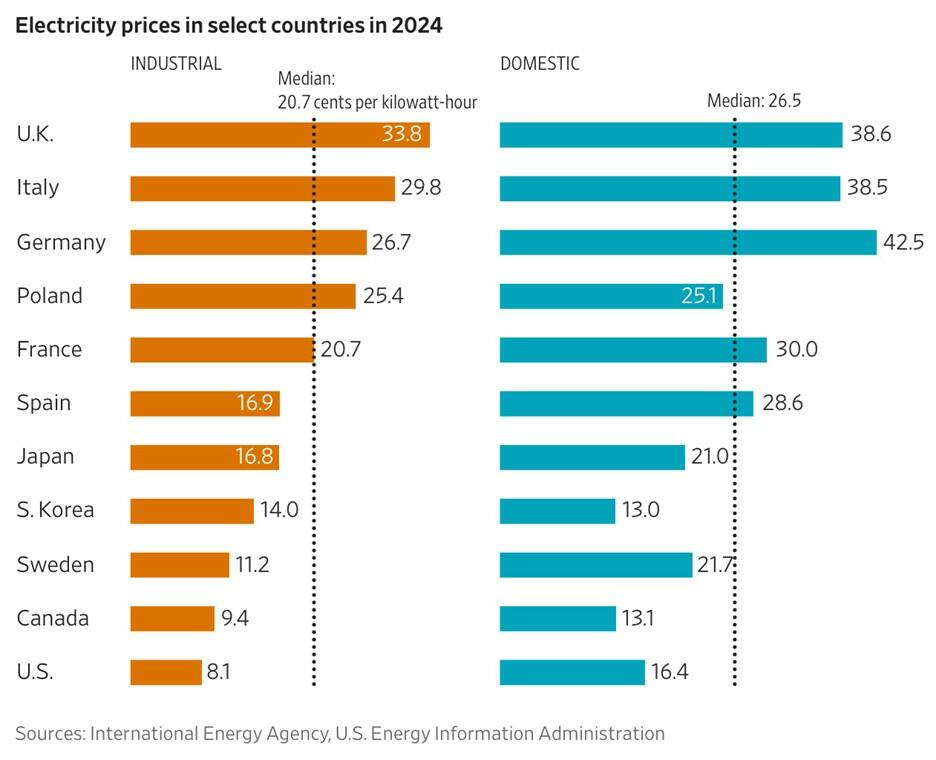 With the U.S. taking the more productive “and” approach to renewable energy, the country has added GW of power across a range of energy varieties, including both green sources like wind and solar, and traditional sources like coal, gas, and nuclear. Then again, as we discussed yesterday, the US will need to add over 100+ GW by 2032 to maintain the AI cycle, a staggering amount of power generation.
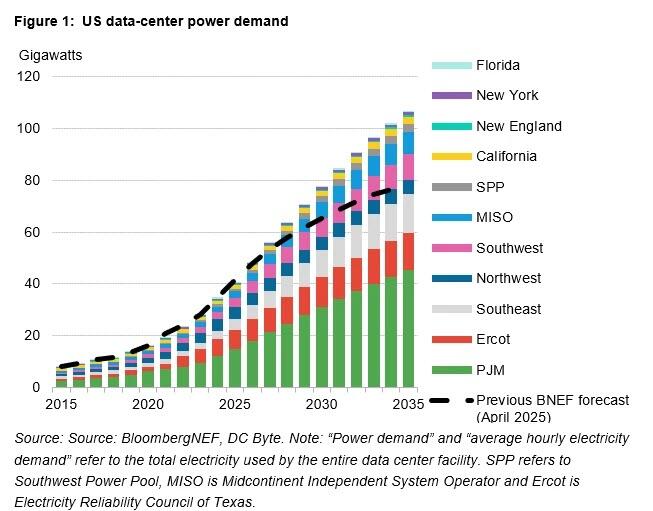 Jensen elaborated a little bit further on the energy-AI relationship, noting that energy is “the” bottleneck with developing new AI factories:
Rogan: So currently that is a big bottleneck, right? [It] is energy.
Huang: Yeah, it is the bottleneck. The bottleneck
Because you can print money, you can't print energy.
The money is not the problem: AI is the new global arms race, and capex will eventually be funded by governments (US and China). If you want to know why gold/silver/bitcoin is soaring, it's the "debasement" to fund the AI arms race.
But you can't print energy
Jensen elaborated a little bit further on the energy-AI relationship, noting that energy is “the” bottleneck with developing new AI factories:
Rogan: So currently that is a big bottleneck, right? [It] is energy.
Huang: Yeah, it is the bottleneck. The bottleneck
Because you can print money, you can't print energy.
The money is not the problem: AI is the new global arms race, and capex will eventually be funded by governments (US and China). If you want to know why gold/silver/bitcoin is soaring, it's the "debasement" to fund the AI arms race.
But you can't print energy 
 US media, for example, has widely reported that Maduro and Trump talked amnesty, but this was ultimately rejected by the US side after Maduro attacked certain conditions to the transfer of power in Caracas.
Speaking to state-run Venezolana de Television, Maduro described, "I don’t like diplomacy with microphones; when there are important matters, they must be handled quietly until they are resolved!"
He further welcomed that the call may have been a step towards "respectful dialogue" and that Venezuela would always seek peace. But out of "prudence" and "respect" Maduro said he would not divulge further details of the call.
"With the favor of God and our Commander of Commanders, Our Lord Jesus Christ, everything will go well for the peace, independence, dignity, and future of Venezuela," he said. Notably he did not confirm whether he was offered a safe exit by Trump or some kind of amnesty if he would relinquish rule of the country.
Meanwhile in Washington a bipartisan group of senators have reintroduced a War Powers Resolution designed to prevent Trump as commander-in-chief from unilaterally initiating military action against Venezuela without approval from Congress.
By and large lawmakers have been missing in action, though there has been rising anger and questions on the over 20 deadly strikes on suspected drug boats. However, this has mostly focused on details of which precise orders Pentagon chief Pete Hegseth did or didn't give.
The measure was
US media, for example, has widely reported that Maduro and Trump talked amnesty, but this was ultimately rejected by the US side after Maduro attacked certain conditions to the transfer of power in Caracas.
Speaking to state-run Venezolana de Television, Maduro described, "I don’t like diplomacy with microphones; when there are important matters, they must be handled quietly until they are resolved!"
He further welcomed that the call may have been a step towards "respectful dialogue" and that Venezuela would always seek peace. But out of "prudence" and "respect" Maduro said he would not divulge further details of the call.
"With the favor of God and our Commander of Commanders, Our Lord Jesus Christ, everything will go well for the peace, independence, dignity, and future of Venezuela," he said. Notably he did not confirm whether he was offered a safe exit by Trump or some kind of amnesty if he would relinquish rule of the country.
Meanwhile in Washington a bipartisan group of senators have reintroduced a War Powers Resolution designed to prevent Trump as commander-in-chief from unilaterally initiating military action against Venezuela without approval from Congress.
By and large lawmakers have been missing in action, though there has been rising anger and questions on the over 20 deadly strikes on suspected drug boats. However, this has mostly focused on details of which precise orders Pentagon chief Pete Hegseth did or didn't give.
The measure was 

 Dollar General posted a strong quarter, with third-quarter EPS of $1.28, beating last year's .89 cents and coming in well above the Bloomberg consensus estimate of .94 cents. Same-store sales rose 2.5%, also ahead of BBG expectations, driven entirely by higher traffic (+2.5%) while average ticket remained flat. Gains were broad-based across consumables, seasonal, home, and apparel.
Here's a snapshot of the third quarter (courtesy of Bloomberg):
EPS: $1.28 vs. $0.89 y/y, estimate $0.94
Net sales: $10.65 billion, +4.6% y/y, estimate $10.62 billion
Comparable sales: +2.5% vs. +1.3% y/y, estimate +2.47%
Gross margin: 29.9% vs. 28.8% y/y, estimate 29.5%
SG&A as % of revenue: 25.9% vs. 25.7% y/y, estimate 26.4%
Operating profit: $425.9 million, +32% y/y, estimate $328.1 million
Dollar General also lifted its FY25 outlook:
Sees comparable sales +2.5% to +2.7%, prior +2.1% to +2.6%, estimate +2.5% (Bloomberg consensus)
Sees EPS $6.30 to $6.50, prior $5.80 to $6.30, estimate $6.12
Sees net sales +4.7% to +4.9%, prior +4.3% to +4.8%
Sees capital expenditure at the low end of $1.3 billion to $1.4 billion, unchanged, estimate $1.39 billion
Still sees an effective tax rate of about 23.5%
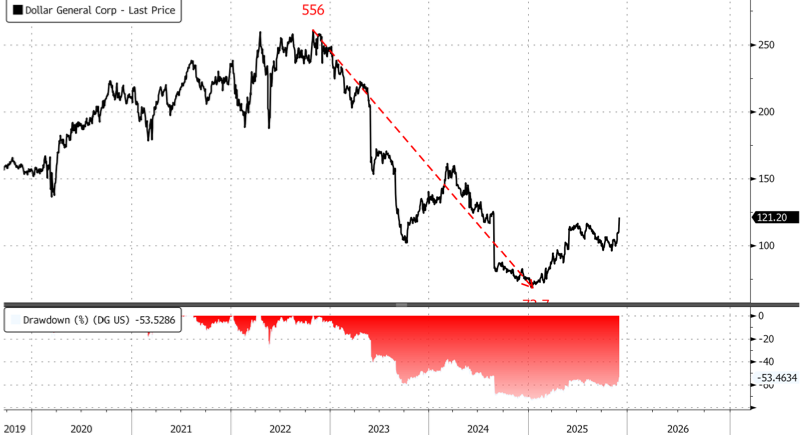
In markets, DG shares surged nearly 11% - the biggest jump since early June. The stock had been down as much as 73% from its 2022 highs as high interest rates crushed lower-income consumer activity, but the rebound is now well underway. DG suddenly looks like a name to watch heading into next year.
Dollar General posted a strong quarter, with third-quarter EPS of $1.28, beating last year's .89 cents and coming in well above the Bloomberg consensus estimate of .94 cents. Same-store sales rose 2.5%, also ahead of BBG expectations, driven entirely by higher traffic (+2.5%) while average ticket remained flat. Gains were broad-based across consumables, seasonal, home, and apparel.
Here's a snapshot of the third quarter (courtesy of Bloomberg):
EPS: $1.28 vs. $0.89 y/y, estimate $0.94
Net sales: $10.65 billion, +4.6% y/y, estimate $10.62 billion
Comparable sales: +2.5% vs. +1.3% y/y, estimate +2.47%
Gross margin: 29.9% vs. 28.8% y/y, estimate 29.5%
SG&A as % of revenue: 25.9% vs. 25.7% y/y, estimate 26.4%
Operating profit: $425.9 million, +32% y/y, estimate $328.1 million
Dollar General also lifted its FY25 outlook:
Sees comparable sales +2.5% to +2.7%, prior +2.1% to +2.6%, estimate +2.5% (Bloomberg consensus)
Sees EPS $6.30 to $6.50, prior $5.80 to $6.30, estimate $6.12
Sees net sales +4.7% to +4.9%, prior +4.3% to +4.8%
Sees capital expenditure at the low end of $1.3 billion to $1.4 billion, unchanged, estimate $1.39 billion
Still sees an effective tax rate of about 23.5%
In markets, DG shares surged nearly 11% - the biggest jump since early June. The stock had been down as much as 73% from its 2022 highs as high interest rates crushed lower-income consumer activity, but the rebound is now well underway. DG suddenly looks like a name to watch heading into next year.
 Goldman Sachs Managing Director Kate McShane is "Buy" rated on Dollar General with a 12-month price target of $126 ...
Here's what other Wall Street analysts are saying:
Bernstein, outperform (Zhihan Ma)
This is another "strong beat and raise" from Dollar General, with gross margin outperformance (up 110bps y/y) the key driver amid shrink recovery, higher inventory markups, partly offset by LIFO charges
NOTE: "Shrink" in retail refers reduced inventory due to theft, damage or other causes of product loss before it is sold to the consumer
Ma notes that comp. sales were "entirely led by traffic growth while ticket was flat"
"We don't expect outsized comp sales growth from DG, like what Five Below reported yesterday, as DG doesn't benefit nearly as much from tariff-driven price increases or Temu's pullback," she says
For DG, she sees further gross margin recovery potential into FY26
"Jury is still out on the retail media growth potential," which she hasn't assigned any value to
Bloomberg Intelligence, Jennifer Bartashus
"Dollar General's efforts to improve operations by executing well on retail basics like clean stores, in-stock levels and sufficient labor are gaining traction with core and higher- income trade-down shoppers," though it remains to be seen whether those new customers will stick, Bartashus writes
Gains in both consumable and discretionary categories in 3Q enabled the retailer to boost annual sales and profit forecasts
Jefferies (buy), Corey Tarlowe
This is a "clean beat" on both top- and bottom-line, driven by better‑than‑expected margins and "steady traffic gains"
Boosted guidance signals "confidence in holiday execution and continued market share gains across both departments"
Inventory discipline is "notable"
"Near term, the story strengthens on operational leverage and improved cost efficiency," while longer term, "store growth and remodel productivity provide visibility into sustained EPS growth"
"The Company is raising its financial expectations for the year, primarily to reflect its outperformance in the third quarter, as well as its improved outlook for the remainder of the year, while also taking into consideration the potential for uncertainty related to consumer behavior," Dollar General wrote in a press release.
Important to note: Dollar General's customer base is primarily lower- to middle-income households that have been trapped in the
Goldman Sachs Managing Director Kate McShane is "Buy" rated on Dollar General with a 12-month price target of $126 ...
Here's what other Wall Street analysts are saying:
Bernstein, outperform (Zhihan Ma)
This is another "strong beat and raise" from Dollar General, with gross margin outperformance (up 110bps y/y) the key driver amid shrink recovery, higher inventory markups, partly offset by LIFO charges
NOTE: "Shrink" in retail refers reduced inventory due to theft, damage or other causes of product loss before it is sold to the consumer
Ma notes that comp. sales were "entirely led by traffic growth while ticket was flat"
"We don't expect outsized comp sales growth from DG, like what Five Below reported yesterday, as DG doesn't benefit nearly as much from tariff-driven price increases or Temu's pullback," she says
For DG, she sees further gross margin recovery potential into FY26
"Jury is still out on the retail media growth potential," which she hasn't assigned any value to
Bloomberg Intelligence, Jennifer Bartashus
"Dollar General's efforts to improve operations by executing well on retail basics like clean stores, in-stock levels and sufficient labor are gaining traction with core and higher- income trade-down shoppers," though it remains to be seen whether those new customers will stick, Bartashus writes
Gains in both consumable and discretionary categories in 3Q enabled the retailer to boost annual sales and profit forecasts
Jefferies (buy), Corey Tarlowe
This is a "clean beat" on both top- and bottom-line, driven by better‑than‑expected margins and "steady traffic gains"
Boosted guidance signals "confidence in holiday execution and continued market share gains across both departments"
Inventory discipline is "notable"
"Near term, the story strengthens on operational leverage and improved cost efficiency," while longer term, "store growth and remodel productivity provide visibility into sustained EPS growth"
"The Company is raising its financial expectations for the year, primarily to reflect its outperformance in the third quarter, as well as its improved outlook for the remainder of the year, while also taking into consideration the potential for uncertainty related to consumer behavior," Dollar General wrote in a press release.
Important to note: Dollar General's customer base is primarily lower- to middle-income households that have been trapped in the 

 This article explores how an enterprise moved ahead of central banks in purchasing gold for its reserves and discusses independent attestations of the purchase. It also examines the rise of non-state gold buyers and what Tether’s gold buying does not indicate.
A private company outpacing central banks in buying gold
During the third quarter of 2025, Tether added 26 metric tons of gold to its holdings. According to
This article explores how an enterprise moved ahead of central banks in purchasing gold for its reserves and discusses independent attestations of the purchase. It also examines the rise of non-state gold buyers and what Tether’s gold buying does not indicate.
A private company outpacing central banks in buying gold
During the third quarter of 2025, Tether added 26 metric tons of gold to its holdings. According to 
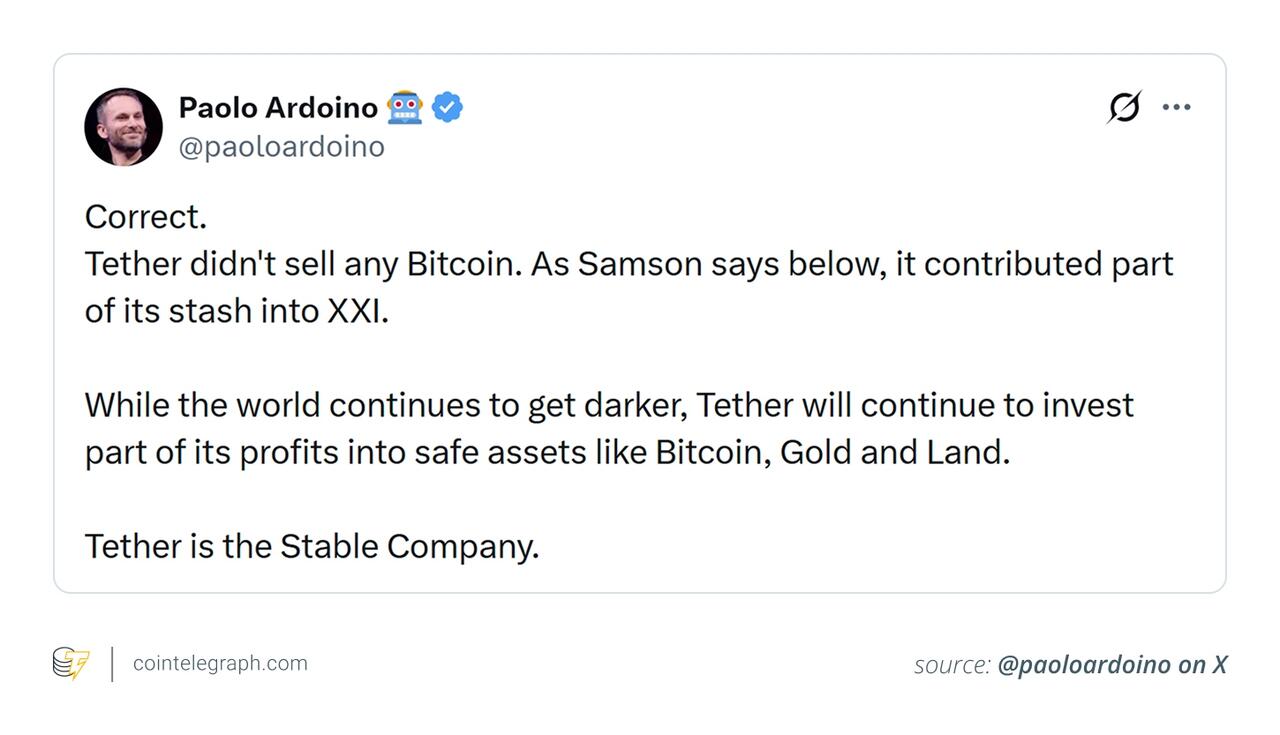 Independent attestations: The verified gold breakdowns
Tether publishes quarterly independent attestations prepared by major accounting firms. These reports provide insight into the company’s reserves:
As of Sept. 30, 2025, gold and precious metals represent about
Independent attestations: The verified gold breakdowns
Tether publishes quarterly independent attestations prepared by major accounting firms. These reports provide insight into the company’s reserves:
As of Sept. 30, 2025, gold and precious metals represent about  The suspect is expected to face charges for allegedly planting the devices, which were later deemed to be viable explosives that could have caused "serious injury or death."
The FBI did not share additional information about the suspect, however MS Now reports that the suspect has been linked to statements that show support for an anarchist ideology.
The bureau has conducted more than 1,000 interviews, reviewed over 39,000 video files, and fielded over 600 tips from the public - yet what led to the arrest was "the same trove of material that had mostly been gathered in 2021 and 2022," two sources told the outlet - meaning that the Biden administration had the evidence over three years ago.
Video footage and photos of the suspect showed a figure walking around in a hoodie and a face mask. The bombs were quickly disarmed shortly after they were discovered.
"There is a massive cover-up, because the person who planted those pipe bombs -- they don't want you to know who it was, because it's either a connected anti-Trump insider, or this was an inside job," Dan Bongino, now the deputy FBI Director, said in November 2024 on his show. "Those bombs were planted there. This was a setup. I have zero doubt."
Last month a forensic analysis
The suspect is expected to face charges for allegedly planting the devices, which were later deemed to be viable explosives that could have caused "serious injury or death."
The FBI did not share additional information about the suspect, however MS Now reports that the suspect has been linked to statements that show support for an anarchist ideology.
The bureau has conducted more than 1,000 interviews, reviewed over 39,000 video files, and fielded over 600 tips from the public - yet what led to the arrest was "the same trove of material that had mostly been gathered in 2021 and 2022," two sources told the outlet - meaning that the Biden administration had the evidence over three years ago.
Video footage and photos of the suspect showed a figure walking around in a hoodie and a face mask. The bombs were quickly disarmed shortly after they were discovered.
"There is a massive cover-up, because the person who planted those pipe bombs -- they don't want you to know who it was, because it's either a connected anti-Trump insider, or this was an inside job," Dan Bongino, now the deputy FBI Director, said in November 2024 on his show. "Those bombs were planted there. This was a setup. I have zero doubt."
Last month a forensic analysis  Former FBI Special Agent Kyle Seraphin told Blaze News that, in the days immediately after Jan. 6, he and his team conducted surveillance “one door away” from the residence tied to the female suspect. He says the team was pulled off the assignment without explanation, and requests to interview a person linked to the suspect’s movements were denied.
So the fact that a man was just arrested suggests that while the FBI may have been looking into her, it may have been a dead end - or they've arrested the wrong person.
The Blaze report was disputed by Headline USA and journalist
Former FBI Special Agent Kyle Seraphin told Blaze News that, in the days immediately after Jan. 6, he and his team conducted surveillance “one door away” from the residence tied to the female suspect. He says the team was pulled off the assignment without explanation, and requests to interview a person linked to the suspect’s movements were denied.
So the fact that a man was just arrested suggests that while the FBI may have been looking into her, it may have been a dead end - or they've arrested the wrong person.
The Blaze report was disputed by Headline USA and journalist 
 Source: Bloomberg
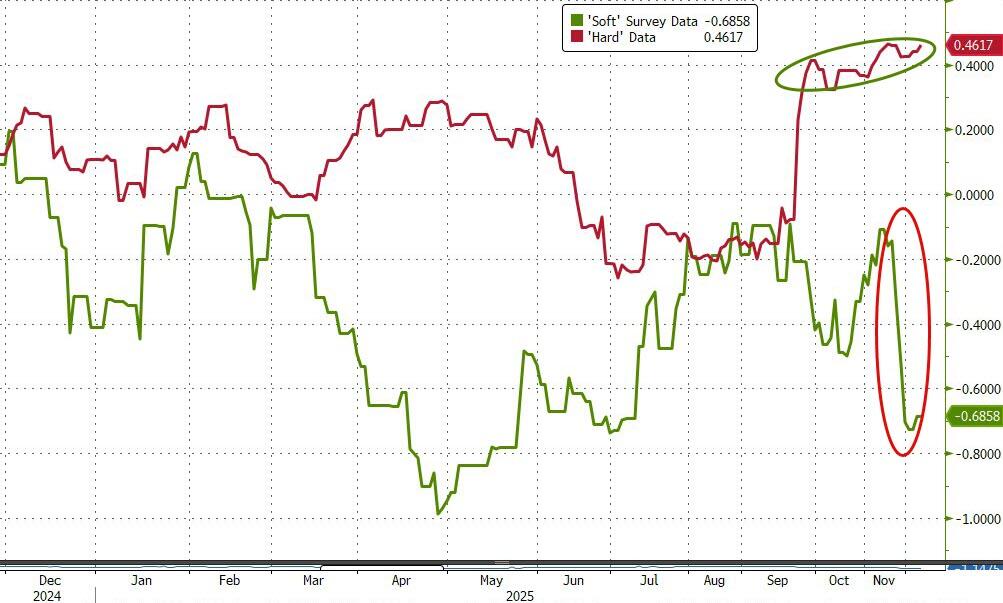
Today we get more 'catch-up' data with Factory Orders and Durable Goods data for September.
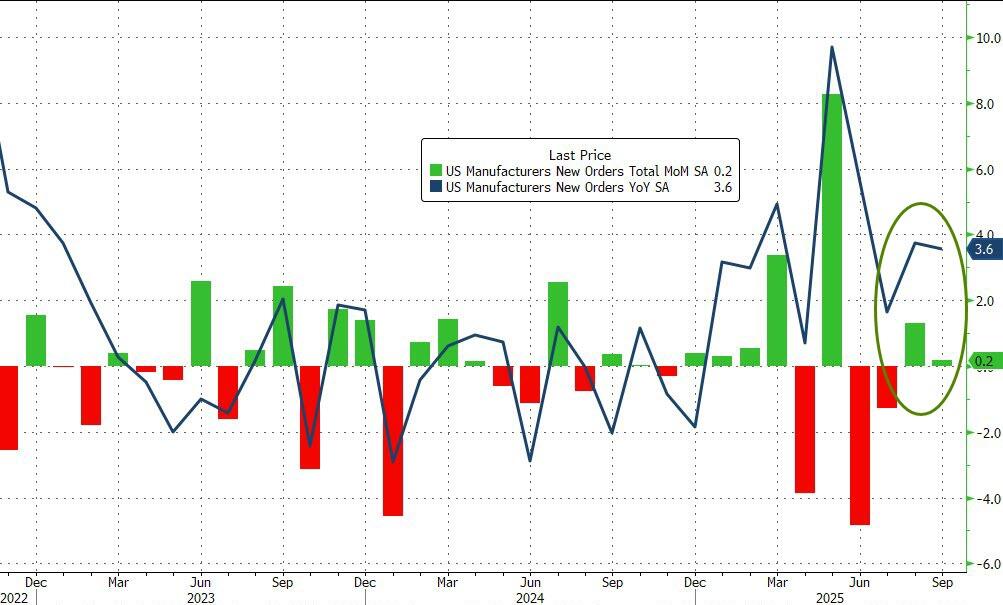
US Factory Orders disappointed, rising just 0.2% MoM (+0.3% exp) and slowing notably from the +1.3% MoM jump in August (and up 3.6% YoY)...
Source: Bloomberg
Today we get more 'catch-up' data with Factory Orders and Durable Goods data for September.
US Factory Orders disappointed, rising just 0.2% MoM (+0.3% exp) and slowing notably from the +1.3% MoM jump in August (and up 3.6% YoY)...
 Source: Bloomberg
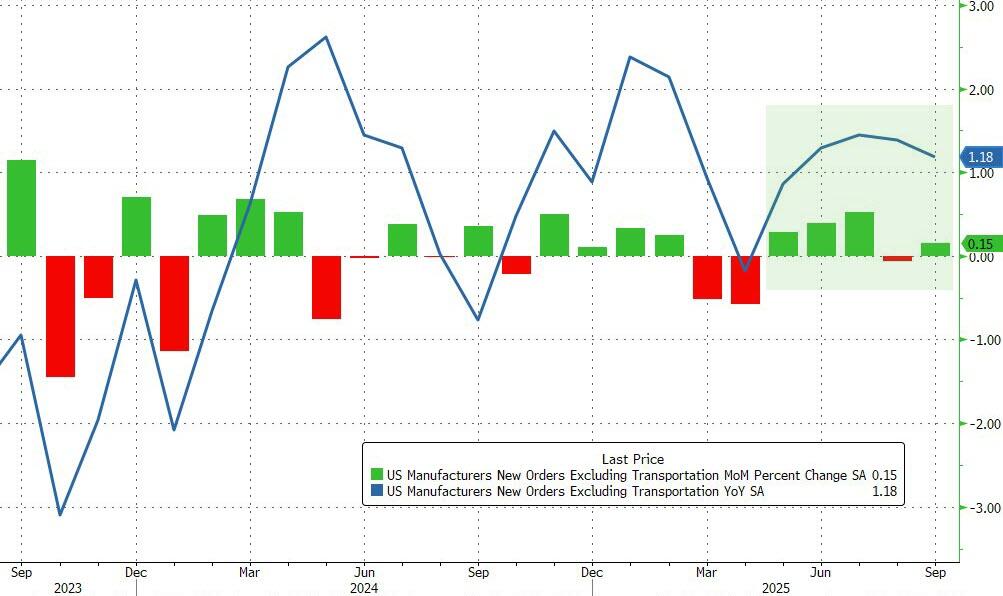
Core Factory Orders (ex-Transports) also rose 0.2% MoM, up notably from the downwardly revised 0.1% MoM decline in August (but remains up over 1% YoY)...
Source: Bloomberg
Core Factory Orders (ex-Transports) also rose 0.2% MoM, up notably from the downwardly revised 0.1% MoM decline in August (but remains up over 1% YoY)...
 Source: Bloomberg
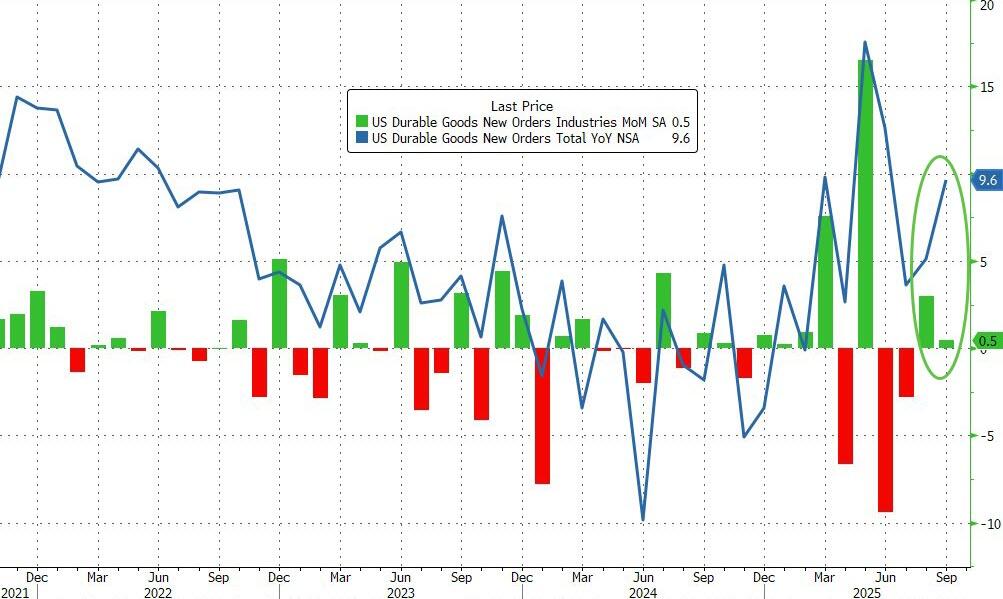
The final print for Durable Goods Orders were all in line with the flash prints, with the headline rising 0.5% MoMm which helped push Orders up a solid 9.6% YoY...
Source: Bloomberg
The final print for Durable Goods Orders were all in line with the flash prints, with the headline rising 0.5% MoMm which helped push Orders up a solid 9.6% YoY...
 Source: Bloomberg
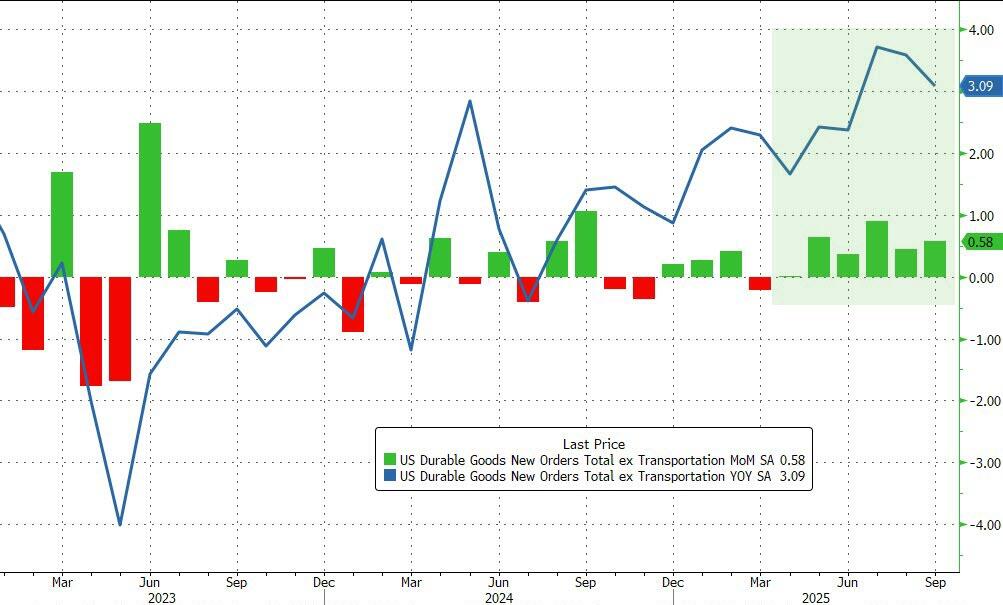
Core Durable Goods orders rose for the 6th straight month and are up over 3% YoY...
Source: Bloomberg
Core Durable Goods orders rose for the 6th straight month and are up over 3% YoY...
 Source: Bloomberg
Of course, this data is extremely stale now, but still it's positive overall (despite job losses in the goods-producing sector).
Source: Bloomberg
Of course, this data is extremely stale now, but still it's positive overall (despite job losses in the goods-producing sector).

 alt=""/></a>
Here's more from the report:
The proposed metaverse cuts are part of the company's annual budget planning for 2026, which included meetings at Zuckerberg's compound in Hawaii last month, the people said. Zuckerberg has asked Meta executives to look for 10% cuts across the board, which has been the standard request during similar budget cycles the past few years, they added.
In 2021, Zuckerberg told investors in a founder's letter that the metaverse marked "the beginning of the next chapter for the internet — and the next chapter for our company."
<a href="/s3/files/inline-images/2025-12-04_09-29-47.png?itok=ag4WVYA0" rel="nofollow"><img height="176" width="500" src="
alt=""/></a>
Here's more from the report:
The proposed metaverse cuts are part of the company's annual budget planning for 2026, which included meetings at Zuckerberg's compound in Hawaii last month, the people said. Zuckerberg has asked Meta executives to look for 10% cuts across the board, which has been the standard request during similar budget cycles the past few years, they added.
In 2021, Zuckerberg told investors in a founder's letter that the metaverse marked "the beginning of the next chapter for the internet — and the next chapter for our company."
<a href="/s3/files/inline-images/2025-12-04_09-29-47.png?itok=ag4WVYA0" rel="nofollow"><img height="176" width="500" src="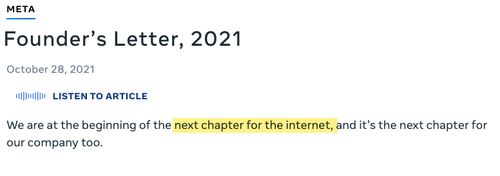 alt=""/></a>
Zuckerberg's failures continue piling up.
Meta AI - fail
Metaverse - fail
Meta glasses - fail
Meta Portal Services- fail
Meta Clubhouse - fail
Meta Threads - fail
Time to retire Zuckerberg.
alt=""/></a>
Zuckerberg's failures continue piling up.
Meta AI - fail
Metaverse - fail
Meta glasses - fail
Meta Portal Services- fail
Meta Clubhouse - fail
Meta Threads - fail
Time to retire Zuckerberg. 

 alt=""/></a>
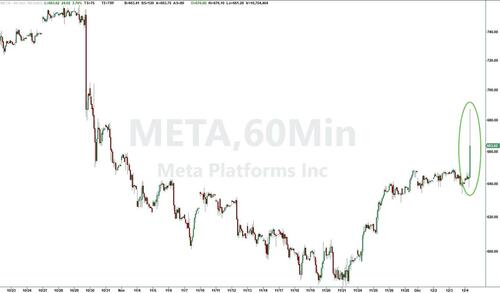
If the gains hold during the cash session, this would be the largest intraday jump since the 11% spike in late July. Year-to-date, shares are up 9.3% as of Wednesday's close.
<a href="/s3/files/inline-images/Snag_7350442b.png?itok=cRmVhRe8" rel="nofollow"><img height="498" width="500" src="
alt=""/></a>
If the gains hold during the cash session, this would be the largest intraday jump since the 11% spike in late July. Year-to-date, shares are up 9.3% as of Wednesday's close.
<a href="/s3/files/inline-images/Snag_7350442b.png?itok=cRmVhRe8" rel="nofollow"><img height="498" width="500" src="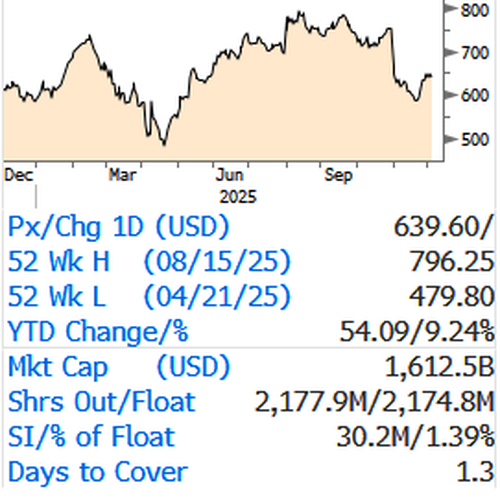 alt=""/></a>
In 2023...
Meta Hit With Trifecta Of Fails: Metaverse, Smart Glasses, Threads
alt=""/></a>
In 2023...
Meta Hit With Trifecta Of Fails: Metaverse, Smart Glasses, Threads  Those familiar with the Altman-Stoke Space talks said those discussions to invest billions and take a controlling stake were over the summer and have since ended.
WSJ's report comes days after OpenAI declared "
Those familiar with the Altman-Stoke Space talks said those discussions to invest billions and take a controlling stake were over the summer and have since ended.
WSJ's report comes days after OpenAI declared " Altman's space ambitions come as Musk recently laid out his vision of humanoid robots, as well as AI data centers in low Earth orbit.
The lowest cost place for data centers is space when 300 GW of computer data center you can power and cool in space when you have continuous solar and no batteries needed.
Altman's space ambitions come as Musk recently laid out his vision of humanoid robots, as well as AI data centers in low Earth orbit.
The lowest cost place for data centers is space when 300 GW of computer data center you can power and cool in space when you have continuous solar and no batteries needed. 

