
**Astronomy Picture of the Day**
25 January 2026
**Earthset from Orion**
 Image Credit: NASA, Artemis 1
Explanation:
Eight billion people
are about to disappear in this
snapshot from space
taken on 2022 November 21.
On the
sixth day of the Artemis I mission,
their home world is setting behind the Moon's bright edge as viewed by
an
external camera
on the outbound Orion spacecraft.
Orion was headed for a powered flyby that
took it to within 130 kilometers of the lunar surface.
Velocity gained in the flyby maneuver was used to reach a
distant retrograde orbit
around the Moon.
That orbit is considered distant because it's another 92,000 kilometers
beyond the Moon, and retrograde because the spacecraft
orbited in the opposite direction of the Moon's orbit around planet
Earth.
Swinging around the Moon,
Orion reached a maximum distance (just over 400,000 kilometers)
from Earth on 2022 November 28, exceeding a record set by
Apollo 13 for most distant
spacecraft designed for
human space exploration.
The Artemis II mission,
carrying 4 astronauts around the moon and back
again, is due to launch as early as February 6.
#APOD #Earthset #OrionSpacecraft #ArtemisI #LunarFlyby #SpaceObservations
Image Credit: NASA, Artemis 1
Explanation:
Eight billion people
are about to disappear in this
snapshot from space
taken on 2022 November 21.
On the
sixth day of the Artemis I mission,
their home world is setting behind the Moon's bright edge as viewed by
an
external camera
on the outbound Orion spacecraft.
Orion was headed for a powered flyby that
took it to within 130 kilometers of the lunar surface.
Velocity gained in the flyby maneuver was used to reach a
distant retrograde orbit
around the Moon.
That orbit is considered distant because it's another 92,000 kilometers
beyond the Moon, and retrograde because the spacecraft
orbited in the opposite direction of the Moon's orbit around planet
Earth.
Swinging around the Moon,
Orion reached a maximum distance (just over 400,000 kilometers)
from Earth on 2022 November 28, exceeding a record set by
Apollo 13 for most distant
spacecraft designed for
human space exploration.
The Artemis II mission,
carrying 4 astronauts around the moon and back
again, is due to launch as early as February 6.
#APOD #Earthset #OrionSpacecraft #ArtemisI #LunarFlyby #SpaceObservations
Image Credit: NASA, Artemis 1
Explanation:
Eight billion people
are about to disappear in this
snapshot from space
taken on 2022 November 21.
On the
sixth day of the Artemis I mission,
their home world is setting behind the Moon's bright edge as viewed by
an
external camera
on the outbound Orion spacecraft.
Orion was headed for a powered flyby that
took it to within 130 kilometers of the lunar surface.
Velocity gained in the flyby maneuver was used to reach a
distant retrograde orbit
around the Moon.
That orbit is considered distant because it's another 92,000 kilometers
beyond the Moon, and retrograde because the spacecraft
orbited in the opposite direction of the Moon's orbit around planet
Earth.
Swinging around the Moon,
Orion reached a maximum distance (just over 400,000 kilometers)
from Earth on 2022 November 28, exceeding a record set by
Apollo 13 for most distant
spacecraft designed for
human space exploration.
The Artemis II mission,
carrying 4 astronauts around the moon and back
again, is due to launch as early as February 6.
#APOD #Earthset #OrionSpacecraft #ArtemisI #LunarFlyby #SpaceObservations
APOD: 2026 January 24 - Earthset from Orion
A different astronomy and space science
related image is featured each day, along with a brief explanation.
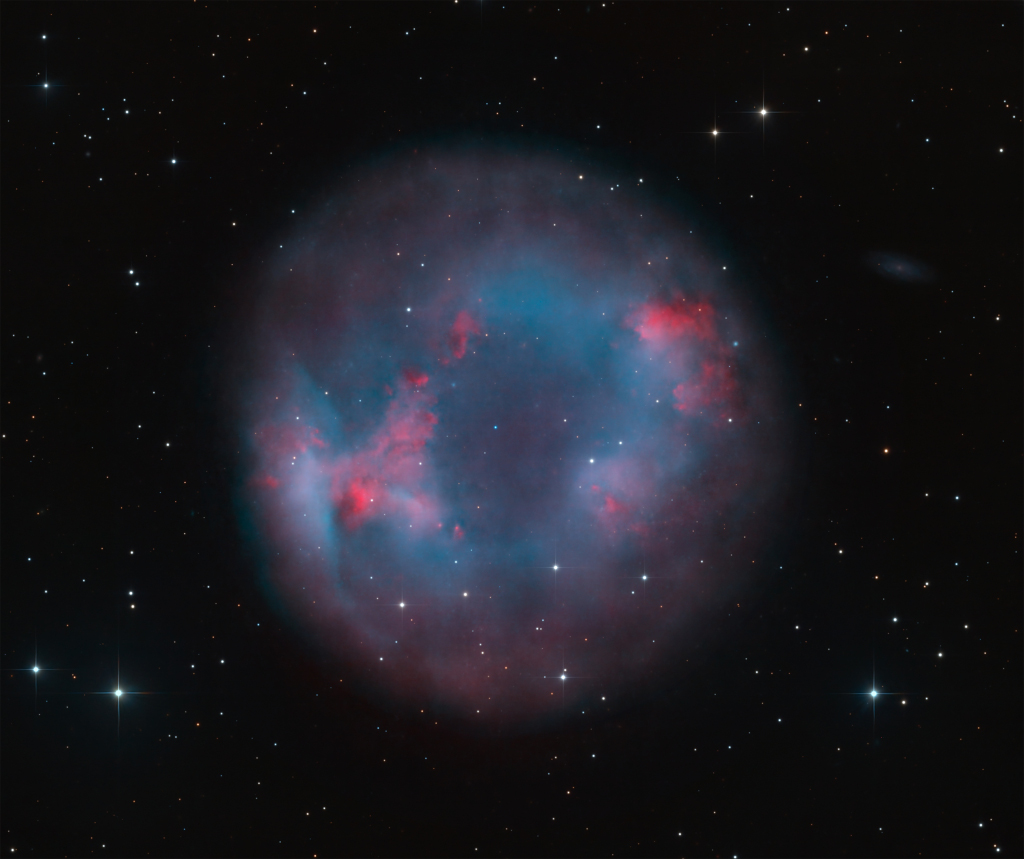 Image Credit: Martin Pugh
Explanation:
Very faint planetary nebula Abell 7 is about 1,800 light-years distant.
It lies just south of Orion in planet Earth's skies toward the
constellation
Lepus, The Hare.
Posing with scattered Milky Way stars, its
generally
simple spherical shape about 8 light-years in diameter is revealed in
this deep telescopic image.
The beautiful and complex shapes
seen within the cosmic cloud are visually
enhanced by the use of long exposures and
narrowband filters
that capture emission from hydrogen and oxygen atoms.
Otherwise Abell 7 would be much
too faint to be appreciated by eye.
A
planetary nebula
represents a very brief final phase
in stellar evolution that our own Sun will experience 5 billion
years hence,
as the nebula's central, once sun-like star shrugs off its outer layers.
Abell 7 itself is estimated to be 20,000 years old.
But its central star, seen here as a
fading white dwarf,
is some 10 billion years old.
#APOD #Abell7 #PlanetaryNebula #Orion #Lepus #DeepSky
Image Credit: Martin Pugh
Explanation:
Very faint planetary nebula Abell 7 is about 1,800 light-years distant.
It lies just south of Orion in planet Earth's skies toward the
constellation
Lepus, The Hare.
Posing with scattered Milky Way stars, its
generally
simple spherical shape about 8 light-years in diameter is revealed in
this deep telescopic image.
The beautiful and complex shapes
seen within the cosmic cloud are visually
enhanced by the use of long exposures and
narrowband filters
that capture emission from hydrogen and oxygen atoms.
Otherwise Abell 7 would be much
too faint to be appreciated by eye.
A
planetary nebula
represents a very brief final phase
in stellar evolution that our own Sun will experience 5 billion
years hence,
as the nebula's central, once sun-like star shrugs off its outer layers.
Abell 7 itself is estimated to be 20,000 years old.
But its central star, seen here as a
fading white dwarf,
is some 10 billion years old.
#APOD #Abell7 #PlanetaryNebula #Orion #Lepus #DeepSky
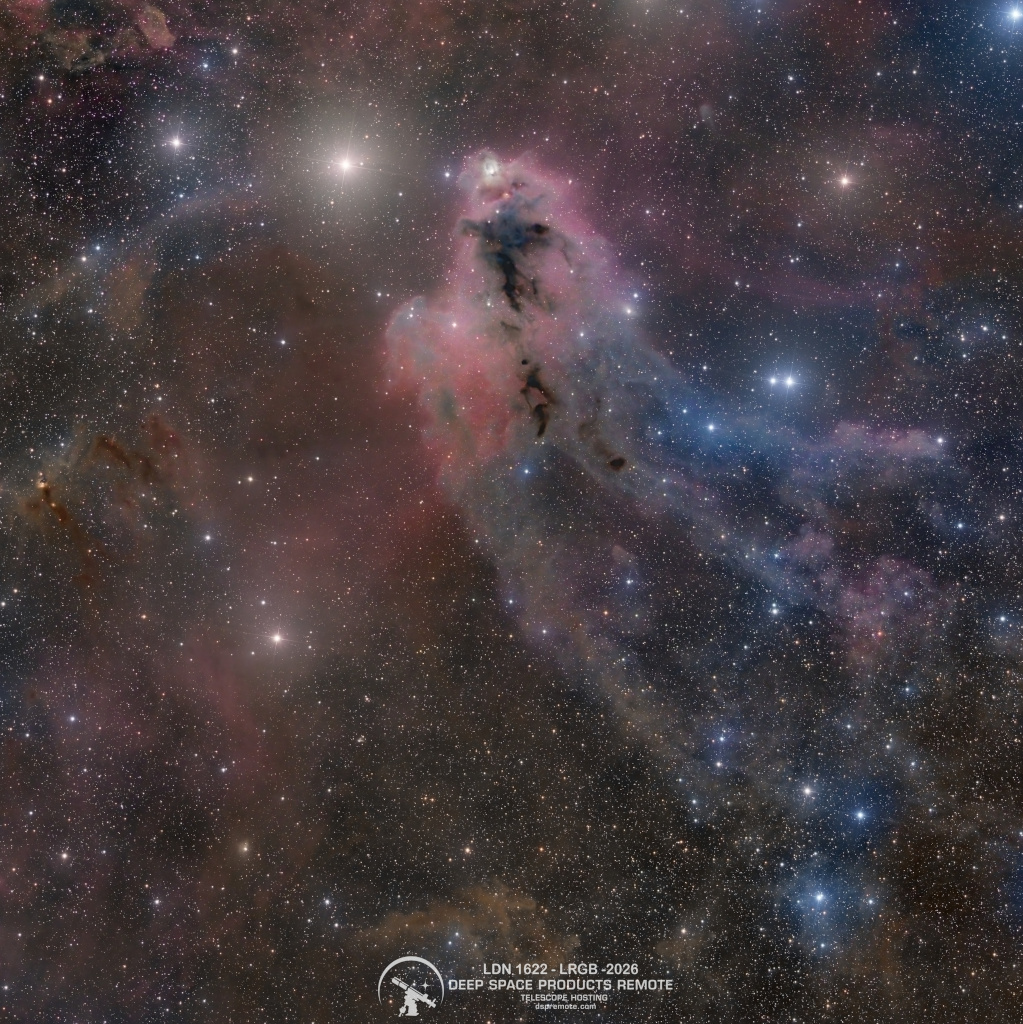 Image Credit: Chris Fellows
Explanation:
The silhouette of an intriguing
dark nebula
inhabits
this cosmic scene.
Lynds' Dark Nebula
(LDN)
1622 appears against a faint
background of glowing hydrogen gas only visible in long telescopic
exposures of the region.
In contrast, a brighter reflection nebula,
vdB 62,
is more easily seen just above the dusty dark nebula.
LDN 1622 lies near the plane of our Milky Way Galaxy,
close on the sky to
Barnard's Loop,
a large cloud surrounding the rich
complex of emission nebulae found in the Belt and Sword
of Orion.
With swept-back outlines, the obscuring dust of LDN 1622 is thought
to lie at a similar distance, perhaps 1,500 light-years away.
At that distance, this 3 degree wide field of view
would span about 100 light-years.
Young
stars do lie hidden within the dark expanse and have been
revealed in Spitzer Space telescope
infrared
images.
Still, the
foreboding
visual appearance of LDN 1622
inspires its popular name,
the Boogeyman Nebula.
#APOD #LDN1622 #DarkNebula #OrionNebula #MilkyWay #BarnardsLoop
Image Credit: Chris Fellows
Explanation:
The silhouette of an intriguing
dark nebula
inhabits
this cosmic scene.
Lynds' Dark Nebula
(LDN)
1622 appears against a faint
background of glowing hydrogen gas only visible in long telescopic
exposures of the region.
In contrast, a brighter reflection nebula,
vdB 62,
is more easily seen just above the dusty dark nebula.
LDN 1622 lies near the plane of our Milky Way Galaxy,
close on the sky to
Barnard's Loop,
a large cloud surrounding the rich
complex of emission nebulae found in the Belt and Sword
of Orion.
With swept-back outlines, the obscuring dust of LDN 1622 is thought
to lie at a similar distance, perhaps 1,500 light-years away.
At that distance, this 3 degree wide field of view
would span about 100 light-years.
Young
stars do lie hidden within the dark expanse and have been
revealed in Spitzer Space telescope
infrared
images.
Still, the
foreboding
visual appearance of LDN 1622
inspires its popular name,
the Boogeyman Nebula.
#APOD #LDN1622 #DarkNebula #OrionNebula #MilkyWay #BarnardsLoop
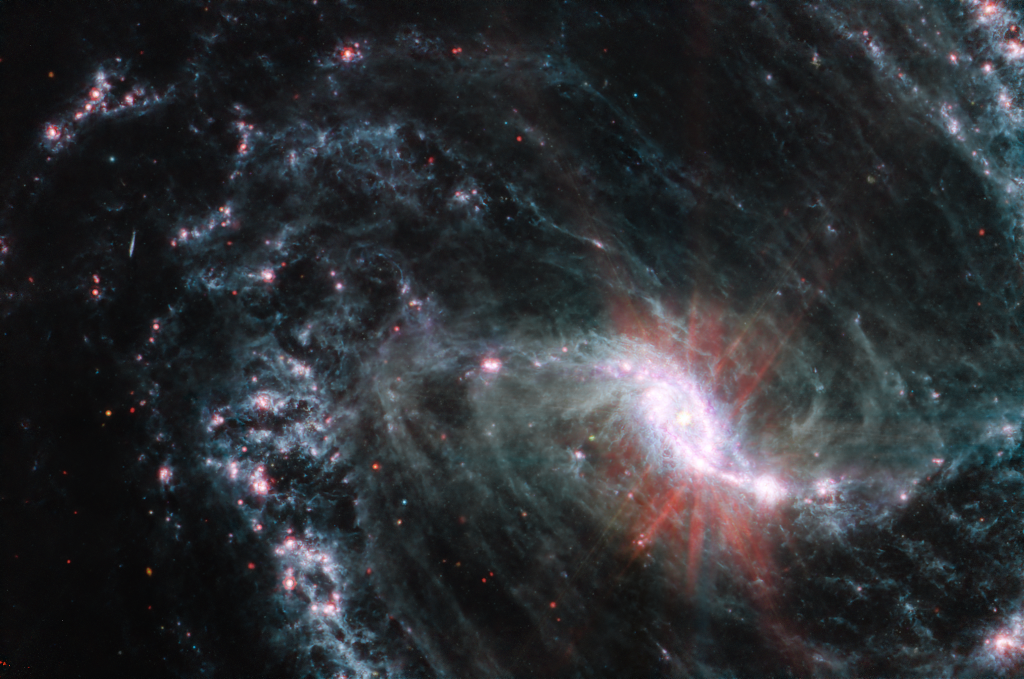 Image Credit: NASA, ESA, CSA, NOIRLab, STScI
Explanation:
A mere
56 million light-years distant toward the
southern constellation Fornax,
NGC 1365 is an enormous
barred spiral galaxy about 200,000 light-years in diameter.
That's twice the size of our own barred spiral Milky Way.
This sharp image
from the
James Webb Space Telescope's
Mid-Infrared Instrument (MIRI)
reveals stunning details
of this magnificent spiral
in infrared light.
Webb's
field of view
stretches about 60,000 light-years
across NGC 1365, exploring the galaxy's core and bright newborn star
clusters.
The intricate network of dusty filaments and bubbles is
created by young stars along spiral arms winding from the
galaxy's central bar.
Astronomers suspect
the gravitational field of NGC 1365's bar plays
a crucial role in the galaxy's evolution, funneling gas and dust into a
star-forming maelstrom
and ultimately feeding material
into the active galaxy's central,
supermassive black hole.
#APOD #NGC1365 #BarredSpiralGalaxy #JamesWebb #WebbSpaceTelescope #InfraredAstronomy
Image Credit: NASA, ESA, CSA, NOIRLab, STScI
Explanation:
A mere
56 million light-years distant toward the
southern constellation Fornax,
NGC 1365 is an enormous
barred spiral galaxy about 200,000 light-years in diameter.
That's twice the size of our own barred spiral Milky Way.
This sharp image
from the
James Webb Space Telescope's
Mid-Infrared Instrument (MIRI)
reveals stunning details
of this magnificent spiral
in infrared light.
Webb's
field of view
stretches about 60,000 light-years
across NGC 1365, exploring the galaxy's core and bright newborn star
clusters.
The intricate network of dusty filaments and bubbles is
created by young stars along spiral arms winding from the
galaxy's central bar.
Astronomers suspect
the gravitational field of NGC 1365's bar plays
a crucial role in the galaxy's evolution, funneling gas and dust into a
star-forming maelstrom
and ultimately feeding material
into the active galaxy's central,
supermassive black hole.
#APOD #NGC1365 #BarredSpiralGalaxy #JamesWebb #WebbSpaceTelescope #InfraredAstronomy
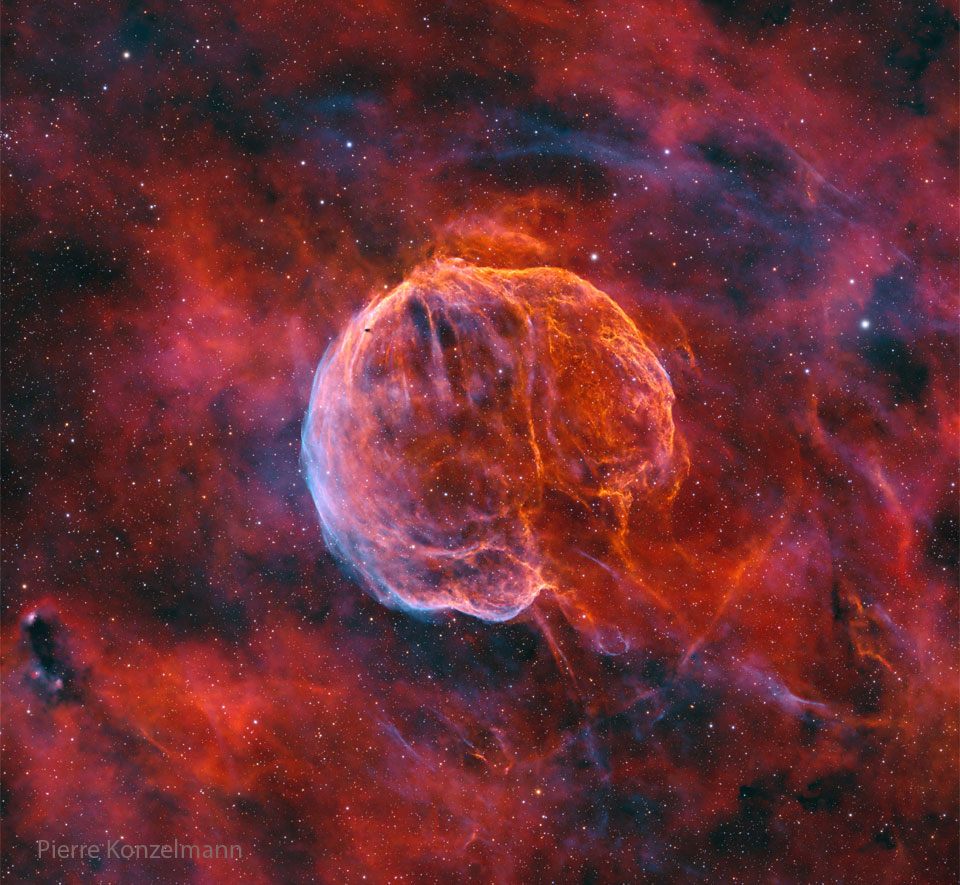 Image Credit: Pierre Konzelmann
Explanation:
What powers this unusual nebula?
CTB 1 is the expanding gas shell that was left when a massive star toward the constellation of Cassiopeia
exploded about 10,000 years ago.
The star likely detonated when it ran out of elements, near its core, that could create
stabilizing pressure with
nuclear fusion.
The resulting
supernova remnant, nicknamed the Medulla Nebula for its
brain-like shape, still glows in
visible light
because of the heat generated by its collision with confining
interstellar gas.
Why
the nebula also glows in
X-ray light, though,
remains a topic of research.
One hypothesis holds that an energetic
pulsar
was created and powers the nebula with a fast outwardly moving wind.
Following this lead, a pulsar was
found in
radio waves
that appears to have
been expelled by the
supernova explosion
at over 1000 kilometers per second.
Although the Medulla Nebula appears as large as a
full moon,
it is so faint that it took 84-hours of exposure with
a small telescope in
Texas,
USA, to create the
featured image.
#APOD #astronomy #CTB1 #MedullaNebula #nebula #celestial
Image Credit: Pierre Konzelmann
Explanation:
What powers this unusual nebula?
CTB 1 is the expanding gas shell that was left when a massive star toward the constellation of Cassiopeia
exploded about 10,000 years ago.
The star likely detonated when it ran out of elements, near its core, that could create
stabilizing pressure with
nuclear fusion.
The resulting
supernova remnant, nicknamed the Medulla Nebula for its
brain-like shape, still glows in
visible light
because of the heat generated by its collision with confining
interstellar gas.
Why
the nebula also glows in
X-ray light, though,
remains a topic of research.
One hypothesis holds that an energetic
pulsar
was created and powers the nebula with a fast outwardly moving wind.
Following this lead, a pulsar was
found in
radio waves
that appears to have
been expelled by the
supernova explosion
at over 1000 kilometers per second.
Although the Medulla Nebula appears as large as a
full moon,
it is so faint that it took 84-hours of exposure with
a small telescope in
Texas,
USA, to create the
featured image.
#APOD #astronomy #CTB1 #MedullaNebula #nebula #celestial
 Image Credit: Apollo 14, NASA, Eric M. Jones
Explanation:
Apollo 14's Lunar Module Antares
landed
on the Moon
on February 5, 1971.
Toward the end of the stay astronaut
Ed
Mitchell
snapped
a series
of photos
of the lunar surface while looking out a window,
assembled
into this detailed mosaic by
Apollo Lunar Surface Journal
editor Eric Jones.
The view looks across the
Fra Mauro
highlands
to the northwest
of the landing site after the Apollo 14 astronauts had completed
their second and final
walk on the
Moon.
Prominent in the foreground is their Modular Equipment Transporter,
a two-wheeled, rickshaw-like device used to carry tools and samples.
Near the horizon at top center is a 1.5 meter wide boulder dubbed
Turtle rock.
In the shallow crater below Turtle rock
is the long white handle of a sampling instrument,
thrown there javelin-style by Mitchell.
Mitchell's fellow moonwalker and first American in space,
Alan Shepard, also used a makeshift six iron
to hit
two
golf balls.
One of Shepard's golf balls is just visible as a white spot
below
Mitchell's javelin.
#APOD #Apollo14 #Antares #LunarModule #NASA #LunarSurface
Image Credit: Apollo 14, NASA, Eric M. Jones
Explanation:
Apollo 14's Lunar Module Antares
landed
on the Moon
on February 5, 1971.
Toward the end of the stay astronaut
Ed
Mitchell
snapped
a series
of photos
of the lunar surface while looking out a window,
assembled
into this detailed mosaic by
Apollo Lunar Surface Journal
editor Eric Jones.
The view looks across the
Fra Mauro
highlands
to the northwest
of the landing site after the Apollo 14 astronauts had completed
their second and final
walk on the
Moon.
Prominent in the foreground is their Modular Equipment Transporter,
a two-wheeled, rickshaw-like device used to carry tools and samples.
Near the horizon at top center is a 1.5 meter wide boulder dubbed
Turtle rock.
In the shallow crater below Turtle rock
is the long white handle of a sampling instrument,
thrown there javelin-style by Mitchell.
Mitchell's fellow moonwalker and first American in space,
Alan Shepard, also used a makeshift six iron
to hit
two
golf balls.
One of Shepard's golf balls is just visible as a white spot
below
Mitchell's javelin.
#APOD #Apollo14 #Antares #LunarModule #NASA #LunarSurface
 Image Credit: Justus Falk
Explanation:
These cosmic clouds have blossomed 1,300 light-years away
in the fertile starfields of the
constellation Cepheus.
Called the Iris Nebula,
NGC 7023
is not the only nebula
to evoke the imagery of flowers.
Still, this
deep telescopic image
shows off the Iris Nebula's range of colors and symmetries
embedded in surrounding fields of interstellar dust.
Within the Iris itself, dusty nebular material surrounds a hot, young
star.
The dominant color of the brighter reflection nebula is blue,
characteristic of dust grains reflecting starlight.
Central filaments
of the reflection nebula glow with a faint reddish
photoluminescence as some dust grains
effectively convert
the star's invisible ultraviolet radiation to visible red light.
Infrared
observations
indicate that this nebula contains complex carbon molecules known as
PAHs.
The dusty blue petals of the Iris Nebula span about six light-years.
#APOD #NGC7023 #IrisNebula #Cepheus #Nebula #ReflectionNebula
Image Credit: Justus Falk
Explanation:
These cosmic clouds have blossomed 1,300 light-years away
in the fertile starfields of the
constellation Cepheus.
Called the Iris Nebula,
NGC 7023
is not the only nebula
to evoke the imagery of flowers.
Still, this
deep telescopic image
shows off the Iris Nebula's range of colors and symmetries
embedded in surrounding fields of interstellar dust.
Within the Iris itself, dusty nebular material surrounds a hot, young
star.
The dominant color of the brighter reflection nebula is blue,
characteristic of dust grains reflecting starlight.
Central filaments
of the reflection nebula glow with a faint reddish
photoluminescence as some dust grains
effectively convert
the star's invisible ultraviolet radiation to visible red light.
Infrared
observations
indicate that this nebula contains complex carbon molecules known as
PAHs.
The dusty blue petals of the Iris Nebula span about six light-years.
#APOD #NGC7023 #IrisNebula #Cepheus #Nebula #ReflectionNebula
 Image Credit: Luigi Morrone
Explanation:
The dark-floored, 95 kilometer wide crater Plato and sunlit peaks of the
lunar Alps
(Montes Alpes) are highlighted in this
this
sharp telescopic snapshot of the Moon's surface.
While the Alps
of planet Earth were uplifted over millions of
years as continental plates slowly collided, the lunar Alps were likely
formed by a sudden collision that created the giant
impact basin
known as the Mare Imbrium or Sea of Rains.
The mare's generally smooth, lava-flooded floor is seen
below the bordering mountain range.
The prominent straight feature cutting through the mountains
is the lunar Alpine Valley (Vallis Alpes).
Joining the Mare Imbrium and northern Mare Frigoris (Sea of Cold)
the valley extends toward the upper right, about 160 kilometers long
and up to 10 kilometers wide.
Of course, the large, bright
lunar alpine
mountain below and right of Plato crater is named
Mont Blanc.
Lacking an atmosphere, not to mention snow,
the lunar Alps are probably not an ideal location for a winter
vacation.
Still, a 150 pound skier
would
weigh a mere 25 pounds
on the Moon.
#APOD #PlatoCrater #LunarAlps #MontesAlpes #MareImbrium #LunarValleys
Image Credit: Luigi Morrone
Explanation:
The dark-floored, 95 kilometer wide crater Plato and sunlit peaks of the
lunar Alps
(Montes Alpes) are highlighted in this
this
sharp telescopic snapshot of the Moon's surface.
While the Alps
of planet Earth were uplifted over millions of
years as continental plates slowly collided, the lunar Alps were likely
formed by a sudden collision that created the giant
impact basin
known as the Mare Imbrium or Sea of Rains.
The mare's generally smooth, lava-flooded floor is seen
below the bordering mountain range.
The prominent straight feature cutting through the mountains
is the lunar Alpine Valley (Vallis Alpes).
Joining the Mare Imbrium and northern Mare Frigoris (Sea of Cold)
the valley extends toward the upper right, about 160 kilometers long
and up to 10 kilometers wide.
Of course, the large, bright
lunar alpine
mountain below and right of Plato crater is named
Mont Blanc.
Lacking an atmosphere, not to mention snow,
the lunar Alps are probably not an ideal location for a winter
vacation.
Still, a 150 pound skier
would
weigh a mere 25 pounds
on the Moon.
#APOD #PlatoCrater #LunarAlps #MontesAlpes #MareImbrium #LunarValleys
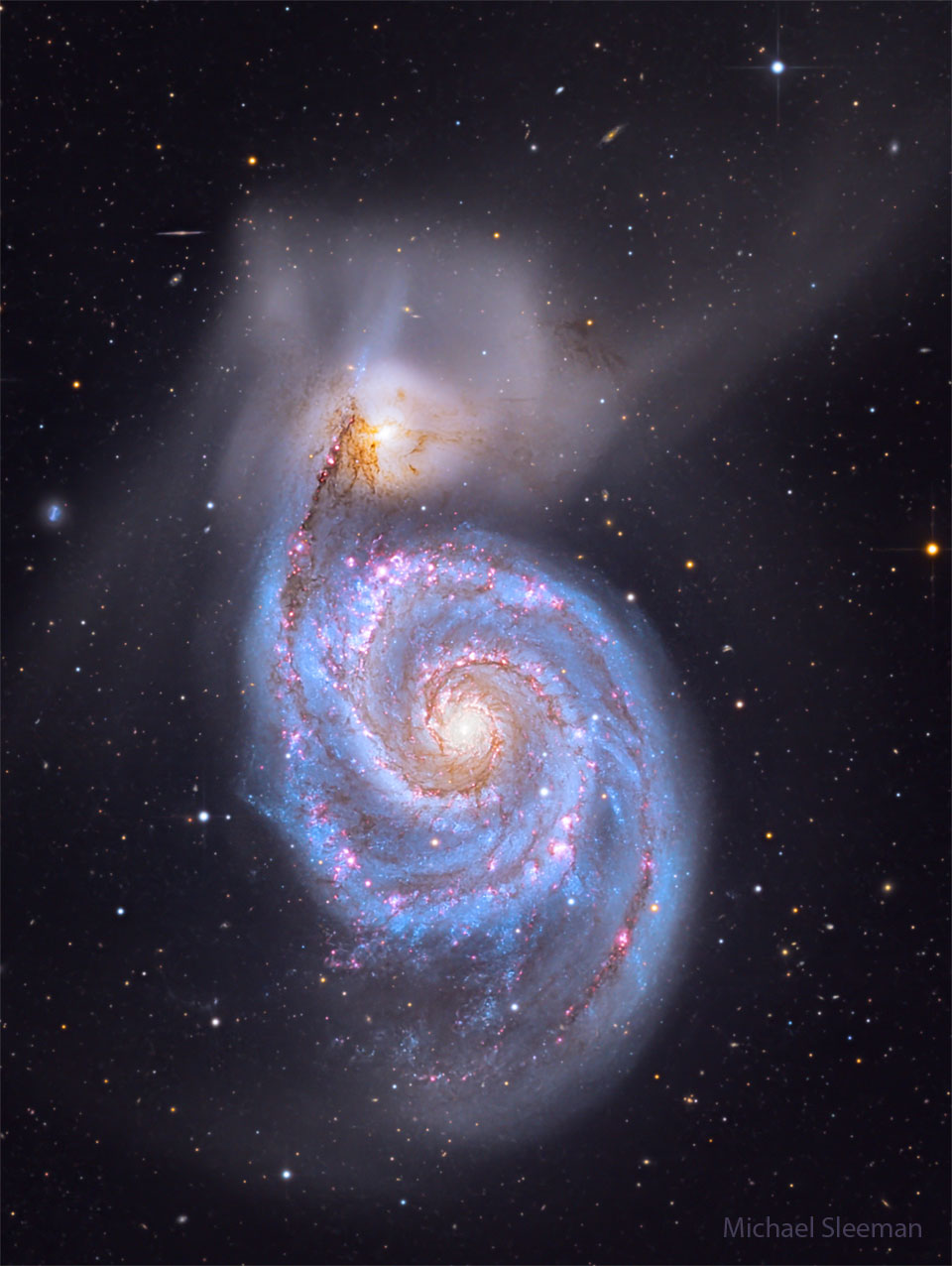 Image Credit: Michael Sleeman
Explanation:
The Whirlpool Galaxy is a classic spiral galaxy.
At only 30 million
light years distant and fully 60 thousand light years across,
M51, also known as
NGC 5194, is one of the brightest and most
picturesque galaxies on the sky.
The featured deep image
is a digital combination of images taken in different colors
over 58 hours with a
telescope from
Lijiang,
China.
Anyone with a good pair of
binoculars,
however, can see this
Whirlpool toward the constellation
of the Hunting Dogs
(Canes Venatici).
M51 is a
spiral galaxy of type Sc
and is the dominant member of a
whole group of galaxies.
Astronomers
speculate that M51's
spiral structure is primarily due to its
gravitational interaction with the
smaller galaxy just above it.
#APOD #M51 #WhirlpoolGalaxy #NGC5194 #SpiralGalaxy #Astronomy
Image Credit: Michael Sleeman
Explanation:
The Whirlpool Galaxy is a classic spiral galaxy.
At only 30 million
light years distant and fully 60 thousand light years across,
M51, also known as
NGC 5194, is one of the brightest and most
picturesque galaxies on the sky.
The featured deep image
is a digital combination of images taken in different colors
over 58 hours with a
telescope from
Lijiang,
China.
Anyone with a good pair of
binoculars,
however, can see this
Whirlpool toward the constellation
of the Hunting Dogs
(Canes Venatici).
M51 is a
spiral galaxy of type Sc
and is the dominant member of a
whole group of galaxies.
Astronomers
speculate that M51's
spiral structure is primarily due to its
gravitational interaction with the
smaller galaxy just above it.
#APOD #M51 #WhirlpoolGalaxy #NGC5194 #SpiralGalaxy #Astronomy
 Image Credit: Xu Chen
Explanation:
What's happening to this meteor?
It is shedding its outer layers as it passes through the
Earth's atmosphere and heats up.
The sudden high temperatures not only cause the bright glow along the
dramatic streak but also
melt and vaporize the
meteor's component rock and ice, creating dust.
Wind in the atmosphere typically
blows this dust away
over the next few seconds, leaving
no visible trace after only a few minutes.
Much of this dust will
eventually settle down to the
Earth.
The featured image was captured in mid-December,
coincident with the
Geminids meteor shower.
On the upper left is Sirius, the
brightest star in the night sky,
while in the foreground is fog-engulfed
Huangshan,
the Yellow Mountains of eastern
China.
#APOD #Astrogeek lookUp #Astronomy #NASA
Image Credit: Xu Chen
Explanation:
What's happening to this meteor?
It is shedding its outer layers as it passes through the
Earth's atmosphere and heats up.
The sudden high temperatures not only cause the bright glow along the
dramatic streak but also
melt and vaporize the
meteor's component rock and ice, creating dust.
Wind in the atmosphere typically
blows this dust away
over the next few seconds, leaving
no visible trace after only a few minutes.
Much of this dust will
eventually settle down to the
Earth.
The featured image was captured in mid-December,
coincident with the
Geminids meteor shower.
On the upper left is Sirius, the
brightest star in the night sky,
while in the foreground is fog-engulfed
Huangshan,
the Yellow Mountains of eastern
China.
#APOD #Astrogeek lookUp #Astronomy #NASA