
**Astronomy Picture of the Day**
16 January 2026
**Plato and the Lunar Alps**
 Image Credit: Luigi Morrone
Explanation:
The dark-floored, 95 kilometer wide crater Plato and sunlit peaks of the
lunar Alps
(Montes Alpes) are highlighted in this
this
sharp telescopic snapshot of the Moon's surface.
While the Alps
of planet Earth were uplifted over millions of
years as continental plates slowly collided, the lunar Alps were likely
formed by a sudden collision that created the giant
impact basin
known as the Mare Imbrium or Sea of Rains.
The mare's generally smooth, lava-flooded floor is seen
below the bordering mountain range.
The prominent straight feature cutting through the mountains
is the lunar Alpine Valley (Vallis Alpes).
Joining the Mare Imbrium and northern Mare Frigoris (Sea of Cold)
the valley extends toward the upper right, about 160 kilometers long
and up to 10 kilometers wide.
Of course, the large, bright
lunar alpine
mountain below and right of Plato crater is named
Mont Blanc.
Lacking an atmosphere, not to mention snow,
the lunar Alps are probably not an ideal location for a winter
vacation.
Still, a 150 pound skier
would
weigh a mere 25 pounds
on the Moon.
#APOD #PlatoCrater #LunarAlps #MontesAlpes #MareImbrium #LunarValleys
Image Credit: Luigi Morrone
Explanation:
The dark-floored, 95 kilometer wide crater Plato and sunlit peaks of the
lunar Alps
(Montes Alpes) are highlighted in this
this
sharp telescopic snapshot of the Moon's surface.
While the Alps
of planet Earth were uplifted over millions of
years as continental plates slowly collided, the lunar Alps were likely
formed by a sudden collision that created the giant
impact basin
known as the Mare Imbrium or Sea of Rains.
The mare's generally smooth, lava-flooded floor is seen
below the bordering mountain range.
The prominent straight feature cutting through the mountains
is the lunar Alpine Valley (Vallis Alpes).
Joining the Mare Imbrium and northern Mare Frigoris (Sea of Cold)
the valley extends toward the upper right, about 160 kilometers long
and up to 10 kilometers wide.
Of course, the large, bright
lunar alpine
mountain below and right of Plato crater is named
Mont Blanc.
Lacking an atmosphere, not to mention snow,
the lunar Alps are probably not an ideal location for a winter
vacation.
Still, a 150 pound skier
would
weigh a mere 25 pounds
on the Moon.
#APOD #PlatoCrater #LunarAlps #MontesAlpes #MareImbrium #LunarValleys
Image Credit: Luigi Morrone
Explanation:
The dark-floored, 95 kilometer wide crater Plato and sunlit peaks of the
lunar Alps
(Montes Alpes) are highlighted in this
this
sharp telescopic snapshot of the Moon's surface.
While the Alps
of planet Earth were uplifted over millions of
years as continental plates slowly collided, the lunar Alps were likely
formed by a sudden collision that created the giant
impact basin
known as the Mare Imbrium or Sea of Rains.
The mare's generally smooth, lava-flooded floor is seen
below the bordering mountain range.
The prominent straight feature cutting through the mountains
is the lunar Alpine Valley (Vallis Alpes).
Joining the Mare Imbrium and northern Mare Frigoris (Sea of Cold)
the valley extends toward the upper right, about 160 kilometers long
and up to 10 kilometers wide.
Of course, the large, bright
lunar alpine
mountain below and right of Plato crater is named
Mont Blanc.
Lacking an atmosphere, not to mention snow,
the lunar Alps are probably not an ideal location for a winter
vacation.
Still, a 150 pound skier
would
weigh a mere 25 pounds
on the Moon.
#APOD #PlatoCrater #LunarAlps #MontesAlpes #MareImbrium #LunarValleys
APOD: 2026 January 15 - Plato and the Lunar Alps
A different astronomy and space science
related image is featured each day, along with a brief explanation.
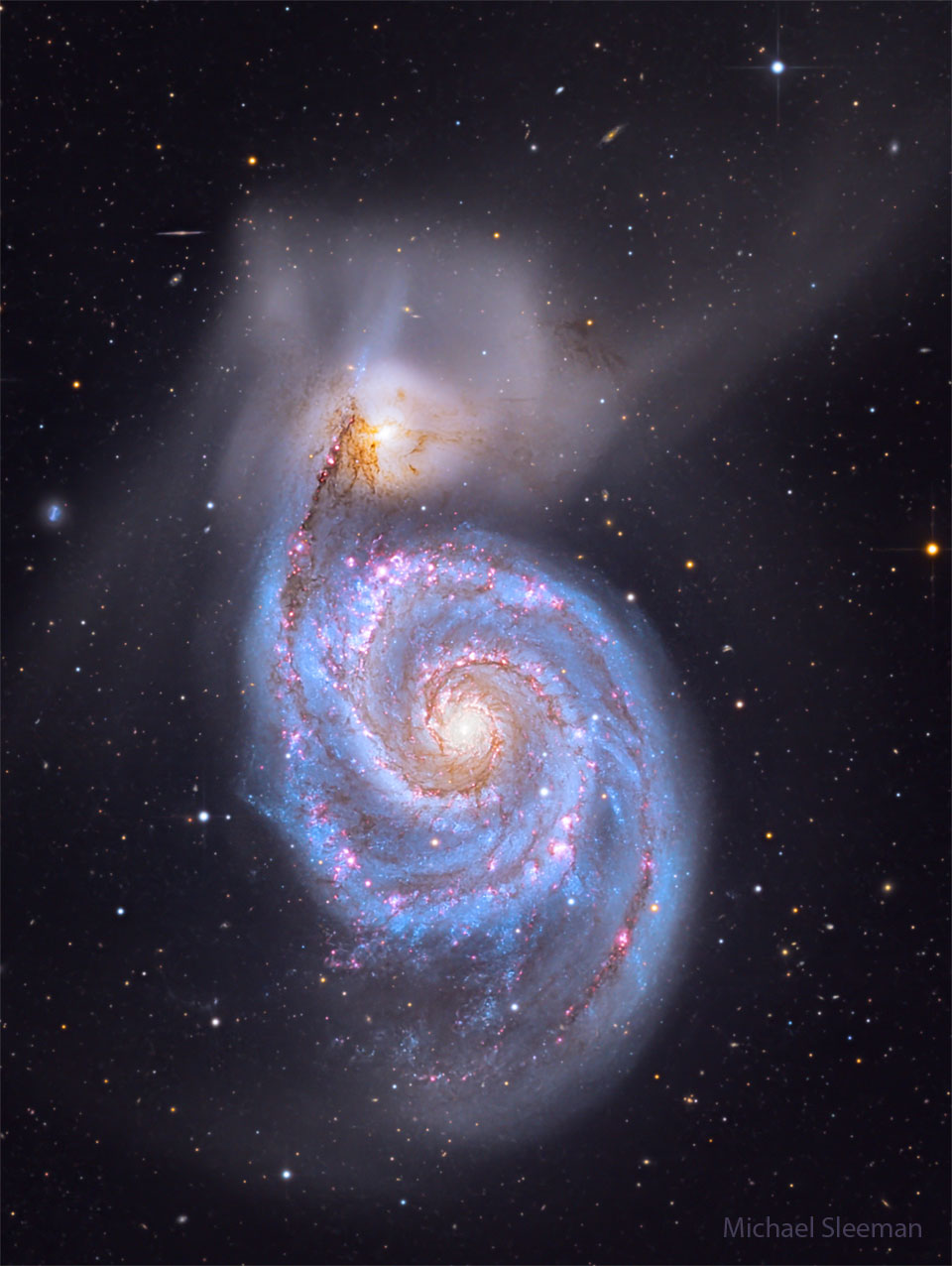 Image Credit: Michael Sleeman
Explanation:
The Whirlpool Galaxy is a classic spiral galaxy.
At only 30 million
light years distant and fully 60 thousand light years across,
M51, also known as
NGC 5194, is one of the brightest and most
picturesque galaxies on the sky.
The featured deep image
is a digital combination of images taken in different colors
over 58 hours with a
telescope from
Lijiang,
China.
Anyone with a good pair of
binoculars,
however, can see this
Whirlpool toward the constellation
of the Hunting Dogs
(Canes Venatici).
M51 is a
spiral galaxy of type Sc
and is the dominant member of a
whole group of galaxies.
Astronomers
speculate that M51's
spiral structure is primarily due to its
gravitational interaction with the
smaller galaxy just above it.
#APOD #M51 #WhirlpoolGalaxy #NGC5194 #SpiralGalaxy #Astronomy
Image Credit: Michael Sleeman
Explanation:
The Whirlpool Galaxy is a classic spiral galaxy.
At only 30 million
light years distant and fully 60 thousand light years across,
M51, also known as
NGC 5194, is one of the brightest and most
picturesque galaxies on the sky.
The featured deep image
is a digital combination of images taken in different colors
over 58 hours with a
telescope from
Lijiang,
China.
Anyone with a good pair of
binoculars,
however, can see this
Whirlpool toward the constellation
of the Hunting Dogs
(Canes Venatici).
M51 is a
spiral galaxy of type Sc
and is the dominant member of a
whole group of galaxies.
Astronomers
speculate that M51's
spiral structure is primarily due to its
gravitational interaction with the
smaller galaxy just above it.
#APOD #M51 #WhirlpoolGalaxy #NGC5194 #SpiralGalaxy #Astronomy