
**Astronomy Picture of the Day**
12 January 2026
**M104: The Sombrero Galaxy in Infrared**
 Image Credit: NASA, JPL, Caltech, SSC, R. Kennicutt, Steward Obs.
Explanation:
This floating ring is the size of a galaxy.
In fact, it is a galaxy -- or at least part of one: the photogenic
Sombrero Galaxy,
one of the largest galaxies in the nearby
Virgo Cluster of Galaxies.
The dark band of
dust that obscures the mid-section of the
Sombrero Galaxy in
visible light actually
glows brightly in
infrared light.
The featured image, digitally
sharpened, shows the
infrared glow, recently recorded by the orbiting
Spitzer Space Telescope, superposed in false-color on an
existing image taken by
NASA's Hubble Space Telescope in
visible light.
The Sombrero
Galaxy, also known as
M104, spans about 50,000
light years and lies 28 million light years away.
M104
can be seen with a small telescope in the direction of the
constellation Virgo.
#APOD #Astroeducation #Cosmos #Science #NASAInspires
Image Credit: NASA, JPL, Caltech, SSC, R. Kennicutt, Steward Obs.
Explanation:
This floating ring is the size of a galaxy.
In fact, it is a galaxy -- or at least part of one: the photogenic
Sombrero Galaxy,
one of the largest galaxies in the nearby
Virgo Cluster of Galaxies.
The dark band of
dust that obscures the mid-section of the
Sombrero Galaxy in
visible light actually
glows brightly in
infrared light.
The featured image, digitally
sharpened, shows the
infrared glow, recently recorded by the orbiting
Spitzer Space Telescope, superposed in false-color on an
existing image taken by
NASA's Hubble Space Telescope in
visible light.
The Sombrero
Galaxy, also known as
M104, spans about 50,000
light years and lies 28 million light years away.
M104
can be seen with a small telescope in the direction of the
constellation Virgo.
#APOD #Astroeducation #Cosmos #Science #NASAInspires
Image Credit: NASA, JPL, Caltech, SSC, R. Kennicutt, Steward Obs.
Explanation:
This floating ring is the size of a galaxy.
In fact, it is a galaxy -- or at least part of one: the photogenic
Sombrero Galaxy,
one of the largest galaxies in the nearby
Virgo Cluster of Galaxies.
The dark band of
dust that obscures the mid-section of the
Sombrero Galaxy in
visible light actually
glows brightly in
infrared light.
The featured image, digitally
sharpened, shows the
infrared glow, recently recorded by the orbiting
Spitzer Space Telescope, superposed in false-color on an
existing image taken by
NASA's Hubble Space Telescope in
visible light.
The Sombrero
Galaxy, also known as
M104, spans about 50,000
light years and lies 28 million light years away.
M104
can be seen with a small telescope in the direction of the
constellation Virgo.
#APOD #Astroeducation #Cosmos #Science #NASAInspires
APOD: 2026 January 11 – M104: The Sombrero Galaxy in Infrared
A different astronomy and space science
related image is featured each day, along with a brief explanation.
 Image Credit: Christopher Go
Explanation:
Jupiter reaches
its 2026 opposition today, January 10.
That puts our Solar System's
most massive planet
opposite the
Sun and near its closest and brightest for viewing from planet Earth.
In fact, captured only 3 days ago this sharp
telescopic snapshot
reveals excellent details of the ruling gas giant's
swirling cloudtops,
in light zones and dark belts girdling the
rapidly rotating outer planet.
Jupiter's famous, persistent anticyclonic vortex, known as the
Great Red Spot,
is south of the equator at the lower right.
But two smaller red spots are also visible, one near the top in the
northernmost zone, and one close to Jupiter's south pole.
And while Jupiter's Great Red Spot is
known to be shrinking,
it's still about the size of the Earth itself.
#APOD #Jupiter #GreatRedSpot #SolarSystem #Opposition2026 #SpaceObservation
Image Credit: Christopher Go
Explanation:
Jupiter reaches
its 2026 opposition today, January 10.
That puts our Solar System's
most massive planet
opposite the
Sun and near its closest and brightest for viewing from planet Earth.
In fact, captured only 3 days ago this sharp
telescopic snapshot
reveals excellent details of the ruling gas giant's
swirling cloudtops,
in light zones and dark belts girdling the
rapidly rotating outer planet.
Jupiter's famous, persistent anticyclonic vortex, known as the
Great Red Spot,
is south of the equator at the lower right.
But two smaller red spots are also visible, one near the top in the
northernmost zone, and one close to Jupiter's south pole.
And while Jupiter's Great Red Spot is
known to be shrinking,
it's still about the size of the Earth itself.
#APOD #Jupiter #GreatRedSpot #SolarSystem #Opposition2026 #SpaceObservation
 Image Credit & Copyright: Jeff Dai
The Full Moon is the brightest lunar phase, and tonight you can stand in the light of the first Full Moon of 2026. In fact, the Moon's full phase occurs on January 3 at 10:03 UTC, while only about 7 hours later planet Earth reaches its 2026 perihelion, the closest point in its elliptical orbit around the Sun, at 17:16 UTC. January's Full Moon was also not far from its own perigee, or closest approach to planet Earth. For this lunation the Moon's perigee was on January 1 at 21:44 UTC. You can also spot planet Jupiter, near its brightest for 2026 and close on the sky to the Full Moon tonight. But while you're out skygazing don't forget to look for rare, bright fireballs from the Quadrantid meteor shower.
#APOD #Astroeducation #Astroengineering #SpaceTech #Cosmology
Image Credit & Copyright: Jeff Dai
The Full Moon is the brightest lunar phase, and tonight you can stand in the light of the first Full Moon of 2026. In fact, the Moon's full phase occurs on January 3 at 10:03 UTC, while only about 7 hours later planet Earth reaches its 2026 perihelion, the closest point in its elliptical orbit around the Sun, at 17:16 UTC. January's Full Moon was also not far from its own perigee, or closest approach to planet Earth. For this lunation the Moon's perigee was on January 1 at 21:44 UTC. You can also spot planet Jupiter, near its brightest for 2026 and close on the sky to the Full Moon tonight. But while you're out skygazing don't forget to look for rare, bright fireballs from the Quadrantid meteor shower.
#APOD #Astroeducation #Astroengineering #SpaceTech #Cosmology
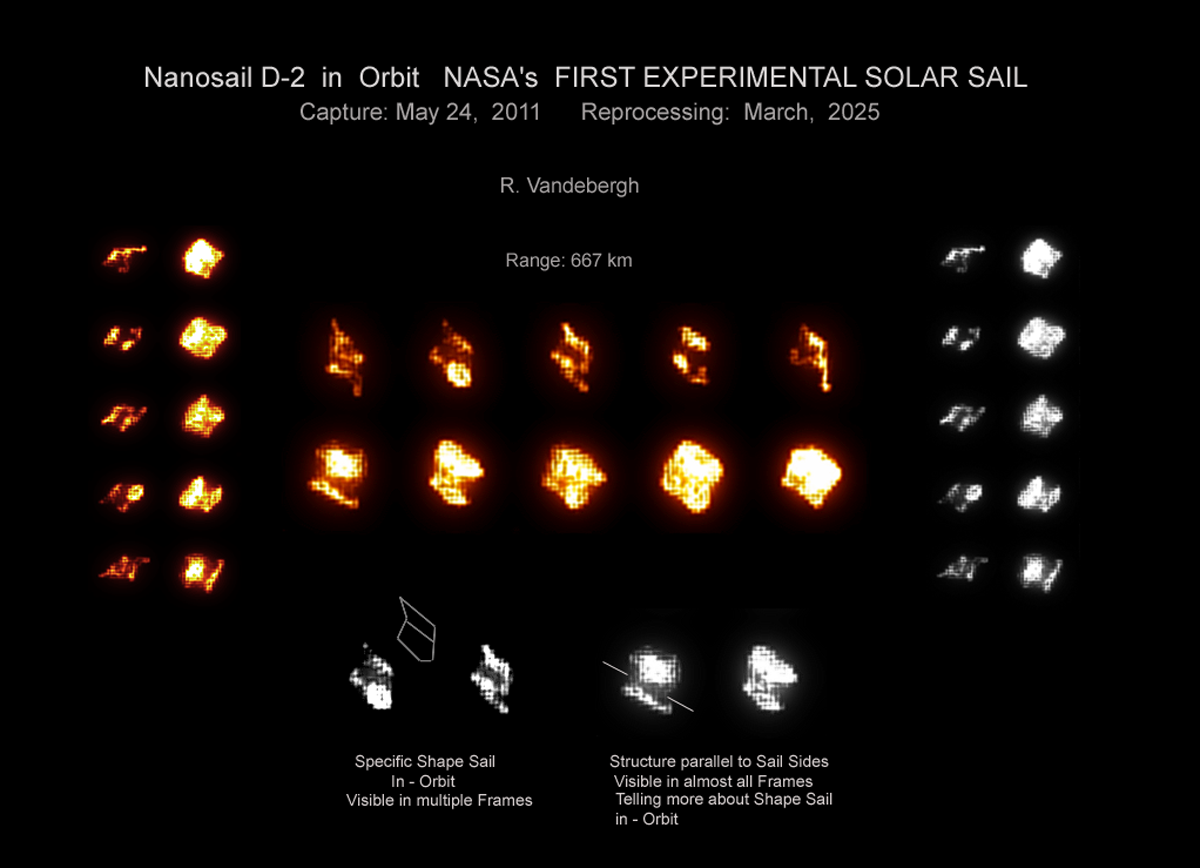 Image Credit & Copyright: Ralf Vandebergh
In 2011, on January 20, NASA's NanoSail-D2 unfurled a very thin and very reflective 10 square meter sail becoming the first solar sail spacecraft in low Earth orbit. Often considered the stuff of science fiction, sailing through space was suggested 400 years ago by astronomer Johannes Kepler, who had observed comet tails blown by the solar wind. But modern solar sail spacecraft designs, like NanoSail-D2, Japan's interplanetary spacecraft IKAROS, or the Planetary Society's Lightsail A, rely on the small but continuous pressure from sunlight itself for thrust. Glinting in the sunlight as it circled planet Earth, NanoSail-D2's solar sail was periodically bright and visible to the eye. These remarkably detailed images were captured by manually tracking the orbiting solar sail spacecraft with a small telescope.
#APOD #SpaceAdventures #Stellar #Planets #MeteorShowers
Image Credit & Copyright: Ralf Vandebergh
In 2011, on January 20, NASA's NanoSail-D2 unfurled a very thin and very reflective 10 square meter sail becoming the first solar sail spacecraft in low Earth orbit. Often considered the stuff of science fiction, sailing through space was suggested 400 years ago by astronomer Johannes Kepler, who had observed comet tails blown by the solar wind. But modern solar sail spacecraft designs, like NanoSail-D2, Japan's interplanetary spacecraft IKAROS, or the Planetary Society's Lightsail A, rely on the small but continuous pressure from sunlight itself for thrust. Glinting in the sunlight as it circled planet Earth, NanoSail-D2's solar sail was periodically bright and visible to the eye. These remarkably detailed images were captured by manually tracking the orbiting solar sail spacecraft with a small telescope.
#APOD #SpaceAdventures #Stellar #Planets #MeteorShowers