
**Astronomy Picture of the Day**
25 December 2025
**Unicorn, Fox Fur and Christmas Tree**
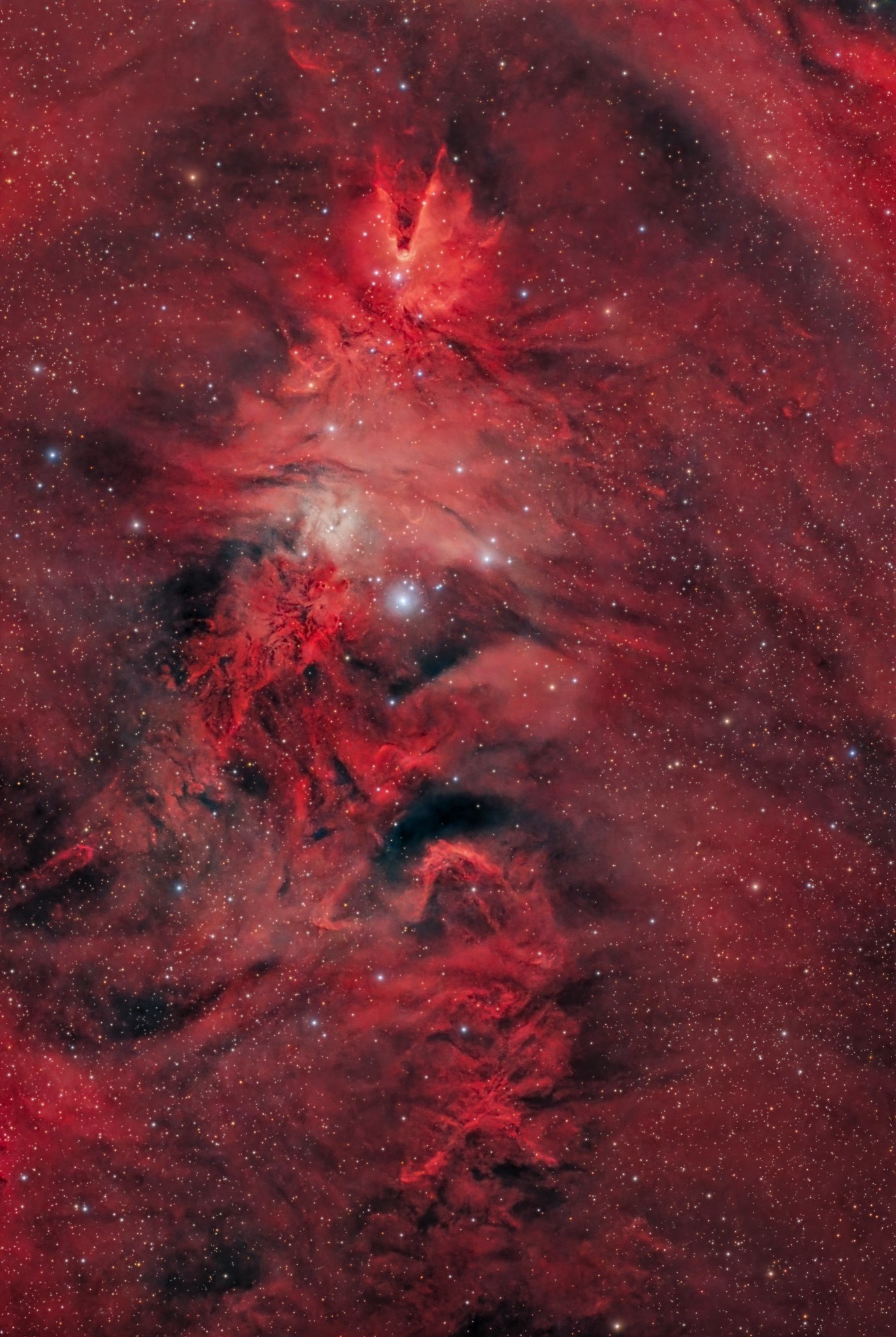 Image Credit & Copyright: Michael Kalika
A star forming region cataloged as NGC 2264, this beautiful but complex arrangement of interstellar gas and dust is about 2,700 light-years distant in the faint but fanciful constellation Monoceros, the Unicorn. Seen toward the celestial equator and near the plane of our Milky Way galaxy, the seasonal skyscape mixes reddish emission nebulae excited by energetic light from newborn stars with dark interstellar dust clouds. Where the otherwise obscuring dust clouds lie close to the hot, young stars, they also reflect starlight, forming blue reflection nebulae. In fact, bright variable star S Monocerotis is immersed in a blue-tinted haze near center. Arrayed with a simple triangular outline above S Monocerotis, the stars of NGC 2264 are popularly known as the Christmas Tree star cluster. Carved by energetic starlight, the Cone Nebula sits upside down at the apex of this cosmic Christmas tree while the dusty, convoluted pelt of glowing gas and dust under the tree is called the Fox Fur Nebula. This rich telescopic frame spans about 1.5 degrees or 3 full moons on the sky top to bottom, covering nearly 80 light-years at the distance of NGC 2264.
#APOD #Meteorology #Exploration #Space #SpaceMission
Image Credit & Copyright: Michael Kalika
A star forming region cataloged as NGC 2264, this beautiful but complex arrangement of interstellar gas and dust is about 2,700 light-years distant in the faint but fanciful constellation Monoceros, the Unicorn. Seen toward the celestial equator and near the plane of our Milky Way galaxy, the seasonal skyscape mixes reddish emission nebulae excited by energetic light from newborn stars with dark interstellar dust clouds. Where the otherwise obscuring dust clouds lie close to the hot, young stars, they also reflect starlight, forming blue reflection nebulae. In fact, bright variable star S Monocerotis is immersed in a blue-tinted haze near center. Arrayed with a simple triangular outline above S Monocerotis, the stars of NGC 2264 are popularly known as the Christmas Tree star cluster. Carved by energetic starlight, the Cone Nebula sits upside down at the apex of this cosmic Christmas tree while the dusty, convoluted pelt of glowing gas and dust under the tree is called the Fox Fur Nebula. This rich telescopic frame spans about 1.5 degrees or 3 full moons on the sky top to bottom, covering nearly 80 light-years at the distance of NGC 2264.
#APOD #Meteorology #Exploration #Space #SpaceMission
Image Credit & Copyright: Michael Kalika
A star forming region cataloged as NGC 2264, this beautiful but complex arrangement of interstellar gas and dust is about 2,700 light-years distant in the faint but fanciful constellation Monoceros, the Unicorn. Seen toward the celestial equator and near the plane of our Milky Way galaxy, the seasonal skyscape mixes reddish emission nebulae excited by energetic light from newborn stars with dark interstellar dust clouds. Where the otherwise obscuring dust clouds lie close to the hot, young stars, they also reflect starlight, forming blue reflection nebulae. In fact, bright variable star S Monocerotis is immersed in a blue-tinted haze near center. Arrayed with a simple triangular outline above S Monocerotis, the stars of NGC 2264 are popularly known as the Christmas Tree star cluster. Carved by energetic starlight, the Cone Nebula sits upside down at the apex of this cosmic Christmas tree while the dusty, convoluted pelt of glowing gas and dust under the tree is called the Fox Fur Nebula. This rich telescopic frame spans about 1.5 degrees or 3 full moons on the sky top to bottom, covering nearly 80 light-years at the distance of NGC 2264.
#APOD #Meteorology #Exploration #Space #SpaceMission
APOD: 2025 December 25 - Unicorn, Fox Fur and Christmas Tree
A different astronomy and space science
related image is featured each day, along with a brief explanation.
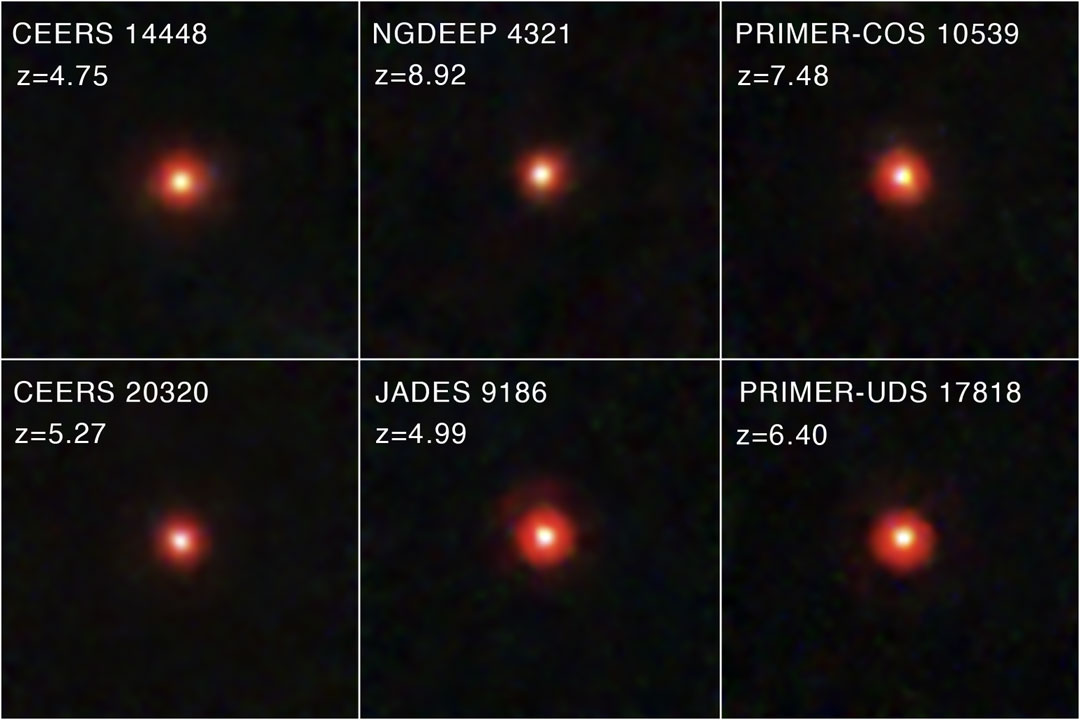 *Image creditor details unavailable via API. Visit linked page below for full info.*
What are these little red dots (LRDs)? Nobody knows. Discovered only last year, hundreds of LRDs have now been found by the James Webb Space Telescope in the early universe. Although extremely faint, LRDs are now frequently identified in deep observations made for other purposes. A wide-ranging debate is raging about what LRDs may be and what importance they may have. Possible origin hypotheses include accreting supermassive black holes inside clouds of gas and dust, bursts of star formation in young dust-reddened galaxies, and dark matter powered gas clouds. The highlighted images show six nearly featureless LRDs listed under the JWST program that found them, and z, a distance indicator called cosmological redshift. Additionally, searches are underway in our nearby universe to try to find whatever previous LRDs might have become today.
#APOD #PlanetaryScience #Astrophysics #SpaceAdventures #Astroenthusiast
*Image creditor details unavailable via API. Visit linked page below for full info.*
What are these little red dots (LRDs)? Nobody knows. Discovered only last year, hundreds of LRDs have now been found by the James Webb Space Telescope in the early universe. Although extremely faint, LRDs are now frequently identified in deep observations made for other purposes. A wide-ranging debate is raging about what LRDs may be and what importance they may have. Possible origin hypotheses include accreting supermassive black holes inside clouds of gas and dust, bursts of star formation in young dust-reddened galaxies, and dark matter powered gas clouds. The highlighted images show six nearly featureless LRDs listed under the JWST program that found them, and z, a distance indicator called cosmological redshift. Additionally, searches are underway in our nearby universe to try to find whatever previous LRDs might have become today.
#APOD #PlanetaryScience #Astrophysics #SpaceAdventures #Astroenthusiast
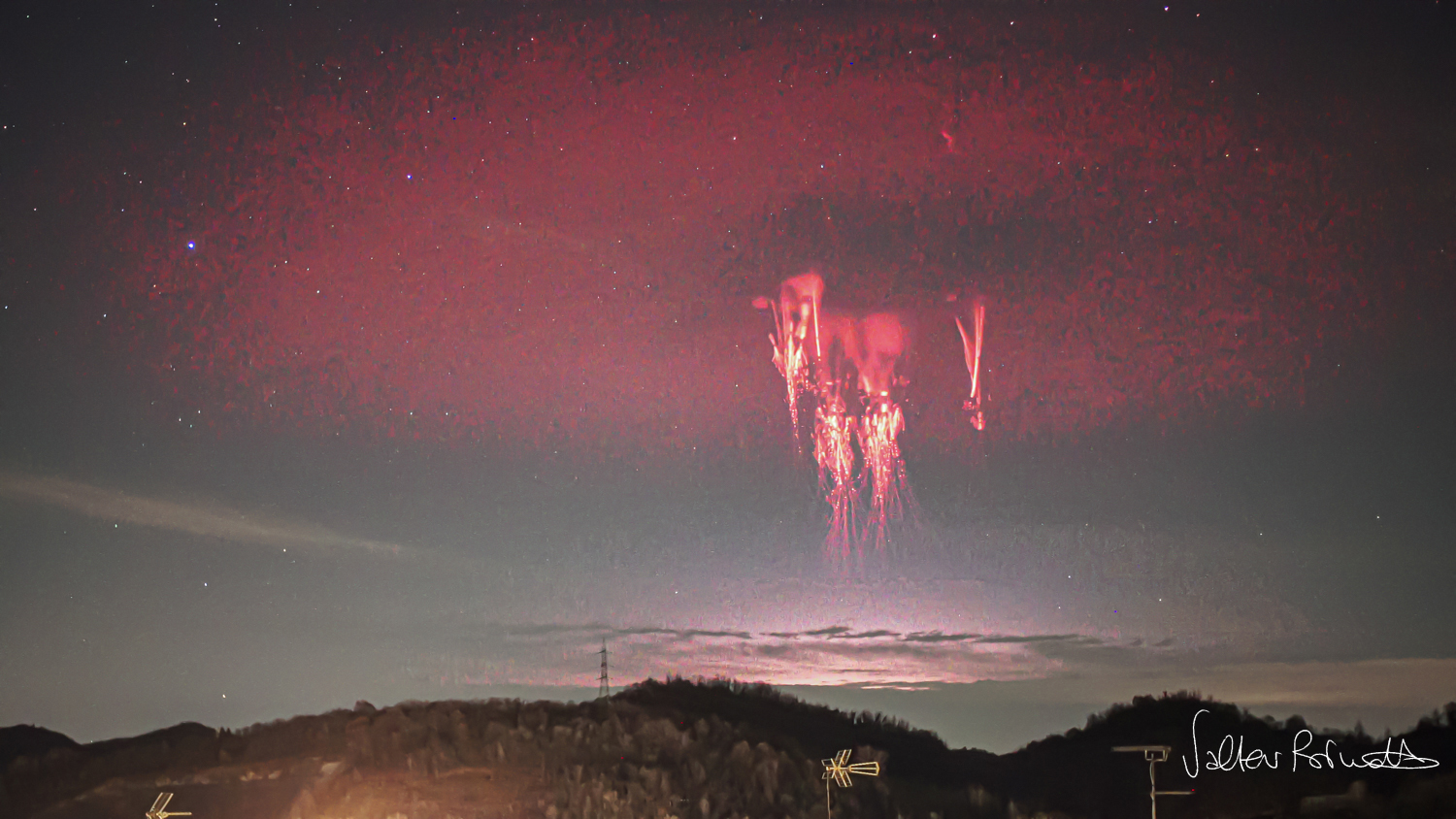 Image Credit & Copyright:
Valter Binotto
What's happening in the sky? Lightning. The most commonly seen type of lightning involves flashes of bright white light between clouds. Over the past 50 years, though, other types of upper-atmospheric lightning have been confirmed, including tentacled red sprites and ringed ELVES. Although both last only a small fraction of a second, sprites are brighter and easier to photograph than their more common electrical-discharge cousins. ELVES are rapidly expanding rings that are thought to be created when an electromagnetic pulse shoots upward from charged clouds and impacts the ionosphere, causing nitrogen molecules to glow. Capturing either form of lightning takes patience and experience -- capturing them both together, since they usually occur separately, is rare. The featured image is a frame from a video recorded from Possagno, Italy late last month above a distant thunderstorm over the Adriatic Sea.
#APOD #PlanetaryScience #Planets #Astrodata #SpaceMission
Image Credit & Copyright:
Valter Binotto
What's happening in the sky? Lightning. The most commonly seen type of lightning involves flashes of bright white light between clouds. Over the past 50 years, though, other types of upper-atmospheric lightning have been confirmed, including tentacled red sprites and ringed ELVES. Although both last only a small fraction of a second, sprites are brighter and easier to photograph than their more common electrical-discharge cousins. ELVES are rapidly expanding rings that are thought to be created when an electromagnetic pulse shoots upward from charged clouds and impacts the ionosphere, causing nitrogen molecules to glow. Capturing either form of lightning takes patience and experience -- capturing them both together, since they usually occur separately, is rare. The featured image is a frame from a video recorded from Possagno, Italy late last month above a distant thunderstorm over the Adriatic Sea.
#APOD #PlanetaryScience #Planets #Astrodata #SpaceMission
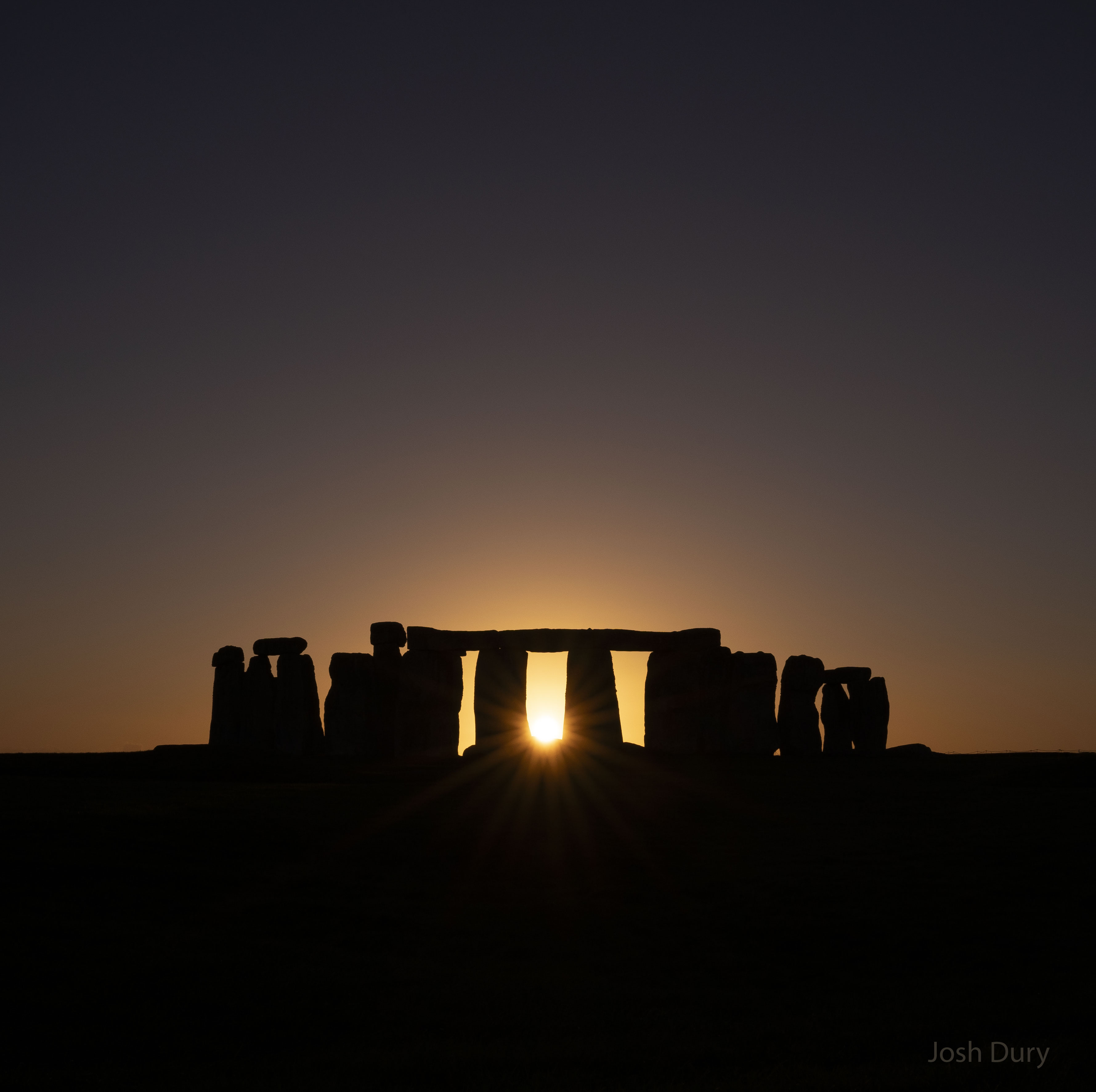 Image Credit & Copyright:
English Heritage,
Josh Dury
Yesterday the Sun reached its southernmost point in planet Earth's sky. Called a solstice, many cultures mark yesterday's date as a change of seasons -- from autumn to winter in Earth's Northern Hemisphere and from spring to summer in Earth's Southern Hemisphere. The featured image was taken just before the longest night of the 2025 northern year at Stonehenge in United Kingdom. There, through stones precisely placed 4,500 years ago, a 4.5 billion year old large glowing orb is seen setting. Even given the precession of the Earth's rotational axis over the millennia, the Sun continues to set over Stonehenge in an astronomically significant way.
#APOD #Astrophotography #Exoplanets #SpaceResearch #LunarMission
Image Credit & Copyright:
English Heritage,
Josh Dury
Yesterday the Sun reached its southernmost point in planet Earth's sky. Called a solstice, many cultures mark yesterday's date as a change of seasons -- from autumn to winter in Earth's Northern Hemisphere and from spring to summer in Earth's Southern Hemisphere. The featured image was taken just before the longest night of the 2025 northern year at Stonehenge in United Kingdom. There, through stones precisely placed 4,500 years ago, a 4.5 billion year old large glowing orb is seen setting. Even given the precession of the Earth's rotational axis over the millennia, the Sun continues to set over Stonehenge in an astronomically significant way.
#APOD #Astrophotography #Exoplanets #SpaceResearch #LunarMission
 Image Credit & Copyright: Marcella Pace
The word solstice is from the Latin for Sun and to pause or stand still. And in the days surrounding a solstice the Sun's annual north-south drift in planet Earth's sky does slow down, pause, and then reverse direction. So near the solstice the daily path of the Sun through the sky really doesn't change much. In fact, near the December solstice, the Sun's consistent, low arc through northern hemisphere skies, along with low surface temperatures, has left a noticeable imprint on this path to the mountain town of Peaio in northern Italy. The morning frost on the road has melted away only where the sunlight was able to reach the ground. But it remains in the areas persistently shadowed by the fence, tattooing in frost an image of the fence on the asphalt surface.
#APOD #Cosmological #SpaceMission #SpaceTech #PlanetExploration
Image Credit & Copyright: Marcella Pace
The word solstice is from the Latin for Sun and to pause or stand still. And in the days surrounding a solstice the Sun's annual north-south drift in planet Earth's sky does slow down, pause, and then reverse direction. So near the solstice the daily path of the Sun through the sky really doesn't change much. In fact, near the December solstice, the Sun's consistent, low arc through northern hemisphere skies, along with low surface temperatures, has left a noticeable imprint on this path to the mountain town of Peaio in northern Italy. The morning frost on the road has melted away only where the sunlight was able to reach the ground. But it remains in the areas persistently shadowed by the fence, tattooing in frost an image of the fence on the asphalt surface.
#APOD #Cosmological #SpaceMission #SpaceTech #PlanetExploration
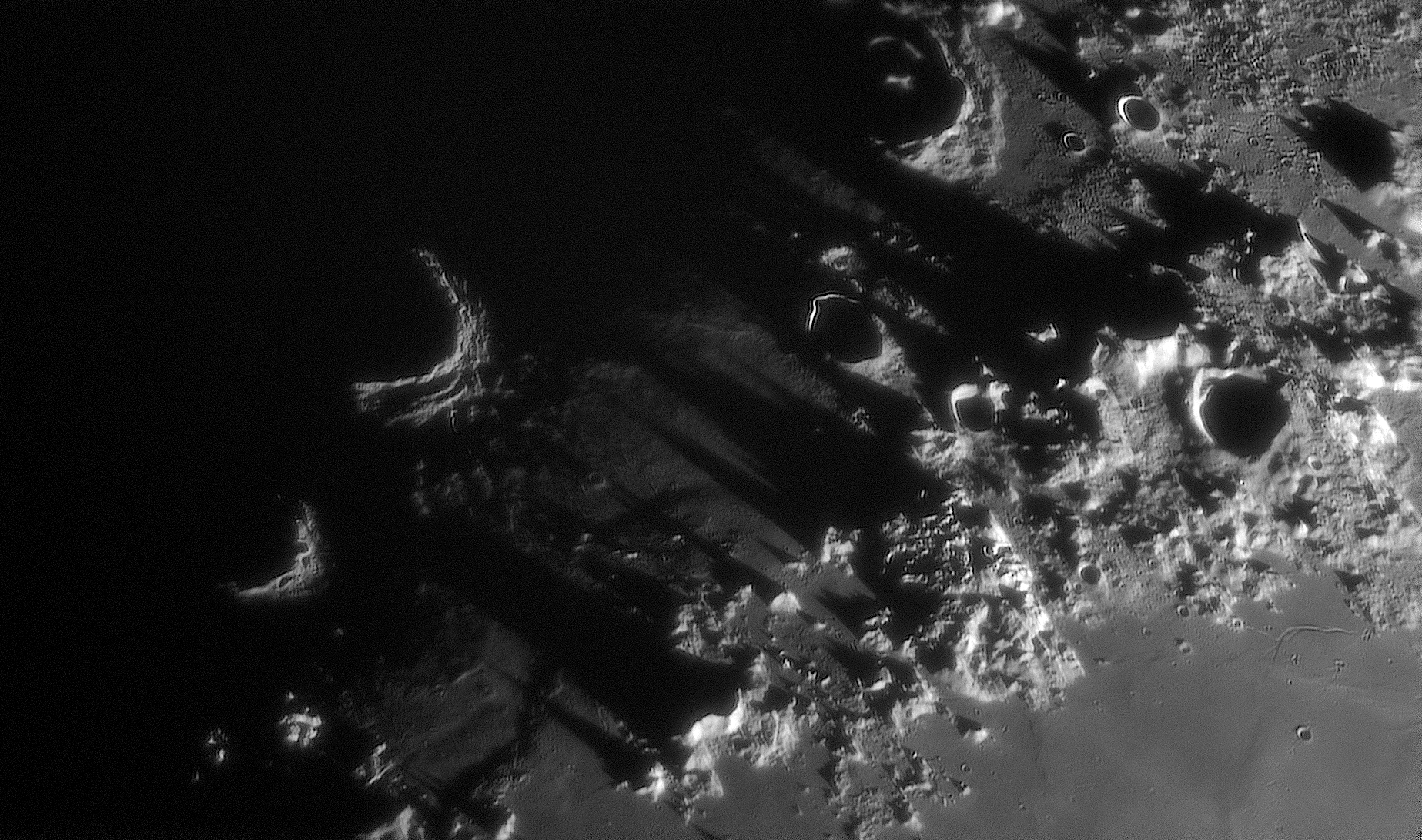 Image Credit & Copyright: When the Moon
When the Moon is at its first quarter phase, the Sun rises along the Montes Caucasus as seen from the lunar surface. The lunar mountain range casts the magnificent, spire-like shadows in this telescopic view from planet Earth, looking along the lunar terminator or the boundary between lunar night and day. Named for Earth's own Caucasus Mountains, the rugged lunar Montes Caucasus peaks, up to 6 kilometers high, are located between the smooth Mare Imbrium to the west and Mare Serenitatis to the east. Still mostly in shadow in this first quarter lunarscape, at the left (west) impact craters reflect the light of the rising Sun along their outer, eastern crater walls.
#APOD #Astrophysics #Astrospace #Planetarium #Astrobiology
Image Credit & Copyright: When the Moon
When the Moon is at its first quarter phase, the Sun rises along the Montes Caucasus as seen from the lunar surface. The lunar mountain range casts the magnificent, spire-like shadows in this telescopic view from planet Earth, looking along the lunar terminator or the boundary between lunar night and day. Named for Earth's own Caucasus Mountains, the rugged lunar Montes Caucasus peaks, up to 6 kilometers high, are located between the smooth Mare Imbrium to the west and Mare Serenitatis to the east. Still mostly in shadow in this first quarter lunarscape, at the left (west) impact craters reflect the light of the rising Sun along their outer, eastern crater walls.
#APOD #Astrophysics #Astrospace #Planetarium #Astrobiology
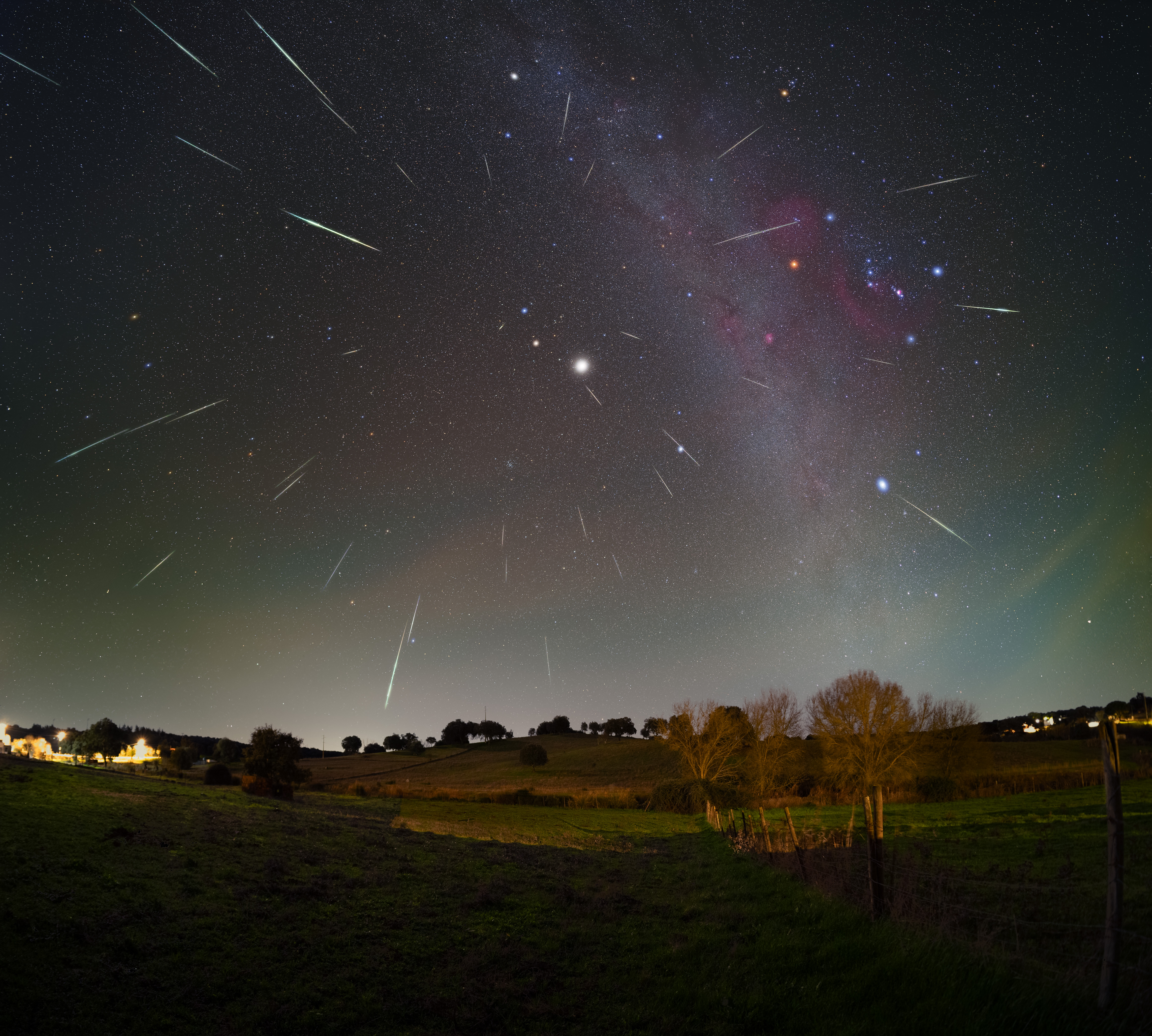 Image Credit & Copyright: David Cruz
Jupiter, the Solar System's ruling gas giant, is the brightest celestial beacon at the center of this composite night skyscape. The scene was constructed by selecting the 40 exposures containing meteors from about 500 exposures made on the nights of December 13 and 14, near peak activity for this year's annual Geminid meteor shower. With each selected exposure registered in the night sky above Alentejo, Portugal, planet Earth, it does look like the meteors are streaming away from Jupiter. But the apparent radiant of the Geminid meteors is actually closer to bright star Castor, in the shower's eponymous constellation Gemini. In this frame that's just a little above and left of the Solar System's most massive planet. Still, the parent body of Geminid meteors is known to be rocky, near-Earth asteroid 3200 Phaethon. And the orbit of Phaethon itself is influenced by the gravitational attraction exerted by massive Jupiter, in concert with planets of the inner Solar System.
#APOD #Astrobiology #SpaceResearch #SpaceResearch #OuterSpace
Image Credit & Copyright: David Cruz
Jupiter, the Solar System's ruling gas giant, is the brightest celestial beacon at the center of this composite night skyscape. The scene was constructed by selecting the 40 exposures containing meteors from about 500 exposures made on the nights of December 13 and 14, near peak activity for this year's annual Geminid meteor shower. With each selected exposure registered in the night sky above Alentejo, Portugal, planet Earth, it does look like the meteors are streaming away from Jupiter. But the apparent radiant of the Geminid meteors is actually closer to bright star Castor, in the shower's eponymous constellation Gemini. In this frame that's just a little above and left of the Solar System's most massive planet. Still, the parent body of Geminid meteors is known to be rocky, near-Earth asteroid 3200 Phaethon. And the orbit of Phaethon itself is influenced by the gravitational attraction exerted by massive Jupiter, in concert with planets of the inner Solar System.
#APOD #Astrobiology #SpaceResearch #SpaceResearch #OuterSpace
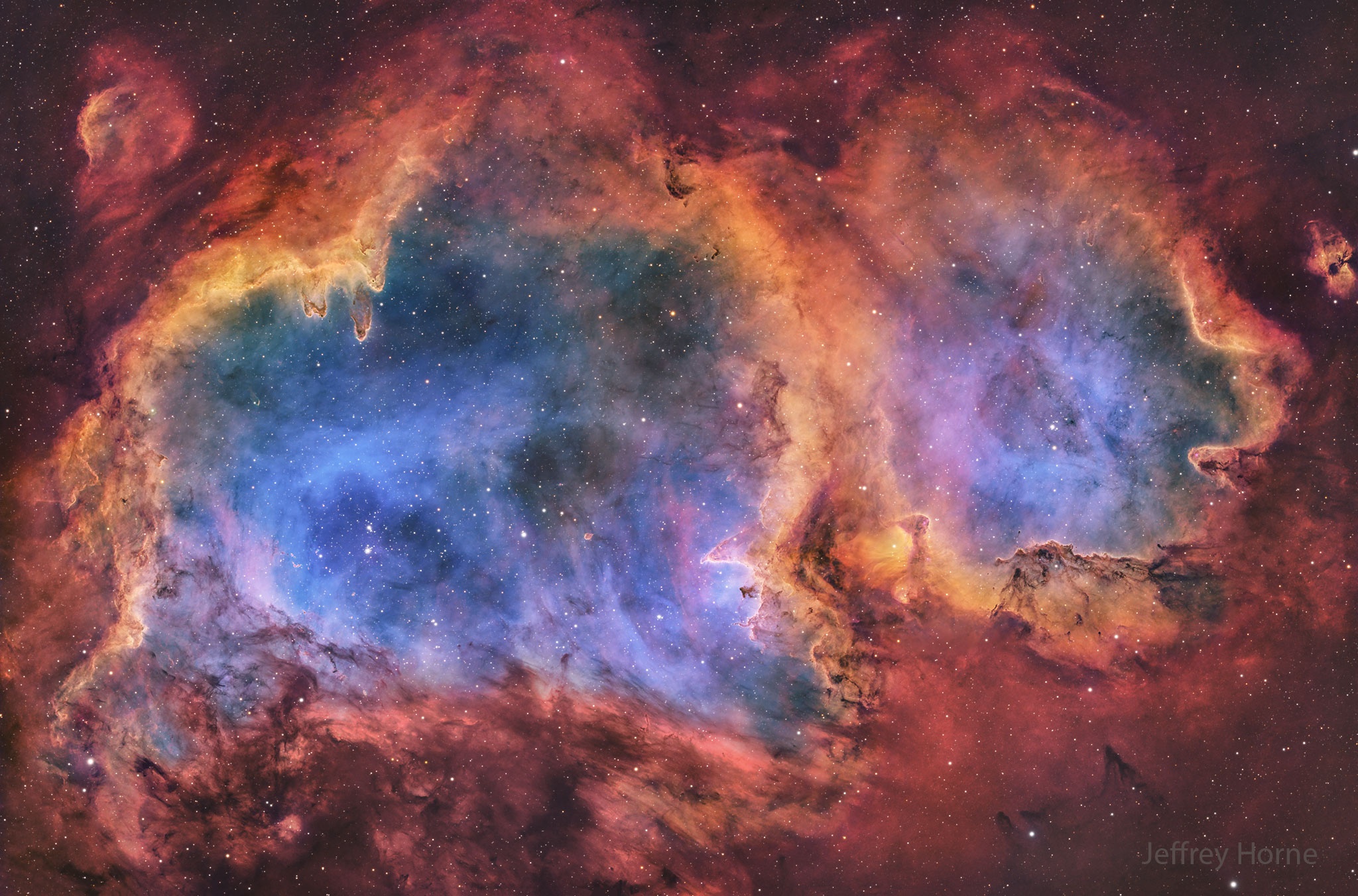 Image Credit & Copyright:
Jeffrey Horne
Stars are forming in the Soul of the Queen of Aethopia. More specifically, a large star forming region called the Soul Nebula can be found in the direction of the constellation Cassiopeia, whom Greek mythology credits as the vain wife of a King who long ago ruled lands surrounding the upper Nile river. Also known as Westerhout 5 (W5), the Soul Nebula houses several open clusters of stars, ridges and pillars darkened by cosmic dust, and huge evacuated bubbles formed by the winds of young massive stars. Located about 6,500 light years away, the Soul Nebula spans about 100 light years and is usually imaged next to its celestial neighbor the Heart Nebula (IC 1805). The featured image, taken from near Nashville, Tennessee, USA, is a composite of 234 hours of exposures made in different colors: red as emitted by hydrogen gas, yellow as emitted by sulfur, and blue as emitted by oxygen. Explore the Universe: Random APOD Generator
#APOD #Astrozone #SpaceMission #SpaceFacts #RocketScience
Image Credit & Copyright:
Jeffrey Horne
Stars are forming in the Soul of the Queen of Aethopia. More specifically, a large star forming region called the Soul Nebula can be found in the direction of the constellation Cassiopeia, whom Greek mythology credits as the vain wife of a King who long ago ruled lands surrounding the upper Nile river. Also known as Westerhout 5 (W5), the Soul Nebula houses several open clusters of stars, ridges and pillars darkened by cosmic dust, and huge evacuated bubbles formed by the winds of young massive stars. Located about 6,500 light years away, the Soul Nebula spans about 100 light years and is usually imaged next to its celestial neighbor the Heart Nebula (IC 1805). The featured image, taken from near Nashville, Tennessee, USA, is a composite of 234 hours of exposures made in different colors: red as emitted by hydrogen gas, yellow as emitted by sulfur, and blue as emitted by oxygen. Explore the Universe: Random APOD Generator
#APOD #Astrozone #SpaceMission #SpaceFacts #RocketScience
 Image Credit & Copyright:
JJ Rao
What’s happening over that tree? Two very different things. On the left is the Andromeda galaxy, an object that is older than humanity and will last billions of years into the future. Andromeda (M31) is similar in size and shape to our own Milky Way Galaxy. On the right is a red sprite, a type of lightning that lasts a fraction of a second and occurs above violent thunderstorms. Red sprites were verified as real atmospheric phenomena only about 35 years ago. The tree in the center is a boab, which may live for as long as a thousand years. Boab trees grow naturally in Australia and Africa and are known for being able to store large amounts of water: up to 100,000 liters. The featured image was captured last month near Derby in Western Australia.
#APOD #Astroengineer #GalacticAdventures #Astrophoto #SpaceExploration
Image Credit & Copyright:
JJ Rao
What’s happening over that tree? Two very different things. On the left is the Andromeda galaxy, an object that is older than humanity and will last billions of years into the future. Andromeda (M31) is similar in size and shape to our own Milky Way Galaxy. On the right is a red sprite, a type of lightning that lasts a fraction of a second and occurs above violent thunderstorms. Red sprites were verified as real atmospheric phenomena only about 35 years ago. The tree in the center is a boab, which may live for as long as a thousand years. Boab trees grow naturally in Australia and Africa and are known for being able to store large amounts of water: up to 100,000 liters. The featured image was captured last month near Derby in Western Australia.
#APOD #Astroengineer #GalacticAdventures #Astrophoto #SpaceExploration
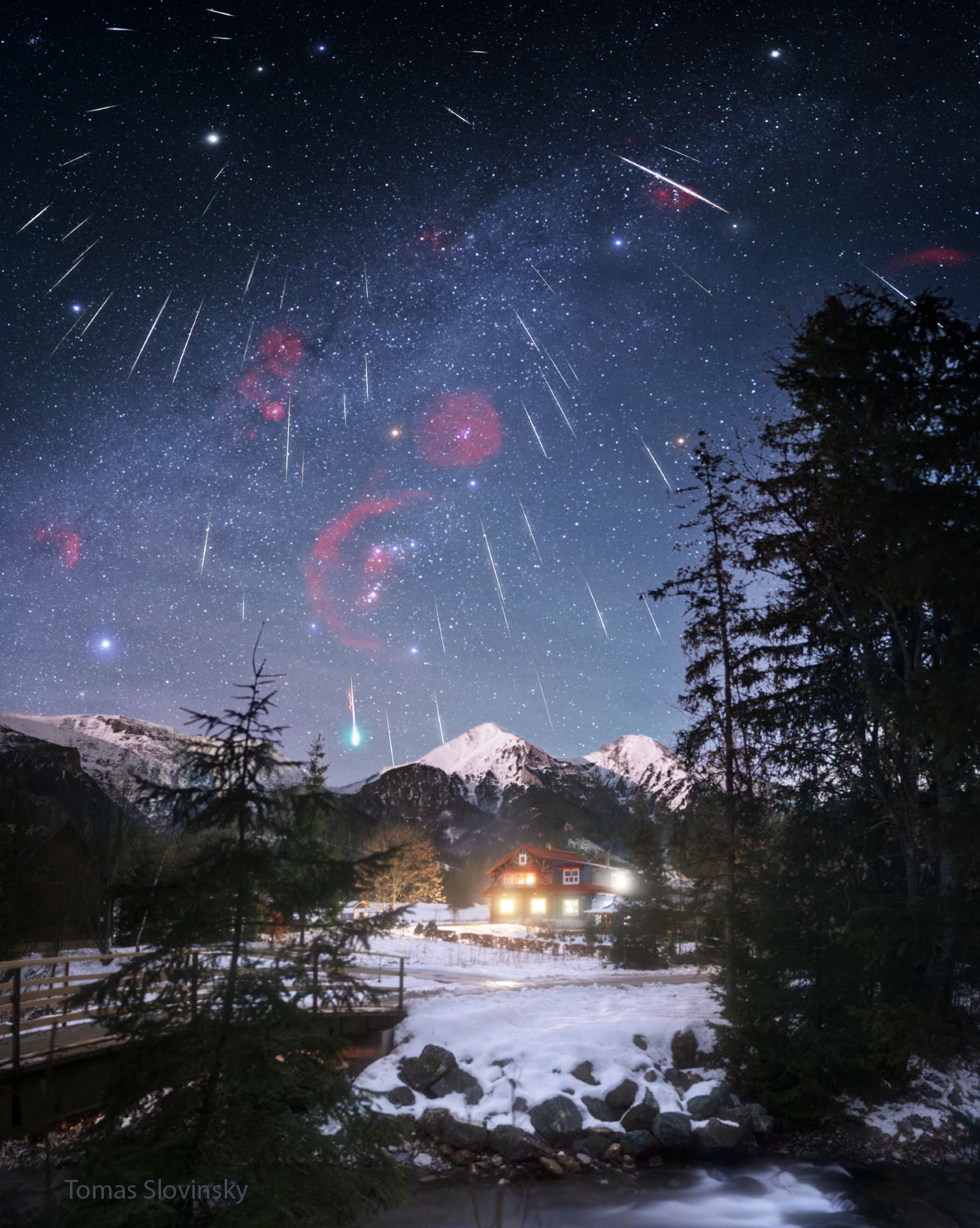 Image Credit & Copyright:
Tomáš Slovinský
Where are all of these meteors coming from? In terms of direction on the sky, the pointed answer is the constellation of Gemini. That is why the major meteor shower in December is known as the Geminids -- because shower meteors all appear to come from a radiant toward Gemini. Three dimensionally, however, sand-sized debris expelled from the unusual asteroid 3200 Phaethon follows a well-defined orbit about our Sun, and the part of the orbit that approaches Earth is superposed in front of the constellation of Gemini. Therefore, when Earth crosses this orbit, the radiant point of falling debris appears in Gemini. Featured here is a composite of many images taken over the past few days through dark skies from Slovakia and capturing the snow-covered peaks of the Belianske Tatra mountains Numerous bright meteor streaks from the Geminids meteor shower are visible. Orion is visible above the horizon, while the bright star nearest the radiant is Castor. APOD Review: RJN's Night Sky Network Lecture
#APOD #Research #AstronomyLovers #SpaceMissions #Astrodata
Image Credit & Copyright:
Tomáš Slovinský
Where are all of these meteors coming from? In terms of direction on the sky, the pointed answer is the constellation of Gemini. That is why the major meteor shower in December is known as the Geminids -- because shower meteors all appear to come from a radiant toward Gemini. Three dimensionally, however, sand-sized debris expelled from the unusual asteroid 3200 Phaethon follows a well-defined orbit about our Sun, and the part of the orbit that approaches Earth is superposed in front of the constellation of Gemini. Therefore, when Earth crosses this orbit, the radiant point of falling debris appears in Gemini. Featured here is a composite of many images taken over the past few days through dark skies from Slovakia and capturing the snow-covered peaks of the Belianske Tatra mountains Numerous bright meteor streaks from the Geminids meteor shower are visible. Orion is visible above the horizon, while the bright star nearest the radiant is Castor. APOD Review: RJN's Night Sky Network Lecture
#APOD #Research #AstronomyLovers #SpaceMissions #Astrodata