“Where is the public roadmap for Bitcoin Core?”
This sentiment from Zach is common and Ill give my own thoughts on it

X (formerly Twitter)
Zach Herbert 🇺🇸 (@zherbert) on X
Where is the public roadmap for Bitcoin Core?
Bitcoin is already a multi trillion dollar asset and will continue to rapidly grow. Where is the de...
The subprojects that individual Bitcoin Core engineers contribute to reflect the project’s *software development priorities* which can include things like testing improvements, refactors, features, maintenance, or performance improvements.
These software engineering efforts are distinct from the Bitcoin *protocol*, whose consensus rules change only through broad community agreement and network adoption, not by decisions made exclusively within the Bitcoin Core repository.
If I were looking to derive a shorter term “public roadmap for Bitcoin Core” (again, the Bitcoin Core software, not Bitcoin protocol), there are a few places to look.
**Working Groups**
Contributors actively working on similar efforts form working groups to implement and review projects in Bitcoin Core. A list of the current working groups is on the Bitcoin Core Wiki:

GitHub
Working Groups
Wiki for Bitcoin Core development. Contribute to bitcoin-core/bitcoin-devwiki development by creating an account on GitHub.
From here we can see interest in: Erlay, Fuzzing, Kernel, Benchmarking, Silent Payments, Cluster Mempool, Stratum v2, Multiprocess, QML GUI, and Net Split
These working groups also provide updates at the weekly Bitcoin Core developer meetings on IRC:

Bitcoin Core
IRC Meetings
IRC Meetings
This is another place to see current work.
**Tracking issues**
Many subprojects within Bitcoin Core have a place to track a todo list of code changes that roll up into that project.
Here are just a few examples (search the GitHub for “tracking issue” for more):
Multiprocess -

GitHub
Multiprocess tracking issue · Issue #28722 · bitcoin/bitcoin
This issue will be updated to reflect the current state of bitcoin core multiprocess support. PRs for review related to building & releasing: #3362...
Mining interface -

GitHub
Mining interface tracking issue · Issue #33777 · bitcoin/bitcoin
The mining interface is defined in: https://github.com/bitcoin/bitcoin/blob/master/src/interfaces/mining.h https://github.com/bitcoin/bitcoin/blob/...
MuSig2 -

GitHub
MuSig2 Tracking Issue · Issue #31246 · bitcoin/bitcoin
Current PR to review: #31242 libsecp: libsecp module: bitcoin-core/secp256k1#1479 libsecp named structs: bitcoin-core/secp256k1#1628 libsecp subtre...
Cluster mempool -

GitHub
Cluster mempool tracking issue · Issue #30289 · bitcoin/bitcoin
What to review next: #34085 Plan: Lowest level: generic utilities: #29242 FeeFrac type #30535 Add FeeFrac::EvaluateFee #32240 Fix integer overflow ...
Erlay -

GitHub
Erlay Project Tracking · Issue #30249 · bitcoin/bitcoin
This issue will be edited frequently to reflect the current status of the project. What should I review now? 👇 👇 👇 👇 👇 👇 👇 #30...
Bitcoin Kernel Library -

GitHub
Bitcoin Kernel Library Project Tracking · Issue #27587 · bitcoin/bitcoin
Project Board for pull requests past and present: https://github.com/orgs/bitcoin/projects/3 This is the tracking issue for the bitcoin kernel libr...
SENDTEMPLATE -

GitHub
SENDTEMPLATE Tracking Issue · Issue #33691 · bitcoin/bitcoin
Plan: Protocol specification BIN25-2 and BIP153 PR#1937 Implementation: PR#33191 - Providing templates to peers sendtemplate3 branch - Using templa...
**Core Dev meetups**
What developers discuss at recent in-person meetings is another data point. Here are transcripts from the
October 2025 meeting -
Bitcoin Core Dev Tech 2025 (Oct)
A collection of technical bitcoin and lightning transcripts
February 2025 meeting -
Bitcoin Core Dev Tech 2025 (Feb)
A collection of technical bitcoin and lightning transcripts
**Merged PRs**
As code changes are merged into the Bitcoin Core GitHub before the next release you can see precisely what will be in the upcoming release. These code changes include PRs related to projects above, but also more general changes unrelated to a particular project, like maintenance work, additional testing, one-off features, etc.

GitHub
Pull requests · bitcoin/bitcoin
Bitcoin Core integration/staging tree. Contribute to bitcoin/bitcoin development by creating an account on GitHub.
Likewise Optech has a weekly notable code segment that picks interesting code merges to cover:

Bitcoin Optech
Bitcoin Optech
Helping Bitcoin-based businesses integrate scaling technology.
**Release Milestones**
As Bitcoin Core progresses toward a new release, PRs can be tagged with a milestone representing that release.
For example, here are the items tagged for the previous v30 release:
GitHub
Pull requests · bitcoin/bitcoin
Bitcoin Core integration/staging tree. Contribute to bitcoin/bitcoin development by creating an account on GitHub.
And here are considerations for the v31 release:
GitHub
Pull requests · bitcoin/bitcoin
Bitcoin Core integration/staging tree. Contribute to bitcoin/bitcoin development by creating an account on GitHub.
**TLDR, just tell me what will be in v31**
Sorry, there isn’t a definitive authoritative answer for a decentralized open source project like this. But also in the spirit of decentralization, I can provide my own guesses of what might be in there.
Kernel API - modular use of Bitcoin’s consensus and validation logic outside the full node
MuSig2 (in wallet) - fee-efficient, privacy-preserving multi-signature support
Cluster mempool - makes transaction relay and block assembly more efficient, predictable, and network reliability.
ASMap - help diversify peer connections, strengthening network resilience against eclipse attacks
Static builds - reproducible, portable binaries that enhance security, verifiability, and ease of deployment
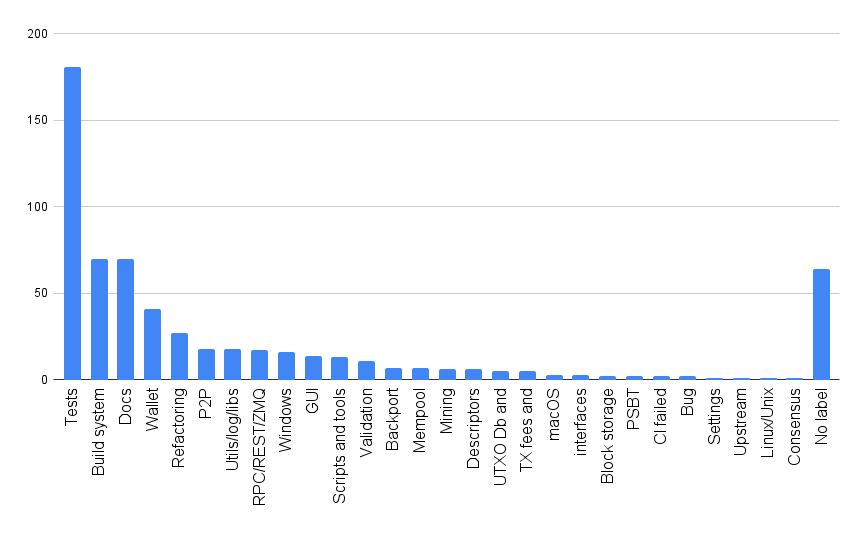
I’ll emphasize that while these projects took a ton of work to get where they are, there will also be a majority of PRs in v31 that will not be part of a “project”. They will simply be general improvements, bug fixes, and maintenance work (see
X (formerly Twitter)
Schmidty (@bitschmidty) on X
Bitcoin Core v30: a deeper look
What is in Bitcoin Core v30? One way to answer this is to review the release notes and discuss features. A few con...
for examples)

 View quoted note →