"Meta’s chief artificial intelligence scientist Yann LeCun is in early talks to raise €500mn for his new start-up, in a move that would value the AI company at about €3bn before it has officially launched. LeCun, who recently announced he would be leaving Meta at the end of the year, has also lined up the founder of French health tech start-up Nabla, Alexandre LeBrun, as chief executive, according to people familiar with the matter. LeCun, a French-US scientist and Turing award winner who is considered one of the pioneers of modern AI, is targeting a €3bn valuation but discussions were still in the early stages and could change, the people added. Details of the new venture, called Advanced Machine Intelligence Labs, will be announced in January and LeCun will serve as an executive chair. LeCun declined to comment. LeBrun did not respond to an immediate request for comment. “As part of a planned, board-supported transition, Nabla co-founder and CEO Alex LeBrun will transition from his role to become CEO of AMI Labs,” said Nabla co-founder Delphine Groll in a statement." #AI #StartUps #AIBubble #AIHype
"The “scientific” study of politics has lost what the anthropologist Clifford Geertz called “thick description,” the analysis of the deep ethnographic and cultural meanings constituting society and individual actions. Geertz was a master of this humanistic art, which required patient fluency and subtle attention to the linguistic and meaning-making features of politics. Such meanings are not accessible to an empirical approach that breaks down narratives, traditions, and ideologies into atomistic bits or multiple-choice options on a survey. Achieving thick descriptions requires the time-consuming art of interpretation, informed by years of learning about a culture and its history. But Geertz believed that it was the form of inquiry most capable of grasping the ideological and cultural realities of a society. Anyone who abandoned this art would be at risk of experiencing even their own culture as a stranger would, perplexed by the symbols and signs swirling about them. Ironically, this state of cultural bewilderment is now typical of many of the experts who spend their lives studying American government. Wonkish blindness to the power of MAGA is a direct result of neglecting the art of interpretation. What interpretive engagement reveals is that since its inception MAGA marked a dramatic ideological mutation on the right, a homegrown fusion of celebrity, neoliberal boss culture, Christian nationalism, and autocratic notions of the executive. Ideological innovation within the movement has only accelerated since 2016, leaving political scientists, pundits, and an elite liberal public struggling to grasp MAGA both past and present. This has made many American liberals years too late in realizing what was happening, as well as inept at organizing a response." #PoliticalScience #Trump #Trumpism #MAGA #Politics #Ideology #SocialSciences
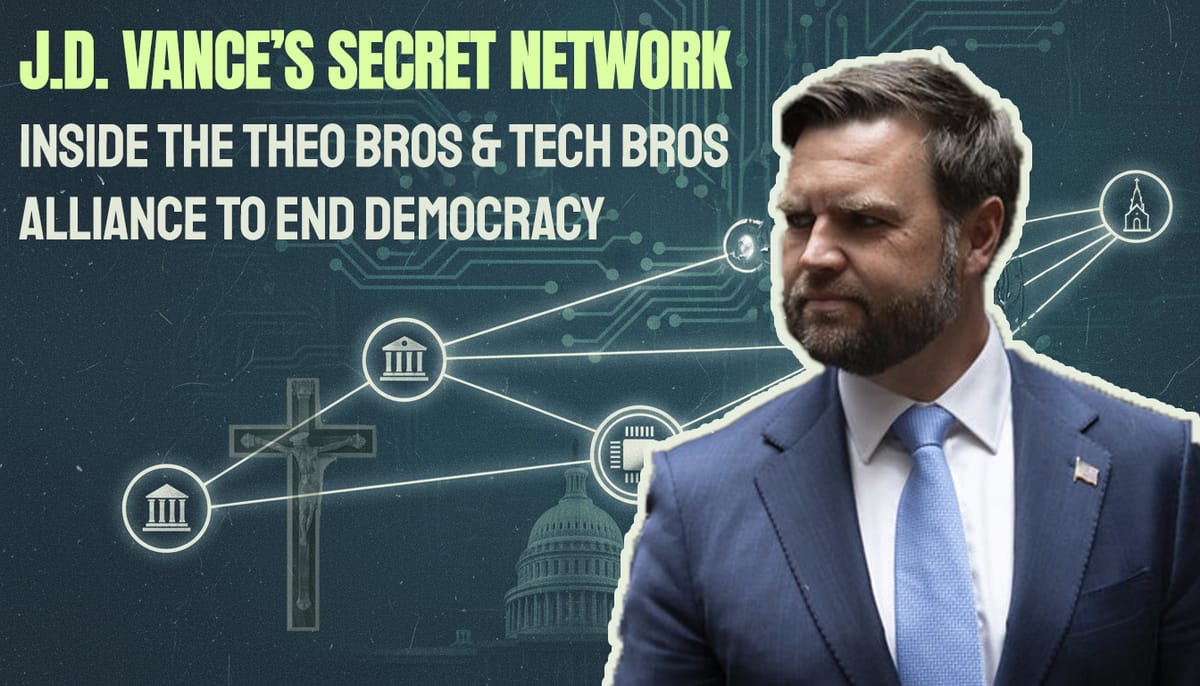
"Silicon Valley venture capitalists are now quoting scripture—and Christian nationalists are now pitching network state cities. So you know things are getting bizarre. But here's the thing: It makes perfect sense because it's a strategy, and it's spelled out in black and white. In his book, The Network State: How to Start a New Country, Balaji Srinivasan identifies evangelical Christians as followers of the so-called "Red God"—right-wing Republicans who will ally with his gray tribe of tech billionaires. Together, they'll crush Democrats, democracy, and the nation state. It's a clinical, almost contemptuous framing of Christianity as a political weapon. But it works because both Christian nationalism and tech fascism share the same playbook: seize the pillars of democratic society and replace them with parallel alternatives, all run by authoritarian elites. The Christian nationalists call it the Seven Mountains mandate—taking over government, media, education, business, arts, family, and religion. The tech authoritarians call it replacing the cathedral with parallel institutions. Different language, same goal: elite minority rule and the end of democracy as we know it. Today on the Nerd Reich podcast, we expose how this alliance actually works. I'm joined by Matthew Boedy, author of the definitive book on the Seven Mountains mandate, who explains how figures like Charlie Kirk and other religious extremists have been systematically organizing this takeover. And Mother Jones reporter Kiera Butler takes us inside Highland Rim—a proposed settlement on the Tennessee-Kentucky border that's basically a network state for Christian nationalists. It comes complete with crypto and investments from the same venture capital networks funding Silicon Valley's dreams of exiting democracy." #SiliconValley #Nationalism #ChristianNationalism #NetworkStates #Religion #Crypto
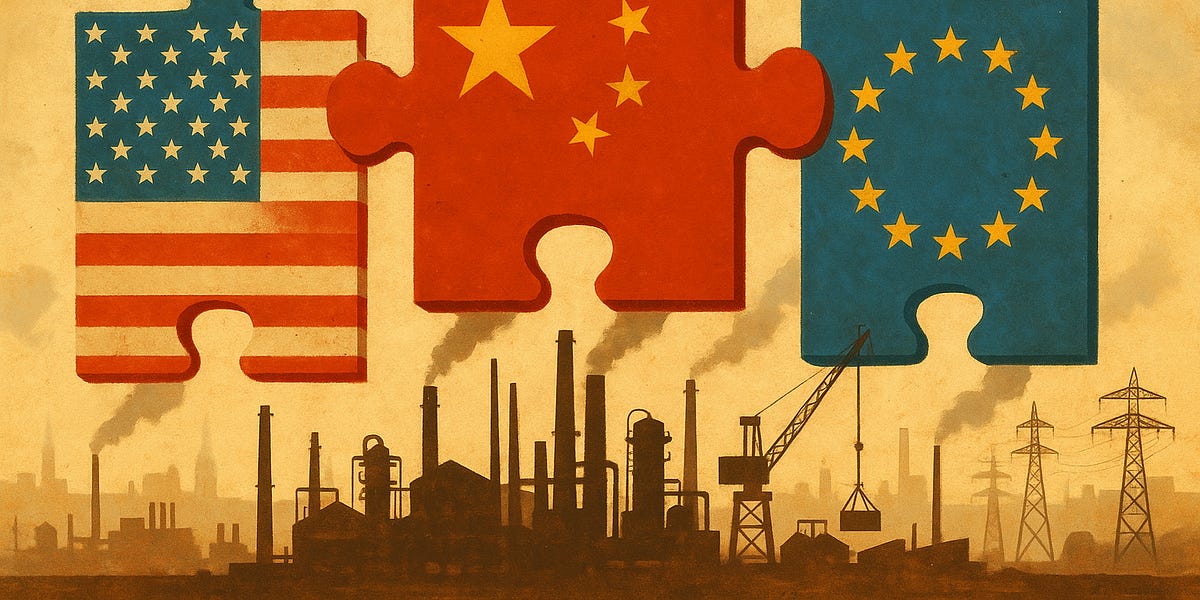
"The global economy is undergoing a fundamental shift. After decades of free-market orthodoxy and neoliberal globalization, we’re witnessing the return of industrial policy — but this time with a twist. Major economic powers — especially the United States, China, and the European Union — are now explicitly intertwining their economic strategies with national security concerns. This isn’t just a policy adjustment. It represents a wholesale transformation of how major powers approach economic development and competition. These three economic giants are implementing distinct approaches to industrial policy while pursuing similar objectives: technological leadership, supply chain security, and national economic sovereignty. What we’re seeing is the emergence of a new economic nationalism, one that is reshaping the global economic order. (...) The crucial point is this: neomercantilism — the idea that countries should actively use industrial and trade policies to generate trade surpluses and enhance competitiveness — has always viewed economic power and national security as inseparable. So, what we’re witnessing today isn’t the invention of something entirely new, but rather the resurrection of ideas that were temporarily suppressed during the neoliberal era of the 1980s onwards. During that period, international organizations effectively outlawed industrial policy through structural adjustment programmes and free trade agreements. The Washington Consensus reigned supreme. But the 2008 financial crisis, rising inequality, climate change pressures, supply chain vulnerabilities exposed by COVID-19, and intensifying geopolitical tensions have collectively demolished faith in free-market orthodoxy. Industrial policy is back. And it’s back with a vengeance." #IndustrialPolicy #EconomicNationalism #Nationalism #Protectionism #PoliticalEconomy
"The growth of the U.S. electric grid depends on factory workers like Cisco, whose craft can take three to five years to master and can’t be fully automated. The manual precision and specialty materials required are among many reasons that the U.S. is struggling to meet the surging electricity needs of the artificial-intelligence frenzy. “Believe me when I say that they are artists,” Anthony Allard, head of North America for Hitachi Energy, said of winders. “This is an extremely manual job because they have to be extremely precise in the way they do it. If not, there will be some issue later down the road with the equipment.” Transformers are used to step up voltage from power plants to send electricity onto the grid, or to step down voltage so it can be used by cities, neighborhoods and large customers such as factories, data centers and oil-and-gas facilities. New ones are needed every time a new source of power generation or a big customer connects to the grid. They can be as large as buildings or as small as garbage cans. The ones made in South Boston can weigh up to 285,000 pounds, roughly the equivalent of 24 elephants or 65 pickup trucks. Orders for larger transformers have exceeded supply by about 14,000 units this year, according to Wood Mackenzie. Similar labor and supply-chain hurdles are slowing the construction of natural-gas-fired power plants and gas turbines, which have a yearslong backlog. The South Boston factory, which already has three shifts, is expanding. Construction has also begun on a new $457 million facility in an adjacent field, where Hitachi Energy will make even bigger transformers beginning in 2028. A potential bottleneck: hiring around 800 more workers, including winders, in a county with a population of about 34,000." https://www.wsj.com/business/the-factory-workers-who-build-the-power-grid-by-hand-4a846658 #AI #PowerGrid #Energy #DataCenters #USA
RT @RnaudBertrand This is an incredible story by Reuters: they reveal that China now has a working EUV lithography machine prototype, which makes China the only country in the world to have succeeded at replicating the ASML technology, years earlier than anticipated. The machine apparently "fills nearly an entire factory floor". It's operational and successfully generates extreme ultraviolet light (what "EUV" stands for), but has not yet produced working chips. The objective for the latter is 2028, which is a crazy fast timeline: ASML took 18 years to go from prototype to machines that could produce commercially-available chips, China aims to do it in 3. The security measures around the project look insane. The employees work under fake identities so they don't know each other's real names. They work inside secure facilities where "no one outside the compound could know what they were building - or that they were there at all". They're divided in "teams who are kept isolated from each other to protect the confidentiality of the project," where "they don't know what the other teams work on." For foreign employees, China exceptionally gave them Chinese passports and allowed them to maintain dual citizenship, which is normally forbidden under Chinese law. This seems to be because some of the employees are former ASML workers such as Lin Nan, ASML's former head of light source technology (), who would be less vulnerable to Western sanctions under Chinese citizenship. https://www.reuters.com/world/china/how-china-built-its-manhattan-project-rival-west-ai-chips-2025-12-17/
"The scale of investment into legal AI startups has been massive. Robin AI is one of many well-funded players in a crowded space. With large capital inflows come large growth expectations. Robin’s inability to meet those expectations may indicate that investor appetite has outpaced market readiness. Competition in contract-review AI is fierce. Many players are pursuing similar approaches, which erodes differentiation and pressures pricing. Robin had to compete not only with established legal tech vendors but also with DIY in-house solutions and large platform entrants with deeper resources. And then there’s the broader narrative: commentators are already flagging generative AI investment as frothy. Legal tech won’t be immune to that dynamic, whether the spillover is beneficial or problematic. Robin’s distressed sale announcement is uncomfortably public. This isn’t “quietly pivoting to a new strategy.” This is “we might be for sale because we’re out of runway.” That kind of visible stumble casts a shadow on the entire peer group. Bubble warning, not bubble burst I lean toward seeing this as more than Robin’s personal misstep, but I’m not ready to declare a full legal-tech-AI bubble burst. What I see is a bubble warning. The fundamentals of legal AI (contract review, document analytics, workflow automation) still hold promise. Firms genuinely want better efficiency, and AI is one tool in that effort. But the mismatch between expectation and execution is large, and it’s been this way for a while." #AI #GenerativeAI #LegalAI #RobinAI #UK #Law
"We could, and indeed should, discuss not only whether to use social media, but also, and above all, which social media we would like to use, or rather, how to implement them. Social media, in fact, are software products, and therefore infinitely more flexible than, say, cigarettes or alcohol, to name two products that have been heavily regulated with respect to minors. We should, therefore, broaden the debate by aiming to design social media capable of contributing to the intellectual, social, and emotional development of children and young people. Naturally, we should also address the broader question of the role we would like social media to have in contemporary society, but for now, let's limit ourselves to the specific category of young users. Given that a social media project specifically designed for children and young people should involve various professionals, particularly psychologists and teachers, it seems possible to identify six key characteristics from which to begin the discussion. First, eliminate data collection. No data of any kind is collected on minors, with no exceptions. Second, zero advertising. Even excluding minors, social media users still number in the billions, so it's more than legitimate to ask companies to subsidize services for minors with the huge revenue generated by all other users. The same goes for the ban on data collection. Third, strictly limit the daily screen time." #SocialMedia #Censorship #NannyState #AgeVerification
"A new report, shared exclusively with WIRED and published today by researchers from Columbia and Harvard, is a first-of-its-kind study designed to measure the impact influencers and online creators can have on their audiences. The study was conducted with 4,716 Americans aged between 18 and 45, most of whom were randomly assigned a list of progressive content creators to follow. Over the course of five months, from August to December 2024, these creators produced nonpartisan content designed to educate followers rather than explicitly advocate for a specific political viewpoint. The results showed that exposure to these progressive-minded creators not only increased general political knowledge, but also shifted followers’ policy and partisan views to the left. In contrast, a placebo group that was not assigned any creators to follow but was allowed to scroll social media as normal “showed significant rightward movement,” which researchers said was related to the right-leaning nature of social media networks. For the study’s authors, and experts who have reviewed the research, the findings confirm that not only are influencers now potentially more powerful than traditional media, but content creators who rarely share political content may be the most powerful of all." #SocialMedia #Politics #Influencers #Propaganda
"Human-staffed call centers and customer service were supposed to be heavily disrupted by AI, but companies quickly learned there are limits to the amount of human interaction that can be delegated to chatbots. In early 2024, Swedish payments company Klarna rolled out an OpenAI-powered customer service agent that it said could do the work of 700 full-time customer service agents. In 2025, however, CEO Sebastian Siemiathowski was forced to dial that back and acknowledge that some customers preferred to talk with humans. Siemiathowski said AI is reliable on simple tasks and can now do the work of about 850 agents, but more complex issues quickly get referred to human agents. For 2026, Klarna is focused on building its second-generation AI chatbot, which it hopes to ship soon, but human beings will remain a big part of the mix. “If you want to stay customer-obsessed, you can't rely [entirely] on AI,” he said. Similarly, U.S. telecommunications giant Verizon is leaning back into human customer service agents in 2026 after attempts to delegate calls to AI. “I think 40% of consumers like the idea of still talking to a human, and they're frustrated that they can't get to a human agent,” said Ivan Berg, who leads Verizon’s AI-driven efforts to enhance service operations for business customers, in a Reuters interview this fall. The company, which has about 2,000 frontline customer service agents, still uses AI to screen calls, get information on customers, and direct them to either self-service systems or to human agents. Using AI to handle routine questions frees up agents to handle complex issues and try new things, such as making outbound calls and doing sales. “Empathy is probably the key thing that's holding us from having AI agents talk to customers holistically right now,” Berg said."" https://www.reuters.com/business/business-leaders-agree-ai-is-future-they-just-wish-it-worked-right-now-2025-12-16/ #AI #GenerativeAI #AIAgents #AgenticAI #AIHype