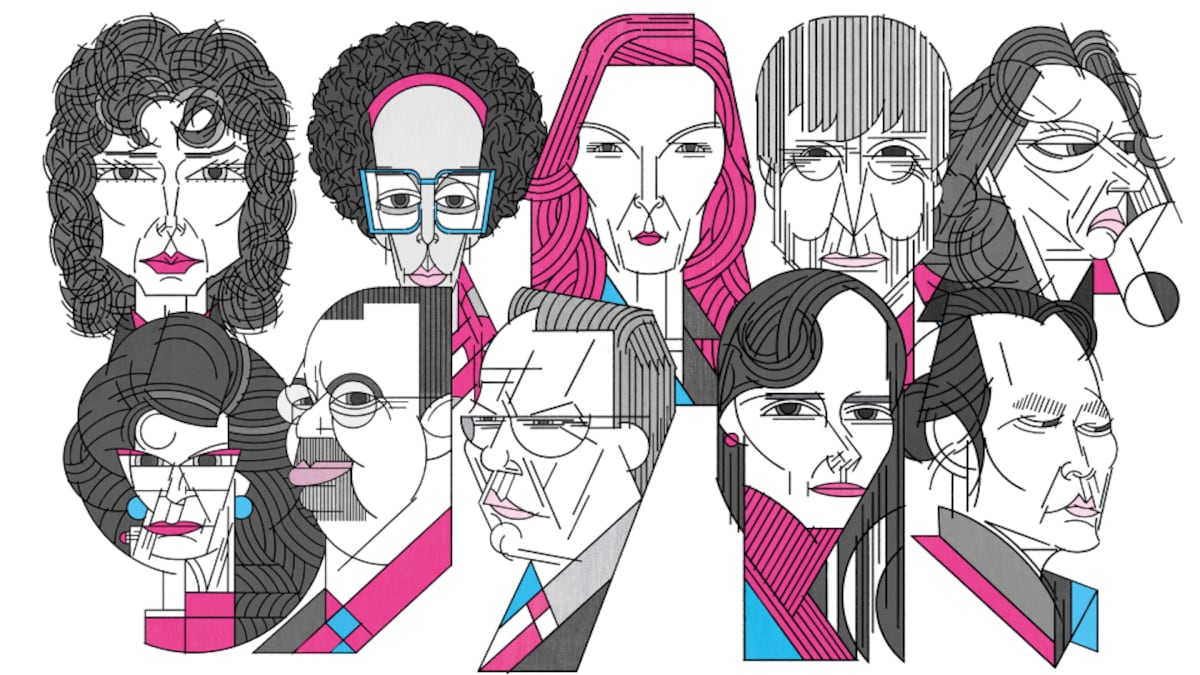
"Los 10 pensadores que han conseguido más votos de nuestro jurado no solo reflexionan sobre estos temas y otros relacionados, y no solo describen y en ocasiones dan nombre a lo que está ocurriendo para que podamos identificarlo y analizarlo. (...) Casi todas las novedades de las empresas de plataformas han venido acompañadas de un discurso que las presentaba casi como naturales, como el fruto de un supuesto e imparable progreso. Esto será así, nos decían, hay que adaptarse o desaparecer. Mark Zuckerberg, fundador de Facebook, asegura que la privacidad es cosa del pasado. Empresas como Amazon y Uber disfrazan de libertad lo que no es más que trabajo precario a las órdenes de un algoritmo. Sam Altman, consejero delegado de OpenAI, promete que la inteligencia artificial ayudará en el futuro —quizás, no lo sabemos— a solucionar el problema del cambio climático y por eso se le ha de permitir agravarlo hoy en día mediante el uso de las cantidades ingentes de agua que necesitan los grandes centros de datos. En sus libros y artículos, estos pensadores nos muestran que no tiene por qué ser así, que, como escribe la filósofa estadounidense Shoshana Zuboff, nada de esto es inevitable. Podemos defender unas redes sociales que respeten nuestra privacidad, como plantean la investigadora en IA Meredith Whittaker y la filósofa Carissa Véliz, o exigir una inteligencia artificial que esté subordinada a nuestras prioridades sociales, políticas y medioambientales, como proponen el filósofo Éric Sadin y la ingeniera Timnit Gebru. Y podemos imaginar un modelo de negocio para estas empresas que no suponga una amenaza para la democracia, como defienden Daron Acemoglu y la misma Zuboff. En definitiva, nos alertan de los peligros de obedecer ciegamente a personas que tienen en cuenta sus intereses y no los nuestros, y nos animan a moldear el futuro a través de acciones individuales y colectivas. Con su ayuda, podemos imaginar una tecnología diferente..."
"A cryptocurrency firm run by the billionaire Winklevoss twins was facing a punishing federal lawsuit. After Donald J. Trump returned to the White House, the Securities and Exchange Commission moved to freeze the case. The S.E.C. had also sued Binance, the world’s largest crypto exchange, but then dropped the case altogether under the new administration. And after a yearslong legal fight with Ripple Labs, the new S.E.C. tried to reduce a court-ordered penalty against the crypto firm, seeking to soften the blow of the punishment. The agency’s pullback from these cases illustrated a wide-ranging transformation in the federal government’s treatment of the crypto industry during President Trump’s second term, a New York Times investigation has found. It is unheard-of for the agency to retreat from a swath of lawsuits against a single industry. And yet, The Times found that the S.E.C. had eased up on more than 60 percent of the crypto cases that were ongoing when Mr. Trump returned to the White House, moving to pause litigation, lessen penalties or outright dismiss the cases. The dismissals were particularly unusual, The Times found. Under Mr. Trump, S.E.C. dismissals came at a far higher rate for crypto firms than other cases. And although the particulars of the crypto lawsuits differed, many of these firms had something in common: financial ties to Mr. Trump, the self-described crypto president." #USA #Trump #Crypto #Cryptocurrencies #Kleptocracy #Plutocracy #SEC #Binance #Winklevoss #RippleLabs
"Billionaires control the cable channels, social media platforms, newspapers, movie studios and essentially everything else that we consume, but for their own information sources they are in some cases more likely to trust their own kind. Semafor documented one ultraexclusive group chat that included Mr. Andreessen and Mr. Srinivasan, among others, in which the self-reinforcing discourse is reported to have pushed many Silicon Valley tycoons toward right-wing politics. “If you weren’t in the business at all,” the writer Thomas Chatterton Williams said of a similar group chat he was a member of, “you’d think everyone was arriving at conclusions independently.” Such disconnection goes a long way to explaining why billionaires can’t grasp how the real world is convulsing outside their well-secured gates. And convulsing it is. According to the most recent edition of an annual Harris Poll, for the first time, a majority of Americans believe billionaires are a threat to democracy. A remarkable 71 percent believe there should be a wealth tax. A majority believe there should be a cap on how much wealth a person can accumulate. A realignment may be underway. The recent push for the Epstein files, a previously unimaginable collaboration between conspiracy-addled MAGA true believers and anti-corporatist Democrats, was just the latest sign. At a moment when income inequality, the looming threat of A.I. and the rise of authoritarianism seem to be straining American societal cohesion, a revolt against self-dealing elites may be the only cause compelling enough to bring us together. The favor of billionaires is already in some cases proving to be more of a liability than a blessing. In Seattle last month, a democratic socialist was elected mayor over a Democratic incumbent backed by wealthy interests." #USA #Capitalism #Billionaires #Kleptocracy #Plutocracy #Ideology #Democracy #Inequality
Lots of sloppy/lazy thinking and flawed reasoning here, but generally a good read. Just because GPUs are no longer improving and scaling is not enough to achieve AGI, that doesn't mean AGI is impossible. It just means that LLMs per se are not the way to go. "In summary, AGI, as commonly conceived, will not happen because it ignores the physical constraints of computation, the exponential costs of linear progress, and the fundamental limits we are already encountering. Superintelligence is a fantasy because it assumes that intelligence can recursively self-improve without bound, ignoring the physical and economic realities that constrain all systems. These ideas persist not because they are well-founded, but because they serve as compelling narratives in an echo chamber that rewards belief over rigor. The future of AI will be shaped by economic diffusion, practical applications, and incremental improvements within physical constraints — not by mythical superintelligence or the sudden emergence of AGI. The sooner we accept this reality, the better we can focus on building AI systems that actually improve human productivity and well-being." #AI #AGI #GPUs #Scaling #SuperIntelligence
"Invisible labellers’ toil has allowed self-driving cars to recognise pedestrians and chatbots to speak in natural-sounding sentences. For a generative artificial intelligence system to learn how to write an autopsy report, human workers must sort and annotate thousands of crime scene images. The precarious work of training AI, which generally pays just a few dollars, has sparked a movement for better wages and conditions stretching from Kenya to Colombia. “You have to spend your whole day looking at dead bodies and crime scenes… Mental health support was not provided,” Kenyan national Ephantus Kanyugi told AFP. Labellers “need to spend time with these images, zoom into the wounds of dead people” to outline them so they can be fed into the AI, the 30-year-old added. Kanyugi, who has worked on image labelling since 2018, is the vice-president of the Data Labelers Association (DLA), an 800-strong labour group based in Nairobi. The DLA plans to unveil a code of conduct this month aimed at major labelling platforms, calling for improved conditions for workers." #AI #GenerativeAI #AITraining #DataLabeling #Precarity #Kenya
Anti-humanitarian Aid: "With three-quarters of Gaza’s structures damaged or destroyed by two years of Israeli strikes, the rebuilding effort to come – estimated at $70bn by the United Nations – could be a rich prize for companies that specialize in construction, demolition, transportation and logistics. But there’s no way to issue long-term contracts for reconstruction or humanitarian aid yet: a Board of Peace, chaired by Donald Trump, was endorsed by the United Nations to administer the territory but is not yet in operation. And the mandate of the new Civil-Military Coordination Center is limited. Parallel to these official efforts, the White House has established its own Gaza taskforce led by Jared Kushner, Steve Witkoff and Aryeh Lightstone. The Guardian has learned that two former Doge officials – once assigned to Elon Musk’s effort to slash government and fire federal workers in bulk – are leading the group’s conversations about humanitarian assistance and the postwar reconstruction of Gaza. They have circulated slide decks with detailed plans for logistics operations, including prices, financial projections and the locations of potential warehouses. US companies are gathering for the spoils." #USA #Trump #Palestine #Gaza #Reconstruction #DOGE #HumanitarianAid #UN
"By comparison, at least, the way the Chinese government speaks about AI is more modest. Yes, China’s economic leadership views AI as a priority and has boldly claimed it seeks to lead the world by 2030. Yet the rhetoric lacks the eschatological tone common in Silicon Valley. Chinese economic planners appear more interested in AI as a tool for industrial processes than as a means of creating a superintelligence that will reach the singularity. The State Council’s 2025 “AI+” initiative is focused entirely on efficiency-enhancing applications rather than intelligence explosions. There is another important difference. China is banking far more heavily on simpler, lower-cost open-source AI models. In the US, most of the leading “frontier” AI models are secret and proprietary, in part as a business model and in part due to the apocryphal fears that the wrong actors could trigger human extinction. The smaller, lower-cost Chinese models may be seeking, in that sense, to be the more nimble 1970s Toyota rivals to the giant American cars produced by General Motors. More importantly, China is hedging its bets by investing heavily in a wide range of other technologies that might reasonably be described as “the future”. In 2024, the country invested an estimated $940bn in clean-energy capex, broadly defined as renewables, electricity grids and energy storage (batteries), dwarfing its AI investments. In these sectors, AI is meant to be a complement — the glue rather than the structure. While China’s overall economy remains weaker than it was in the 2010s, elements of this broader strategy seem to be bearing fruit." #USA #China #AI #AIHype #AIBubble
"The EU plans a crackdown on “very dangerous” products sold on online platforms including China’s Shein and Alibaba, its justice commissioner has said, admitting “we need to do better” to protect European consumers. Michael McGrath told the Financial Times in an interview that the bloc was not protecting its citizens sufficiently from a rising tide of unsafe goods sent directly from China to customers’ homes. “I am very concerned about the volume of unsafe products coming into the European Union. I think we have a duty to better protect EU citizens, and we also have a duty to European businesses to ensure that they are operating on a level playing field,” McGrath said. The Irish commissioner said that “year in, year out” national authorities found products that were “very dangerous, with life-changing consequences for individuals” and which could “even cause loss of life”. Customs and enforcement officers were overwhelmed, with only “a tiny proportion of the unsafe products coming into the European Union” being stopped, McGrath admitted. “That’s not good enough.” Some 4.6bn low-value parcels entered the EU in 2024, and the number is continuing to double every two years, he said. Around 90 per cent come from China." #EU #China #TradeWar #Shein #Alibaba
"Some say if everyone is talking about a bubble, it’s a sign there isn’t one. Yet bubble arguments raged in 1999 even as it continued to inflate. The same is happening now. One big difference between now and 1999-2000 is the scale of price gains. Sure, Nvidia’s up a lot (really, a lot). But gains in the company’s shares of 54% this year to an October peak, and 30% including the drop since then, pale in comparison to the leaps in 1999. Cisco more than doubled in a month from mid-October 1999, while Apple was up 150% that year and Intel gained 75% in just under three months early in 2000. Even the best big stocks this year, names such as Western Digital, Seagate and Micron Technology, only tripled or quadrupled to their peaks this week, before falling hard on Friday. In 1999, Qualcomm soared 2,620%. It took until 2020 before it recovered from the subsequent bust. Ultimately, whether this is a bubble depends on whether it pops. If it turns out AI can’t deliver both the promised productivity gains and fat profits for its creators, the parallel will be to the painful dot-com aftermath, not the boom." https://www.wsj.com/finance/stocks/the-eerie-parallels-between-ai-mania-and-the-dot-com-bubble-f99be6fe #AI #GenerativeAI #AIBubble #AIHype #DotComs
RT @VaughnVernon "Microsoft Scales Back AI Goals Because Almost Nobody Is Using Copilot"