
GM ☀️ Your word of the day is!
🔤 Dreidel [DRAY-dul]
📖 What It Means:
A dreidel is a 4-sided toy marked with Hebrew letters and spun like a top in a game of chance. The game, played by children especially at Hanukkah, is also called dreidel.
📰 Example:
All the kids in the family look forward to playing dreidel together during Hanukkah.
💬 In Context:
“The Jewish tradition has always been syncretic, adapting and responding to the culture around it, he [Rabbi Steven Philp] said. Hanukkah is ‘a great example of this,’ Philp said, noting that the holiday’s traditions—like spinning the dreidel, eating latkes or potato pancakes, and munching on ... jelly-filled doughnuts—are customs that were borrowed from neighboring cultures over time.” — Kate Heather, The Chicago Sun-Times, 25 Dec. 2024
💡 Did You Know?
If your dreidel is spinning beneath the glow of the menorah, it’s probably the Jewish festival of lights known as Hanukkah. The holiday celebrates the miracle of a small amount of oil—enough for one day—burning for eight days in the Temple of Jerusalem. And though it’s a toy, the dreidel’s design is very much an homage: on each of its four sides is inscribed a Hebrew letter—nun, gimel, he, and shin—which together stand for Nes gadol haya sham, meaning “A great miracle happened there.” (In Israel, the letter pe, short for po, “here,” is often used instead of shin). In the game of dreidel, each letter bears its own significance: the dreidel is spun and depending on which letter is on top when it lands, the player’s currency, or gelt, is added to or taken from the pot. Nun means the player does nothing; gimel means the player gets everything; he means the player gets half; and shin means the player adds to the pot. Wherever you land on holiday traditions, we wish you words of gimel: gratitude, grub, and, of course, gaiety.
🔗  #WordOfTheDay #Nostr #Dictionary #Learning
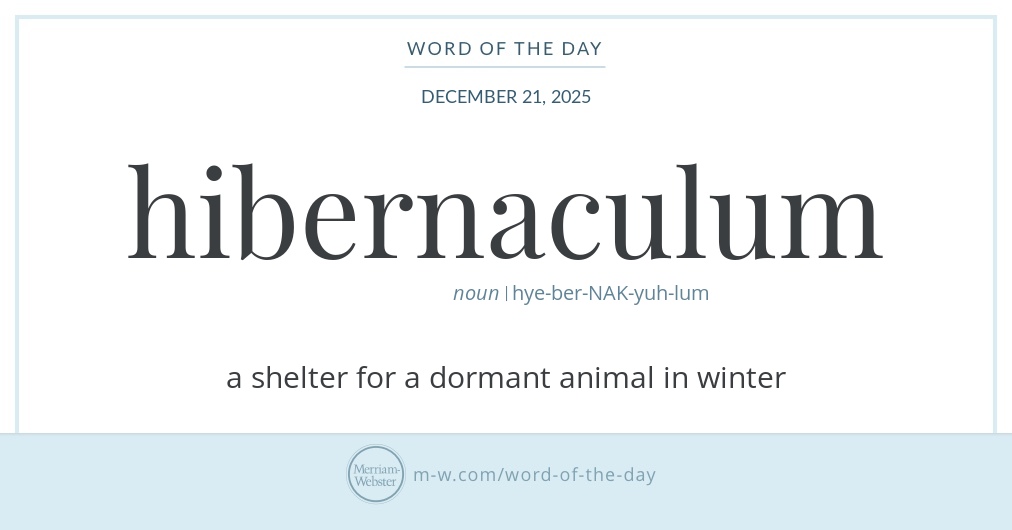
Word of the Day: Hibernaculum
If you’re afraid of snakes or bats, you probably won’t enjoy thinking about hibernacula, where hundreds, even thousands, of these creatures mig...