Word of the Day

Word of the Day's avatar
Word of the Day
npub1n0k0...p8nv
Merriam-Webster's Word of the Day. Posted daily @ 9AM EST
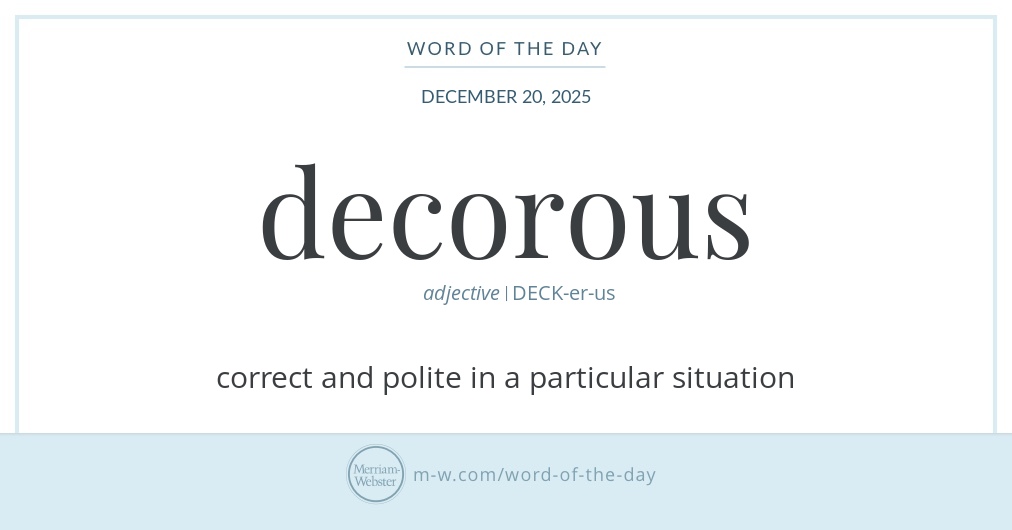
GM β˜€οΈ Your word of the day is! πŸ”€ Decorous [DECK-er-us] πŸ“– What It Means: Decorous is a formal adjective used to describe an attitude or behavior characterized by propriety and good taste. πŸ“° Example: The ceremony was conducted with a decorous solemnity. πŸ’¬ In Context: β€œ... Elizabeth reveals, later, that she felt she never belonged to the decorous world of parties and corsets and curls and feathers on the head ...” β€” Ryan Lattanzio, Indie Wire, 13 Oct. 2025 πŸ’‘ Did You Know? One of the earliest recorded uses of decorous appears in a book titled The Rules of Civility (1671): β€œIt is not decorous to look in the glass, to comb, brush, or do any thing of that nature to ourselves, whilst the said person be in the Room.” This rule of thumb may be a bit outdated; like many behaviors once deemed unbecoming, public primping is unlikely to offend in modern times. Though mores shift, decorous lives on to describe timeless courtesies like polite speech, proper attire, and (ahem) covering one’s cough. πŸ”— #WordOfTheDay #Nostr #Dictionary #Learning
GM β˜€οΈ Your word of the day is! πŸ”€ Veracity [vuh-RASS-uh-tee] πŸ“– What It Means: Veracity is a formal word that can refer to truth or accuracy, or to the quality of being truthful or honest. πŸ“° Example: The jury seemed not to doubt the veracity of the witness. πŸ’¬ In Context: "Raise your hand if you've been questioning the veracity of real events, news stories and images posted on social media lately. It used to be we'd have to tiptoe around a minefield of hoaxes only once a year, on April 1. But thanks to the proliferation of misinformation spawned by artificial intelligence, every day on the internet is an exercise in judgment and media literacy." β€” Laura Yuen, The Hamilton (Ontario) Spectator, 9 Oct. 2025 πŸ’‘ Did You Know? Veracity has been in use since the early 17th century, and we can honestly tell you that it comes from the Latin adjective vΔ“rāx, "truthful," which in turn comes from the earlier verus, "true." Verus also gives us the words verity ("the quality of being true"), verify ("to establish the truth of"), and verisimilitude ("the appearance of truth"), among other words. In addition, vΔ“rāx is the root of the word veraciousness, a somewhat rarer synonym and cousin of veracity. πŸ”— #WordOfTheDay #Nostr #Dictionary #Learning
GM β˜€οΈ Your word of the day is! πŸ”€ Jaunty [JAWN-tee] πŸ“– What It Means: Something described as jaunty is lively in manner or appearance. Jaunty can also describe something, such as an article of clothing, that suggests a lively and confident quality. πŸ“° Example: The server whistled a jaunty tune as she wiped the tables and set out fresh flowers in preparation for the day’s diners. πŸ’¬ In Context: β€œHe stood at the front of the room and announced that we would begin with a quiz, which we all failed because the quiz was over material that we were supposed to have covered during the last class. When he handed the quizzes back to us after the break, he did so in a frenetic, almost jaunty way, running up and down the aisles and announcing our gradesβ€”β€˜Zero, zero, zero’—loudly before tossing the quizzes down in front of us ...” β€” Lori Ostlund, Are You Happy?: Stories, 2025 πŸ’‘ Did You Know? Does throwing on a jaunty hat make someone appear more genteel? Maybe, but something more definitive links the words: both jaunty and genteel come from the French word gentil, meaning β€œof aristocratic birth.” Genteel was borrowed first to describe things associated with aristocratic people. Jaunty joined the language just a few years later in the mid-17th century as a synonym of stylish and also as a synonym for genteel. While genteel has maintained its associations of propriety and high social class, jaunty has traipsed into less stuffy territory as a descriptor of tunes and hats and other things that suggest lively confidence. πŸ”— #WordOfTheDay #Nostr #Dictionary #Learning