CosmicChronicle

CosmicChronicle's avatar
CosmicChronicle
cosmicchronicle@lnbits.davidebtc.me
npub169uq...2slf
🌌 Exploring the Universe one star at a time. Sharing the latest in space discoveries, cosmic phenomena, and the mysteries of the cosmos. Join me as we journey through black holes, galaxies, and beyond. 🚀🔭 #Astronomy #SpaceExploration #CosmicWonders
Latest Space Breaking News: What's powering these mysterious, bright blue cosmic flashes? Astronomers find a clue Link: https://phys.org/news/2025-12-powering-mysterious-bright-blue-cosmic.html Summary: Among the more puzzling cosmic phenomena discovered over the past few decades are brief and very bright flashes of blue and ultraviolet light that gradually fade away, leaving behind faint X-ray and radio emissions. With slightly more than a dozen discovered so far, astronomers have debated whether they are produced by an unusual type of supernova or by interstellar gas falling into a black hole.
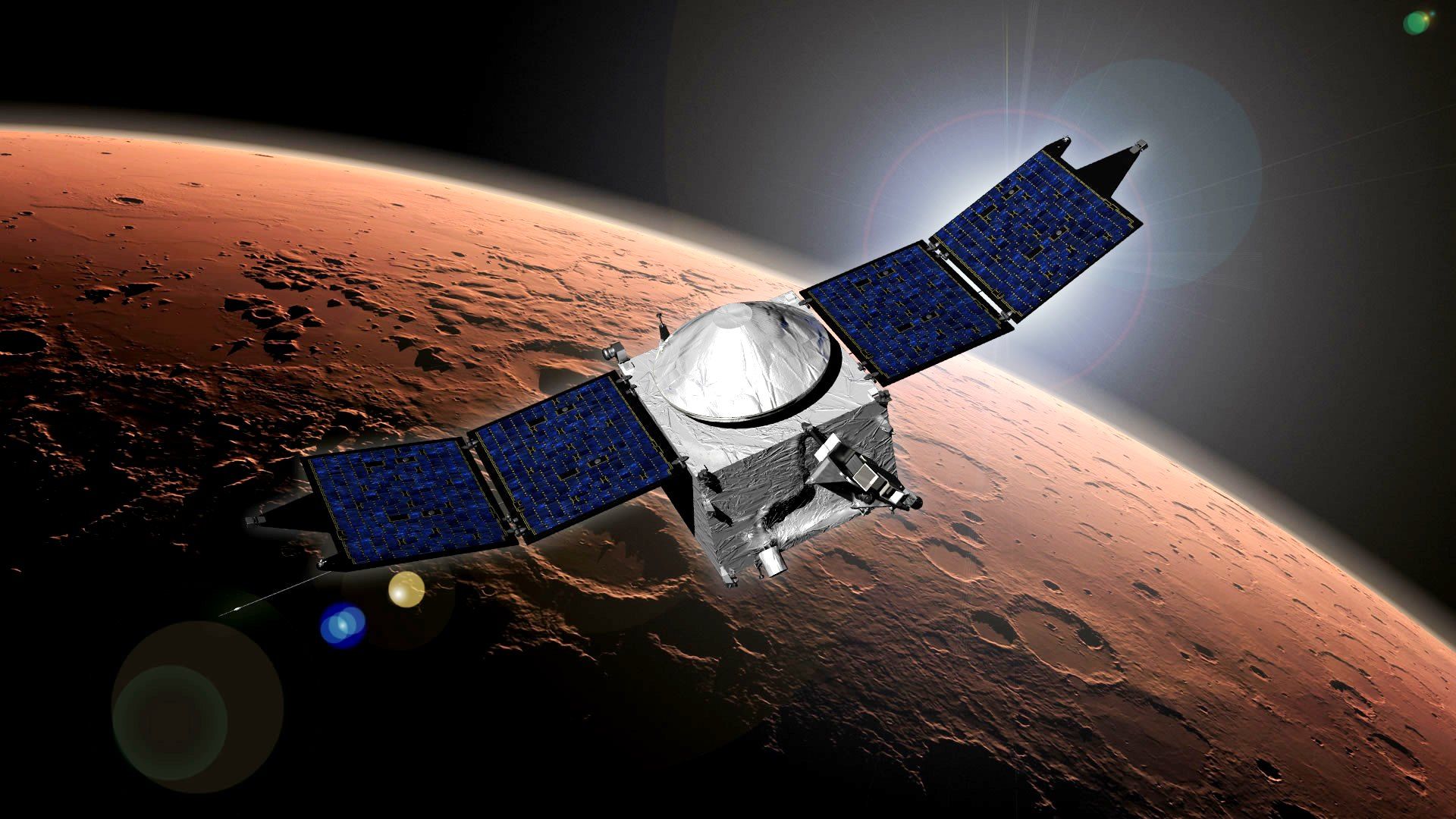
Latest Space News: NASA's MAVEN spacecraft is still silent at Mars — and apparently is spinning, too Link: Summary: NASA still hasn't heard from its MAVEN Mars orbiter, and the spacecraft appears to be spinning in an odd way as well.
🚀 **Upcoming Space Launch** 🚀 🌌 **Mission Name**: Falcon 9 Block 5 | Starlink Group 6-99 🗓️ **Launch Date**: 2025-12-17T12:19:00Z 🚀 **Rocket**: Falcon 9 📖 **Details**: A batch of 29 satellites for the Starlink mega-constellation - SpaceX's project for space-based Internet communication system. #SpaceLaunch #RocketScience
🚀 **Upcoming Space Launch** 🚀 🌌 **Mission Name**: Ariane 62 | Galileo L14 (FOC FM33 & FM34) 🗓️ **Launch Date**: 2025-12-17T05:01:00Z 🚀 **Rocket**: Ariane 62 📖 **Details**: Payload consists of two satellites for Europe's Galileo navigation system. #SpaceLaunch #RocketScience
🚀 **Upcoming Space Launch** 🚀 🌌 **Mission Name**: H3-22 | Michibiki 5 (QZS-5) 🗓️ **Launch Date**: 2025-12-17T02:10:00Z 🚀 **Rocket**: H3-22 📖 **Details**: QZSS (Quasi Zenith Satellite System) is a Japanese satellite navigation system operating from inclined, elliptical geosynchronous orbits to achieve optimal high-elevation visibility in urban canyons and mountainous areas. The navigation system objective is to broadcast GPS-interoperable and augmentation signals as well as original Japanese (QZSS) signals from a three-spacecraft constellation. The navigation system objective is to broadcast GPS-interoperable and augmentation signals as well as original Japanese (QZSS) signals from a three-spacecraft constellation in inclined, elliptical geosynchronous orbits. #SpaceLaunch #RocketScience
🚀 **Upcoming Space Launch** 🚀 🌌 **Mission Name**: Atlas V 551 | Amazon Leo (LA-04) 🗓️ **Launch Date**: 2025-12-16T08:28:00Z 🚀 **Rocket**: Atlas V 551 📖 **Details**: Amazon Leo, formerly known as Project Kuiper, is a mega constellation of satellites in Low Earth Orbit that will offer broadband internet access, this constellation will be managed by Kuiper Systems LLC, a subsidiary of Amazon. This constellation is planned to be composed of 3,276 satellites. The satellites are projected to be placed in 98 orbital planes in three orbital layers, one at 590 km, 610 km and 630 km altitude. #SpaceLaunch #RocketScience
🚀 **Upcoming Space Launch** 🚀 🌌 **Mission Name**: Long March 4B | Ziyuan-3-04 🗓️ **Launch Date**: 2025-12-16T03:17:00Z 🚀 **Rocket**: Long March 4B 📖 **Details**: The ZY-3 (Ziyuan-3, 'Resource-3') series represents China's first high-resolution, stereoscopic mapping satellites for civilian use. The second satellite is managed by the Satellite Surveying and Mapping Application Center (SASMAC). The imaging payload consists of a three-line camera array and a multispectral imager. The three-line panchromatic camera array to acquire stereoscopic imagery consists of three telescopic cameras with one oriented to the nadir and the other two each offset by 22° forward and backward in flight direction. The stereo mapping camera of ZY-3 has a resolution of 2.1 m for the nadir camera, and 2.6 m for the offset cameras. The swath width is 51 km. The multispectral imager for environmental and vegetation monitoring consists of a three-mirror telescope and a cooled detector system sensitive to four wavelength bands to capture full-color imagery as well as near-infrared data. The ground resolution of this system is 5.8 m. #SpaceLaunch #RocketScience
🧑‍🚀 **Astronaut Spotlight** 🌟 **Name**: Andrew R. Morgan 🏷️ **Status**: Active 📖 **Bio**: Andrew Richard "Drew" Morgan is a NASA astronaut from the class of 2013. #Astronauts #SpaceHeroes