Book Review: "Encounters with Einstein" by Heisenberg
Published on May 10, 2025 8:55 PM GMTThe title of this book is clickbait. "Encounters with Einstein" is a short collection of lectures given or written by Werner Heisenberg in the 1970's, only one of which discusses Einstein.<a href="#fnuw3t6vb218" rel="nofollow">[1]</a> The remaining lectures discuss various aspects of the history and development of quantum mechanics and science in general: tradition and concepts in science; Heisenberg's time in Göttingen, where he, Born and Jordan developed matrix mechanics; a history of cosmic ray science, and more. Concepts and QuarksOne thread comes up repeatedly in the lectures: the role of concepts in science, and in particular, the concept of an elementary particle. (You get the sense that he would harp on this point to whoever would listen.) Much progress in science has come from asking what things consist of, and whether they can be broken down into smaller pieces: molecules, atoms, then electrons and protons in the early 20th century. It was believed that these elementary particles were truly immutable, that their number was always constant. This proved incorrect, though. The discoveries of matter-antimatter pair production and nuclear decay showed that while mass-energy, momentum, charge, etc. might be conserved, the number of particles was not. Cosmic ray events, in which the collision of two highly energetic particles releases a shower of secondary particles through the transformation of energy into matter, also demonstrated this conclusively. Heisenberg argues that it thus makes little sense to talk of "dividing" particles into their constituent parts any longer:A proton, for example, could be made up of neutron and pion, or Λ-hyperon and kaon, or out of two nucleons and an anti-nucleon; it would be simplest of all to say that a proton just consists of continuous matter, and all these statements are equally correct or equally false. The difference between elementary and composite particles has thus basically disappeared. (p. 73)The pervasive Democritean idea that everything can be decomposed into some indivisible, immutable "atoms" must, he claims, be rejected: "good physics is unconsciously being spoiled by bad philosophy." How should we instead conceptualize matter? He prefers to describe it as a "spectrum," analogous to the spectra of atoms or molecules. The different particles that we observe correspond to particular stationary states, with transformations between them determined by the relevant symmetries and conservation laws. These symmetries and the dynamics they lead to would then be the primary objects of study for physics.This leads us to the theory of quarks.<a href="#fneuj5sa1l8gj" rel="nofollow">[2]</a> Heisenberg is not a fan:Here the question has obviously been asked, "What do protons consist of?" But it has been forgotten in the process, that the term consist of only has a halfway clear meaning if we are able to dissect the particle in question, with a small expenditure of energy, into constituents whose rest mass is very much greater than this energy-cost; otherwise, the term consist of has lost its meaning. And that is the situation with protons. (p. 83)He addresses the experimental evidence in favor of quarks,<a href="#fn1uki0lbs59kj" rel="nofollow">[3]</a> arguing that just because a theory can explain some narrow set of experiments does not mean we should immediately jump to adopt it. He draws an analogy to the pre-Bohr theory that atoms are composed of harmonic oscillators. Woldemar Voigt used this theory to develop complex formulas predicting certain properties of the optical spectra of atoms, predictions which closely matched experiments. When Heisenberg and Jordan later tried to model these properties using quantum mechanics, they found the exact same formulas. "But," he says, "the Voigtian theory contributed nothing to the understanding of atomic structure." The equivalence between the oscillator theory and quantum mechanics was a purely formal, mathematical one, as they both lead to a system of coupled linear equations whose parameters Voigt could pick to match experiments.Voigt had made phenomenological use of a certain aspect of the oscillator hypothesis, and had either ignored all the other discrepancies of this model, or deliberately left them in obscurity. Thus he had simply not taken his hypothesis in real earnest. In the same way, I fear that the quark hypothesis is just not taken seriously by its exponents. The questions about the statistics of quarks, about the forces that hold them together, about the particles corresponding to these forces, about the reasons why quarks never appear as free particles, about the pair-creation of quarks in the interior of the elementary particle -- all these questions are more or less left in obscurity. (p. 85)I don't know nearly enough physics to evaluate Heisenberg's arguments on a technical level (I'd be interested to hear from people who do!). Conceptually, though, they seem fairly convincing. Of course, reality turned out the other way: quarks are by now more or less universally accepted as part of the Standard Model of particle physics. Heisenberg died in 1976; I have to wonder at what point he would have updated had he lived to see the theory fully developed.Eureka MomentsThe book covers a range of other topics; most interesting to me was Heisenberg's discussion of the development of new theories in science. He asks, "why, at the very first moment of their appearance, and especially for him who first sees them, the correct closed theory possesses an enormous persuasive power, long before the conceptual or even the mathematical foundations are completely clarified, and long before it could be said that many experiments had confirmed it?" (By "correct closed theory" he means a consistent mathematical theory that fully and accurately describes some large set of phenomena, at least within some bounded conceptual domain: he gives Newtonian mechanics, special relativity, Gibbs's theory of heat, and the Dirac-von Neumann axiomatization of quantum mechanics as examples.) Heisenberg's somewhat cryptic answer is that "the conceptual systems under consideration undoubtedly form a discrete, not a continuous, manifold." In other words:In all probability, the decisive precondition here is that the physicists most intimately acquainted with the relevant field of experience have felt very clearly, on the one hand, that the phenomena of this field are closely connected and cannot be understood independently of each other, while this very connection, on the other, resists interpretation within the framework of existing concepts. The attempt, nonetheless, to effect such an interpretation, has repeatedly led these physicists to assumptions that harbor contradictions, or to wholly obscure distinctions of cases, or to an impenetrable tangle of semi-empirical formulae, of which it is really quite evident that they cannot be correct... The surprise produced by the right proposal, the discovery that "yes, that could actually be true," thus gives it from the very outset a great power of persuasion. (p. 127-129)This sounds very much like a description of Thomas Kuhn's crises and paradigm shifts, translated into a much more personal and psychological setting. "The Structure of Scientific Revolutions" was published in 1962; Heisenberg doesn't cite it<a href="#fnhv5wrtg89wu" rel="nofollow">[4]</a> but he could very well have been familiar with its ideas.Heisenberg doesn't mention quarks in this chapter, but they would seem to be a good example of what he describes: a set of confusing but highly interrelated observations and a theory that unifies and explains many of them. (Quarks were initially proposed as a way of simplifying and organizing the extensive "particle zoo" of putative elementary particles that physicists had identified by the 60's.<a href="#fn4kg72ohekai" rel="nofollow">[5]</a>) I don't know what Gell-Mann and Zweig experienced when they proposed the quark model in 1964, whether they had the sort of "eureka" moment that Heisenberg describes. (Obviously, the theory did not have any sort of "enormous persuasive power" for Heisenberg.) Of course, just like many other scientific revolutions, the adoption of quark theory was a slow, messy process, regardless of how its originators may have felt. The original proposals only included three flavors of quark (up, down, strange): the other three (charm, top, bottom) were added to the theory over the subsequent decade. And as Heisenberg points out, the theory had some major theoretical and empirical weaknesses at first, which were only slowly resolved. Regardless, the chapter is an interesting discussion of the psychological process of scientific discovery from someone with extensive first-hand experience.Oh yeah, EinsteinThe lecture from which the book takes its overall title opens with the disclaimer that "The word encounters here must be taken to refer, not only to personal meetings, but also to encounters with Einstein's work." (I suppose with that definition the title can indeed be applied to the entire book, as well as to most of 20th century physics.) He did meet Einstein a few times, though, each time struggling to convince him of the conceptual shifts required by quantum theory. In 1926 he discussed with Einstein how quantum mechanics contains no notion of an "electron path," with electrons instead jumping discontinuously between states. In 1927 at the famous Solvay Conference he, Bohr, and Pauli contended with Einstein's attacks on the uncertainty principle. And much later in 1954 he argued with him about whether quantum theory must be a consequence of some unified field theory, as Einstein thought, or whether quantum theory was itself fundamental. Einstein, of course, famously stuck to his maxim that "God does not play dice" for the rest of his life.Negative SpaceOne thing very prominently not discussed in the book is what Heisenberg did during the Second World War. Unlike most top scientists, he stayed in Germany throughout the war. He alludes to this only once, mentioning as an aside that his institute "was engaged during the war in work on the construction of an atomic reactor." That's all we get, though, so this story will have to wait for a different book review.<a href="#fnr88b3c7p2uf" rel="nofollow">[6]</a>ConclusionHeisenberg is right, of course, about the importance of conceptual frames in science and in human reasoning in general. Progress often comes about by the introduction of new concepts or new ways of thinking about a domain. And both Einstein and, unknowingly, Heisenberg himself demonstrate the risk of becoming too attached to a set of concepts that don't match reality. How did Einstein and Heisenberg go so wrong? Heisenberg, at least, might have the excuse of age: he was in his late 60's and 70's when the theory of quarks was developed. But Einstein spent decades struggling with quantum physics.I don't have a great answer to this question. I'm sure an immense amount has been written about Einstein's failure to accept quantum physics, of which I've read very little. For me, the important point is whether Einstein and Heisenberg changed -- maybe their research taste degraded with age, or they became too invested in particular theories, or too confident in their own instincts -- or whether they simply stayed the same while physics moved past them. If it's the former, then the lesson to take away from this is one of intellectual humility (and also that we should cure aging). If it's the latter, though, then their example suggests to me that research taste may be much more contextual than we typically think.<a href="#fn5nfdi9bka3l" rel="nofollow">[7]</a> Maybe they developed some set of mental tools, implicit or explicit conceptual frames, etc. that were very well-suited to the scientific problems they dealt with in their youth, but which failed them when physics moved on to new settings. It's tempting to take away the lesson that one should try to explore widely and not become too attached to any one way of doing things. But this is the classic
Exploration–exploitation dilemma - Wikipedia


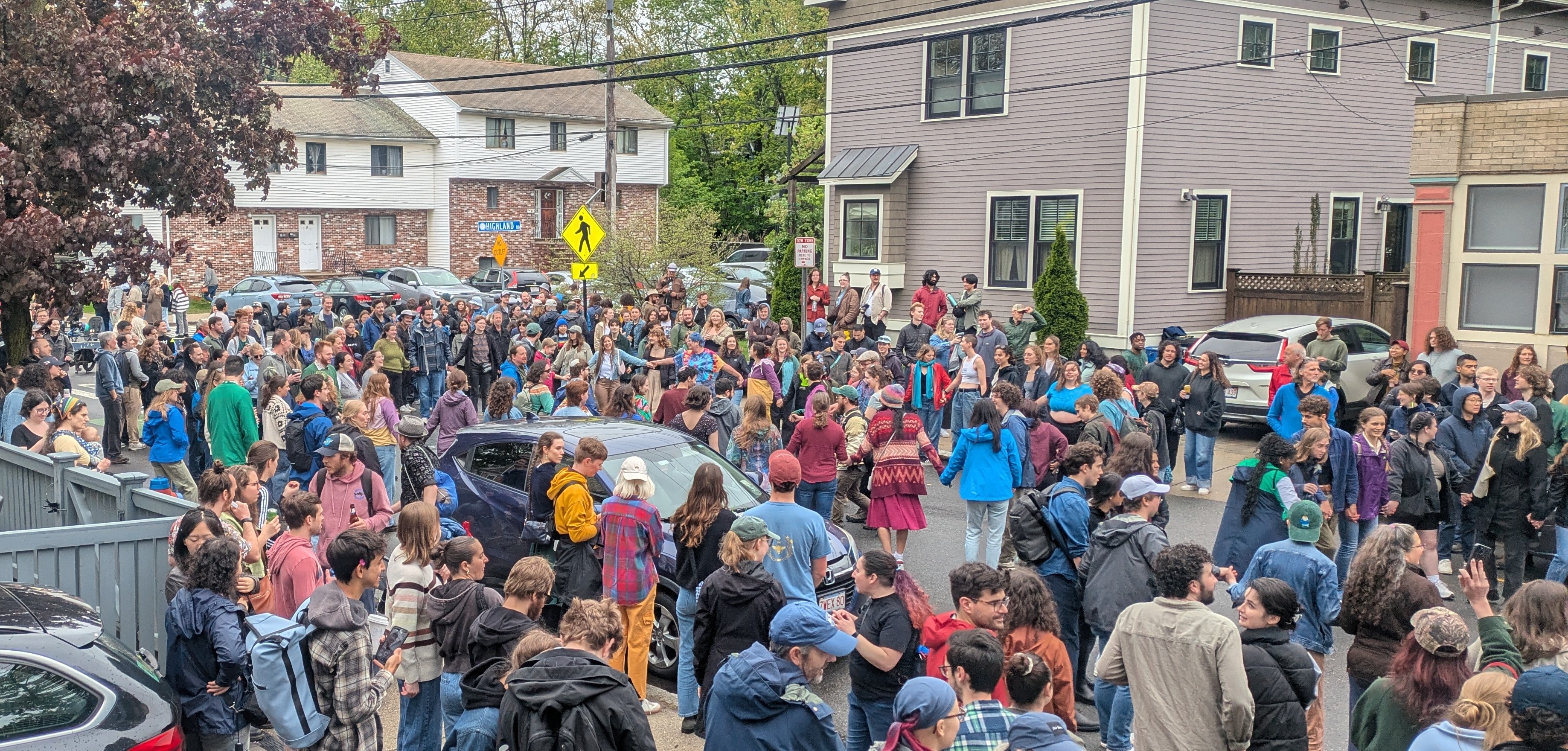
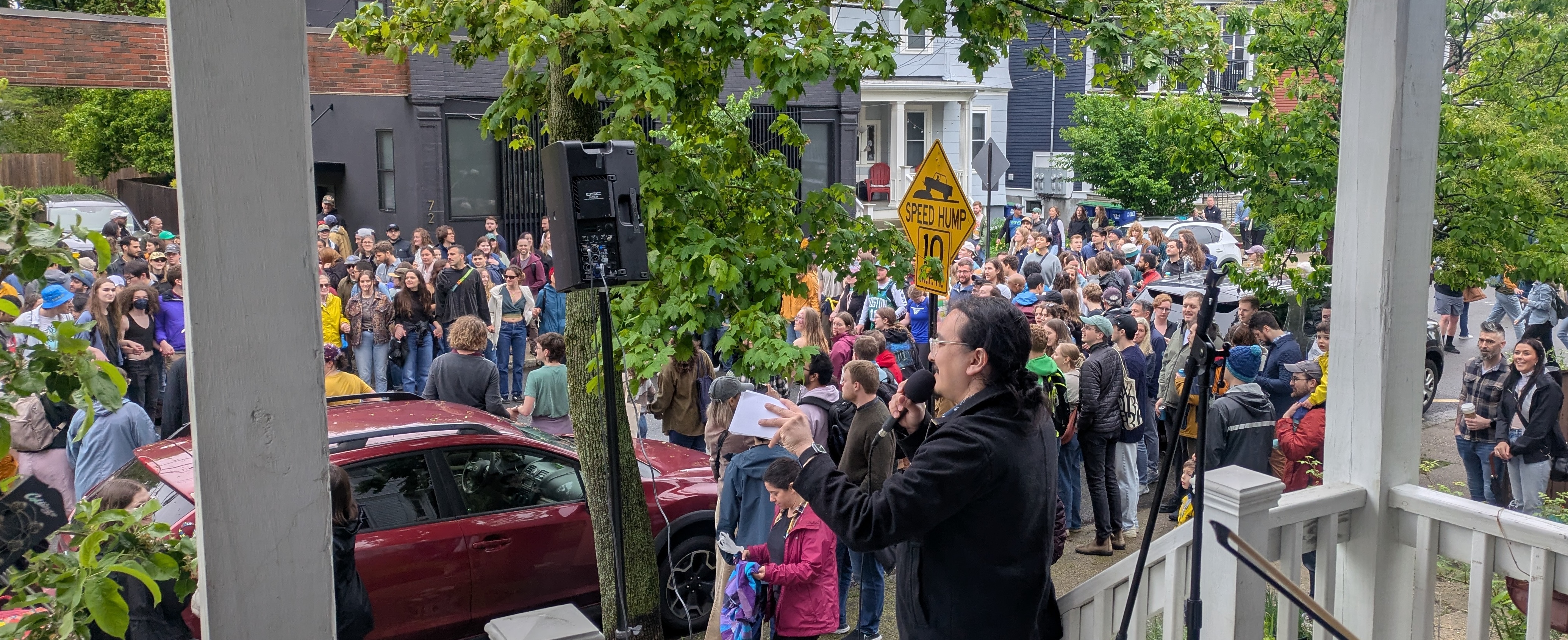
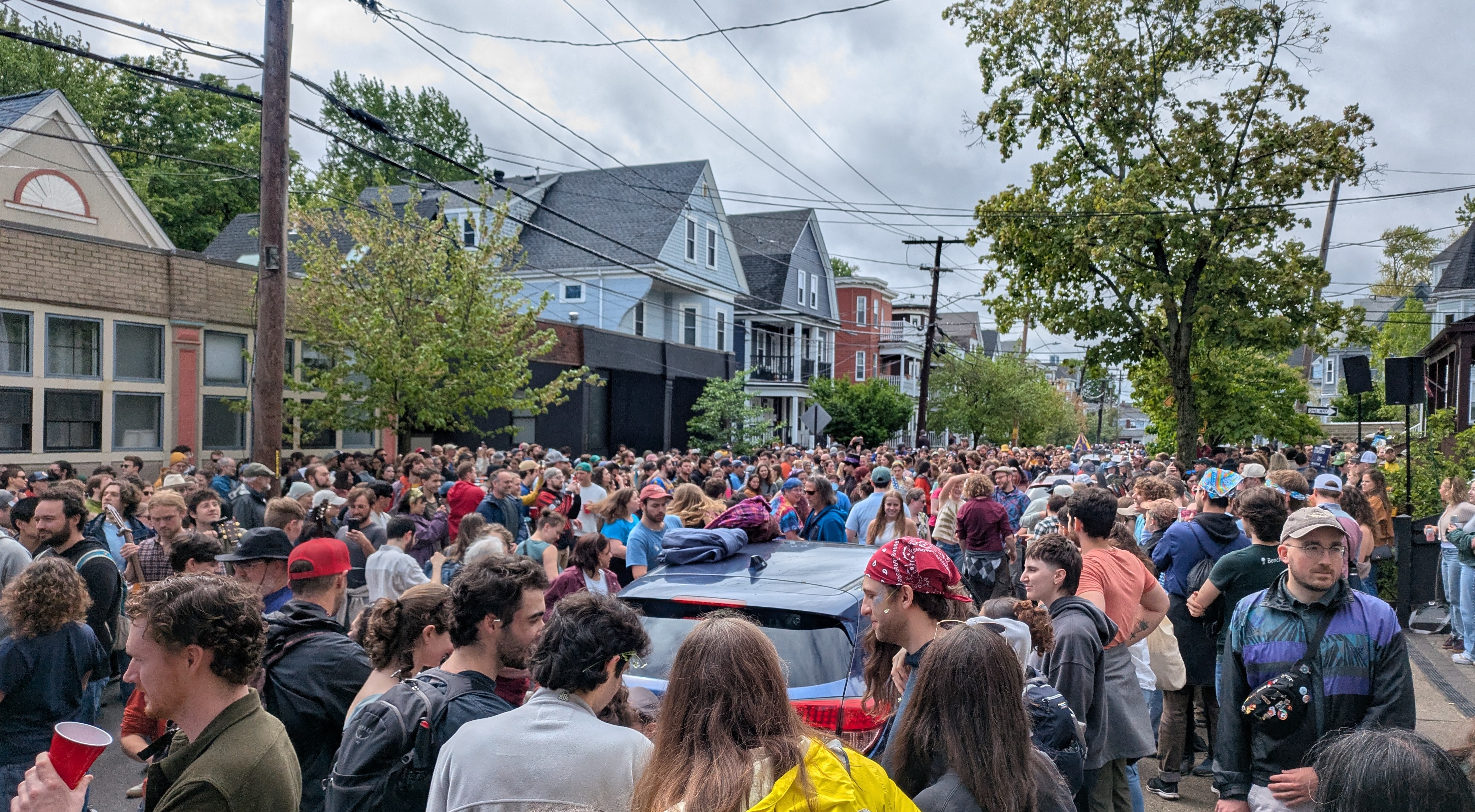 Showing some pictures to Claude it guesses there might have been 600
people. Very glad the city gave us permission to close the street! [1]
It would have been good not having cars parked in the main dance area,
since this ended up making us need to spread out a lot more than would
be ideal. Next time I'm going to see if I can get friends to park in
the four main spots in the ~day leading up to the dance and then move
their cars just as we're starting.
Showing some pictures to Claude it guesses there might have been 600
people. Very glad the city gave us permission to close the street! [1]
It would have been good not having cars parked in the main dance area,
since this ended up making us need to spread out a lot more than would
be ideal. Next time I'm going to see if I can get friends to park in
the four main spots in the ~day leading up to the dance and then move
their cars just as we're starting.

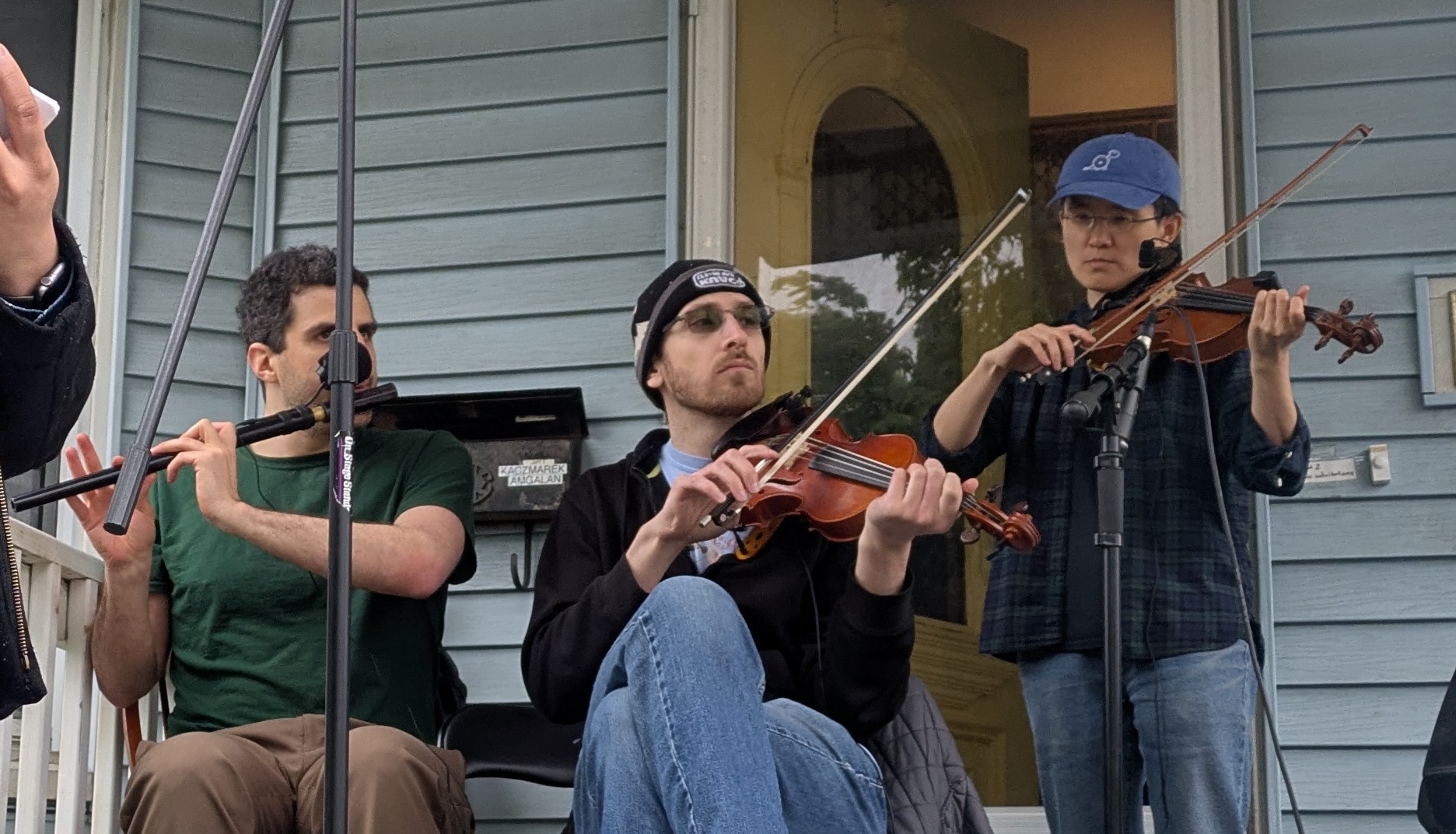 I played with Rohan and Charlie, with Weiwei and Rick sitting in. I
think we sounded pretty good; a bit of a pickup band, but still fun!
Sam sat in for one dance on piano and Weiwei and I got to play trumpet
and baritone together. At the end I convinced Sam to try playing the
kick drum while I played hi-hat—part of my long-term plan to
hook more people on <a href="
I played with Rohan and Charlie, with Weiwei and Rick sitting in. I
think we sounded pretty good; a bit of a pickup band, but still fun!
Sam sat in for one dance on piano and Weiwei and I got to play trumpet
and baritone together. At the end I convinced Sam to try playing the
kick drum while I played hi-hat—part of my long-term plan to
hook more people on <a href="