Did The New York Times Publish Manipulated Footage Of A Bitcoin Mine?
Level39
May 31, 2023
Footage accompanying a New York Times article critical of Bitcoin mining appears to have been manipulated to reinforce the paper’s bias.

Bitcoin Magazine
Did The New York Times Publish Manipulated Footage Of A Bitcoin Mine?
Footage accompanying a New York Times article critical of Bitcoin mining appears to have been manipulated to reinforce the paper’s bias.
This is an opinion editorial by Level39, a researcher focused on Bitcoin, technology, history, ethics and energy.
----------------------------------------------------------------------------------------------------
Did The New York Times manipulate aerial drone photography for its recent article attacking Bitcoin mining, in order to make the air in Rockdale, Texas appear smoggy?
On April 9, 2023, the paper published its article, "The Real-World Costs Of The Digital Race For Bitcoin[1]," which included attacks on Bitcoin miners who purchase energy through sanctioned demand-response programs [2] within the state’s energy grid.
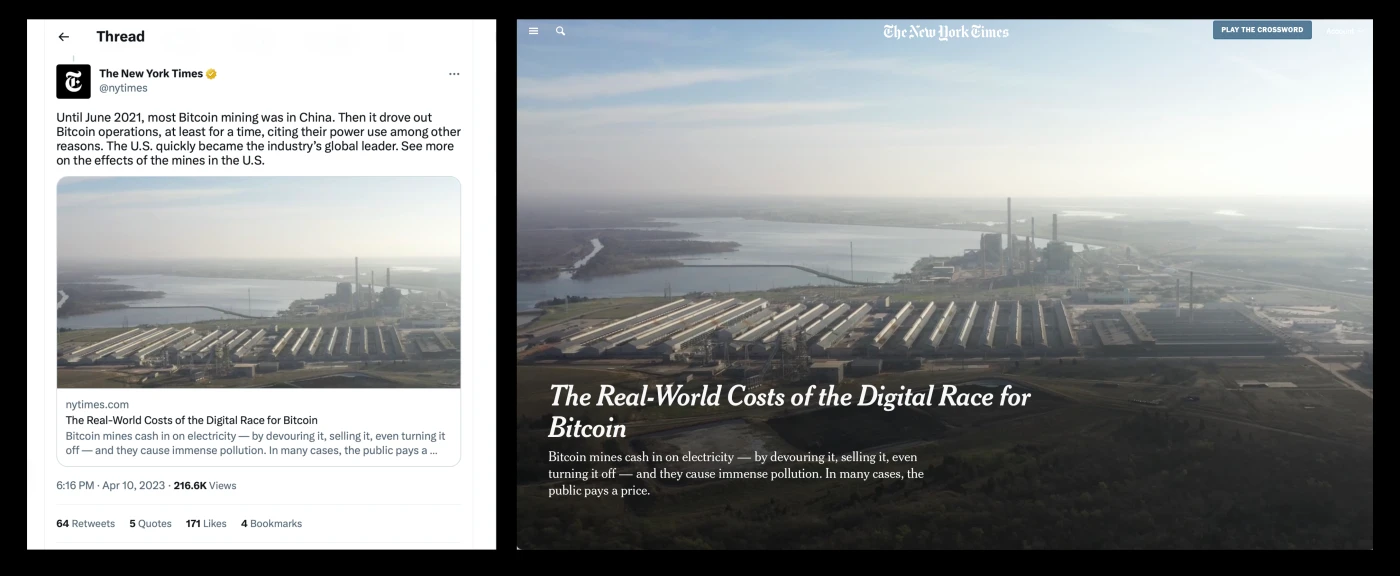
[Sources: Twitter[3], nytimes.com[4]]
The article featured a sweeping hero video banner [5], which was also used as a still image for social media sharing, showing smog-filled aerial drone footage [6] over operations run by Bitdeer, a Bitcoin mining company that occupies a previously-abandoned aluminum smelting plant on the outskirts of Rockdale. However, evidence suggests that the footage may have either been manipulated [7] or lacks the necessary color grading that would have maintained photojournalistic integrity and adhered to ethical standards.
Links:
[1]

The Real-World Costs of the Digital Race for Bitcoin (Published 2023)
Bitcoin mines cash in on electricity — by devouring it, selling it, even turning it off — and they cause immense pollution. In many cases, the ...
[2]
Load Resource Participation in the ERCOT Markets
Learn how a Load or aggregation of Loads, through a QSE, can qualify to provide Ancillary Services (Responsive Reserves, Nonspin Reserves, and/or R...
[3]

X (formerly Twitter)
The New York Times (@nytimes) on X
Until June 2021, most Bitcoin mining was in China. Then it drove out Bitcoin operations, at least for a time, citing their power use among other re...
[4]
The Real-World Costs of the Digital Race for Bitcoin (Published 2023)
Bitcoin mines cash in on electricity — by devouring it, selling it, even turning it off — and they cause immense pollution. In many cases, the ...
[5]
What is a Hero Banner?
Wondering what a hero banner is and why it matters for your website? We have the answers to all your hero banner questions here.
[6]
[7]
----------------------------------------------------------------------------------------------------
Color Histograms And Image Manipulation
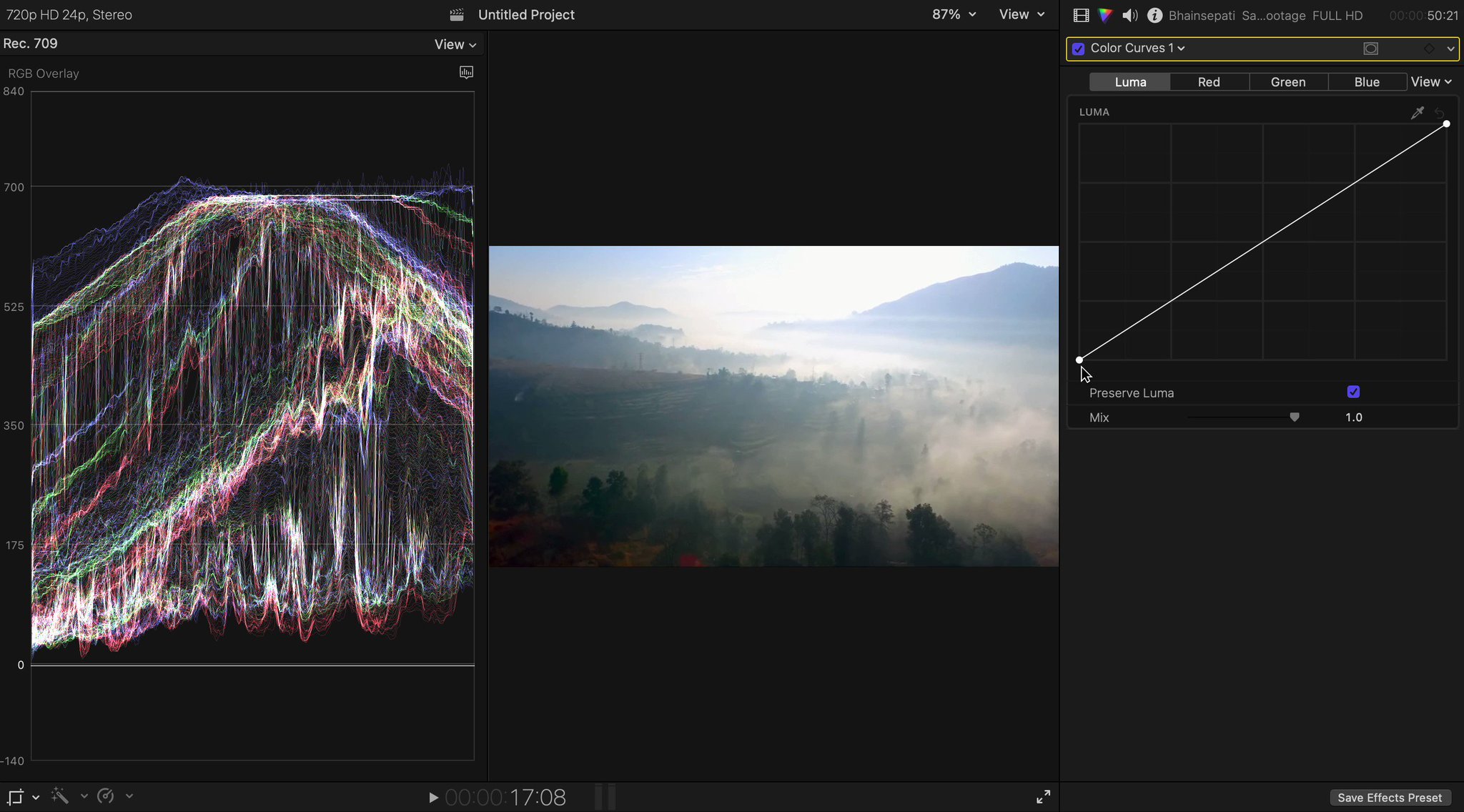
Color histograms are useful for analyzing the exposure and color balance of an image [1]. A color histogram is essentially a bar chart where the left side of the x-axis is black and the right side is white. The y-axis represents the number of pixels found in the image, for each part of the tonal scale between black and white. A properly exposed photograph, where the full spectrum of tonal blacks and whites are naturally found in a scene, will have pixels that span across the entire x-axis, from left to right [2]. When color data fails to span the entire x-axis, it can show that either those tones were entirely unavailable to the camera sensor, or that manipulation was performed to purposefully omit those colors.
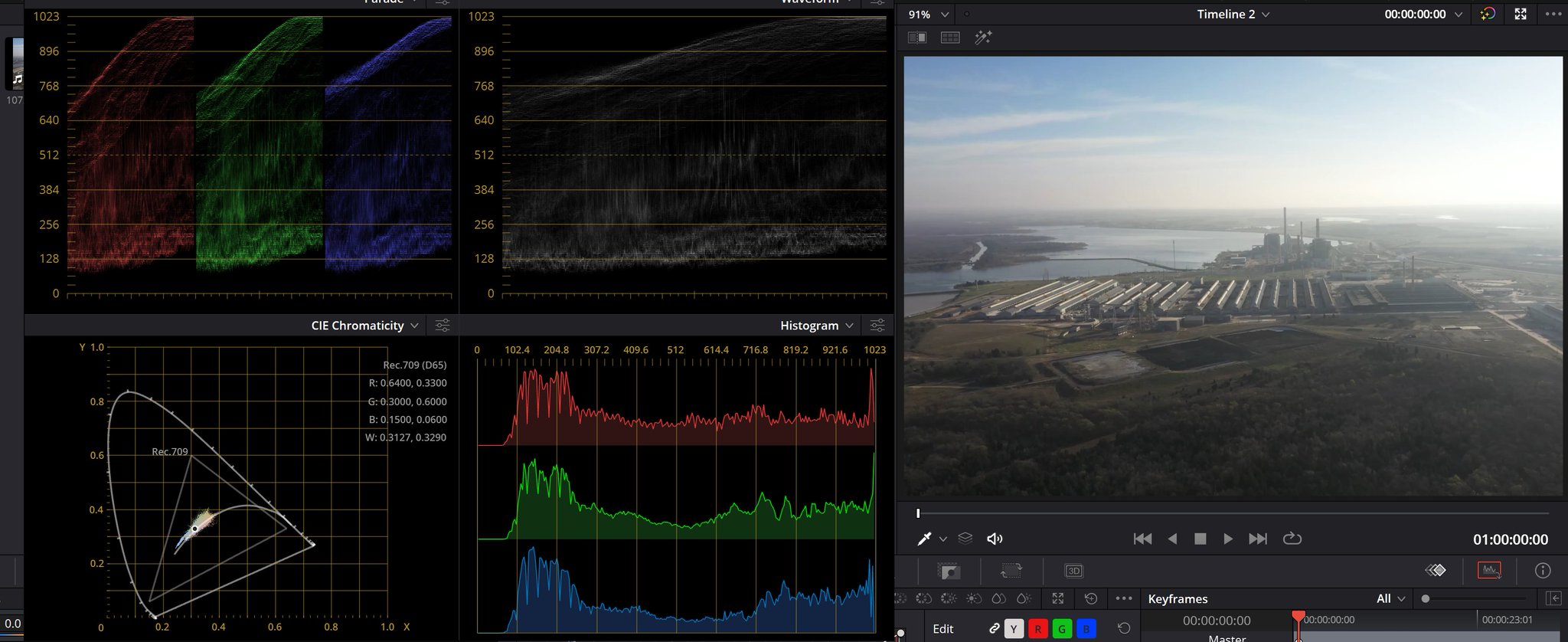
In the side-by-side comparison below, the color histogram in the aerial footage published by the Times [3] (left) has no pixels approaching the black point. This is particularly strange for footage that has bright sun and stark shadows that are clearly visible as the camera moves over the scene. When color parameters are enhanced and corrected (as shown below in the version on the right), a brighter and more stunning scene emerges.
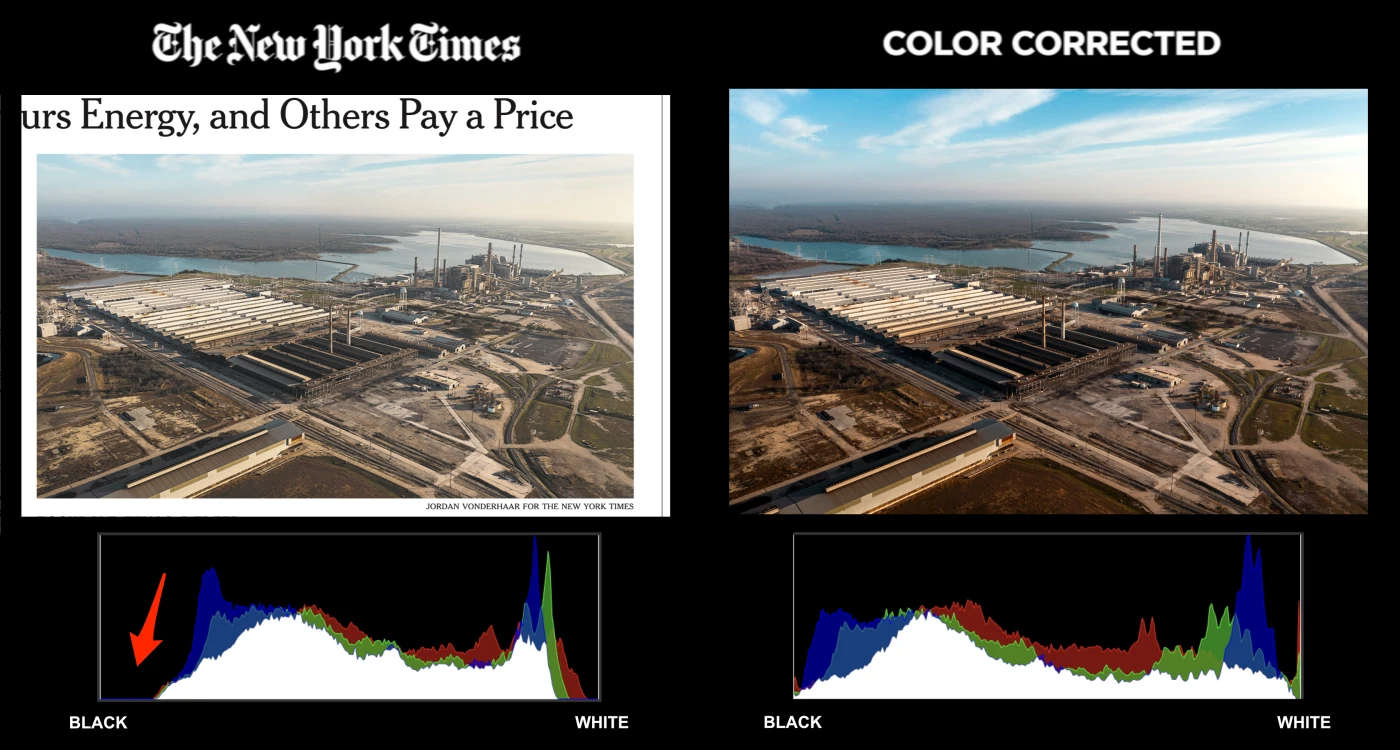
[The color histogram [4] for the image on the left, featured on The New York Times’ [5] website, has a distinct gap between its color data and its black point, possibly indicating either an improperly exposed image [6] or manipulation to add a smog effect [7]. The photo on the right has been color corrected, showing a normalized histogram with the full range of colors and indicating that the Times’ version seems to have been altered for effect.]
The hazy footage used by the Times may give readers a false impression that rural Texas air has been polluted by Bitcoin mining. Bitcon mines are fully electrified and, like electric vehicles [8], the mining facilities photographed by The Times have zero Scope 1 carbon emissions. In other words [9], there are no direct greenhouse (GHG) emissions [10] that occur from sources that are controlled or owned by the operators of the mines. Any indirect Scope 2 emissions [11] associated from mining’s energy use comes from the grid’s normal emissions.
Links:
[1]
https://www.bhphotovideo.com/explora/photography/tips-and-solutions/how-to-read-your-cameras-histogram
[2]

Digital Photography School
How to Read (and Use) Histograms for Beautiful Exposures
What is a histogram, and how can it improve your photography? Discover how to read and use a histogram so you can capture well-exposed photos!
[3]
[4]
Color histogram - Wikipedia
[5]
The Real-World Costs of the Digital Race for Bitcoin (Published 2023)
Bitcoin mines cash in on electricity — by devouring it, selling it, even turning it off — and they cause immense pollution. In many cases, the ...
[6]

Digital Photography School
Rescuing Poorly Exposed Photos with Photoshop Levels
Exposure may be the most common problem in photography. Whether your image is underexposed (too dark), overexposed (too bright), or just washed out...
[7]
[8]
Zero-emissions vehicle - Wikipedia
[9]
X (formerly Twitter)
Riot Platforms, Inc. (@RiotPlatforms) on X
@nytimes Bitcoin mining has zero carbon emissions.
[10]
[11]

US EPA
Scope 1 and Scope 2 Inventory Guidance | US EPA
Tools and guidance for low emitters and small businesses to develop an organization-wide GHG inventory and establish a plan to ensure GHG emissions...
----------------------------------------------------------------------------------------------------
Reply Hazy, Try Again
The alleged manipulation appears to have been indirectly confirmed by Jordan Vonderhaar, the freelance photographer who took the aerial footage in question. Vonderhaar published another photo from the same drone [1] flight on his personal website [2], showing that the weather was perfectly clear within moments of the hazy photo published by the Times. This clear photo, from a different angle, indicates that the missing color data in the hazy photo was not due to weather conditions.
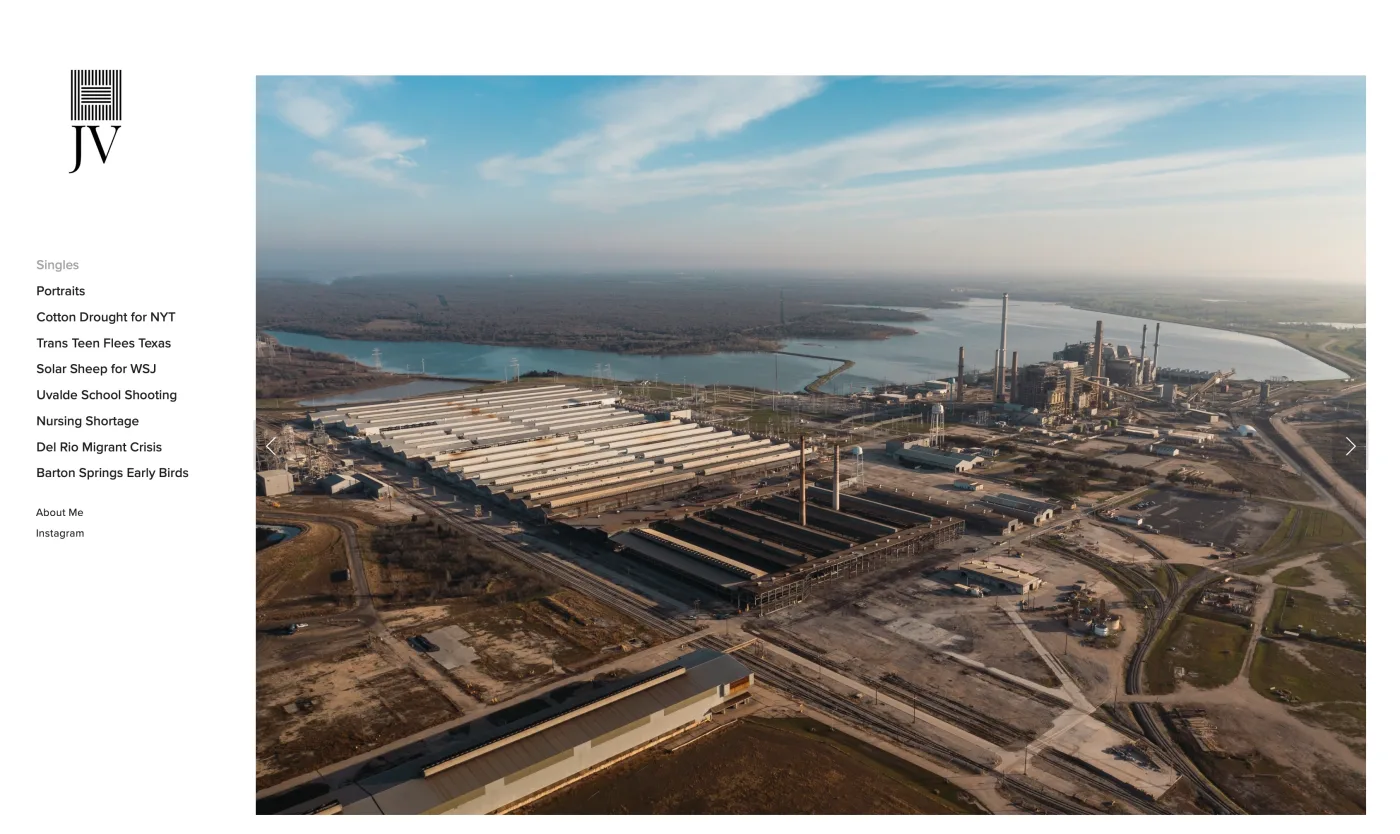
[Vonderhaar published a clear weather photo on his personal website [3], taken within minutes [4] of the photo that showed smog surrounding the same Bitdeer mine.]
Vonderhaar's clear and sunny photo was also featured on the front page of the Times’ print edition [5] (from April 11, 2023), with a color histogram that had similarities to the one found in the smoggy photo — another extended black point. Normalizing the black and white points on Vonderhaar's portfolio image reveals vibrant colors and a sunny morning in Rockdale. Notice in the side-by-side comparison below that the Times intentionally cropped out some of the blue skies when it published this particular shot:
[The image on the left was published on the April 11, 2023, front page of the Times’ print edition [6]. In addition to cropping out the blue skies, it appears to have had its black point extended, to wash out colors, as evidenced by the gap [7] between the color histogram data and the black point. Normalizing [8] the color histogram (right), brings out the full color spectrum.]
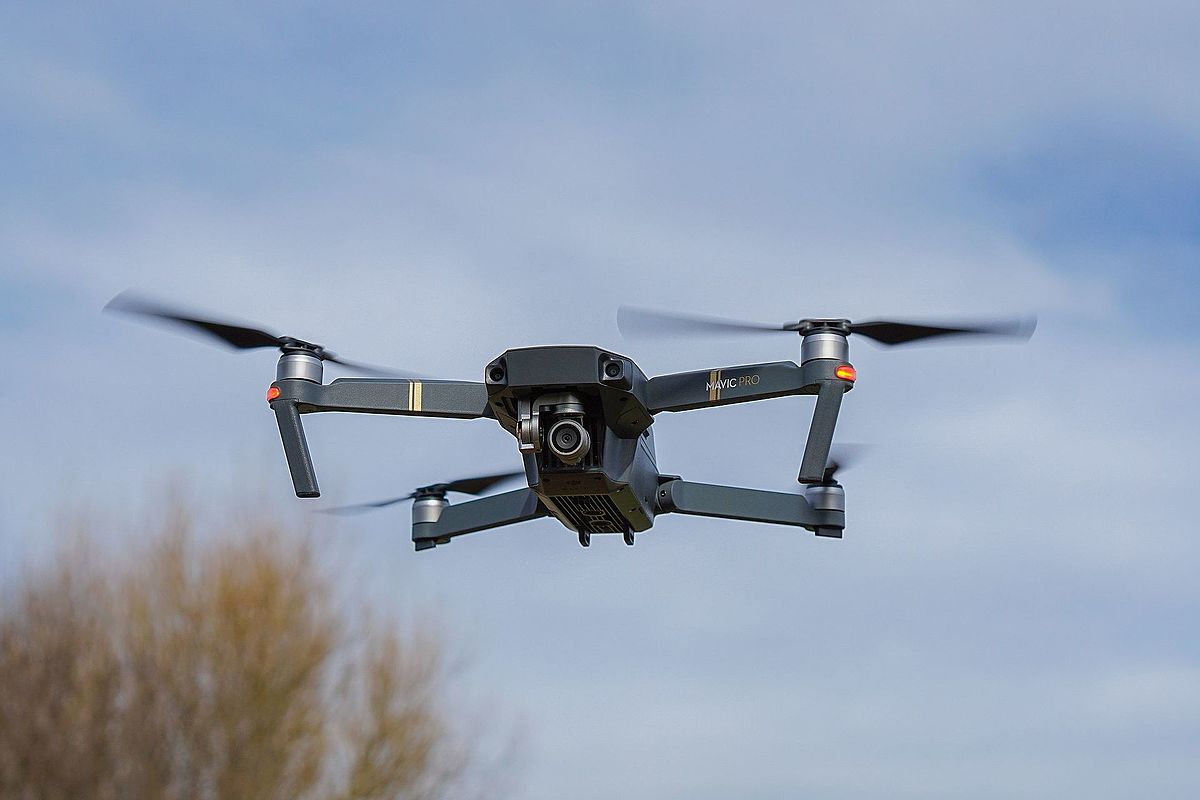
Vonderhaar’s photo on his portfolio site included full Exif metadata [9] that shows details about the imaging, such as the fact that it was taken on the morning of February 28, 2023, at 8:02 a.m. in raw [10] format, with a DJI FC220, the camera supplied by the DJI Mavic Pro drone [11].
Analysis of the shadows in the photo not only confirms this timing, but further analysis also indicates that the smoggy video footage [12] was taken only nine minutes after [13] the photo that showed clear and smog-free air surrounding the mine. Yet, the golden hues from the morning sunlight and blue skies are completely missing from the hazy hero footage. That a perfectly gorgeous moment in Rockdale could suddenly become hazy, at all altitudes and distances only nine minutes later, is nearly impossible.
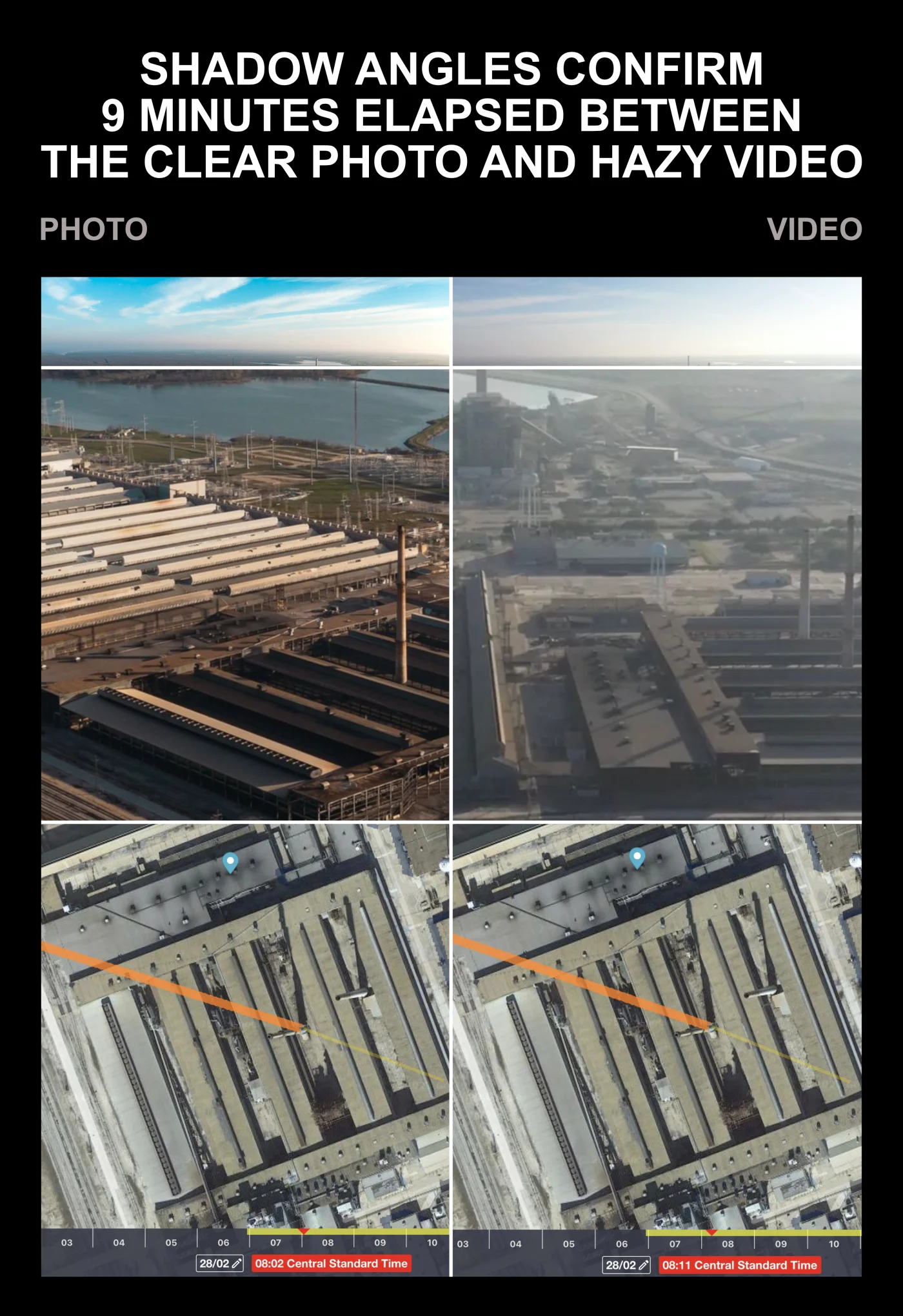
[Footage filmed nine minutes apart shows both clear weather and smog. Photos by Jordan Vonderhaar (top, middle), Shademap [14] (bottom), via @yeolddoc [15].]
Responding to allegations of manipulation, Vonderhaar — who described miners as “massive polluters [16]” — publicly stated on Twitter [17] that, “Nothing about the footage was doctored. It’s humid most mornings in Texas and when the sun rises you get low level haze. This is very common.”
Leaving aside for a moment that Vonderhaar appears to be admitting that he was perhaps intentionally seeking out hazy weather for his photojournalistic spread, the nearest automated weather observation station [18], located at Hearne Municipal Airport — 40 miles to the Northeast [19] and well out of view of the aerial photography — reported low-level fog [20] at that same moment.
Indeed, Vonderhaar's clear and sunny photo shows low-level fog on the distant horizon, many miles beyond Alcoa Lake. “Low-level” fog is not a high-altitude phenomenon, and sure enough, Vonderhaar's photo shows blue skies in the upper atmosphere and golden hues that are conspicuously missing in his smoggy footage, taken a few minutes later.
----------------------------------------------------------------------------------------------------
Links:
[1]
https://archive.ph/QVUQ9
[2]

Jordan Vonderhaar Photography
Jordan Vonderhaar Photography
[3]
Jordan Vonderhaar Photography
Jordan Vonderhaar Photography
[4]

X (formerly Twitter)
YeOldDoc ⚡ (@yeolddoc) on X
@level39 "Smoggy" picture was indeed taken within ~10 minutes of the first "clear" one. 2 of the 4 nearest weather stations reported "Fog" (vis <...
[5]
📄.pdf
[6]
📄.pdf
[7]
[8]
Digital Photography School
Rescuing Poorly Exposed Photos with Photoshop Levels
Exposure may be the most common problem in photography. Whether your image is underexposed (too dark), overexposed (too bright), or just washed out...
[9]
https://archive.is/Bqamk
[10]
Raw image format - Wikipedia
[11]
Category:Taken with DJI FC220 - Wikimedia Commons
[12]
[13]
X (formerly Twitter)
YeOldDoc ⚡ (@yeolddoc) on X
@level39 "Smoggy" picture was indeed taken within ~10 minutes of the first "clear" one. 2 of the 4 nearest weather stations reported "Fog" (vis <...
[14]

ShadeMap for 30°33'43"N 97°4'12"W
Every mountain, building and tree shadow in the world simulated for any date and time
[15]
X (formerly Twitter)
YeOldDoc ⚡ (@yeolddoc) on X
@level39 "Smoggy" picture was indeed taken within ~10 minutes of the first "clear" one. 2 of the 4 nearest weather stations reported "Fog" (vis <...
[16]
https://twitter.com/jordan_vondy/status/1645446668635058176
[17]
https://twitter.com/jordan_vondy/status/1645455851006640130
[18]
National Centers for Environmental Information (NCEI)
Automated Surface/Weather Observing Systems (ASOS/AWOS)
The Automated Surface Observing Systems (ASOS) program is a joint effort of the National Weather Service (NWS), the Federal Aviation Administration...
[19]

Alcoa Lake to Hearne Municipal Airport
Alcoa Lake to Hearne Municipal Airport
Find local businesses, view maps and get driving directions in Google Maps.
[20]

February 28, 2023 Historical Weather at Hearne Municipal Airport, Texas, United States - Weather Spark
----------------------------------------------------------------------------------------------------
Problems Uncovered
Rory Highside [1] — a VFX artist who has expertise in CGI video effects [2] — was among the first to notice problems with the footage that the Times had used. Analyzing the video and color histograms, Highside suspected that either the color grading was mishandled or the color balance had been manipulated [3]. One of the most noticeable issues was that the “black point” was extended, which is indicative of footage that is washed out [4]. This was evidenced by the fact that, as colors approached black, there was a noticeable and unnatural gap between pitch black and the available color data where darker colors should be. Vonderhaar did not respond to these allegations on Twitter, and did not respond to questions about them by email.
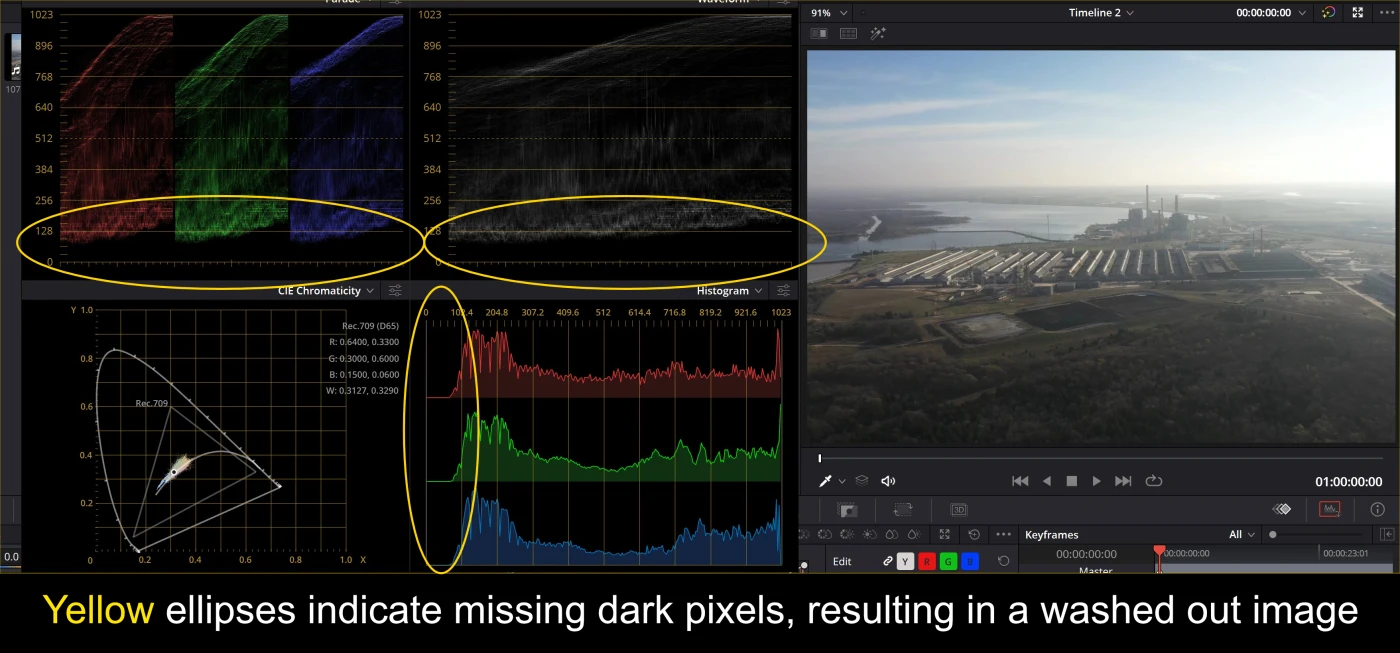
[Analysis by Rory Highside [5] of Vonderhaar’s Times footage.]
Links:
[1]

X (formerly Twitter)
Rory (@roryhighside) on X
Australian economics, she’ll be right mate. Bitcoin Supremacist. Zuckbuck Maximalist. Bergchain not blockchain. Heil Zoltan!
[2]
[3]
X (formerly Twitter)
Rory (@roryhighside) on X
@jordan_vondy @wadaniel @nytimes Either you're a completely clueless hack, or you extended the bounds of your black point to wash the image out. Se...
[4]

Photography Stack Exchange
How to/Best Methods to Correct Washed Out JPEGs?
I have many photos that have that washed out look about them and some that are completely blown out. These photos are JPEG only and were not taken ...
[5]
X (formerly Twitter)
Rory (@roryhighside) on X
@jordan_vondy @wadaniel @nytimes Either you're a completely clueless hack, or you extended the bounds of your black point to wash the image out. Se...
----------------------------------------------------------------------------------------------------
The Hazy Truth Of Photojournalism
Determining truth in photojournalism is a murky endeavor. The raw footage captured by professional-grade digital cameras can be thought of as the digital version of undeveloped film. Camera sensors capture raw data, which retains maximum image information and flexibility [1] during post-processing, but requires processing and interpolation to produce an accurate final image. The photographer must adjust various parameters, such as contrast, white balance, exposure, and color saturation — meaning the photographer always has some artistic leeway in the final product. Color manipulations are trivial adjustments in post production. It only takes one slight adjustment [2] to wash out an image. Minor adjustments are very common, and typically not an issue. But, at the end of the process, photographers have to walk a fine line between enhancing an image for visual impact and maintaining its authenticity.
Links:
[1]
Camera Raw Formats (Group Description)
Format Description for CAM_RAW -- A group of proprietary formats employed by digital cameras that use a color filter array to capture image data. R...
[2]
X (formerly Twitter)
Level39 (@level39) on X
2) These waveforms show the full potential range of colors. White is at the top (700), black is at the bottom (0). It's easy to manipulate media to...
----------------------------------------------------------------------------------------------------
Unedited Raw Drone Footage Is Visibly Hazy
There is perhaps an alternate explanation for why Vonderhaar’s video footage was so hazy and lacking in contrast, while his still photograph taken nine minutes earlier was sunny and cinematic. The FC220 camera on Vonderhaar’s DJI Mavic Pro drone is capable of capturing video footage in a logarithmic (log) color profile [1]. Raw log footage is a flat and low-contrast format — not intended for publishing — that preserves a wide dynamic range of details, which allows for greater flexibility during post-processing. Much like how negative film [2] has inverted colors that enable positive images to be developed, log video footage always appears hazy when its raw, unedited format isn’t properly color graded [3].It would be the photojournalist’s responsibility, then, to accurately map to the colors they witnessed in real life.
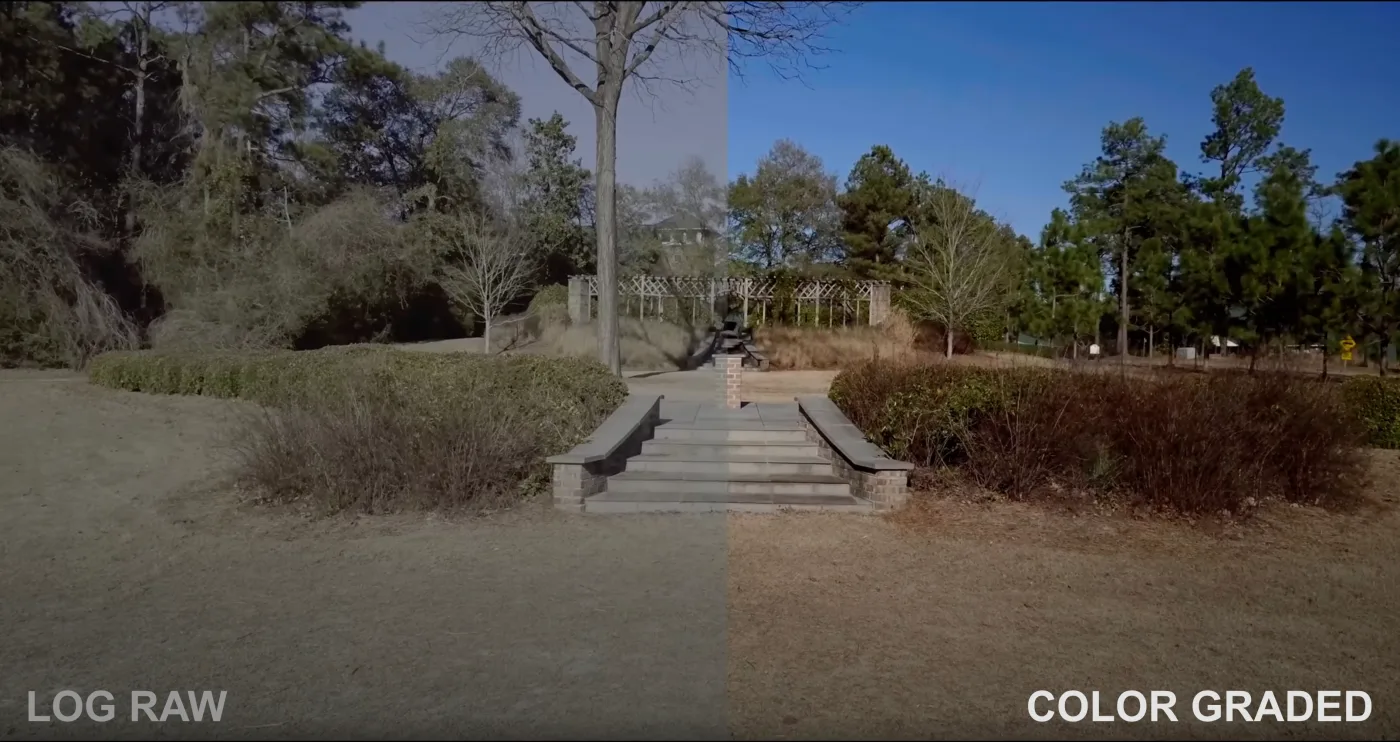
[DJI drones can record in a logarithmic (log) color profile, which appears hazy if it isn’t color graded in post-processing [4]. Source: “Shooting In D-Log - DJI Mavic Pro [5].”]
To convert log footage to an accurate color profile, a process called “color grading” or “color correction” is typically performed [6]. This involves adjusting the image's color and tonal properties to achieve a more visually pleasing and accurate representation of the scene. The proper conversion from log [7] involves mapping the tonal values in the log footage to their corresponding values, such as with lookup tables, or LUTS, to color grade the final footage.
Vonderhaar could very well have been telling the truth when he claimed [8] that “Nothing about the footage was doctored.” Indeed, publishing unedited log footage without proper color grading would quite literally result in a misleading smog effect, without having to do anything. Doing this deliberately, of course, would be unethical if it intentionally misleads viewers into seeing smog that did not exist.
Photojournalists have a duty [9] to maintain journalistic integrity and adhere to ethical standards to truthfully convey the events they witnessed. While there is no definitive "correct" color to any image, intentionally misleading readers by failing to color grade log footage is a breach of ethical standards. Photojournalists must depict the scene as faithfully as possible, avoiding anything that might distort reality. Publishing raw and uncorrected video footage, which actively removes colors from a scene and creates a misleading smog effect, is effectively a passive form of photographic manipulation. If not manipulation, then it is an egregious example of Hanlon’s razor [10].
It should be noted that Vonderhaar’s lack of color grading may not be due to malice or even artistic bias. While a professional photographer who has expertise in color correcting raw still images [11] to JPEG may possess a solid foundation in color correction and a good understanding of color theory, it does not automatically mean they have the necessary skills to color grade log video footage. Color grading log video involves a different set of skills and considerations [12] compared to color correcting raw still images [13]. Expertise in video editing software and a specific understanding of the technical aspects of working with video formats — such as frame rates, codecs and color spaces — is a requirement to adeptly work with log footage. Managing temporal continuity and ensuring consistent color grading is critical to maintaining visual coherence. It’s entirely plausible that Vonderhaar was simply unable to color grade log video. But, whether it be malice or inability, the Times should issue a correction.
Links:
[1]
https://www.dpreview.com/articles/4978813437/how-to-shoot-log-video-using-dji-s-d-log-color-profile
[2]

Negative (photography) - Wikipedia
[3]
[4]
https://www.dpreview.com/articles/4978813437/how-to-shoot-log-video-using-dji-s-d-log-color-profile
[5]
[6]
[7]
https://www.dpreview.com/articles/4978813437/how-to-shoot-log-video-using-dji-s-d-log-color-profile
[8]
https://twitter.com/jordan_vondy/status/1645455851006640130
[9]
NPPA
Code of Ethics for Visual Journalists
PREAMBLE
The National Press Photographers Association, a professional society that promotes the highest standards in visual journalism, acknowledg...
[10]
Hanlon's razor - Wikipedia
[11]
Jordan Vonderhaar Photography
Jordan Vonderhaar Photography
[12]
[13]
----------------------------------------------------------------------------------------------------
The Signature Style Of The Times
The Times has a signature style for its photographs [1], where it typically darkens images when it wants to portray a somber or moody tone. However, an extended black point — resulting in washed out colors — is the direct opposite of this iconic style.
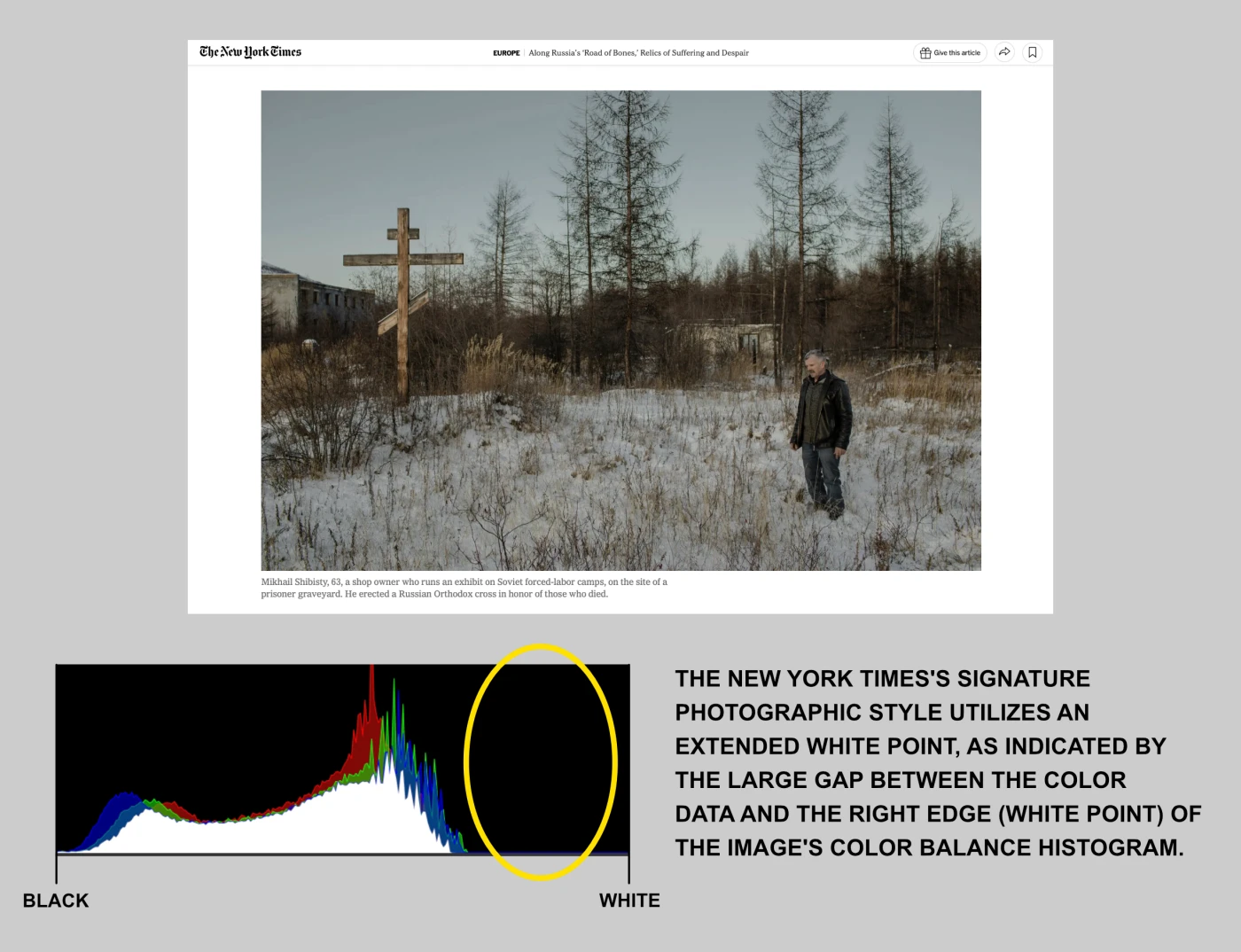
[The Times’ signature photographic style [2] uses an extended white point that slightly darkens the image.]
----------------------------------------------------------------------------------------------------
Links:
[1]
Reddit - The heart of the internet
[2]

Along Russia’s ‘Road of Bones,’ Relics of Suffering and Despair (Published 2020)
The Kolyma Highway in the Russian Far East once delivered tens of thousands of prisoners to the work camps of Stalin’s gulag. The ruins of that c...
----------------------------------------------------------------------------------------------------
The Ethics Of Photo Manipulation
All photography requires some form of color correction. Minor stylistic choices aside, adjustments that actively mislead readers are unethical [1]. A 2015 article in the Times [2] about a World Press Photo research project, for instance, explained that photo editors cross an ethical line, which becomes explicit manipulation, when their processing obscures an image to create conditions that were not actually in the scene:
“The only point at which processing becomes manipulation is when the toning is so great — usually by transforming significant parts of an image to opaque black or white — that it obscures substantial detail.”
–“Debating The Rules And Ethics Of Digital Photojournalism [3],” The New York Times
According to Highside, the extent of the manipulation and our ability to restore the full color potential will remain unknown unless Vonderhaar releases his original raw footage. The Society of Professional Journalists (SPJ) recommends in its code of ethics [4] that journalists need to be proactive about addressing concerns and allegations of improper conduct:
“Ethical journalism means taking responsibility for one’s work and explaining one’s decisions to the public. Journalists should: Explain ethical choices and processes to audiences. Encourage a civil dialogue with the public about journalistic practices, coverage and news content. Respond quickly to questions about accuracy, clarity and fairness. Acknowledge mistakes and correct them promptly and prominently. Explain corrections and clarifications carefully and clearly. Expose unethical conduct in journalism, including within their organizations. Abide by the same high standards they expect of others.”
–SPJ code of ethics [5]
Despite the missing color data, which can only be sourced from Vonderhaar’s unreleased raw footage, Highside was able to partially restore the washed out footage to demonstrate what the imaging could have looked like if a proper color grading had been applied. The results are striking when compared alongside the video that was published by the Times:

New York Times Color Profile Comparison
Intentionally deciding not to color grade or fully correct log footage is a breach of ethical standards in photojournalism. However, if it was due to lack of ability, it can still be considered a breach of ethical standards, particularly if the Times fails to correct the misinformation or take appropriate action to rectify the situation. A fundamental principle [6] of photojournalism is to provide an accurate and truthful representation of events. Misrepresenting the visual aspects of a scene goes against this principle and compromises the integrity of the profession. It undermines the credibility of photojournalists and the publication, it damages the reputation of the profession and erodes public trust in the media.
It’s unclear why the Times is seemingly motivated [7] to deliberately portray Bitcoin mining in such a negative light. It appears to fit a long pattern of distortions and bias [8] from the newspaper, which has become more evident to readers in recent years. When the public is being misled by photojournalists into believing a small and rural Texas town has thick smog typically found in populated and polluted cities, it’s necessary and appropriate to question the paper’s ethical choices.
Vonderhaar could clear up suspicions over his work by releasing the original raw log footage. This would allow members of the public to properly assess the color grading of the footage and reveal the true details that were present [9]. If indeed the log footage was intentionally left in a low contrast state, it would be an embarrassment for the Times.
Links:
[1]
http://spj.org/ethicscode.asp
[2]

Lens Blog
Debating the Rules and Ethics of Digital Photojournalism
The disqualification of a large number of images from this year’s World Press Photo contest has generated a debate over the need for more ex...
[3]
Lens Blog
Debating the Rules and Ethics of Digital Photojournalism
The disqualification of a large number of images from this year’s World Press Photo contest has generated a debate over the need for more ex...
[4]
http://spj.org/ethicscode.asp
[5]
http://spj.org/ethicscode.asp
[6]
NPPA
Code of Ethics for Visual Journalists
PREAMBLE
The National Press Photographers Association, a professional society that promotes the highest standards in visual journalism, acknowledg...
[7]

Bitcoin Magazine
Who Benefits From The New York Times’ Attacks On Bitcoin?
A recent editorial attack on Bitcoin mining by The New York Times raises questions about its journalistic integrity and editorial process.
[8]
https://www.thegrayladywinked.com/
[9]
----------------------------------------------------------------------------------------------------
This is a guest post by Level39. Opinions expressed are entirely their own and do not necessarily reflect those of BTC Inc or Bitcoin Magazine.

 ------------------------------------------------
Gemini, a global cryptocurrency exchange, has announced [1] its plans to acquire a cryptocurrency license in the United Arab Emirates (UAE) in a move to expand its services. Describing the UAE's position as a forward-thinking financial hub, Gemini aims to tap into the country's growing market. The company is committed to becoming a global entity, according to the announcement, by meeting local regulatory requirements and understanding the needs of UAE crypto investors.
Gemini's decision to apply for a license comes as a result of its findings from the 2022 Global State of Crypto Report. The report revealed a significant increase in cryptocurrency adoption among individuals in the UAE, with many using it for in-person purchases. Additionally, the study indicated a strong intention among non-owners to enter the cryptocurrency space.
Speaking about the application, Gemini leadership expressed their vision of providing a safe, secure, and user-friendly platform for customers in the UAE and beyond. The company stated that it is eager to serve the rapidly growing and vibrant crypto community in the region.
In January, Gemini co-founder Cameron Winklevoss wrote a letter to its parent company [2] Digital Currency Group (DCG) alleging that DCG defrauded Gemini customers in relation to Gemini Earn. Prior to that, Gemini was sued by the CFTC [3] for “misleading the regulator in conversations concerning the launch of bitcoin futures contracts.”
Gemini's move into the UAE highlights the country's emerging status as a bitcoin hub. In addition, it highlights the continued flight of major exchanges out of the U.S. as a result of tightening regulations. At the beginning of May, Coinbase introduced its new international exchange arm [4] called Coinbase International, with the company stating that “countries around the world are increasingly moving forward with responsible crypto-forward regulatory frameworks to strategically position themselves as crypto hubs.”
------------------------------------------------
Links:
[1]
------------------------------------------------
Gemini, a global cryptocurrency exchange, has announced [1] its plans to acquire a cryptocurrency license in the United Arab Emirates (UAE) in a move to expand its services. Describing the UAE's position as a forward-thinking financial hub, Gemini aims to tap into the country's growing market. The company is committed to becoming a global entity, according to the announcement, by meeting local regulatory requirements and understanding the needs of UAE crypto investors.
Gemini's decision to apply for a license comes as a result of its findings from the 2022 Global State of Crypto Report. The report revealed a significant increase in cryptocurrency adoption among individuals in the UAE, with many using it for in-person purchases. Additionally, the study indicated a strong intention among non-owners to enter the cryptocurrency space.
Speaking about the application, Gemini leadership expressed their vision of providing a safe, secure, and user-friendly platform for customers in the UAE and beyond. The company stated that it is eager to serve the rapidly growing and vibrant crypto community in the region.
In January, Gemini co-founder Cameron Winklevoss wrote a letter to its parent company [2] Digital Currency Group (DCG) alleging that DCG defrauded Gemini customers in relation to Gemini Earn. Prior to that, Gemini was sued by the CFTC [3] for “misleading the regulator in conversations concerning the launch of bitcoin futures contracts.”
Gemini's move into the UAE highlights the country's emerging status as a bitcoin hub. In addition, it highlights the continued flight of major exchanges out of the U.S. as a result of tightening regulations. At the beginning of May, Coinbase introduced its new international exchange arm [4] called Coinbase International, with the company stating that “countries around the world are increasingly moving forward with responsible crypto-forward regulatory frameworks to strategically position themselves as crypto hubs.”
------------------------------------------------
Links:
[1]  [2]
[2]  [3]
[3]  [4]
[4]  #UAE #Gemini #Exchanges #Middleeast
------------------------------------------------
#UAE #Gemini #Exchanges #Middleeast
------------------------------------------------








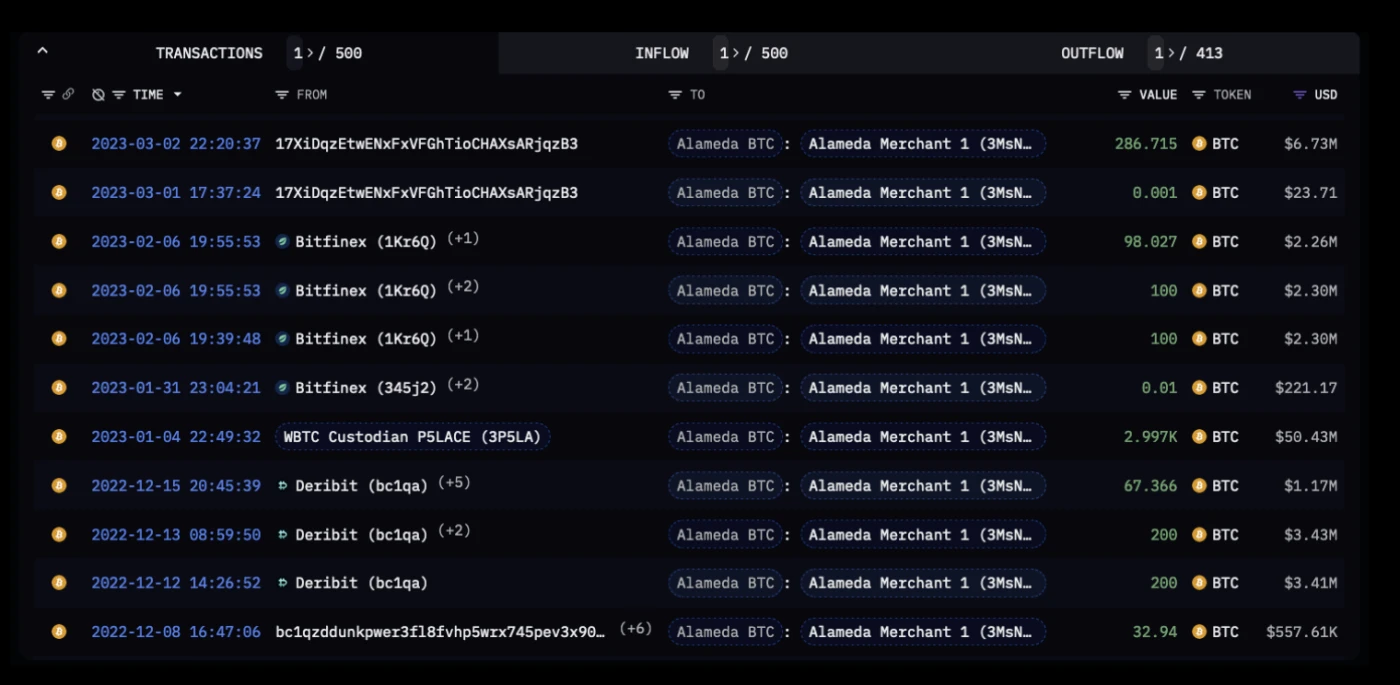 [A screenshot from the provided report.]
“However, this is only a fraction of the BTC that Alameda controlled in the past,” the report noted. “Wallets connected to this network of Alameda’s BTC activity were worth at peak over $800M, with Alameda likely holding more BTC in Centralized Exchanges or unlinked Cold Wallets.”
Arkham Intelligence stated that it will continue to monitor the on-chain activity of Alameda’s liquidators.
------------------------------------------------
Links:
[1]
[A screenshot from the provided report.]
“However, this is only a fraction of the BTC that Alameda controlled in the past,” the report noted. “Wallets connected to this network of Alameda’s BTC activity were worth at peak over $800M, with Alameda likely holding more BTC in Centralized Exchanges or unlinked Cold Wallets.”
Arkham Intelligence stated that it will continue to monitor the on-chain activity of Alameda’s liquidators.
------------------------------------------------
Links:
[1]