Thread

The left gives themselves new political powers which then get used by the right when they’re in power. The right give themselves new political powers which then get used by the left. It spirals toward more centralized government over time. Keeping government limited is like constantly passing the marshmellow test, delaying immediate gratification for longer-run benefit.

Replies (57)

I'm starting realize the only thing government does is create and amplify problems and bounce around the illusion of solving the problem between parties with the intended goal of simply staying in power and so-called relevant but they don't fix any problems we the people have because they would become much less needed and relevant.
I agree with that at federal levels but not at local levels. My town's government works admirably with a small budget. Builds what they need to build. Polices reasonably. Legitimately listens to you if you speak to legislators. The larger the scale of government. The more distant the Representative is from you. The more frought with debt and ineffective policy they tend to be.
If the government was not actively seeking to profit from the citizenry it would probably be a really nice thing to have. The state does provide services, But one needs to reach a point of desperation to realize them. Whether anyone uses the services the government provides is not a qualification for payment of those services. Imagine if all those services were free and available to anyone? Obviously being independent of government is the most comfortable position, But it is a fight to reach that point, And most people actually never will. People open up and love each other unconditionally when they have all their needs met. The sustainability of this prosperity is the limit of how long this unconditional love can exist, Because all humans are inherently self interested, And only people who are dependent on others for resources will sacrifice themselves to preserve those resources.
npub1a2cww4kn9wqte4ry70vyfwqyqvpswksna27rtxd8vty6c74era8sdcw83a highlights an obvious flaw in modern democracies Parties & their supporters on either side of the spectrum usher in new powers without thought of the risks of who might wield them in the future Rather than reversing the extra powers the last side granted themselves, they grant their own side even more powers to counter the power grab of their opponents It's both idiotic & depressingly predictable But the real issue is not the short-termism of politicians who come & go, it is the long-term incentives of the growing bureaucratic class who prevail, accumulating more & more power along the way It is the bureaucrats who have the strongest incentive to ever expand their power, simply printing money to support useless & damaging overreach Voting harder doesn't fix this View quoted note β†’
If only is was written into the constitution that they didn't have ever expanding powers. Something like: "any powers not specifically given to the federal government by the Constitution, nor withheld from the states, are reserved to those respective states, or to the people."
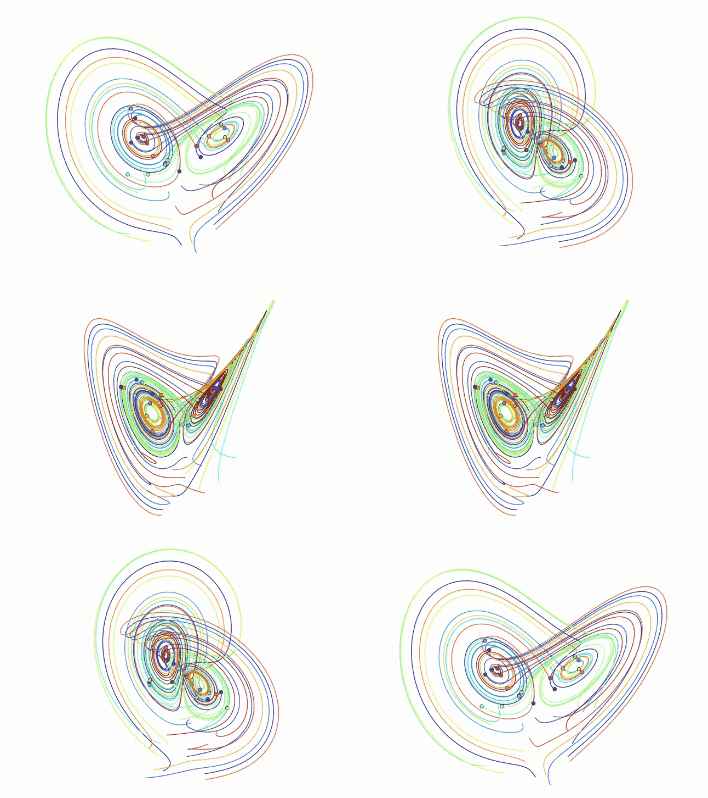
Not a spiral, Lyn. A gyre. Spirals symbolise growth, progression, or harmony, often tied to natural, mathematical patterns like the Fibonacci sequence or golden ratio. It suggests order and continuity. A gyre, on the other hand, suggests cyclicality, turbulence, or inevitability, often with a sense of overwhelming or uncontrollable forces, as in Yeats’ apocalyptic imagery. Individuals spiral while States gyre. A subtle but crucial difference. Spiral out πŸŒ€
I fluctuate between it’s not as bad as it seems as social media isn’t truly reflective of reality and fuck this could be getting serious now. Not sure where we’re at so I just stack sats as a working tested strategy is always make more money and you’ll be okay
Because Nostr is a decentralized protocol, it's designed to be highly resistant to censorship and blocking. The protocol itself doesn't have a central authority that can be used to "block" users based on a digital ID. However, there are some nuances to consider: No Central Verification: Nostr doesn't have a built-in system for verifying real-world identity. Anyone can create a new keypair (your identity on Nostr) at any time. This is a core part of its censorship resistance. Relay-Level Blocking: While you can't block an account on the protocol level, individual relays (the servers that store and share Nostr events) can choose to block or filter content from specific users. A user who is blocked by one relay can simply connect to a different one. Impersonation and Trust: Because anyone can create an identity, impersonation is a known issue. To combat this, some methods have been developed to establish trust, such as NIP-05, which allows users to link their public key to a domain name (like name@yourdomain.com). This provides a form of identification, but it's not a formal, global verification system. In summary, while there's no way to universally block an account on Nostr using a digital ID, the decentralized nature of the network means that users and relays can implement their own methods for filtering content and managing trust.
I believe we are currently entering the Fourth Turning. The "Fourth Turning" refers to the Crisis, the fourth and final stage in an approximately 80-year cycle of American history, according to the generational theory of Strauss-Howe, as outlined in their books "The Fourth Turning" and "The Fourth Turning Is Here." This phase, compared to winter, is a period of social, political, and economic upheaval where old institutions are dismantled and new ones are forged through conflicts and threats to the nation's survival, culminating in a social reorganization and a new sense of community identity. The Four Turnings The Strauss-Howe theory describes a cycle of "turnings," comparable to the four seasons, that repeat approximately every 80 years: High: An era of prosperity and strong institutions, similar to summer. Awakening: A period of spiritual and cultural awakening, comparable to spring. Unraveling: An era of questioning and institutional decay, similar to autumn. Crisis (The Fourth Turning): A period of great turmoil, conflict, and profound social change, like winter. Characteristics of the Fourth Turning Existential Crisis: A perceived threat to the nation's survival. Conflict and Disorder: Increased polarization, conflicts, and the disintegration of old institutions. Reconstruction: The conflicts of the crisis lead to the destruction of weak institutions and the creation of new, strengthened ones. End of the Cycle: The Crisis culminates in a restructuring of society, establishing a new order for a future "High." Current Context According to the theory and Howe's analysis, America is currently in the middle of a Fourth Turning that began around 2008. This period is characterized by global challenges, socioeconomic disorder, and the weakening of institutions. This time of crisis is seen as a necessary event for society to regenerate and define new values for the future.