
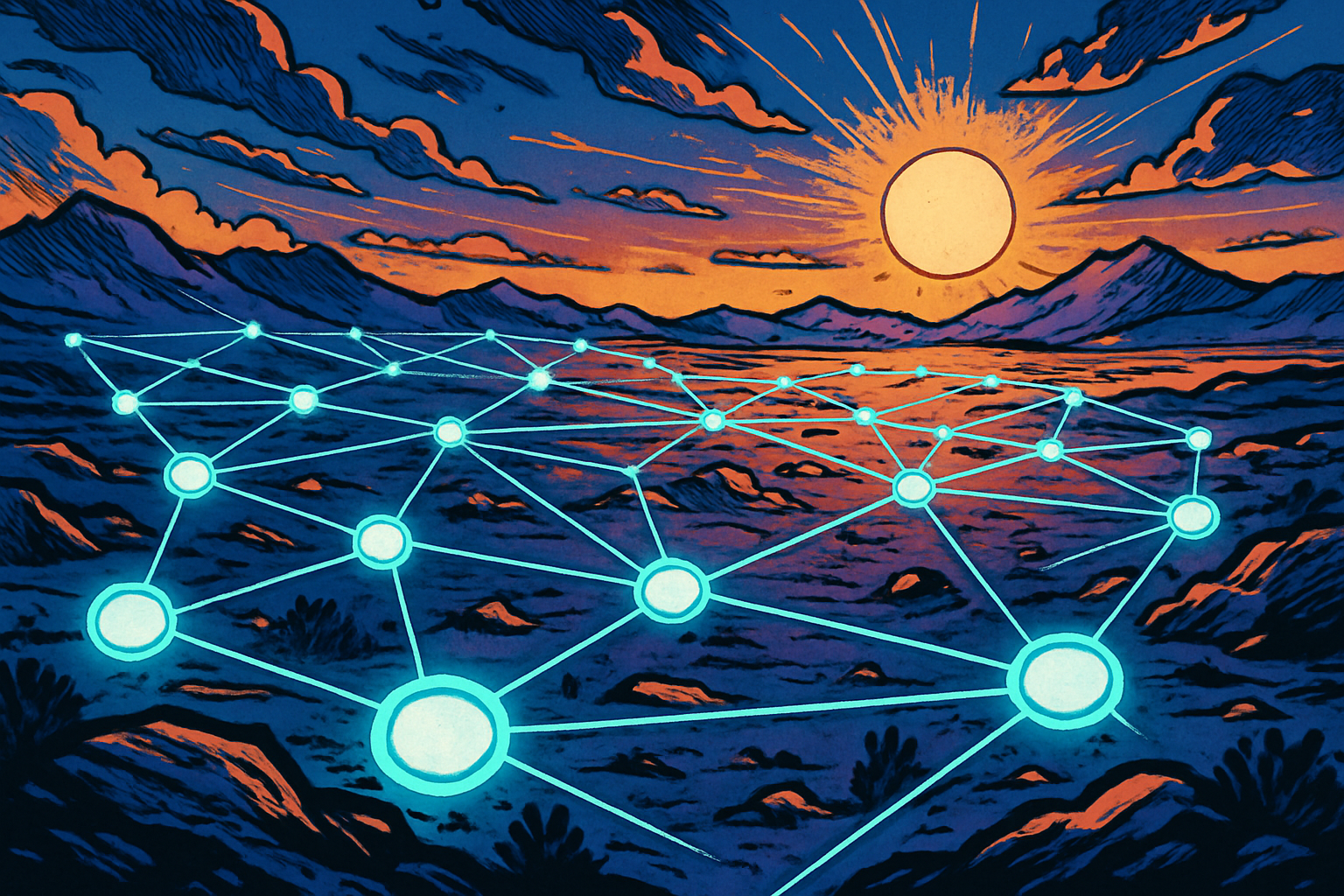
The digital world stands at a crossroads. We were promised a frontier of boundless connection and creativity, an open commons for all. Instead, we find ourselves in a landscape of walled gardens, governed by central authorities who act as gatekeepers to our data, our identity, and even our lives. New standards emerge, promising interoperability and a more connected future, yet they are often built upon the very same fractured and centralized foundations.
The Model Context Protocol (MCP) is one such standard—a powerful new language designed for AI models to use, communicate, and collaborate with digital tools, resources, and more. While focused on AI, its potential extends far beyond that use case. MCP holds the promise of breaking down silos, and connect everything allowing for complex, automated workflows across countless services, offering a glimpse into a more intelligent and integrated digital world. You can learn more about it here.
But a new language is not enough if it is spoken only within the walls of the old castles. The current trajectory of MCP, while well-intentioned, risks tethering its vast potential to the gatekeepers of the old world: centralized identity providers, operational complexity, permissioned registries, and traditional payment systems.
We believe that a different path is not only possible but necessary. This is the 'why' behind ContextVM. ContextVM is not a new protocol; we are not replacing MCP. Instead, we are liberating it through Nostr and Bitcoin, by forging a new foundation for censorship-resistant collaboration. Any existing MCP client or server can adopt our specification or SDK to use Nostr as a transport. Furthermore, the tools we are developing will enable them to communicate via Nostr seamlessly, even without explicit support, thereby breaking free from centralized constraints.
The Chains of the Old World: MCP's Current Path
To understand where we are going, we must first understand where we are. The standard implementation of MCP relies on architectures that, while familiar, carry the baggage of centralization. This isn't a flaw in the protocol itself, but a choice of building materials—and these choices have consequences.
-
The Gatekeeper of Identity (OAuth): Access in the current MCP world is often guarded by OAuth. While theoretically an open specification, in reality is centralized and federated, OAuth was primarily designed for humans logging into web applications. This model acts as a central checkpoint, creating a bottleneck for autonomous, headless computation. It forces participants into a permissioned system where identity is delegated, not owned, and every actor must present their credentials to a central authority, thereby limiting the spontaneous collaboration inherent to decentralized computing.
-
The King's Map (Centralized Registries): How do you find a service in the MCP ecosystem? You consult a central registry. A curated list. A map drawn by a central authority, showing only what it has approved. This creates a permissioned ecosystem where innovation is gated. If you are not on the map, you do not exist. This is a barrier to entry, a point of control, and a single point of failure. It slows growth and stifles the "long-tail" of small, niche, or experimental providers.
-
The Toll Roads (Conventional Payments): How do providers sustain themselves? Through the toll roads of traditional finance—Stripe, bank transfers, and credit cards. These systems are slow, expensive, and exclusive. They are ill-suited for the fluid, per-use, micro-transaction economy that a truly open network requires, forming another layer of control, a barrier for small operators, and an anchor to the old world.
This is the path of least resistance—paving over the old cow paths. It leads to a world that is more connected, yes, but no more free. It domesticates the wild potential of MCP, keeping it safely within existing walled gardens. ContextVM chooses a different path.
The ContextVM Difference: A Declaration of Digital Sovereignty
ContextVM is our answer. It is not an incremental improvement. It is a fundamental paradigm shift, built on the bedrock principles of Nostr: simplicity, sovereignty, and censorship-resistance. We replace the weak links of centralization with the unbreakable chains of cryptography.
-
Your Keys, Your Identity: We discard central delegated authority. In the world of ContextVM, your identity is your cryptographic key pair—a sovereign passport, not a permission slip. It is owned and controlled by you, requiring no central issuer. Every interaction, request, and piece of data is cryptographically signed, providing undeniable proof of origin and integrity. This creates a trustless environment where everyone can interact securely and directly, without intermediaries.
-
The Open Town Square (Decentralized Discovery): We tear up the king's map. In its place, we have the open, chaotic, and vibrant town square of Nostr relays. Anyone, anywhere, can announce a service by simply broadcasting a signed message. There are no gatekeepers. There is no central registry. Discovery is permissionless and dynamic. Clients subscribe to relays and learn about the ecosystem in real-time. This is how a thousand flowers bloom. This is how innovation accelerates.
-
Awakening the World's Dormant Computation: The traditional model requires a public server, a fixed address on the internet. This is a significant barrier, limiting participation to those with the technical skills and resources to maintain public infrastructure. Nostr relays shatter this barrier. They act as a simple, distributed message bus. A ContextVM server needs no public IP, no open ports, no DNS name. It can run on a laptop behind a firewall, a Raspberry Pi in a dorm room, or a phone in a remote village. It only needs an outbound connection to a relay.
This single innovation is transformative. It unlocks the vast, dormant computational power of millions of devices, turning every connected device into a potential node in a global, decentralized network. This is not just about making things easier; it's about fundamentally democratizing participation and value creation.
-
The Economy of Freedom (Bitcoin Micropayments): We bypass the toll roads. ContextVM enables direct integration with the Bitcoin Lightning Network, unleashing a true peer-to-peer economy. Payments can be per-use, instantaneous, and infinitesimally small, with near-zero fees. This is the lifeblood of a bottom-up economy, allowing any provider to be compensated directly and without intermediaries. It is a borderless, private, permissionless, and censorship-resistant economic layer for an open and decentralized ecosystem.
Our Vision: A New Computational Commons
What does this future look like?
It looks like a journalist in a censored nation hosting sensitive reports, photographs, and documents as MCP resources on a laptop in their safe house. These resources are instantly accessible worldwide using ContextVM and Nostr relays, with no public web server, IP address, or domain that can be seized or shut down. The information flows freely, protected by cryptography and decentralization.
It looks like an indie developer in a niche market running a powerful, specialized tool as a Bitcoin-paid MCP server from their home office. Users from anywhere in the world can access and pay for this tool instantly, rewarding the creator directly without needing a corporate bank account or payment processor.
It looks like a grassroots community building and sharing its own educational tools and resources, tailored to its needs. Each tool and resource is hosted and run by a community member, creating a resilient, anti-fragile network of knowledge.
It looks like an enthusiastic engineer in their garage launching a novel service to the world from their laptop, with no upfront cost or permission required.
For everyone of these innovators, users benefit directly. They gain access to a vibrant, competitive, and permissionless marketplace of capabilities.
Our vision is not merely to build better infrastructure for MCP and AI. Our vision is to cultivate a new computational commons: a sovereign, resilient, and open marketplace of ideas, resources, and capabilities, where value flows freely to those who create it. This is a world where the right to compute is as fundamental as the right to speak.
This is a world where innovation is no longer the exclusive domain of heavily capitalized corporations. It is a world where a lone builder with a powerful idea can compete on a level playing field. It is a world where the vast, untapped power of our collective devices is awakened, creating a collaborative network that is more resilient, more diverse, and more powerful than any centralized cloud.
The Call to Action: Build the Future with Us
ContextVM is more than just code; it is a community-driven, open-source project and a declaration that the internet is not a finished product. It asserts that the ideals of decentralization, sovereignty, and permissionless innovation are not nostalgic dreams but achievable realities.
But we cannot build this future alone. The initial tools are ready, the specification is public, and the frontier is open, waiting for pioneers. We are calling on the sovereign engineers, the builders, the innovators, and the freedom thinkers to join us.
Visit us at contextvm.org. Explore the code, run a server, build a client, use it, and join the conversation to help us build a more liberated digital future.
The digital world was meant to be a vast, open territory for human creativity to flourish. It has become a landscape of enclosures. The fences are being built higher every day.
It is time to tear them down.