
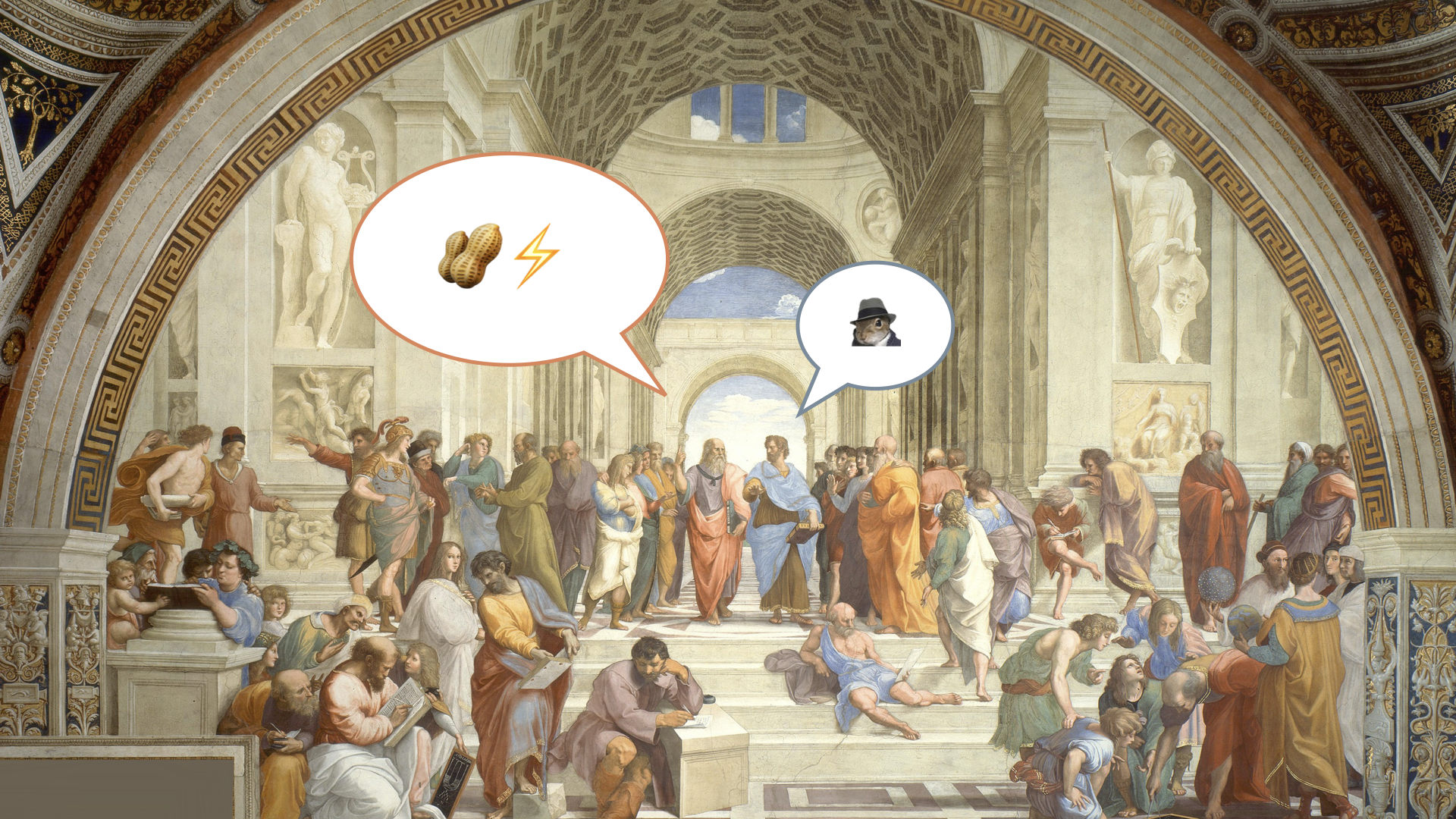
Every time we speak into the void of the internet, we are entering into a dialogue with the world. The world reacts, and even if we can’t see the faces of our audience, their reactions are real. They manifest in the digital realm, in conversations, in shared ideas, in the birth of new projects.
Dialogue is at the core of Sovereign Engineering. It is why the program was created, why we made the decisions we made, and why our weekly loop is structured the way it is. It is the heart and the engine of each cohort.
From the get-go, the idea was to create an environment that is conducive to high-bandwidth communication, experimentation, and ideation. The overarching goal was and is one and the same: implementation. Creating—and shipping—new freedom tech.
The Problem of Creation
Why is dialogue so important? Because creating new things is hard. Innovation is hard. It doesn't just happen magically, and it most definitely doesn't happen on its own.
However, there's a certain kind of magic that we wanted to reproduce when we first started talking about Sovereign Engineering. The magic that sometimes happens in and around conferences: when people who are fascinated with the same topic, drawn together by the same ideals, come together for the first time. When some of this magic happens at conferences (if it does at all), it seems that the time is always too short. A couple of days of hectic energy, and it’s over. We wanted to see if we could replicate and prolong the conditions that make this magic happen.
Shipping new freedom tech is the goal, but how do you get there? How do you move from a vague idea to a tangible implementation? How do you navigate the vast space of possibilities and find something that is not only interesting to you, but also to your peers, and ultimately to the world?
You can't do it alone. It is extremely difficult to solve the hard problems by oneself, if at all. Most ill-defined problems of the world were not solved by individuals, but by distributed cognition, as John Vervaeke would call it.
Writing words and code is now cheaper than ever, which means that having the right idea is one of the most valuable resources. Yes, you will need to sit down in solitude and do the work to make robust implementations. But solitude won't do you any good to figure out whether you are lost or not, to know whether you are headed in the right direction.
That's what we want to provide: some guidance, and possibly even a North Star that orients you.
Creating Dialogue through Structure
But simply throwing a bunch of smart people in a room and hoping for the best is a recipe for chaos, not creation. Raw creative energy, uncontained, dissipates into nothingness. You need a structure—not a cage, but a container. A framework that channels the flow of dialogue, creates the conditions for serendipity, and acts as a midwife for new ideas.
That's why the entire structure of our program is engineered to facilitate dialogue. Every component, every scheduled event, every shared meal is an opportunity for conversation; for the cross-pollination of ideas. The weekly rhythm of our program is a testament to this philosophy.
In addition to this structured approach, the advent of LLMs and "vibe-coding" now allows us to enter into an ongoing dialogue with technology itself. An interesting turn of events, given that dialogue is at the core of what we do.
Plus, thanks to agents getting reasonably good at coding, you don’t have to do the groundwork of sitting down for hours to produce a working prototype. You can literally speak your ideas into existence, as we did in the last cohort. And once something exists, you can properly and meaningfully talk about it, and pursue it further—or not.
The Philosophy of Dialogue
Why this obsession with dialogue? Because top-down preaching has never worked (and never will). We don't want to preach what needs to be done. What we want is a dynamic, interactive program where anyone can participate and everyone has something to contribute.
The structure of our program is downstream from our worldview. It comes from a deep place of self-motivation and belief. We don't want to micromanage. We want to get the right people involved, people with the right values, with the right amount of care and motivation, and let them do the things that need to be done.
We have many mantras that we repeat throughout each cohort, and one of them is the following: everyone knows something that you don't. You have something to learn from absolutely anyone. It doesn't matter how well educated they are (or how well-educated you think you are). It doesn't matter where they come from. It doesn't matter what you think of them. Everyone has something to teach you.
The structure of our program is designed to create an environment where this special kind of learning and trust-building can happen. That's also why we have a strict "no outsiders" rule. Each cohort builds a shared history, a shared context, and a level of camaraderie that allows for open and honest dialogue. We have learned early on that bringing in outsiders destroys this dynamic.
As mentioned in a previous post, Sovereign Engineering is a program geared towards engineers. We are looking for people who can build (and ship!) stuff; people that have an engineer mindset and attitude; people who actually run the numbers; who care about cryptographic verification and know enough about cryptography to apply it. The conversations are technical, the problems are technical, and in our opinion, most of the solutions (if there are any) will have to be technical too.
We wholeheartedly agree with Hal Finney, who famously said that “The computer can be used as a tool to liberate and protect people, rather than to control them.” Liberation is what we're after. From platforms, from golden cages, from the attention economy—in short: liberation from technology that controls its users.
We believe the internet is broken in more ways than one, and we believe that we can do better. We have a burning desire to fix these issues, and we want to work with people who share our vision for a better web.
Education is not the filling of a vessel; it's the kindling of a flame.
— Plutarch
We are here to provide the fuel for your flame, but a flame needs to exist already. You need to be here for the right reasons, be self-motivated, and be truly excited about the things we are constantly talking about and working on.
Birthing new Ideas
In the Socratic sense, we view the program as a midwife to new ideas, a midwife for new freedom tech. We are not here to tell people what to think or what to build. We are here to help them give birth to their own ideas.
When the right people come together—mission-aligned, motivated, and feeling safe enough to build trust and share their wildest ideas for the future—that's when novel insight has a chance of happening.
We often joke that we want ideas to have sex so that new freedom tech can be born, and we're only half-joking when we're saying that. That’s, in a nutshell, what we're aiming for when running a Sovereign Engineering cohort.
Measuring Success
But just inspiration isn't enough, as every engineer knows. It is transpiration that makes things real. "Proof of Work," as some would call it.
Our measure for success is simple: If projects born from the program make it out into the wild, we've succeeded. If they die on the vine, we've failed. And by that measure, the results speak for themselves: Blossom, Nutzaps, Cashu Wallets, Wikifreedia, npub.cash, Nsite, TollGate, Zapstore, and more are out in the wild, and thriving. And we are confident that this list will grow longer with each passing cohort.
This will always be the ultimate test of our dialogues. It’s not about how many interesting conversations we have, or how many great ideas we come up with. It’s about what we create. It’s about the tangible impact we have on the world. It’s about building the tools that will help us build a freer and sovereign future.
And that, in the end, is what Sovereign Engineering is all about. It's not about words, but about actions. It's not just about ideas, but about implementing said ideas to see if they survive contact with reality.
The entire program is an engine built to spur conversations—and, ultimately, produce new creations.
The dialogue continues—in prose, in recorded conversations, and most importantly, in shipped code.
This essay was brought about by various dialogues. If you are interested in participating in Sovereign Engineering, you can apply to the next cohort.