# The Bitcoin “security budget” error for block miners
https://media.licdn.com/dms/image/v2/D4E12AQEFRl1KGagdYw/article-cover_image-shrink_720_1280/B4EZpuQ40FKgAI-/0/1762786516827?e=1765411200&v=beta&t=goLHUaZGJHxwcm6a5WlFf07ViM3J53gqRU4fiiEVWSs
### Introductory reminder
Bitcoin is based on a “**smart contract” (Bitcoin spending script)** between two types of actors: **nodes** and **miners**. This contract, which is entirely written into the protocol code, allows the system to operate stably without a central authority or direct human coordination.
The **nodes** represent the legislative part of the network. They set and enforce the rules for block validity, control the difficulty of the work to be done, and determine which blockchain should be considered legitimate. They also act as a **collective ledger**: each node validates transactions, keeps a complete copy of the history, and automatically rejects any block that does not comply with the consensus rules. The true security of the network lies here, in the **redundancy of checks** and in the **cryptography of wallets**, where the length of private keys prevents any falsification of signatures.
The **miners**, for their part, form the executive power of this contract. Their mission is to produce blocks that comply with the rules defined by the nodes. Their reward—the coinbase and transaction fees—is only valuable if the nodes recognize their work as valid. Miners therefore participate in a purely probabilistic calculation competition: each one randomly searches for a proof of work that satisfies the set difficulty.
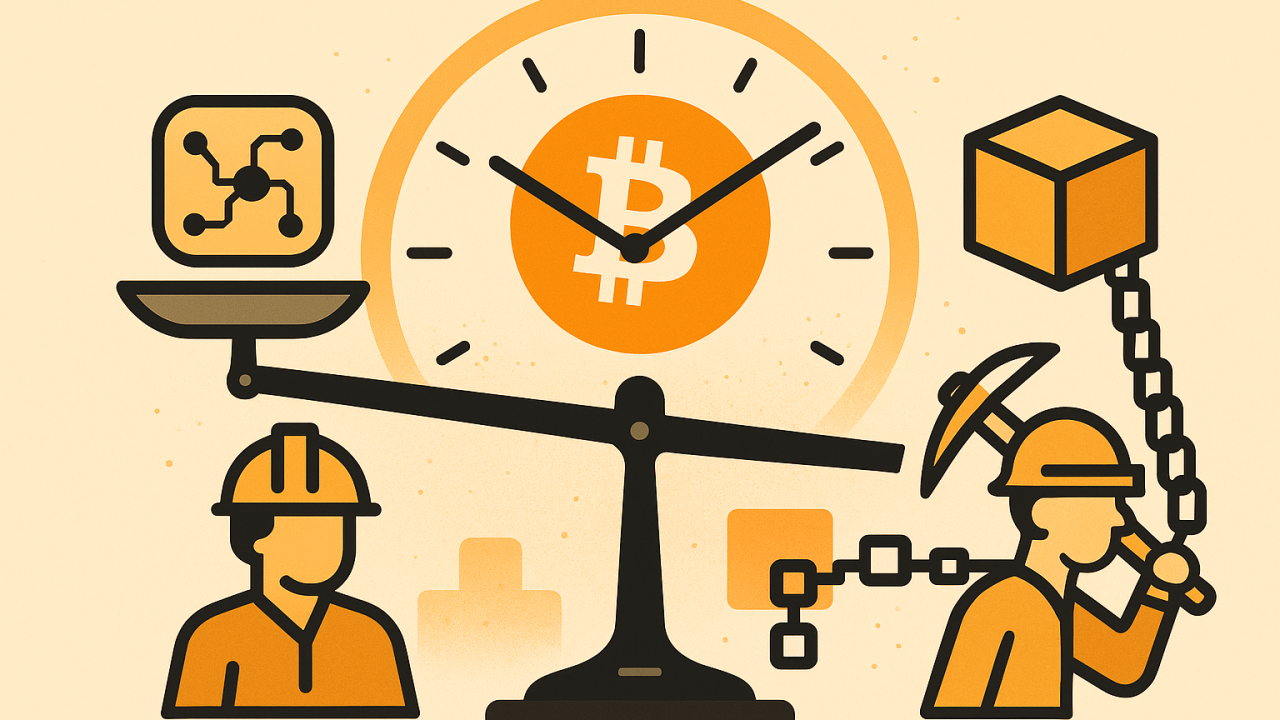
Technically speaking, this mining activity is what enables the **partial synchronization** of a global network without a central clock. Each block found acts as a **shared time reference point**: it marks a common milestone for all nodes, despite latency and propagation differences between them. The proof of work serves here as a **signal**, allowing the entire system to maintain a common and verifiable operating rhythm.
This is not cryptographic security in the strict sense—that resides in the private keys of wallets—but a **distributed timestamping mechanism**. Mining transforms energy into measured time: it does not protect the ledger, it gives it a **rhythm**. The nodes, in turn, use this rhythm to maintain the consistency of the ledger and reject blocks that are produced outside the rules.
Thus, mining is not an army protecting the blockchain, but a **probabilistic synchronization function**. It organizes the coexistence of honest and opportunistic actors in the same game, where cheating is discouraged by the logic of the protocol: an invalid block has no value.
This **self-regulating contract** functions as a dynamic equilibrium system. Miners contribute their computing power to try to register the next block, but the nodes constantly adjust the difficulty of the work to maintain an average pace of about ten minutes per block. If global power increases, the difficulty rises; if it decreases, it falls. The protocol therefore “ignores” the absolute power in circulation: it simply maintains a **constant time interval** between blocks, ensuring that competition is always fair.
The nodes act as **timekeepers**: they measure the rate of block production and recalibrate the computational difficulty to maintain the system's pace. This ten-minute interval acts as a **common clock**—a measured, non-produced collective beat. If the blocks arrive too quickly, the nodes make the calculation more difficult; if they arrive too slowly, they make it easier. Miners, for their part, provide the computational “oscillations” (hashes per second), while nodes extract a stable frequency from them, which can be used as a regulatory variable.
In a conventional clock, time is measured by the **frequency of an oscillator**: a crystal vibrates, a circuit counts the pulses. In Bitcoin, the **hashes** produced by miners play an equivalent role—but the stability of time does not come from the speed of these hashes, it comes from the way the nodes **measure** them and regulate their pace. It is therefore not power that creates security, but collective measurement that transforms a chaotic flow of calculations into an orderly sequence of blocks.
> Security does not therefore lie in the mining of blocks; mining is a measure used by nodes for synchronization, which ensures protection against double spending by the nodes.
Even if global mining power varies greatly, the protocol continues to beat at the same pace. Nodes maintain the consistency of the ledger and the stability of time; miners maintain the regular production of blocks. **This regulation completely decouples the functioning of the network from economic fluctuations in the mining market.**
Economically speaking, **real security** does not depend on the number of miners or the power involved, but on the **balance of power between honest participants and adversaries**, as well as the **flow of remuneration** distributed by the protocol. An attack only becomes rational if the value it allows to be diverted exceeds the opportunity cost of honest mining—a threshold that is rarely achievable.
Bitcoin (the nodes) thus presents itself as an **algorithmic constitution**: the rules are coded, their application is collective, and the sanction—the automatic rejection of invalid blocks—is immediate. The nodes embody the sovereignty of the rules; the miners, the enforcement power. The difficulty adjustment acts as a neutral arbiter, maintaining the regularity of time without any authority being able to alter it.
In short, Bitcoin is not an economy based on power, but on **time measurement and loyalty to code**. It does not need an army of miners, only a consensus on the rules and a fair competition mechanism. This tacit contract between computation and validation makes the blockchain a **universal timestamping system**, where trust is replaced by the regularity of a shared rhythm.
### Why Bitcoin's concept of a “security budget” for miners is a misunderstanding
The term “security budget” is often used to refer to the amount spent on rewards (subsidies and fees) paid to miners, which is supposed to represent the “price” of Bitcoin's security. However, this term, **derived from an accounting analogy, has led to a fundamental misinterpretation**: it assumes that there is a fixed and necessary budget to guarantee the security of the network, as if Bitcoin had to continually “buy” its own survival. In reality, security is not budgeted, but emerges from a self-regulating economic and temporal equilibrium.
**Confusion between flow and stock**
The “budget” implies a finite resource, spent to obtain a measurable service. However, in Bitcoin, the reward paid to miners is not a programmed cost to be spent to buy security; it is an **endogenous flow**, continuously adjusted by the fee market and the difficulty rule. The network spends nothing: it distributes income proportional to the scarcity of blocks and the demand for transaction inclusion.
**A misunderstanding of causality**
The idea of a “budget” suggests that the more miners receive, the more security increases, as if spending preceded security. **In reality, the reliability of clock measurements results from probabilistic competition and difficulty control, not from the amount distributed.** – If the hashrate drops, the difficulty adjusts to maintain the block rate; the logical security of the measurement remains intact as long as the honest majority remains. **Thus, Bitcoin does not “pay” for its security: it pays a market price for successful work, the value of which is determined by the demand for time measurement to perform a given effort, deducing “a universal time by the volume of work accomplished with adjusted power.”**
**A misinterpretation of the role of work**
Work does not buy security, it time-stamps the order of events. **Proof of work (PoW) does not protect the system by expending energy, but by contributing to the function of a random and decentralized metronome**: it synchronizes an asynchronous network by imposing a physical limit on the speed of falsification. The energy expended is an opportunity cost that makes rewriting history economically irrational, not insurance taken out with miners.
**Confusion between marginal cost and total cost**
Bitcoin's security depends on the marginal cost of the attack at a given moment, not the total historical cost of mining. Even if global power declines, an attack remains as costly as the current cost of exceeding the difficulty: **the past expenditure is not an amortized budget, it has no accumulated defensive value.** In other words, security is _instantaneous_, not cumulative.
**A false analogy with an insurance service**
Some commentators equate mining with a defense service that the protocol should continually pay for in order not to lose its security. This view is false: – Miners do not protect anything external; they participate in a game whose only valid result is an accepted block. – The protocol cannot “buy” their loyalty; it only rewards compliance with the rules. **Security comes from automatic verification, not trust in miners.**
**Argument 1: “If the reward decreases, miners will leave, so security will decline.”**
**Weighting:** – Yes, a lower hashrate reduces the absolute cost of an attack, but the difficulty also decreases, preserving the block rate. – What changes is economic security (the cost of a 51% attack), not the logical security of the consensus. – ** In the long term, the transition to a fee-only era makes this dynamic more sensitive; hence the need for an active fee market, but not a fixed “budget.”**
**Argument 2: “Miners provide security, so they should be paid according to the risk.”**
**Weighting:** – Miners do not “protect”; they produce compliant blocks to obtain a random income. – Their incentive is based on the expectation of gain, not on remuneration proportional to risk. – **Their role is neutral: they have neither the responsibility nor the ability to ensure security outside the validation protocol; their work, whether significant or insignificant, is measured to maintain the time interval between blocks.**
**Argument 3: “Lowering the security budget will lead to centralization.”**
**Weighting:** – This risk exists if the break-even point becomes too high. – However, **centralization stems more from economies of scale in energy and geographic concentration than from the overall amount of rewards.** – Lower difficulty also allows smaller miners to compete again, so decentralization is not directly correlated with the total budget.
**Argument 4: “Without a minimum budget, Bitcoin will be vulnerable when subsidies end.”**
**Weighting:** – This is the most serious criticism (Budish 2018) but for 2140. – However, security remuneration through inclusion fees is _endogenous_: if demand for finality increases, fees adjust. – Furthermore, **security depends on the attack/cost ratio, not on an absolute amount: if the attackable value remains lower than the reversal cost, the equilibrium remains stable.**
**Argument 5: “The security budget measures the economic health of the protocol.”**
**Weighting:** – It is a useful accounting indicator (for tracking flows to miners), but it does not measure security. – **The true metric is the inequality of unprofitability:**
k × (R_b × P + C_h) > V_a, where:
- **k**: number of confirmation blocks required
- **R_b**: reward per block (subsidy + fees)
- **P**: price of bitcoin
- **C_h**: operational cost of producing a block
- **V_a**: economic value that the attacker could divert
> As long as this condition is met, economic security is assured, regardless of the overall level of the “budget.”
### Bitcoin security has no fixed price
> **Bitcoin security is not a service to be financed, but an emergent property of a set of incentives and automatic adjustments.**
> **The protocol does not purchase security; the nodes create an environment where cheating becomes economically irrational, in order to synchronize the network without bias. Security comes from the cryptography used on wallets.**
**Flows to miners are not a “budget,” but a** **_tension thermometer_** **: they reflect the demand for finality and competition for block space.** Reducing Bitcoin to a simple question of budget is to misunderstand its fundamental nature: a system where security is a logical consequence of consensus and verification, not an operating cost.
### The value of bitcoins has no relation to their production cost
Some argue that bitcoin should have a minimum value, i.e., the energy and material cost of mining. This idea seems intuitive: if mining is expensive, the price should at least cover this expense, otherwise miners would cease their activity. However, this interpretation confuses **economic value** and **production cost**, two distinct concepts in the tradition of market economics—and, from a methodological point of view, without any direct causal link.
**Production cost is not the cause of value**
In an economy based on the subjectivity of exchanges, the value of a good is not determined by the amount of labor or energy required to produce it, but by **the actors' assessment of its marginal utility**: what they are willing to exchange to obtain it. A mined block is remunerated not because it “costs” a certain number of kilowatt-hours, but because it allows the miner to obtain a bitcoin that is recognized by the network as valid and transferable. If tomorrow the demand for bitcoin exchange collapses, the price may fall below the cost of production without affecting the protocol. The market will simply adjust the hashrate and difficulty downward.
**The cost is based on the price, not the other way around**
The mining adjustment mechanism illustrates this causal reversal. When the price of bitcoin rises, new miners enter the market, increasing the difficulty and therefore the marginal cost of production; when the price falls, miners withdraw, the difficulty decreases, and the average cost follows suit. The cost of production adapts to the market equilibrium price, not the other way around. In other words: **the market price determines the viable cost**, not the cost that sets the price.
The cost of production is therefore not a theoretical floor value, but the consequence of the observed price and the competition to obtain it.
**Bitcoin has no measurable “intrinsic” value**
The belief in a minimum value linked to the energy consumed is based on an analogy with physical goods. But Bitcoin is not a material good: it is a **decentralized property registry**. Its value derives from collective trust in the validity of this registry and its algorithmic scarcity. Neither electricity, silicon, nor the work of miners give the monetary unit intrinsic value; they only serve to guarantee its issuance and temporal consistency. If electricity became free or if more efficient algorithms divided the cost of hashing, the value of Bitcoin would not be affected; only the cost of entering the mining competition would change.
**The market erases any stable correlation**
Historically, the correlation between the estimated production cost and the price of bitcoin has been variable and unstable: – during bull runs, the price rises well above the marginal cost; – during prolonged declines, it often falls below it without the protocol stopping; – the difficulty retarget corrects these imbalances by maintaining the block rate. This proves that the system works without reference to a minimum “energy” value.
**The cost of mining is an equilibrium price, not a floor value**
What some call the “production cost” is actually the **instantaneous equilibrium price** of the proof-of-work service: a point where expected revenues offset the marginal cost of electricity. If the price of bitcoin falls, high-cost miners withdraw, lowering the average cost and bringing the network back to a new equilibrium. **Production is never destroyed due to lack of “budget”; it reorganizes itself.**
### Conclusion
Linking a minimum value for bitcoin to its production cost is to reverse the direction of economic causality. Cost does not determine value; it derives from it. Energy expenditure does not create the price; it reveals competition for a good that is already recognized as useful. The protocol, through its difficulty adjustment, neutralizes any direct link between power, cost, and value: it only guarantees the rate of blocks, not their price.
Thus, **bitcoin has no “energy” value (but an energy measurement),** only **a use and exchange value determined by confidence in its properties: algorithmic scarcity, neutrality, resistance to censorship, and monetary predictability.** The cost of production is only a side effect of the market price, never its cause, nor a guaranteed floor for its value.
--
### Why 10 minutes (approximately between blocks), 2,016 blocks (difficulty adjustment), 210,000 blocks (halving)?
There are technical constraints, there are simulations of latency on the internet, there are economic simulations of the opportunity cost in terms of time, there are 1,000 reasons, some initial and others “discovered,” but when we deviate from them, nothing works anymore, except for compromises that are rejected on Bitcoin.
The nodes would reject any block that is invalid or does not comply with the majority chain. Transactions would remain protected by private key cryptography, which makes it impossible to falsify signatures. The risk of double spending would only arise if an entity managed to gain lasting control of the majority of the computing power—a highly unlikely situation on the scale of the global network—and even in this case, each new block triggers a **full re-verification** of the validity of the previous ones, which reinforces the resilience of the protocol.
However, during a period of block rate readjustment, when the overall computing power varies significantly, temporary imbalances may occur:
- **Blocks too fast**: the difficulty has not yet had time to adjust. The risk of double spending increases slightly, as several miners may find blocks almost simultaneously, before the network has propagated the previous one. This can lead to more **reorganizations** (reorgs) where the majority chain is redefined as blocks propagate and nodes make decisions.
- **Blocks too slow**: the network may fragment into divergent sub-chains for a few moments, as slow propagation lengthens confirmation times. Reorgs then become rarer but also longer, with **prolonged conflicts** between competing versions of the chain before the majority is reestablished.
These episodes do not alter the fundamental security of Bitcoin, but they can temporarily affect the fluidity of consensus and perceived latency. The protocol automatically corrects them with each difficulty readjustment, gradually bringing the network back to a balanced pace.
It is interesting to note that **many other blockchains** have chosen to circumvent these physical constraints by introducing notions of **explicit states or finality**: a transaction is considered irreversible after validation by a fixed number of blocks or by an internal voting mechanism. This approach reduces the need for recalculation and improves the apparent speed of consensus, but it weakens the transparency of collective control: – if an attack or falsification passes the finality barrier, it can remain **invisible and irreversible**, as nodes no longer fully revalidate old blocks; – conversely, if a deep divergence is detected, the network can become **permanently frozen**, unable to decide between several contradictory states.
Bitcoin, by maintaining a model of **continuous validation without arbitrary finality**, assumes the computational cost of rigor: each block rechecks the previous ones, each node participates in measuring common time, and the consistency of the ledger never depends on a human decision or a majority vote, but on a **shared measure of the effort accomplished over time**.
> In this sense, maintaining the average pace of ten minutes is not a technical constraint but a pillar of stability: it ensures that the measurement of time, and therefore the common truth of the ledger, remains independent of the speed of the physical world and human will.
The average ten-minute interval between blocks can be seen as a **window of behavioral stability**: a compromise between the technical speed of the network and the human pace of opportunistic decisions. This time frame allows actors to evaluate their incentives to cheat or remain honest, while preventing these choices from translating into exploitable actions before the consensus has consolidated the previous blocks.
In other words, Bitcoin does not seek to beat real time, but to **synchronize a system of human intentions and mechanical calculations** at the same measured pace. Beyond a certain threshold of speed, the judgment and economic rationality of actors fluctuate faster than the protocol can absorb them: motivations change before actions are validated. The ten-minute delay then acts as a **security latency**, a buffer between the human logic of opportunity and the algorithmic logic of verification—a measure of stability adapted to the speed of our digital age.
### Periods of readjustment: the measurement of time and the pace of circulation
Bitcoin relies on two internal clocks, each governing a distinct aspect of its balance: – **time regulation**, ensured by difficulty adjustment; – and the **pace of circulation**, defined by the decrease in reward, known as halving.
The first cycle, that of **difficulty**, occurs every **2,016 blocks** (approximately two weeks). The nodes measure the actual time taken to produce these blocks and compare it to the theoretical duration of fourteen days. If production has been faster, the difficulty increases; if it has been slower, it decreases. This variation, limited by a factor of four, maintains the regularity of the network's beat. This mechanism does not adjust computing power, but rather the **common measure of time**: it transforms a set of independent hashes into a collective cadence that is perceptible and verifiable by all nodes.
The second cycle, **halving**, occurs every **210,000 blocks**, or approximately every four years. It does not create scarcity—this results from the topology of UTXOs and the effective division of existing units—but it **guides the rate of issuance** of new bitcoins. Halving therefore acts as an economic metronome: it modulates the flow of units into the system without altering the internal structure of the currency.
By combining these two loops, Bitcoin links **temporal stability** to **progress in circulation**: – **difficulty readjustment** ensures a constant pace, regardless of the level of power available; – **halving** organizes the gradual transition from an issuance phase to a maturity phase where circulation becomes virtually stationary.
This dual mechanism reflects the fundamental logic of the protocol: time is not imposed, it is **measured collectively**; value does not come from expenditure, but from the **traceability and consistency** of the units recorded in the ledger.
Thus, difficulty sets the tempo, halving modulates the economic momentum, and true scarcity—the scarcity that makes each bitcoin a unique fragment of the ledger—lies in the finite and verifiable distribution of UTXOs, not in the pace of mining.
One final clarification: true scarcity manifests itself in the granularity of **UTXOs**, i.e., in the actual structure of the ledger, the number of possible expenditures on the network, while halving does not organize scarcity but rather the **rate of circulation**.
[Source](
L
Rappel introductif Bitcoin repose sur un "smart contrat" (script de dépense Bitcoin) entre deux types d’acteurs : les nœuds et les mineurs. Ce ...
)
#Bitcoin #ProofOfWork #Decentralization #Consensus #Mining #DifficultyAdjustment #BitcoinEconomics #NakamotoConsensus