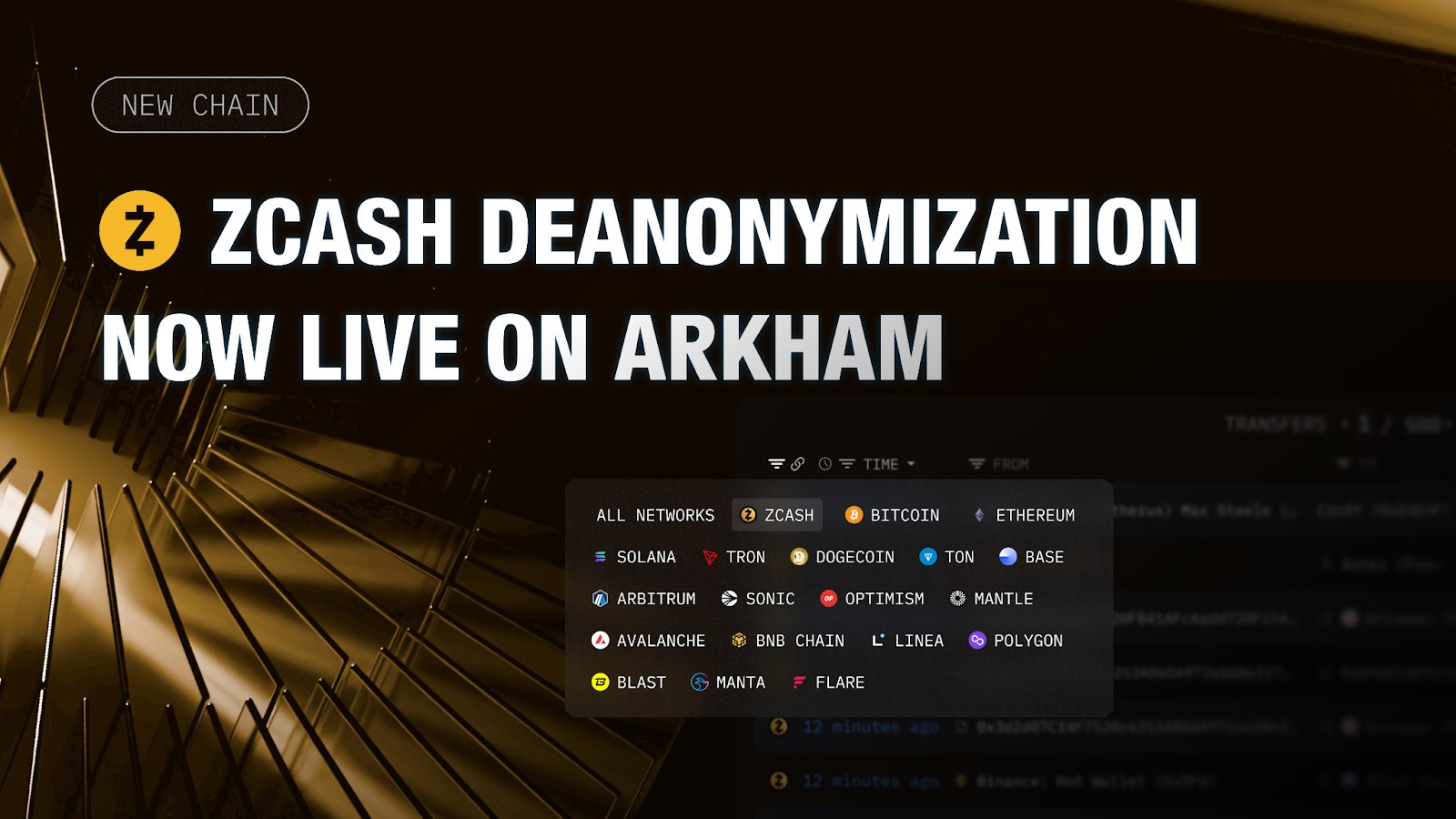
ARKHAM AND ZCASH DEANONYMIZATION: FORENSIC ANALYSIS OR SENSATIONALISM? I am an independent analyst and researcher. Reputation is the most valuable asset in this field. @arkham Arkham Intel has just lost several degrees of reputation. Arkham Intelligence, like Chainalysis, operates in the field of blockchain forensic analysis, providing regulatory compliance services (KYC/AML). Both utilize AI and Machine Learning to process on-chain data. Chainalysis focuses on regulatory compliance (government and banking). Arkham promotes the "transparency first" philosophy. The Hype vs. Reality: The Zcash Case The recent stir was an opportunistic strategy by Arkham to sell its services. Cheap clickbait: DEANONYMIZATION The reality is that there is no evidence that Arkham can deanonymize shielded transactions on networks like Zcash. Their analysis is limited to public or partially exposed data. The controversy arose from the intentional wording of the announcement, using the keyword "deanonymization," with which Arkham seeks to capitalize on the media buzz to attract attention and win customers, but at the cost of damaging its reputation. Source: image
Ford was the great symbolic inspiration for industrial technocracy, but he was not a member of Technocracy Inc. or any formal technocratic party. His figure became so closely linked to mass production and the technocratic imagination that, in the dystopia Brave New World (1932), global society venerates him as ‘Our Ford’, a kind of civic god who replaces traditional religions. image Read my post: TOKENIZATION OF ENERGY AS MONEY in my #TechnocracySeries
ANALOGICAL IDENTITY: BIOMETRICS, GEOLOCATION, AND METADATA ᴬⁿᵃˡʸᶻᵉ ʰⁱˢᵗᵒʳʸ ᵗᵒ ᵘⁿᵈᵉʳˢᵗᵃⁿᵈ ᵗʰᵉ ᵖʳᵉˢᵉⁿᵗ ᵃⁿᵈ ᵃⁿᵗⁱᶜⁱᵖᵃᵗᵉ ᵗʰᵉ ᶠᵘᵗᵘʳᵉ Pass Law and the “Dompas.” South Africa, 1952. Background on Digital Identity Under apartheid, black citizens were required to carry the “Dompas,” an identity book containing fingerprints, employment history, and travel permits. Dompas is an Afrikaans word that literally means “stupid pass” (dom = stupid/foolish, pas = pass). It functioned as a physical geolocation system. The state monitored and restricted movement in real time; if the “identity” (the pass) did not have the correct stamp to be in a white zone, the person was immediately arrested. Ironically called the “Pass Abolition Act,” it actually consolidated multiple documents into a single Reference Booklet that was mandatory for all black men (and later women) over the age of 16. Primitive biometrics: The government created a Central Reference Office that archived the fingerprints of almost the entire black population, linking them to their documents. Complete history: The booklet not only had a photo; it recorded employment history, tax payments, and police permits. The employer had to sign it monthly; if the signature was missing, the person lost their legal status. Surveillance: “Statutory Crime” The system created crimes that existed only because of flaws in documentation. Influx Control: The pass dictated which urban areas (“white zones”) you could be in and for how long (usually 72 hours without a work permit). Random checks: The police could stop any Black person on the street and demand to see the book. Not having it, or having the wrong stamp, resulted in immediate arrest, forced labor, or deportation to rural areas. Why it violated privacy The state eliminated anonymity in public space. Your physical identity was tied to a centralized database that determined your right to move. The government knew where you worked, whether you had paid your taxes, and whether you had “permission” to be on the sidewalk where you were standing.
What is the maximum decentralization in the crypto ecosystem? Not being maximalist. You have all the options available for each use case at any given time. This way, you don't lock yourself in a gilded cage; you set yourself free in the wild jungle.
What are the chances that centralized governments, led by ambitious and megalomaniacal politicians, will not use all the technology at their disposal to implement the social engineering proposed by Technocracy? I would say the chances are very high, of course... as long as governments voluntarily give up power, politicians suddenly become humble, and history ceases to be history. In other words, zero. Technology is the favorite toy of control. The massive scale gives these pathological, megalomaniacal beings a powerful tool. When you give a centralized state data, algorithms, and sensors, it's like giving a hyperactive kid a box of matches. Then we're surprised when he sets fire to everything he can. Technocracy sells efficiency, but its premium package includes social engineering with real-time monitoring. Does anyone really believe that governments are going to look at that and say, “No, thank you, I'd rather govern blindly”? The temptation is too great, and political ambition is cheap fuel. The only question is not whether they will use it, but how long it will take them to say they are doing it “for our own good.”
The enthusiasm of Zooko (founder of Zcash) reveals a dangerous naivety. Believing the SEC—an institution built on financial surveillance and control—will embrace true privacy just because the administration changed is a fundamental error. The state's machinery naturally opposes opaque transactions, regardless of who is in charge. By participating, Zooko risks validating political theater: a charade where regulators pretend to listen to "builders" only to justify stricter crackdowns later. Seeking permission in Washington, rather than relying on code, undermines the cypherpunk ethos. This isn't a diplomatic victory; it is likely a trap that legitimizes the very apparatus designed to dismantle financial #privacy. That's why #Monero image
"Agorism is the consistent integration of libertarian theory with counter-economic practice; an agorist is one who acts consistently for freedom and in freedom." Samuel Edward Konkin III wrote this quote in 'An Agorist Primer', published in 2008, four years after his death.