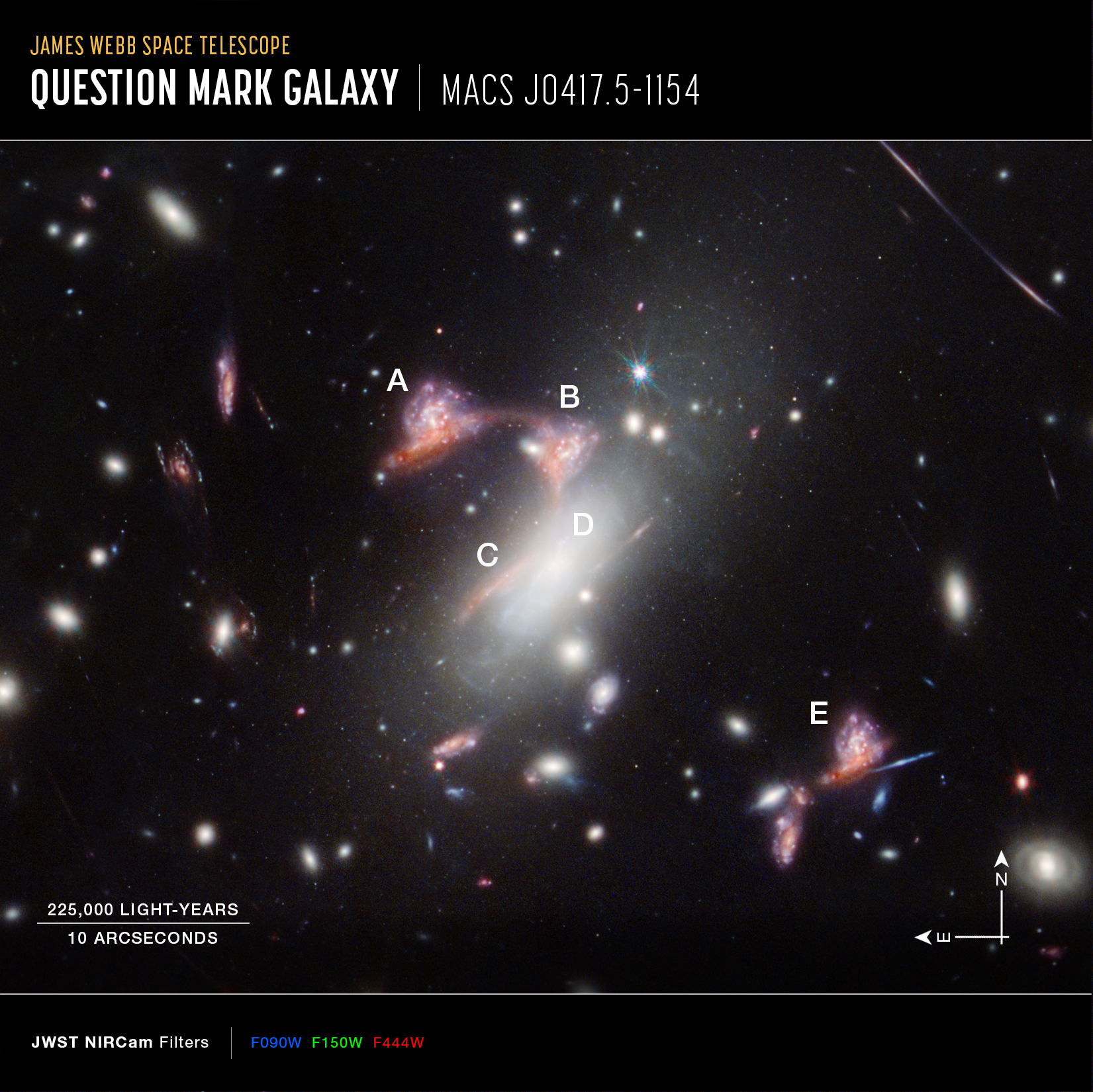
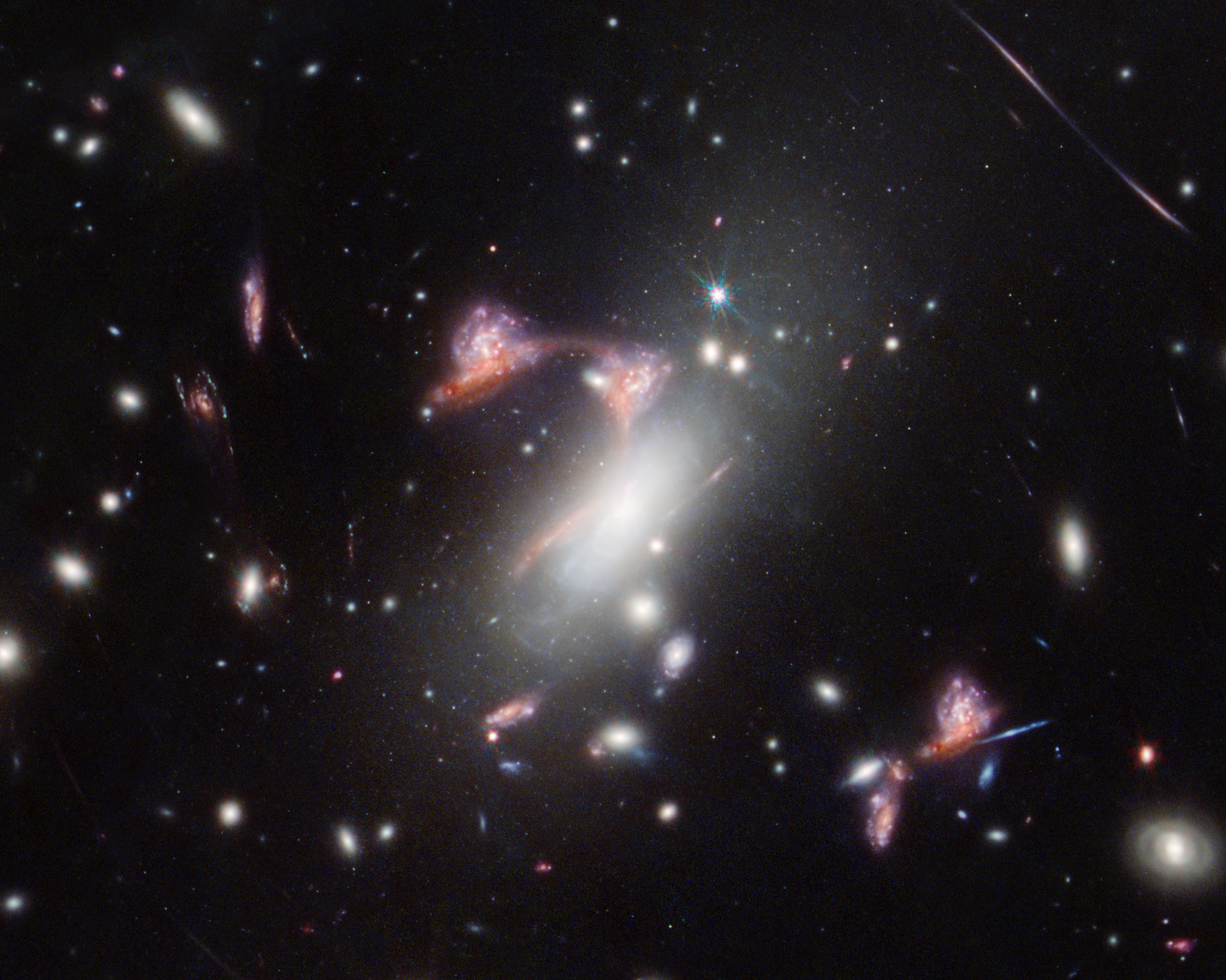
Apparently, the Universe has some questions. #JWST spotted an unusual configuration of a gravitational lens, a hyperbolic umbilic lens. The gravity of a foreground galaxy cluster magnifies and distorts the light from background galaxies. This cosmic question mark is made of five images of the same background galaxy pair, labeled A-E, an interacting red dusty galaxy and a face-on spiral galaxy. The foreground galaxy cluster is the white hazy ovals. #Space #Astronomy image
Our Milky Way galaxy's globular star clusters are old β€” about 12 or 13 billion years old. Where did they come from? A recent #JWST observation provides some clues. Massive galaxy clusters create gravitational lenses, warping and magnifying images of background galaxies. In one image, researchers observed a very distant galaxy, seeing it as it was when the Universe was about 460 million years old. The galaxy has star clusters, which may be proto-globular clusters. image
Some good news about Chandra via Yvette Cendes (@whereisyvette.bsky.social) on BlueSky. The X-ray telescope had been facing mission-ending-level budget cuts. They have been given a 1-year reprieve to avoid layoffs. #Chandra #SaveChandra image
Surprisingly, sometimes people are wrong on the internet. There are a lot of mislabeled astronomical images out there. How can you find images of space from trusted sources? Try AstroPix. It offers access to the public image galleries from leading astronomical observatories under a single unified interface. Search by object name or coordinates, or use the free text to search titles, captions, and topics. 1/3 image
Looking for resources to use in astronomy education or outreach? Want to take a deep dive into topics in astrophysics? NASA’s Universe of Learning has several curated collections of images, videos, activities, and more that focus on specific topics and targets. Check them out: https://universe-of-learning.org/informal-educators/science-resources/ #Astronomy #Astrodon #ITeachPhysics image