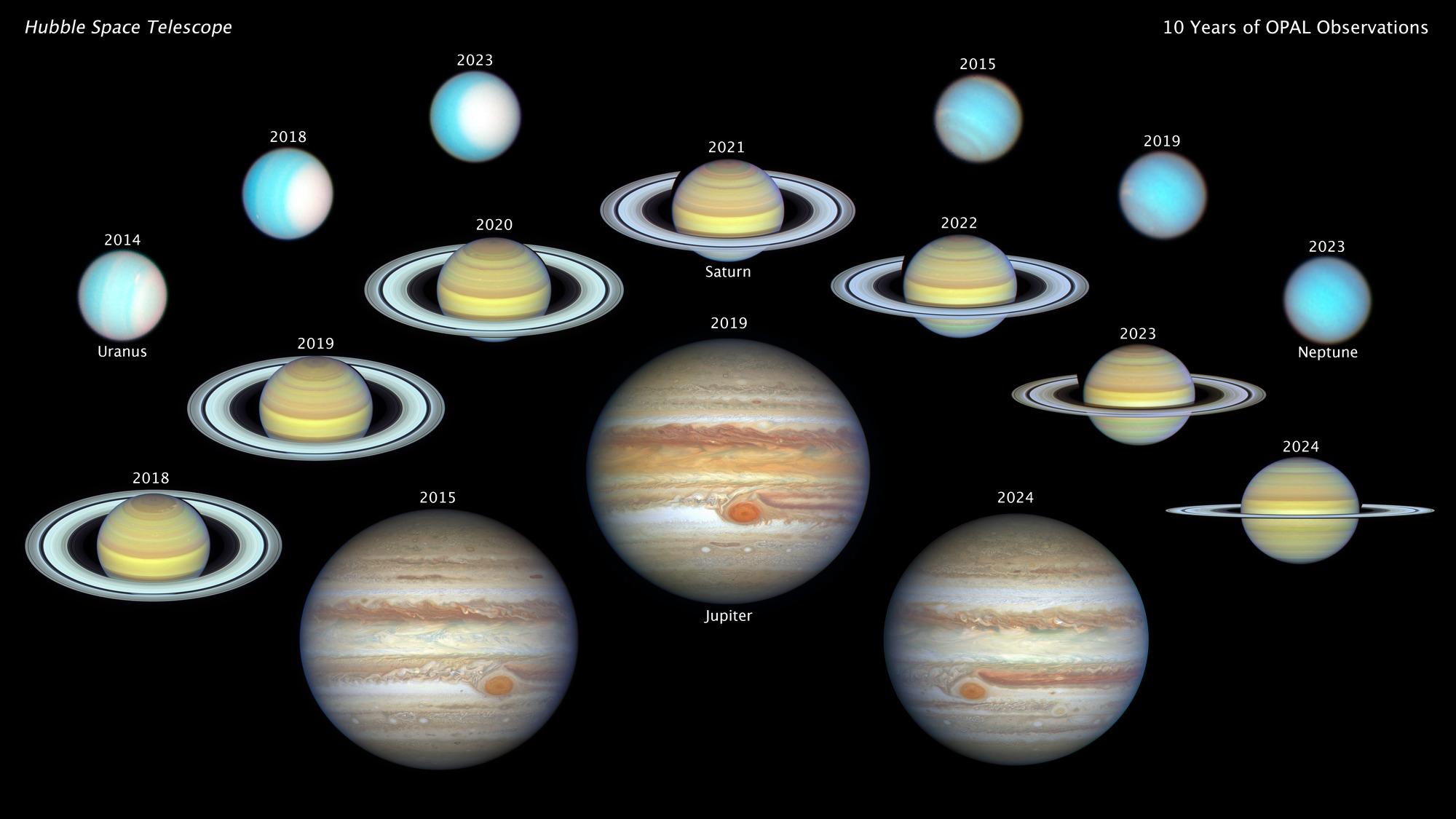
Hubble just celebrated a decade of tracking our solar system’s outer planets: Jupiter, Saturn and Uranus and Neptune—as seen in this montage of observations taken since 2014. (1/8) 🧵
In addition to exploring the far reaches of the universe, #NASAWebb is used for science in our solar system, including this image of Neptune, with detail of its delicate rings and methane-ice clouds. Discover the Solar System with Webb: https://webbtelescope.pub/47v4JRE
Astronomers recently used Uranus as a proxy for an exoplanet, comparing high-resolution images from Hubble to the smaller view from the New Horizons spacecraft.
What they found can help inform future missions designed to image far-flung planets: https://bit.ly/3Y8zJE1
A newly discovered triply-lensed supernova found using #NASAWebb is helping astronomers better understand the rate at which the universe is expanding: https://webbtelescope.pub/3ZBtcmC
Using Hubble, astronomers have found more black holes in the early universe than previously thought. They went black hole hunting in the landmark Hubble Ultra Deep Field, first taken in 2004, and in following observations to look for black holes: https://bit.ly/4efOl9Q
Scientists used #NASAWebb to observe our Extreme Outer Galaxy, a region bursting at the seams with activity.
Find:
⭐ young stars
💨 jets of material
🌌 background galaxies
✨ foreground stars
Learn more about the fringes of our Milky Way: bit.ly/3Xl0F2N
Astronomers used Hubble and Webb telescopes to observe this galaxy cluster, which acts like a magnifying glass because the cluster is so massive it warps the fabric of space-time. This allows us to see enhanced detail in much more distant galaxies behind the cluster. (1/6)