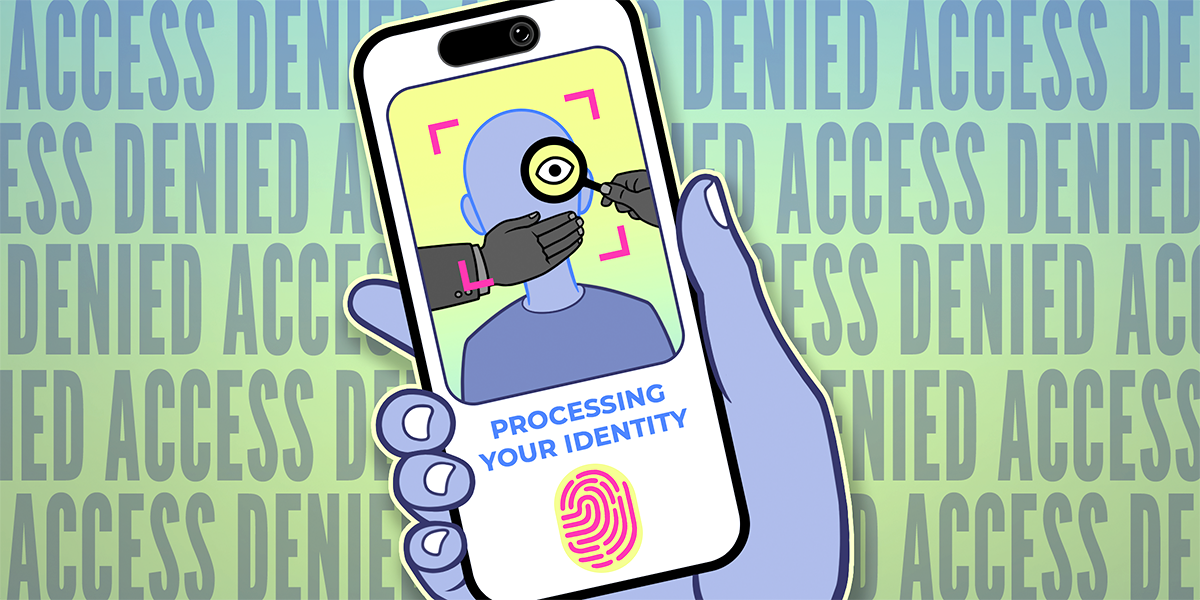
Yesterday marked the launch of our new resource center to answer all of your questions about online age verification mandates! Head over to to explore our explainers, user-friendly guides, technical breakdowns, and advocacy tools—all indexed in the sidebar for easy browsing. .
"Any workplace surveillance should have strict limitations on its use," EFF’s @npub1en7l...l4yw told Business Insider. That might include not using the technology outside the workplace or beyond work hours.
Online age verification isn't like showing ID at a bar. It's more invasive, affects far more transactions, and poses serious privacy, security, and free speech risks that in-person checks never do.
The U.S. proposes asking foreign tourists for five years of social media history before allowing them into the country. EFF’s Lisa Femia breaks down this breaks down this speech-chilling and privacy-invasive scheme for ABC Australia.
Our new Age Verification Resource Hub is live at — and next week (12/15–12/17), we’re hosting an AMA on r/privacy to talk about it. Come ask us anything about what these sweeping laws really mean for your rights and safety.
#E2EE must be explicitly protected, and client-side scanning must be excluded entirely.
Mandatory social media disclosure and surveillance “has not proven effective at finding terrorists and other bad guys,” EFF’s Sophia Cope told The New York Times. “But it has chilled the free speech and invaded the privacy of innocent travelers” and Americans, too.
Losing anonymity online “means that personal private data is able to be collected and retained and stored and breached, maybe used by bad actors linking your identity to the sites that you visit online,” EFF’s Molly Buckley told Michigan Public.
Today we’re launching , our one-stop shop to answer all of your questions about online age verification mandates. What’s at stake for users? How do we push back? What even IS age verification, anyway? Visit now to explore our resources and join the fight to protect the internet.
In general, there is a high risk that the law will end up being extremely complex. The risk categories in the Commission's text, in particular, will quickly lead to mandatory maximum-risk mitigation measures (such as scanning and age verification).