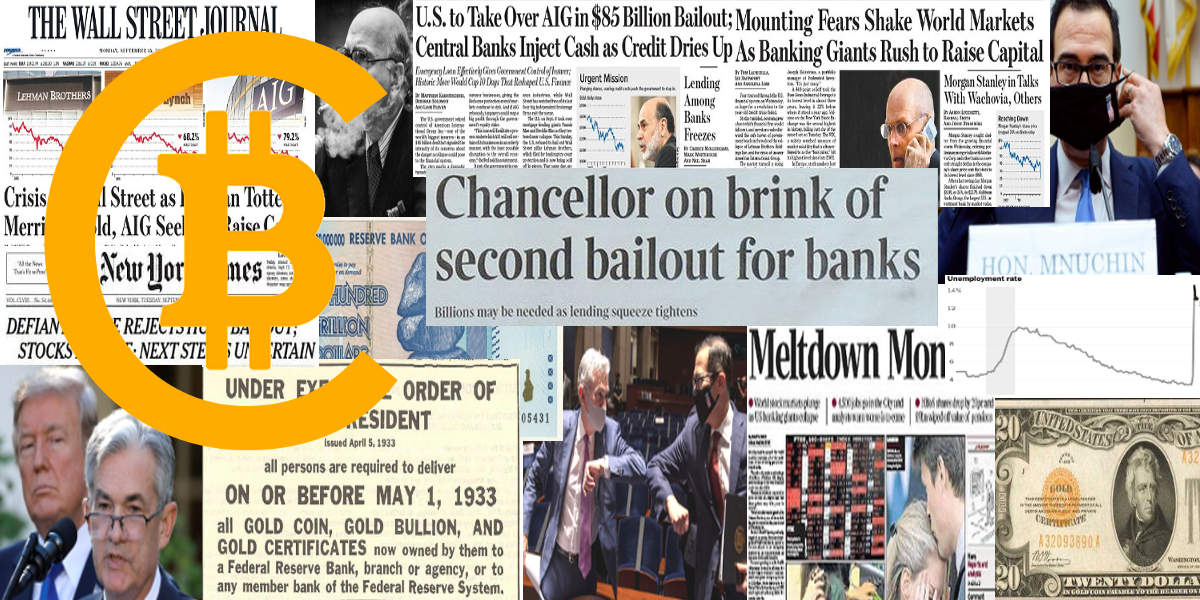
A system dependent on perpetual credit expansion is not a free market capitalist system.
It actively distorts the pricing mechanism and suppresses the natural state of long-term, productivity-driven deflation.
The Keynesian view holds that an unmanaged market economy stagnates in high unemployment and low output.
The solution, therefore, is active government management through fiscal policy (spending and taxation) to restore demand.
After the catastrophic failure of the fractional-reserve system during the Great Depression, why wasn't there a transition to full-reserve banking?
Why did the Chicago Plan, proposed by leading economists to place a 100% reserve requirement on demand deposits, fail?
1. Sound money restrains the state.
A full-reserve system and hard money standard act as a fiscal straitjacket.
Direct taxation is politically unpopular and has limits. Inflating the money supply is a subtler, less transparent way to finance war and welfare.
2. Intervention flatters the political ego.
Letting the market correct itself is viewed as politically untenable.
Government officials want to be seen as pilots of the economy. Avoiding recessions and fighting unemployment earns them political legitimacy.
3. Bankers resist reform.
A transition to full-reserve banking would demote banks to mere custodians. Their profitability and influence would plummet.
Bank lobbyists are a powerful political force, and they would fight tooth and nail to preserve the system that empowers them.
4. Debt is a powerful drug.
Credit would only be extended from real accumulated savings. Loans would become much scarcer as a result.
In a society addicted to leverage, such fiscal rehabilitation would be immensely unpopular.
When people condemn the "excesses of unrestrained free-market capitalism," they fundamentally misdiagnose the problem.
Central banks engineer unsustainable credit booms. Businesses misallocate capital, and governments exploit the busts to justify unprecedented expansions of control.
The Keynesian perspective didn't prevail because it was superior, but because it enabled Cantillonaire government omnipotence:
privatizing profits, socializing losses, and relentlessly collecting the hidden tax of inflation.