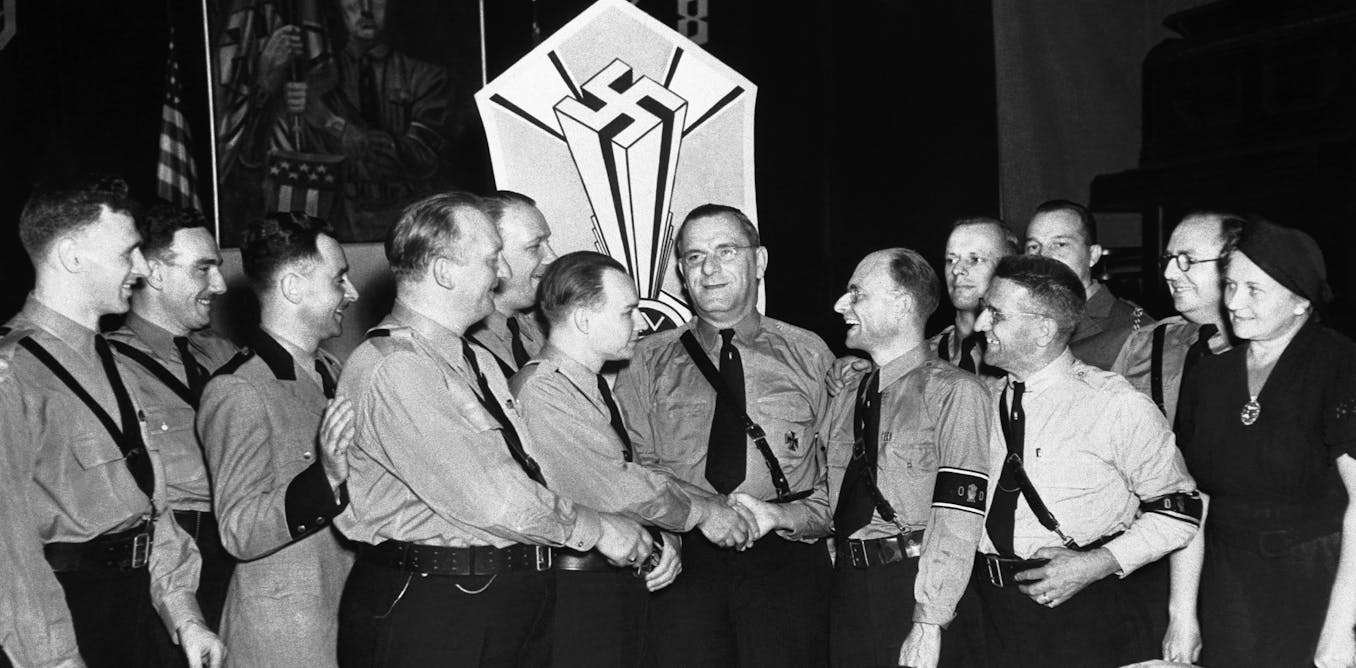
#DomesticTerrorists "America faced domestic fascists before and buried that history Masked officers conduct immigration raids. National Guard troops patrol American cities, and protesters decry their presence as a 'fascist takeover.' White supremacists openly proclaim racist and antisemitic views. Is the United States sliding into fascism? It’s a question that divides a good portion of the country today. Embracing a belief in American exceptionalism – the idea that America is a unique and morally superior country – some historians suggest that 'it can’t happen here,' echoing the satirical title of Sinclair Lewis’ 1935 book about creeping fascism in America. The social conditions required for fascism to take root do not exist in the U.S., these historians say. Still, while fascist ideas never found a foothold among the majority of Americans, they exerted considerable influence during the period between the first and second world wars. Extremist groups like the Silver Shirts, the Christian Front, the Black Legion and the Ku Klux Klan claimed hundreds of thousands of members. Together they glorified a white Christian nation purified of Jews, Black Americans, immigrants and communists. During the 1930s and early ’40s, fascist ideas were promoted and cheered on American soil by groups such as the pro-Nazi German American Bund, which staged a mass rally at New York’s Madison Square Garden in February 1939, displaying George Washington’s portrait alongside swastikas. The Bund also operated lodges, storefronts, summer camps, beer halls and newspapers across the country and denounced the 'melting pot.' It encouraged boycotts and street brawls against Jews and leftists and forged links to Germany’s Nazi party. Yet the Bund and other far-right groups have largely vanished from public memory, even in communities where they once enjoyed popularity. As a sociologist of collective memory and identity, I wanted to know why that is the case. My analysis of hundreds of oral histories of people who grew up in New Jersey in the 1930s and ’40s, where the German American Bund enjoyed a particularly strong presence, suggests that witnesses saw them as insignificant, 'un-American' and unworthy of remembrance. But the people who rallied with the Bund for a white, Christian nation were ordinary citizens. They were mechanics and shopkeepers, churchgoers and small businessmen, and sometimes elected officials. They frequented diners, led PTA meetings and went to church. They were American. When they were interviewed decades later, many of those who had seen Bundists up close in their communities remembered the uniforms, the swastika armbands, the marching columns. They recalled the local butcher who quietly displayed sympathy for Nazism, the Bund’s boycotts of Jewish businesses, and the street brawls at Bund rallies. German American interviewees, who remember firsthand the support the Bund enjoyed before the U.S. entered World War II, 50 years later laughed at family members and neighbors who once supported the organization. Even Jewish interviewees who recalled fearful encounters with Bundists during that period tended to minimize the threat in retrospect. Like their German American counterparts, they framed the Bund as deviant and ephemeral. Few believed the group, and the ideas for which it stood, were significant. (. . .) Communities will remember what they have forgotten or minimized when history is taught, markers are erected, archives are preserved and commemorations are staged. The U.S. has done that for the Holocaust and for the Civil Rights Movement. But when it comes to the history of homegrown fascism, and local resistance to it, few communities have made efforts to preserve this history. Remembering difficult pasts At least one community has tried. In Southbury, Connecticut, community members erected a small plaque in 2022 to honor townspeople who in 1937 organized to keep the Bund from building a training camp there. The inscription is simple: 'Southbury Stops Nazi Training Camp.' The story it tells provides more than an example of local pride – it’s a template for how communities can commemorate the moments when ordinary citizens said 'no. When Americans insist that 'it can’t happen here,' they exempt themselves from vigilance. When they ignore or discount extremism, seeing it as 'weird' or 'foreign,' they miss how effectively such movements borrowed American idioms, such as patriotism, Christianity and law and order, to further hatred, violence and exclusion. Research shows that some Americans have been drawn to movements that promise purity, unity and order at the expense of their neighbors’ rights. The point of remembering such histories is not to wallow in shame, nor to collapse every political dispute into 'fascism.' It is to offer an accurate account of America’s democratic vulnerabilities."
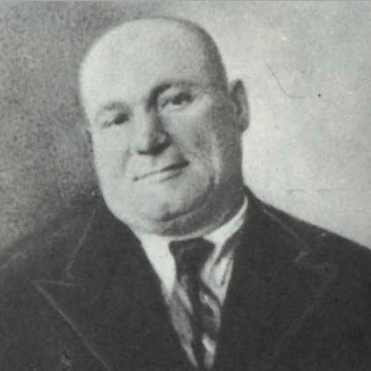
#BrownUniversity "Little is known about the Brown University shooter. Misinformation is filling in the gaps. (. . .) In the absence of a clear narrative, misinformation about the shooter and any possible motives has spread, with a host of right-wing influencers promoting unverified theories. In some cases, they were amplified by members of Congress. The response to the tragedy at Brown University, misinformation experts said, demonstrates how our information environment has deteriorated. Some elected officials are relaying false information or suggesting unproven motives — claims that once may have remained in fringe circles, not leaked into the mainstream. Meanwhile, many in the general public have less trust in institutions providing factual information, and there are few measures in place, especially online, to determine what’s real." https://archive.ph/vaHmM#selection-1395.0-1395.496
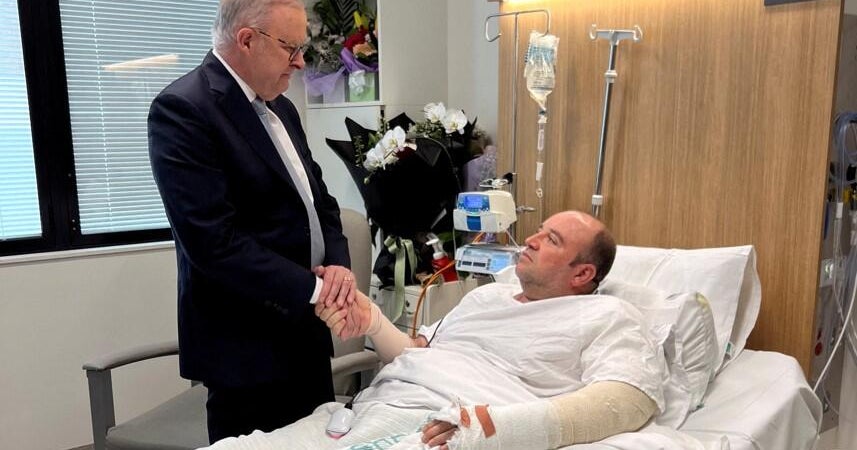
#BondiBeach "Bondi Beach hero Ahmed Al Ahmed receives over $1M in donations after tackling gunman in Australia shooting (. . .) A fundraising page established by Australians who had never met al Ahmed had attracted by Tuesday night donations by some 40,000 people, who gave 2.3 million Australian dollars ($1.5 million). Among the supporters was the billionaire hedge fund manager William Ackman, who pledged AU$99,000. (. . .) Al Ahmed lived in the town of Nayrab in Syria's Idlib region before he arrived in Australia, his cousin Mohammad al Ahmed told The Associated Press. He left Syria in 2006 after finishing his studies, before the 2011 mass protests against the government of then-President Bashar Assad that were met with a brutal crackdown and spiraled into a nearly 14-year civil war. Nayrab was heavily bombed by Assad's forces with most of the town's houses flattened and reduced to rubble. On Tuesday, al Ahmed was the talk of the town. 'Ahmed did really a heroic job,' his cousin, Mohammad al Ahmed told The Associated Press. 'Without any hesitation, he tackled the terrorist and disarmed him just to save innocent people.' (. . .) Other stories of heroism have also emerged."
#TrumpRegime #propaganda #lies "WASHINGTON (AP) — Months after President Donald Trump refashioned a West Wing walkway into what he calls the Presidential Walk of Fame, he has added partisan and subjective plaques to the display, deepening his fingerprints on the White House’s aesthetic and continuing his effort to bend the telling of history to his liking. From 'Sleepy Joe' Biden references to painting Republican icon Ronald Reagan as a fan of a young Trump, the plaques include bombastic language written in Trumpian style. The installation is the Republican president’s latest move to shape the White House in his image, an effort that has spanned from adorning the Oval Office to razing the East Wing in preparation for a massive ballroom addition. An introductory plaque tells passersby that the Presidential Walk of Fame was 'conceived, built, and dedicated by President Donald J. Trump as a tribute to past Presidents, good, bad, and somewhere in the middle.' Biden’s plaque repeats false claims that the 46th president, a Democrat, took office 'as a result of the most corrupt election ever,' when, in fact, he defeated Trump in 2020 in both the popular vote and the Electoral College. Biden is also described as 'by far, the worst president in American history.' Another Democrat, Barack Obama, the nation’s first Black president and Trump’s first presidential predecessor, is labeled 'one of the most divisive political figures in American history.' (. . .) The introductory plaque also presumes that Trump’s addition will stay intact once he is no longer president: 'The Presidential Walk of Fame will long live as a testament and tribute to the Greatness of America.'"
#TrumpRegime #Venezuela "U.S. Tanker Seizure Has Paralyzed Venezuelan Oil Shipping—Except Chevron’s Vessels are idling at ports or veering away from the region. But for Chevron, it’s business as usual. Chevron stands as one of the last big shippers of Venezuelan oil after the U.S. seized a sanctioned tanker last week allegedly carrying the country’s crude to the black market. The threat of another U.S. seizure has disrupted the country’s usually bustling traffic of dark-fleet vessels ferrying the Latin American country’s oil to China and Cuba. Several tankers are idling at Venezuelan ports, and others are veering away from the region, vessel-tracking data show. President Trump on Tuesday ordered a complete blockade of all sanctioned oil tankers going into and out of Venezuela, escalating his administration’s pressure campaign against strongman Nicolás Maduro. For Chevron, though, it remains business as usual. The company is still sending oil tankers to the U.S. Gulf Coast, its operations unimpeded thus far by rising tension between Trump and Maduro. The day after U.S. forces captured the dark-fleet supertanker Skipper, two vessels carrying crude for Chevron departed from the Bajo Grande, a port on Venezuela’s Lake Maracaibo, both bound for the U.S., according to data from TankerTrackers.com. A video posted by Attorney General Pam Bondi shows armed U.S. personnel rappelling from a helicopter and taking control of a tanker off Venezuela’s coast. A Chevron spokesman said its operations in Venezuela continue without disruption and in compliance with the law. He called the company’s presence in Venezuela a stabilizing force for the local economy and directed questions about the security situation to U.S. officials." https://archive.ph/JzlAp#selection-551.0-555.101