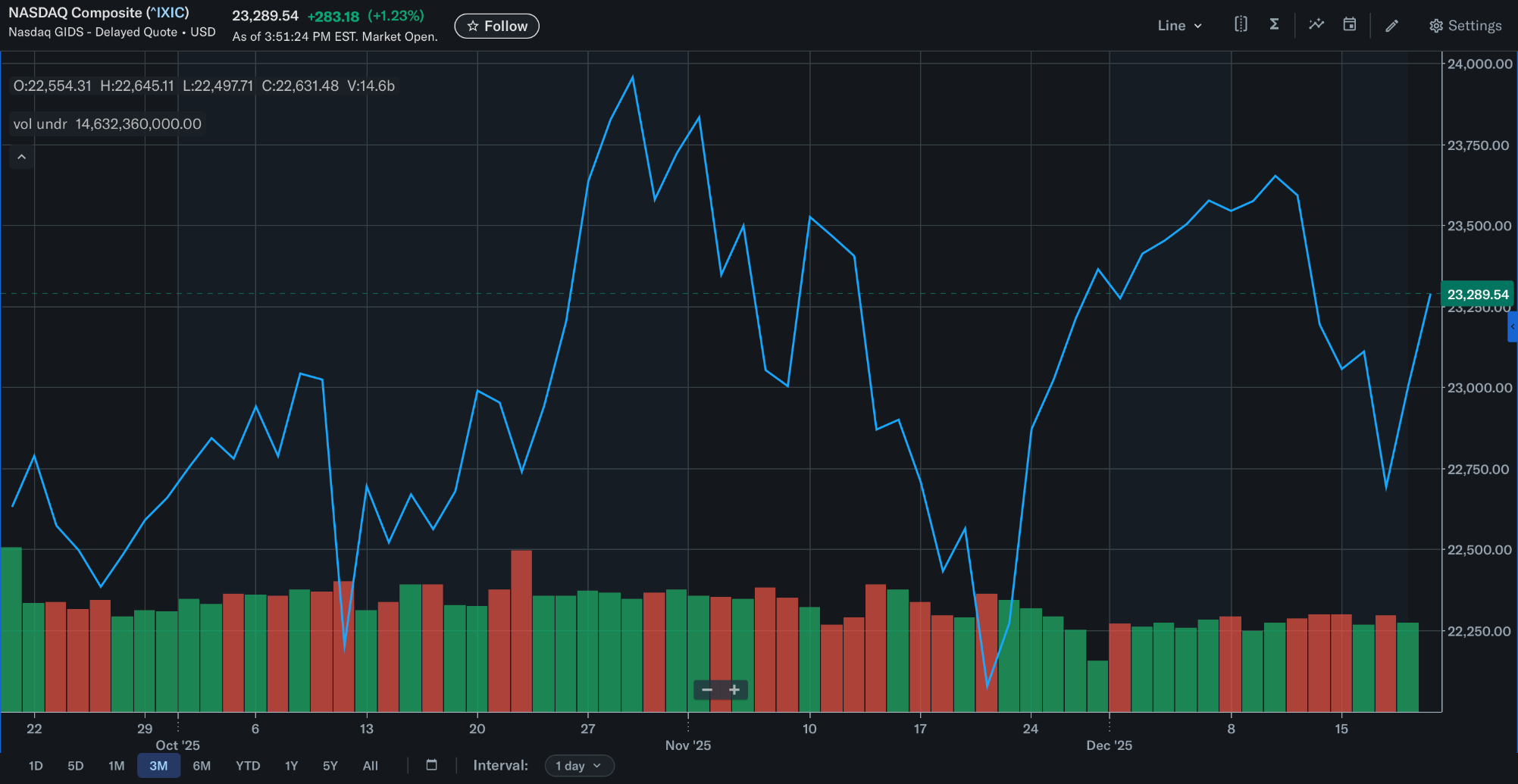
Contrary to the prevailing narrative, the stock market is actually pretty dull right now. There hasn’t been much movement. The NASDAQ Composite hit an all-time high of 24,019.99 on October 29. Today’s high sits at 23,296.05. Despite the constant doom-and-gloom headlines, we’re only about 700 points off that peak. And honestly, I wish it were more interesting. image
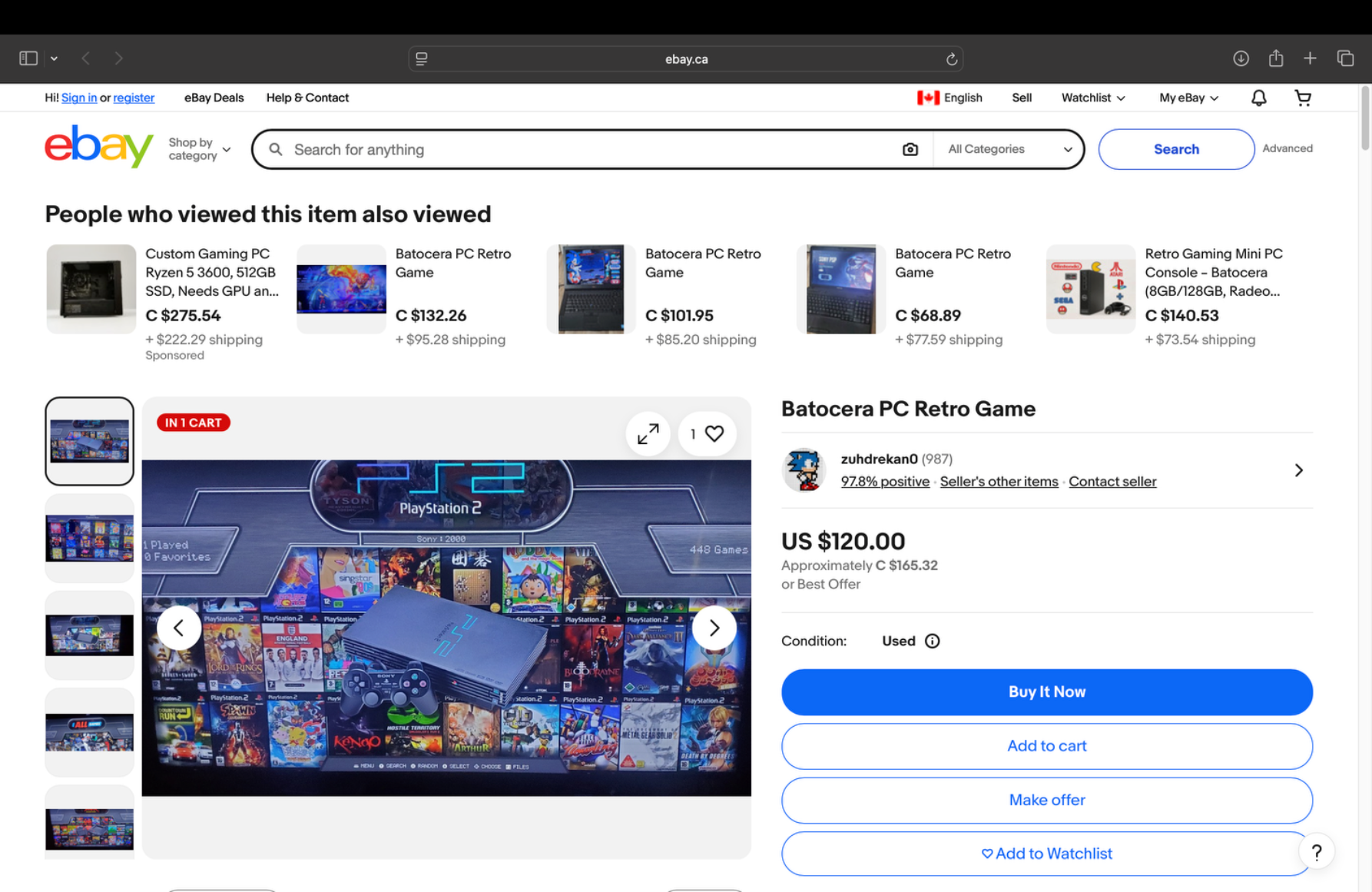
A lot of eBay sellers are now pushing refurbished gaming PCs with Linux preinstalled. The usual suspects are Batocera, Bazzite, or Nobara. Why? Because Microsoft pulled the plug on Windows 10, and Windows 11 is… let’s say *not* a compelling gaming upgrade. Linux runs *most* PC games just fine now, and in plenty of cases it actually performs better. Awkward. It’s going to get more interesting once the Steam Machine shows up. A whole bunch of people are going to have the same realization at the same time: “Wait. I don’t actually need Windows. And I definitely don’t want to throw away my old PC. I’ll just put Linux on it.” Others will look at the Steam Machine price and think, “Or… I could just build this myself.” And then there’s the refurbished route, which is already happening. eBay is absolutely full of mini-PCs for under $200. Slap Linux on it, call it a ‘console’, and suddenly that dusty office computer has a second life. image
Just measured my height. I’m 175cm. That means I’ve been wrong for years. I’ve been telling people I’m 5'6". I’m not. I’m just under 5'9". Off by roughly 3 inches. You always hear about men inflating their height. I did the opposite. I genuinely believed I was shorter and repeated it without thinking. Maybe I measured wrong years ago. Maybe I was slouching. Doesn’t matter. The correction is not trivial. It also means my BMI is lower than I thought. Meaningfully lower. That changes the math.
It’s been a strange year for gaming. On one hand, I’ve spent more money than ever. Not because prices went up, but because there’s been a flood of genuinely good work. When something is good, I buy it. That’s my tiny protest against slop. 2025 is the first year in a long time where the signal beat the noise. More actual art. Less nickel-and-dime nonsense. Indies weren't the also-rans, they ran the table. The Video Game Awards noticed, with indies dominating the major categories. That wasn’t an act of charity. Indies were so good, wins were inevitable. The other side of the ledger is uglier. Big money has been quietly backing out of games. For example, Ziff Davis bought Humble Bundle in 2017. Spun up Humble Games, a publishing arm. Then effectively shut it down in 2024, laying off the entire team and leaving developers hanging. Clean hands. Messy floor. That story repeats everywhere. Microsoft bought Bethesda and Activision, then closed multiple studios. Embracer bought half of Europe, then remembered math exists. Square Enix burned hundreds of millions chasing blockbuster hits that failed to land. Thousands of developers lost their jobs. At the time, I said the same thing I’ve said for years. Games are not franchises. They’re not IP. They’re the people who make them. Those people didn’t vanish. They didn’t wait politely for AAA to come back. They went solo. They formed tiny studios. They built new IP because they had no choice and nothing left to lose. Now we’re playing the results. It’s still choppy. Publishers are still folding. But the creative center of gravity has already moved. Big budgets are shrinking. Big ideas are not. Turns out, talent was never the safe bet. It was the only one.
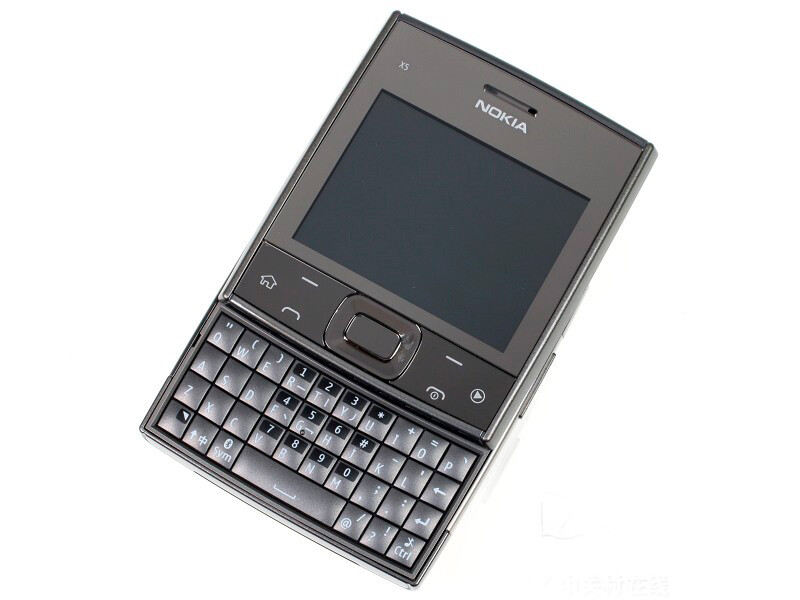
I miss Nokia smartphones. They were willing to get weird with industrial design. Sliders, swivels, asymmetry. Almost every model felt distinct. Compare that to now. Every phone is a flat rectangle with a screen. Efficient. Minimal. Standardized. Also completely interchangeable and dull. They also ran Symbian. From a gaming perspective, that's interesting. The platform had a catalog of genuinely unique titles that never showed up anywhere else. Not iOS-scale, not Android-scale. But enough volume and oddity to make the ecosystem still interesting today. image
Believe it or not, SEGA actually made several Zelda-style games on the Genesis. Golden Axe Warrior and Crusader of Centy are the obvious ones. Both are straightforward takes on the formula. Faithful. Competent. A little safe. Beyond Oasis is also a Zelda-like. But it’s clearly bored of just doing Zelda. Released in late 1994 in Japan and early 1995 in North America, it lands at the absolute tail end of the Genesis lifecycle, after the Saturn was already out in the wild. Bad timing. Instead of cloning Zelda outright, it twists the formula. You play Prince Ali, who wears a gold armlet that lets him summon elemental spirits. Water, fire, shadow, plants. Each one interacts with the environment differently and temporarily buffs your abilities. Combat, puzzles, and progression are built around that system rather than inventory juggling and menu fiddling. It also feels different. Big sprites. Saturated colors. That slightly bouncy animation style Genesis games loved near the end. Think Aladdin, Cool Spot, Earthworm Jim. There’s even some light platforming mixed into the overhead exploration, because why not. The other thing people tend to overlook is who made it. This wasn’t just scored by Yuzo Koshiro. It was developed by Ancient, the studio he co-founded with his mother. That’s right, he was running the whole thing. And yes, he also wrote the music. Obviously. The soundtrack is still held in such high regard that Sega re-issued it on vinyl in 2024, sourced directly from Mega Drive hardware. Reception at the time was… mixed. Some magazines called it one of the best action RPGs on the Genesis. Others gave it a polite shrug. And the criticisms aren’t wrong. Hit detection is weird. Ali’s hitbox is massive. Enemies feel like they’re made of soap. But combat is also trivial, largely optional, and mostly unrewarding in the traditional RPG sense. There’s no real leveling. Enemies respawn endlessly. Once I clocked that, I stopped caring and just ran past most of them. The story barely exists. Gold armlet good. Silver armlet bad. Go stop the guy. Done. Where the game actually shines is in its puzzles. Figuring out when to summon which spirit—when to freeze water, burn obstacles, or manipulate terrain—is consistently satisfying. That’s the part of the design that aged best. It’s also where Beyond Oasis quietly pulls away from Zelda instead of chasing it. Is it a classic? Maybe. Is it a weird, late-era Genesis experiment that most people missed purely because of timing? Absolutely. image
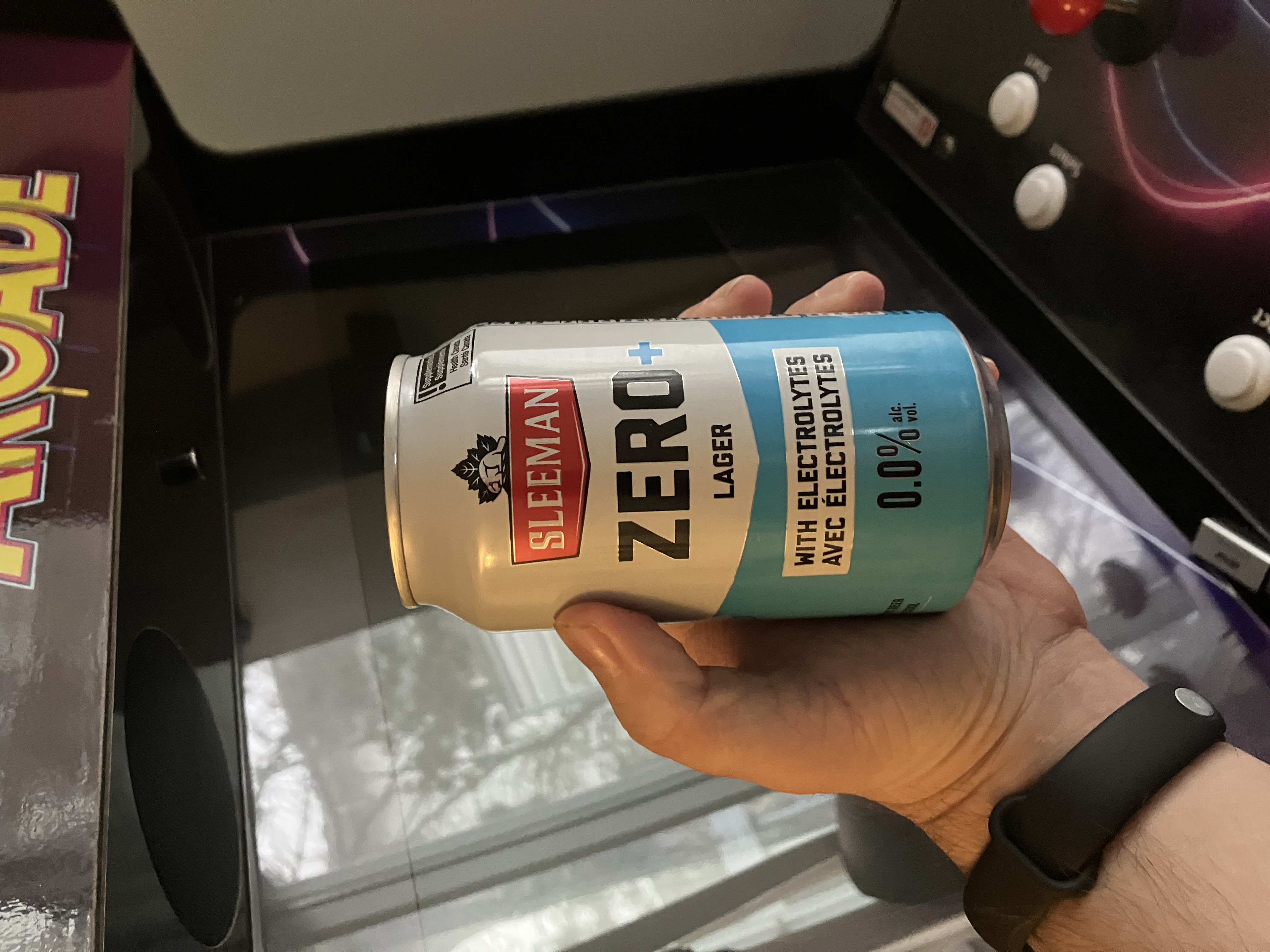
Sleeman Zero is good! Clean, crispy—a bright lager. A worthy addition to my booze free life. image
I’ve been going through lists of the worst songs of 2025. I’m usually skeptical. “Worst” is subjective, and most of these lists are just engagement bait. Then I heard a Kanye West track. And yes, it is genuinely the worst song I have ever heard. That’s not hyperbole. I consider myself a connoisseur of bad music. This one crossed into something else entirely. It’s so bad it’s actively unsettling. I’m annoyed that it exists. Worse, it forced me to learn more about Kanye West than I ever wanted to know. I already had a very low opinion of him. The Hitler stuff was sufficient. Somehow, he still managed to clear a new low bar. Why am I saying this at all? Because I needed to vent. That song should not exist.
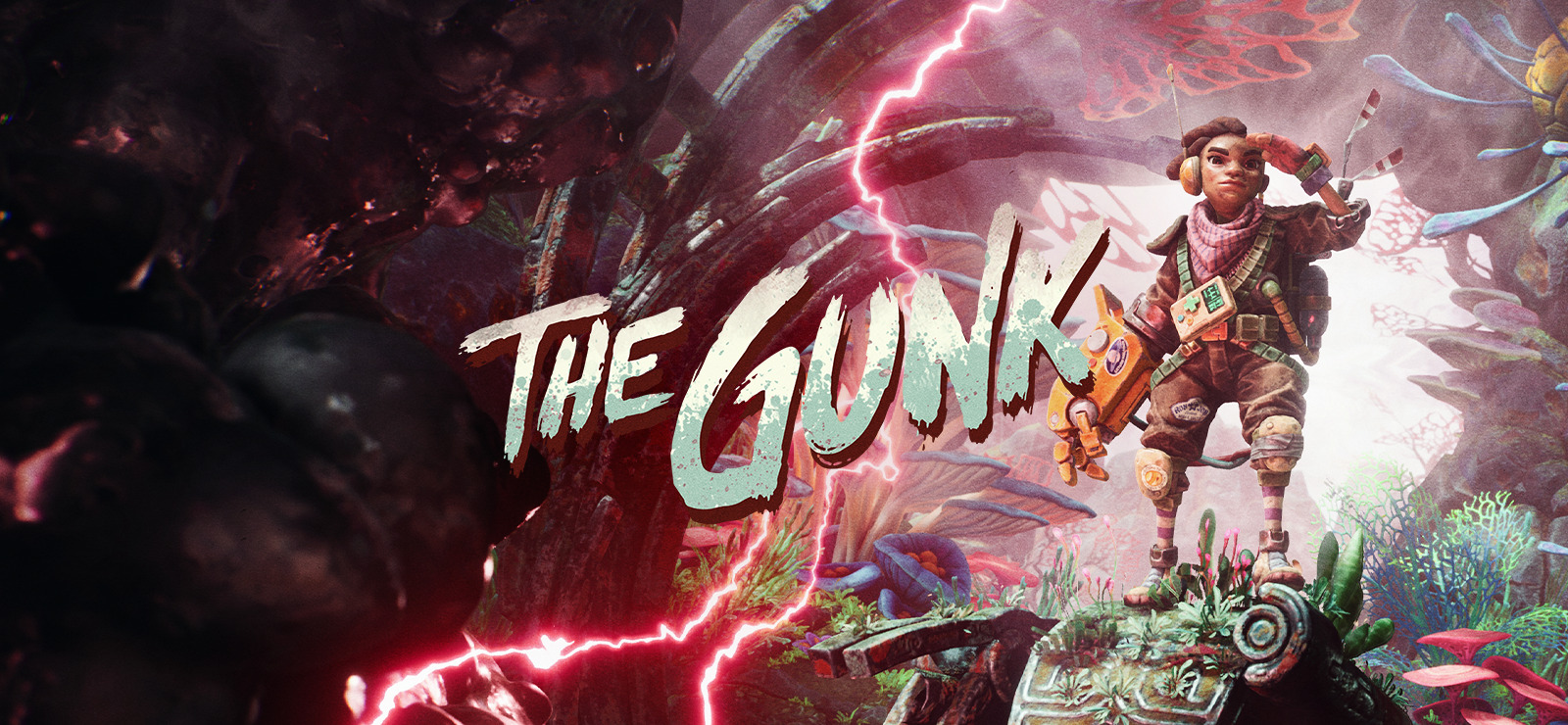
The Gunk was my favourite game I played in 2025. I played 435 games this year. This was the one I spent the most time with. I enjoyed every minute. Right now it sells for $0.74 USD. That’s a 97% discount. The game is 100% DRM-free. It is absolutely worth it.
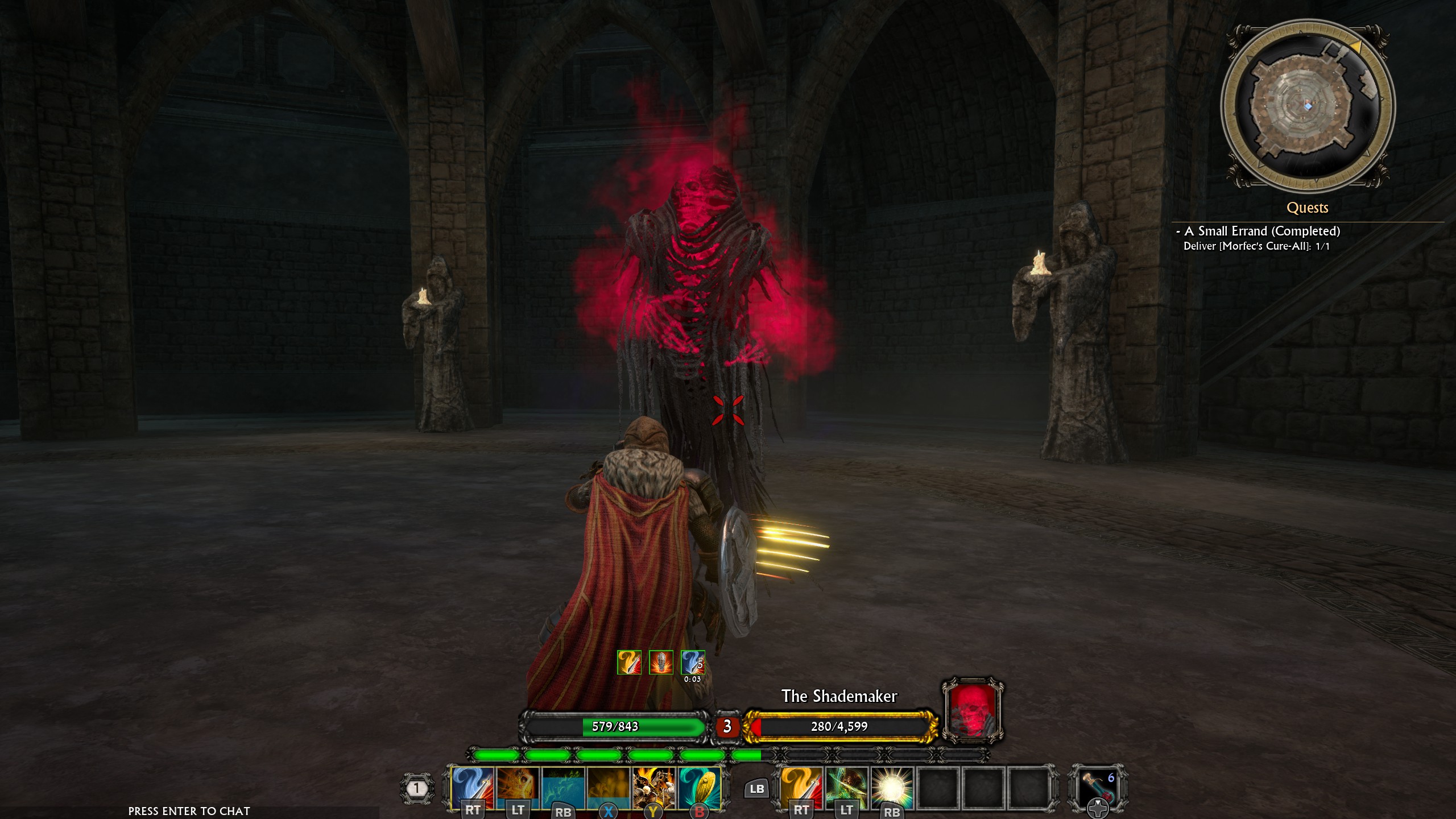
I’m a huge fan of Dungeons of Sundaria. This is a cooperative action RPG dungeon crawler built by Industry Games, a small independent studio out of Arizona. No procedural fluff. Just massive, hand-crafted dungeons designed to be suffered through with up to 4 players. It landed a full 1.0 release on December 12, 2023, across PC, PlayStation, Xbox, and Switch. The dungeons are the entire point here. They are enormous, themed, and unapologetically long. This is not a 15-minute loot jog. You get checkpoints because the developers know what they’re doing to you. Enemy patrols, mines, stunlock nonsense, and bosses that absolutely do not care if you queued solo. The combat is pure mayhem. Five classic classes—Champion, Cleric, Ranger, Rogue, Wizard—lean hard into old-school party roles. Co-op makes this plainly better. Positioning matters. Button-mashing alone will get you folded. It reminds me a lot of Enclave—that early-2000s action RPG where you picked a class, entered isolated combat arenas, and survived on stiff melee, dodgy camera angles, and raw difficulty—but Dungeons of Sundaria takes that foundation, stretches it into massive continuous dungeons, cranks the hostility, and then actually rewards you with mountains of meaningful loot. And yes, the loot. There is a lot of it. A ridiculous amount. The entire gameplay loop is opening doors, decimating monsters, and vacuuming up gear to make your character increasingly unhinged. Finish a run, tweak your build, go back in harder. Post-max-level progression exists specifically so you don’t stop doing this. This is not a AAA production. The graphics are dated. Animations can be stiff. The camera occasionally fights you, especially if you picked a smaller race. None of this matters. The art direction is clear, readable, and easy on the eyes, which is exactly what you want when everything is trying to kill you at once. People keep calling Dungeons of Sundaria an underrated gem, usually right after complaining about the grind and then loading another dungeon anyway. The frequent deep discounts suggest it didn’t set the sales charts on fire. That tracks. This is a niche game for people who miss classic D&D-style dungeon crawls and don’t need cinematic hand-holding. If you want spectacle, look elsewhere. If you want long, punishing dungeon runs, absurd loot, and a game that respects your ability to figure things out, Dungeons of Sundaria absolutely gets it. image