
The Party Flip: Why Trump Is More Jeffersonian Than You Think
 How America’s founding debate over power, class, and sovereignty plays out in modern politics
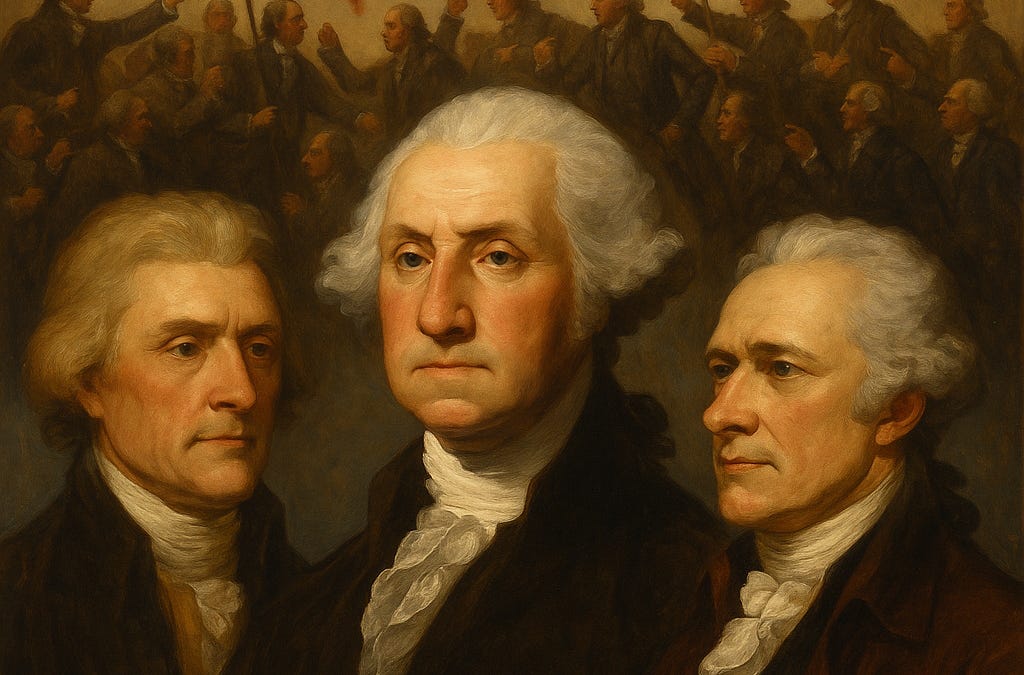
The names of America’s two major political parties haven’t changed—but their ideological foundations have flipped. The Democratic and Republican parties of today bear little resemblance to their historical ancestors. While Thomas Jefferson’s Democratic-Republican Party once championed decentralization and the common man, and Alexander Hamilton’s Federalists favored elite-led industrial centralism, those roles have reversed.
Today, Donald Trump channels Jeffersonian ideals—advocating for states’ rights, dismantling federal overreach, and defending the working class. Meanwhile, the modern Democratic Party carries out the Hamiltonian vision of centralized power, elite alignment, and top-down control through federal agencies and global institutions.
From Jefferson and Hamilton to Trump and Biden
In the early days of the Republic, Jefferson and Hamilton clashed over the soul of the nation. Jefferson favored agrarianism, limited government, and power reserved for the states. Hamilton pushed for a strong national government, a central bank, and an elite-driven industrial economy.
Now, their ideological descendants wear the other party’s label. Jefferson’s suspicion of federal consolidation lives on in Trump’s populism. Hamilton’s faith in centralized authority finds a home in the technocratic wings of the modern Democratic establishment.
Trump’s Jeffersonian Revolution
1. Dismantling Federal Bureaucracy
Trump has taken direct aim at the Department of Education, signing an executive order in 2025 directing its closure and returning control to states and local communities. Massive layoffs and funding freezes followed—clear moves to shrink Washington’s footprint.
This is textbook Jeffersonianism: local control, limited federal authority, and distrust of centralized power.
2. Returning Abortion to the States
Trump’s three Supreme Court nominations directly led to Dobbs v. Jackson, which overturned Roe v. Wade and returned abortion policy to the states. While the media framed it as a “ban,” the ruling didn’t outlaw abortion—it decentralized the decision-making.
Jefferson would have approved: let the people decide locally, not through federal fiat.
3. Tariffs for American Workers
Trump’s trade policy relies on tariffs—tools once favored by Hamilton—but he uses them for populist ends. The goal is not elite industrial consolidation, but rather protecting American manufacturing, reviving middle-class jobs, and challenging China’s grip on supply chains.
It’s a Jeffersonian use of government: protect the nation’s producers, not subsidize global elites.
The Democrats’ Hamiltonian Turn
1. Centralized Control Through Federal Agencies
Modern Democrats support expansive power through federal institutions—from the EPA to the Department of Education to the DOJ. Whether in healthcare, education, or environmental policy, Democrats favor national uniformity over local control.
This reflects Hamilton’s original vision: strong federal management of national affairs through expert-led bureaucracies.
2. Nationalizing Social Policy
Where Trump sought to return controversial decisions like abortion to the states, Democrats push to codify them at the federal level. In doing so, they reinforce the notion that Washington should decide for everyone—exactly the kind of centralism Jefferson feared.
3. Elite Alignment and Globalism
Today’s Democratic Party enjoys support from:
Major financial institutions
Multinational corporations
Tech giants and media conglomerates
Academia and elite universities
This coalition mirrors Hamilton’s vision of governance by the “best and brightest”—a class of educated elites with centralized power and global interests.
Economic Inversion
Jeffersonian Republicans (Then) → Modern Republicans (Trump)
Economic Base: Agrarian, working-class → Blue-collar, industrial, populist
Trade Policy: Anti-tariff, local markets → Tariff-based, protectionist
Power Source: State and local control → Decentralized governance
View of Elites: Suspicious of coastal, academic elites → Anti-globalist, anti-technocrat
Hamiltonian Federalists (Then) → Modern Democrats (Biden)
Economic Base: Banking and merchant class → Finance, tech, and global corporate elite
Trade Policy: Pro-tariff to grow industry → Globalist free trade, offshoring
Power Source: Strong federal government → Executive agencies and courts
View of Elites: Rule by the educated elite → Rule by institutional elite (media, academia, government)
A Flipped Political Landscape
In almost every major policy arena, the ideological positions have reversed. Trump governs like a Jeffersonian—decentralizing power, challenging elites, and putting working-class interests first. The Democratic establishment governs like Hamilton—centralized, elite-driven, and globalist in orientation.
Understanding this reversal is key to making sense of today’s political realignment. The parties haven’t just shifted—they’ve swapped souls.
How America’s founding debate over power, class, and sovereignty plays out in modern politics
The names of America’s two major political parties haven’t changed—but their ideological foundations have flipped. The Democratic and Republican parties of today bear little resemblance to their historical ancestors. While Thomas Jefferson’s Democratic-Republican Party once championed decentralization and the common man, and Alexander Hamilton’s Federalists favored elite-led industrial centralism, those roles have reversed.
Today, Donald Trump channels Jeffersonian ideals—advocating for states’ rights, dismantling federal overreach, and defending the working class. Meanwhile, the modern Democratic Party carries out the Hamiltonian vision of centralized power, elite alignment, and top-down control through federal agencies and global institutions.
From Jefferson and Hamilton to Trump and Biden
In the early days of the Republic, Jefferson and Hamilton clashed over the soul of the nation. Jefferson favored agrarianism, limited government, and power reserved for the states. Hamilton pushed for a strong national government, a central bank, and an elite-driven industrial economy.
Now, their ideological descendants wear the other party’s label. Jefferson’s suspicion of federal consolidation lives on in Trump’s populism. Hamilton’s faith in centralized authority finds a home in the technocratic wings of the modern Democratic establishment.
Trump’s Jeffersonian Revolution
1. Dismantling Federal Bureaucracy
Trump has taken direct aim at the Department of Education, signing an executive order in 2025 directing its closure and returning control to states and local communities. Massive layoffs and funding freezes followed—clear moves to shrink Washington’s footprint.
This is textbook Jeffersonianism: local control, limited federal authority, and distrust of centralized power.
2. Returning Abortion to the States
Trump’s three Supreme Court nominations directly led to Dobbs v. Jackson, which overturned Roe v. Wade and returned abortion policy to the states. While the media framed it as a “ban,” the ruling didn’t outlaw abortion—it decentralized the decision-making.
Jefferson would have approved: let the people decide locally, not through federal fiat.
3. Tariffs for American Workers
Trump’s trade policy relies on tariffs—tools once favored by Hamilton—but he uses them for populist ends. The goal is not elite industrial consolidation, but rather protecting American manufacturing, reviving middle-class jobs, and challenging China’s grip on supply chains.
It’s a Jeffersonian use of government: protect the nation’s producers, not subsidize global elites.
The Democrats’ Hamiltonian Turn
1. Centralized Control Through Federal Agencies
Modern Democrats support expansive power through federal institutions—from the EPA to the Department of Education to the DOJ. Whether in healthcare, education, or environmental policy, Democrats favor national uniformity over local control.
This reflects Hamilton’s original vision: strong federal management of national affairs through expert-led bureaucracies.
2. Nationalizing Social Policy
Where Trump sought to return controversial decisions like abortion to the states, Democrats push to codify them at the federal level. In doing so, they reinforce the notion that Washington should decide for everyone—exactly the kind of centralism Jefferson feared.
3. Elite Alignment and Globalism
Today’s Democratic Party enjoys support from:
Major financial institutions
Multinational corporations
Tech giants and media conglomerates
Academia and elite universities
This coalition mirrors Hamilton’s vision of governance by the “best and brightest”—a class of educated elites with centralized power and global interests.
Economic Inversion
Jeffersonian Republicans (Then) → Modern Republicans (Trump)
Economic Base: Agrarian, working-class → Blue-collar, industrial, populist
Trade Policy: Anti-tariff, local markets → Tariff-based, protectionist
Power Source: State and local control → Decentralized governance
View of Elites: Suspicious of coastal, academic elites → Anti-globalist, anti-technocrat
Hamiltonian Federalists (Then) → Modern Democrats (Biden)
Economic Base: Banking and merchant class → Finance, tech, and global corporate elite
Trade Policy: Pro-tariff to grow industry → Globalist free trade, offshoring
Power Source: Strong federal government → Executive agencies and courts
View of Elites: Rule by the educated elite → Rule by institutional elite (media, academia, government)
A Flipped Political Landscape
In almost every major policy arena, the ideological positions have reversed. Trump governs like a Jeffersonian—decentralizing power, challenging elites, and putting working-class interests first. The Democratic establishment governs like Hamilton—centralized, elite-driven, and globalist in orientation.
Understanding this reversal is key to making sense of today’s political realignment. The parties haven’t just shifted—they’ve swapped souls.
How America’s founding debate over power, class, and sovereignty plays out in modern politics
The names of America’s two major political parties haven’t changed—but their ideological foundations have flipped. The Democratic and Republican parties of today bear little resemblance to their historical ancestors. While Thomas Jefferson’s Democratic-Republican Party once championed decentralization and the common man, and Alexander Hamilton’s Federalists favored elite-led industrial centralism, those roles have reversed.
Today, Donald Trump channels Jeffersonian ideals—advocating for states’ rights, dismantling federal overreach, and defending the working class. Meanwhile, the modern Democratic Party carries out the Hamiltonian vision of centralized power, elite alignment, and top-down control through federal agencies and global institutions.
From Jefferson and Hamilton to Trump and Biden
In the early days of the Republic, Jefferson and Hamilton clashed over the soul of the nation. Jefferson favored agrarianism, limited government, and power reserved for the states. Hamilton pushed for a strong national government, a central bank, and an elite-driven industrial economy.
Now, their ideological descendants wear the other party’s label. Jefferson’s suspicion of federal consolidation lives on in Trump’s populism. Hamilton’s faith in centralized authority finds a home in the technocratic wings of the modern Democratic establishment.
Trump’s Jeffersonian Revolution
1. Dismantling Federal Bureaucracy
Trump has taken direct aim at the Department of Education, signing an executive order in 2025 directing its closure and returning control to states and local communities. Massive layoffs and funding freezes followed—clear moves to shrink Washington’s footprint.
This is textbook Jeffersonianism: local control, limited federal authority, and distrust of centralized power.
2. Returning Abortion to the States
Trump’s three Supreme Court nominations directly led to Dobbs v. Jackson, which overturned Roe v. Wade and returned abortion policy to the states. While the media framed it as a “ban,” the ruling didn’t outlaw abortion—it decentralized the decision-making.
Jefferson would have approved: let the people decide locally, not through federal fiat.
3. Tariffs for American Workers
Trump’s trade policy relies on tariffs—tools once favored by Hamilton—but he uses them for populist ends. The goal is not elite industrial consolidation, but rather protecting American manufacturing, reviving middle-class jobs, and challenging China’s grip on supply chains.
It’s a Jeffersonian use of government: protect the nation’s producers, not subsidize global elites.
The Democrats’ Hamiltonian Turn
1. Centralized Control Through Federal Agencies
Modern Democrats support expansive power through federal institutions—from the EPA to the Department of Education to the DOJ. Whether in healthcare, education, or environmental policy, Democrats favor national uniformity over local control.
This reflects Hamilton’s original vision: strong federal management of national affairs through expert-led bureaucracies.
2. Nationalizing Social Policy
Where Trump sought to return controversial decisions like abortion to the states, Democrats push to codify them at the federal level. In doing so, they reinforce the notion that Washington should decide for everyone—exactly the kind of centralism Jefferson feared.
3. Elite Alignment and Globalism
Today’s Democratic Party enjoys support from:
Major financial institutions
Multinational corporations
Tech giants and media conglomerates
Academia and elite universities
This coalition mirrors Hamilton’s vision of governance by the “best and brightest”—a class of educated elites with centralized power and global interests.
Economic Inversion
Jeffersonian Republicans (Then) → Modern Republicans (Trump)
Economic Base: Agrarian, working-class → Blue-collar, industrial, populist
Trade Policy: Anti-tariff, local markets → Tariff-based, protectionist
Power Source: State and local control → Decentralized governance
View of Elites: Suspicious of coastal, academic elites → Anti-globalist, anti-technocrat
Hamiltonian Federalists (Then) → Modern Democrats (Biden)
Economic Base: Banking and merchant class → Finance, tech, and global corporate elite
Trade Policy: Pro-tariff to grow industry → Globalist free trade, offshoring
Power Source: Strong federal government → Executive agencies and courts
View of Elites: Rule by the educated elite → Rule by institutional elite (media, academia, government)
A Flipped Political Landscape
In almost every major policy arena, the ideological positions have reversed. Trump governs like a Jeffersonian—decentralizing power, challenging elites, and putting working-class interests first. The Democratic establishment governs like Hamilton—centralized, elite-driven, and globalist in orientation.
Understanding this reversal is key to making sense of today’s political realignment. The parties haven’t just shifted—they’ve swapped souls.

 Behind the façade of fairness lies a movement built on deception, favoritism, and anti-male bias
Feminism sells itself with polished slogans like “equal rights,” “gender justice,” and “empowerment.” These words sound noble, even righteous. But beneath the surface lies something far more calculated.
These aren’t reflections of feminism’s true goals. They’re tools of persuasion and rhetorical camouflage. The truth is far uglier. Feminism has never been about balance. It has always been about power — a system that elevates women, vilifies men, and tilts every institution in favor of the feminine.
Doublespeak as a Weapon
Feminism doesn’t speak plainly. It speaks strategically. Words are repurposed to serve the agenda.
“Equality” is used to justify special treatment for women
“Empowerment” means giving women power without responsibility
“Toxic masculinity” is a label slapped on any male trait that threatens the narrative
This isn’t carelessness. It’s design. The feminist lexicon is crafted to obscure truth, shut down dissent, and paralyze opposition. It's not a dialogue. It's a trap.
The True Goal: Favor Women, Penalize Men
From the very beginning, feminism sought to gain privileges for women under the guise of fairness. Every major demand came with a double standard.
Voting? Yes, for women. But not conscription, which remained a male-only burden
Sexual liberation? Yes, but men were still expected to take responsibility for its consequences
Career access? Yes, but without embracing the risks, hours, or physical demands men endured
Feminism cherry-picked every societal advantage for women while dodging every duty. It wasn’t about equality. It was about extraction.
Systemic Tilt: Law, Culture, and Media
The feminist agenda seeped into every corner of culture and law and did so with quiet precision.
Family courts routinely award custody to mothers, marginalizing fathers
Education systems punish boys for normal male behavior while favoring female learning styles
Media outlets glamorize female struggle and vilify male suffering — or worse, ignore it
“Equality” has come to mean women win either way. Different rules. Different standards. Same script: blame the man.
Pathologizing Masculinity, Idolizing Femininity
Under feminism, masculinity became a disease and femininity became sacred.
Strength, logic, stoicism — male virtues for generations — are now rebranded as threats
Emotional volatility, vulnerability, and victimhood — once considered weaknesses — are now praised as feminist power
Boys grow up being told that their instincts are dangerous, their identity is toxic, and their role in the world is obsolete. Girls are told they are flawless by default.
The Rise of the Feminist Victim-Queen
Today’s feminist archetype is a contradiction and a demand.
She is told she’s oppressed yet privileged, strong yet owed protection, independent yet subsidized. She can attack men with impunity and still claim to be a victim the moment she's criticized.
This is not empowerment. It’s entitlement. Feminism has manufactured a class of women trained to blame, extract, and never self-reflect.
The Cost of the Lie
The results of this deception are visible everywhere.
Men are checking out. They’re avoiding marriage, fatherhood, and institutions rigged against them
Women are angrier, more anxious, and less fulfilled than ever before, despite being told they “have it all”
Society is fracturing because when truth is replaced with ideology, decay is inevitable
Feminism didn’t bring equality. It brought resentment, imbalance, and collapse under the banner of a lie.
Conclusion: Feminism’s Language is Its Shield
The feminist movement never intended fairness. It intended dominance. Its power has always come from words — words that manipulate, not illuminate.
It speaks of equality but means supremacy. It cries out for justice but demands vengeance. It hides behind noble language to avoid scrutiny.
If society is to recover, the first step is clear. Call out the lie. Feminism isn’t confused. It’s calculated. And it must be held accountable not just for what it claims, but for what it has done.
Behind the façade of fairness lies a movement built on deception, favoritism, and anti-male bias
Feminism sells itself with polished slogans like “equal rights,” “gender justice,” and “empowerment.” These words sound noble, even righteous. But beneath the surface lies something far more calculated.
These aren’t reflections of feminism’s true goals. They’re tools of persuasion and rhetorical camouflage. The truth is far uglier. Feminism has never been about balance. It has always been about power — a system that elevates women, vilifies men, and tilts every institution in favor of the feminine.
Doublespeak as a Weapon
Feminism doesn’t speak plainly. It speaks strategically. Words are repurposed to serve the agenda.
“Equality” is used to justify special treatment for women
“Empowerment” means giving women power without responsibility
“Toxic masculinity” is a label slapped on any male trait that threatens the narrative
This isn’t carelessness. It’s design. The feminist lexicon is crafted to obscure truth, shut down dissent, and paralyze opposition. It's not a dialogue. It's a trap.
The True Goal: Favor Women, Penalize Men
From the very beginning, feminism sought to gain privileges for women under the guise of fairness. Every major demand came with a double standard.
Voting? Yes, for women. But not conscription, which remained a male-only burden
Sexual liberation? Yes, but men were still expected to take responsibility for its consequences
Career access? Yes, but without embracing the risks, hours, or physical demands men endured
Feminism cherry-picked every societal advantage for women while dodging every duty. It wasn’t about equality. It was about extraction.
Systemic Tilt: Law, Culture, and Media
The feminist agenda seeped into every corner of culture and law and did so with quiet precision.
Family courts routinely award custody to mothers, marginalizing fathers
Education systems punish boys for normal male behavior while favoring female learning styles
Media outlets glamorize female struggle and vilify male suffering — or worse, ignore it
“Equality” has come to mean women win either way. Different rules. Different standards. Same script: blame the man.
Pathologizing Masculinity, Idolizing Femininity
Under feminism, masculinity became a disease and femininity became sacred.
Strength, logic, stoicism — male virtues for generations — are now rebranded as threats
Emotional volatility, vulnerability, and victimhood — once considered weaknesses — are now praised as feminist power
Boys grow up being told that their instincts are dangerous, their identity is toxic, and their role in the world is obsolete. Girls are told they are flawless by default.
The Rise of the Feminist Victim-Queen
Today’s feminist archetype is a contradiction and a demand.
She is told she’s oppressed yet privileged, strong yet owed protection, independent yet subsidized. She can attack men with impunity and still claim to be a victim the moment she's criticized.
This is not empowerment. It’s entitlement. Feminism has manufactured a class of women trained to blame, extract, and never self-reflect.
The Cost of the Lie
The results of this deception are visible everywhere.
Men are checking out. They’re avoiding marriage, fatherhood, and institutions rigged against them
Women are angrier, more anxious, and less fulfilled than ever before, despite being told they “have it all”
Society is fracturing because when truth is replaced with ideology, decay is inevitable
Feminism didn’t bring equality. It brought resentment, imbalance, and collapse under the banner of a lie.
Conclusion: Feminism’s Language is Its Shield
The feminist movement never intended fairness. It intended dominance. Its power has always come from words — words that manipulate, not illuminate.
It speaks of equality but means supremacy. It cries out for justice but demands vengeance. It hides behind noble language to avoid scrutiny.
If society is to recover, the first step is clear. Call out the lie. Feminism isn’t confused. It’s calculated. And it must be held accountable not just for what it claims, but for what it has done.





 When Jermaine Thomas was deported to Jamaica in 2025, it raised questions about how someone born on a U.S. Army base in West Germany and raised in Texas could lack U.S. citizenship. The case has drawn public attention due to the assumption that children born to U.S. soldiers abroad are automatically citizens. However, U.S. citizenship law imposes strict criteria, and Thomas was never legally a U.S. citizen.
Under 8 U.S.C. § 1401(g), in effect at the time of Thomas's birth in 1986, a child born abroad to one U.S. citizen parent and one non-citizen parent could only acquire U.S. citizenship at birth if the U.S. citizen parent had been physically present in the United States for at least 10 years prior to the child’s birth, including at least 5 years after the age of 14. These years do not need to be consecutive, but they must be cumulative and lawfully present. Time spent serving abroad, including military service, does not count toward this requirement.
Thomas’s father was born in Jamaica and immigrated to the U.S. in 1977. He joined the U.S. Army in 1979 and became a naturalized U.S. citizen in May 1984. Jermaine Thomas was born in August 1986. Because his father had only been physically present in the U.S. for about seven years prior to Jermaine’s birth, he did not meet the 10-year threshold required to transmit U.S. citizenship.
Had Thomas's father been born in the United States or immigrated earlier and lived in the U.S. for at least 10 cumulative years (with 5 after age 14), Jermaine would have acquired U.S. citizenship at birth. The distinction between native-born and naturalized citizens in this context is significant under the law.
Several hypothetical scenarios clarify this rule:
A U.S.-born parent who lived in the U.S. from birth to age 20 would meet the requirement.
An immigrant who came to the U.S. at age 5 and lived there through age 25 would also qualify.
A naturalized citizen who immigrated at 18 and had a child abroad 8 years later, as in Thomas's case, would not meet the requirement.
Jermaine Thomas entered the U.S. legally in 1989 as a lawful permanent resident. Despite growing up in Texas, he never acquired U.S. citizenship. Following multiple felony convictions, he became deportable under U.S. immigration law. In 2025, courts confirmed he had no legal claim to citizenship, and he was removed to Jamaica, his father's country of origin.
This case highlights a strict interpretation of U.S. nationality law, which applies uniform standards regardless of military service or upbringing. While some may view the outcome as harsh, the legal framework is based on measurable criteria established by statute. Whether or not reforms should be considered to address similar cases remains a matter of policy debate.
When Jermaine Thomas was deported to Jamaica in 2025, it raised questions about how someone born on a U.S. Army base in West Germany and raised in Texas could lack U.S. citizenship. The case has drawn public attention due to the assumption that children born to U.S. soldiers abroad are automatically citizens. However, U.S. citizenship law imposes strict criteria, and Thomas was never legally a U.S. citizen.
Under 8 U.S.C. § 1401(g), in effect at the time of Thomas's birth in 1986, a child born abroad to one U.S. citizen parent and one non-citizen parent could only acquire U.S. citizenship at birth if the U.S. citizen parent had been physically present in the United States for at least 10 years prior to the child’s birth, including at least 5 years after the age of 14. These years do not need to be consecutive, but they must be cumulative and lawfully present. Time spent serving abroad, including military service, does not count toward this requirement.
Thomas’s father was born in Jamaica and immigrated to the U.S. in 1977. He joined the U.S. Army in 1979 and became a naturalized U.S. citizen in May 1984. Jermaine Thomas was born in August 1986. Because his father had only been physically present in the U.S. for about seven years prior to Jermaine’s birth, he did not meet the 10-year threshold required to transmit U.S. citizenship.
Had Thomas's father been born in the United States or immigrated earlier and lived in the U.S. for at least 10 cumulative years (with 5 after age 14), Jermaine would have acquired U.S. citizenship at birth. The distinction between native-born and naturalized citizens in this context is significant under the law.
Several hypothetical scenarios clarify this rule:
A U.S.-born parent who lived in the U.S. from birth to age 20 would meet the requirement.
An immigrant who came to the U.S. at age 5 and lived there through age 25 would also qualify.
A naturalized citizen who immigrated at 18 and had a child abroad 8 years later, as in Thomas's case, would not meet the requirement.
Jermaine Thomas entered the U.S. legally in 1989 as a lawful permanent resident. Despite growing up in Texas, he never acquired U.S. citizenship. Following multiple felony convictions, he became deportable under U.S. immigration law. In 2025, courts confirmed he had no legal claim to citizenship, and he was removed to Jamaica, his father's country of origin.
This case highlights a strict interpretation of U.S. nationality law, which applies uniform standards regardless of military service or upbringing. While some may view the outcome as harsh, the legal framework is based on measurable criteria established by statute. Whether or not reforms should be considered to address similar cases remains a matter of policy debate.