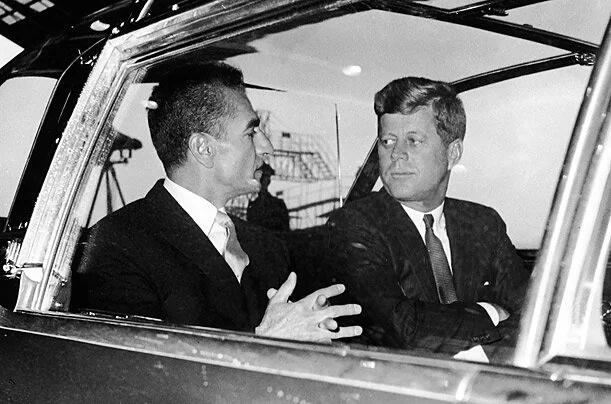
image In the 1960s, a bright idea emerged: "Communism spreads because of poverty!" The thinking went that agricultural societies would remain stuck in poverty until they industrialized. So, America's grand strategy to combat communism? Poverty eradication through industrializing the world's farmers. To achieve this, they pushed land reform programs and modernized agriculture. The mastermind behind it all? Walter Rostow, a famed economist with a book called The Stages of Economic Growth. The U.S. even pressured its allies, like Iran, into land reforms, thinking this would do the trick. But this whole plan was a classic misreading of institutional economics. They believed that by breaking up landowner control and pushing through land reforms, they'd magically create a modern, industrial economy. And the cherry on top? The most extreme version of this mindset was exporting democracy—something we've painfully witnessed over the last two decades. Under the guise of "institution-building," the U.S. left a trail of disastrous results in its wake. Now, let's talk about Iran’s land reforms. Taking lands from the landowners was a massive blunder. First, it was an outright invasion of private property. Second, it made the landowners powerful enemies of the Shah. And third, the farmers, unable to manage their newfound land, flocked to the big cities over the following years. They eventually became a driving force behind the Islamic Revolution of 1978! #grownostr #history #libertarianism #Iran #privateproperty #revolution #economics #state #institutionaleconomics #institutions #democracy
I'm struggling with a theoretical flaw in Rothbard's theory of punishment, particularly his idea of double restitution. He states: 'The criminal should not only have to return the $15,000 but also be forced to pay the victim another $15,000, so that he loses the rights to the amount he took.' I'm fine with the 'double' aspect, but why must it be based on the market value? Isn't value subjective in the Austrian perspective? What if my property is subjectively worth more than $15,000 to me? Wouldn't it make more sense to let independent, voluntarily chosen courts determine the real value? If you're wondering how courts would assess this, that's their responsibility—just like how restaurants figure out how to make a better pizza than their competition. And if you're skeptical about whether such a tool could exist, remember that 500 years ago, we had no tool to record the past, but today we have cameras! #asknostr #grownostr #rothbard #austrianeconomics #law #libertarianism #anarchocapitalism
According to Rothbard, contracts based on future promises without a clear transfer of property shouldn’t be enforced by law. The reasoning is that no one can transfer ownership of their future will. For instance, if I simply promise to pay you $1,000 tomorrow and you act on that, there’s no obligation for me to pay. However, if you give me $900 today and I promise to pay $1,000 tomorrow, this is different. In this case, property has changed hands, and if I don’t pay, it’s effectively theft. Therefore, in a libertarian society, contracts preventing a party from offering future services to others (like exclusivity agreements) wouldn’t be protected by law, ensuring monopolies can’t be legally enforced. #grownostr #rothbard #austrians #contracts #philosophy #moralphilosophy #monopoly #trust #freemarket #libertarianism #llibertarian
I used to believe that tariffs and economic protectionism were mainly about individual freedom or lowering prices. But I’ve come to realize they are tied to something even more critical—global peace. When countries engage in protectionist policies, it restricts free trade, heightens tensions, and can eventually escalate into full-scale conflict. A historical example is America’s protectionism in the early 1930s, which severely impacted Germany’s economy. With the U.S. as its biggest trading partner, Germany’s economy collapsed, unemployment soared, and this environment helped bring the National Socialist German Workers' Party to power. So no matter how much you brag about not supporting Ukraine and call yourself a peacemaker, your policies might tell a different story. #grownostr #Liberalism #EconomicPolicy #Economics #Politics #FreeTrade #History #Ukraine #War
While it's true that voting in elections supports fiat states, as libertarians who advocate for open borders, it's important to clear something up: Democrats and leftists aren't more pro-open borders than Republicans. What they really push for is more immigration to expand the welfare state, mess things up, and secure more votes. In contrast, Republicans are far more honest on this issue. #grownostr #fuckfiat #libertarianism #politics #election
Action is always necessarily rational because an acting man is always aiming his action to satisfy some desire. The terms rational and irrational are inappropriate and meaningless with respect to the subjective goals of a man. Since nobody is in a position to replace his own values for those of an acting individual, it’s futile to pass judgments on other people’s goals that come from their free will. Praxeology takes the values of acting man as a given and does not analyze them. Therefore praxeology is value-free. #LearnPraxeology #Praxeology #grownostr #AustrianEconomics #HumanAction
Action always involves both taking and renunciation, because there are always at least 2 things that a man can't have at the same time. #LearnPraxeology #Praxeology #grownostr #AustrianEconomics #HumanAction