This! This the type of work that makes me so optimistic that the next 3 decades of brain research will be more impactful that the last for understanding/treating mental conditions. We finally have the right measurement tools & analyses (eg for emotion). https://www.science.org/doi/10.1126/science.adt3971 Treating the brain as a complex dynamical system where emotions are persistent, emergent properties is key to understanding emotion. This is what we'll look back on in 30 years and point to as the genius of this era. And this type of cross-species comparative work enables exactly the types of causal perturbation experiments that some are grumbling haven't been done yet. Like this ⬇️ https://www.nature.com/articles/s41586-024-07915-x
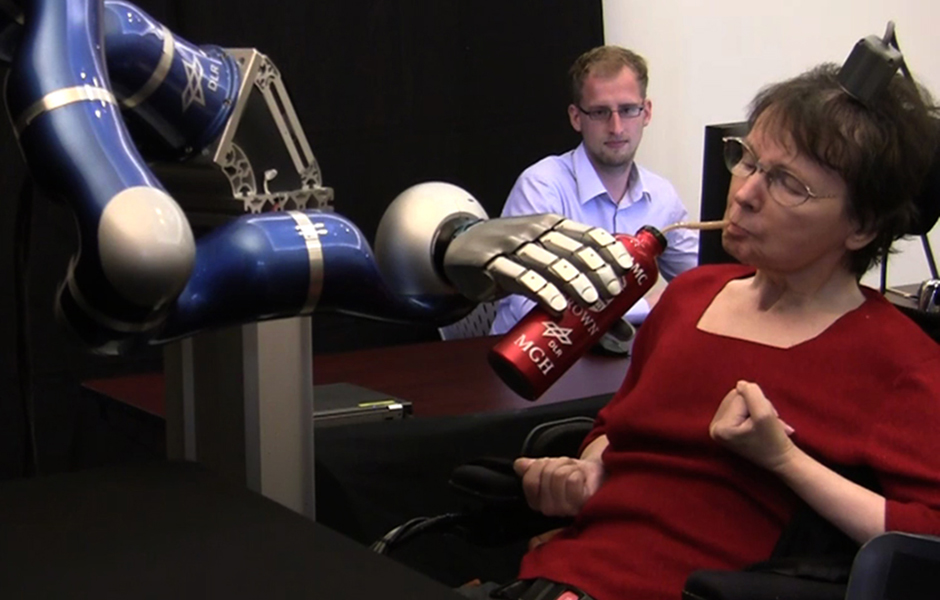
Day 24 (breakthrough): The BrainGate brain computer interface enables individuals with extreme paralysis to move. It's the product of decades of scientific discoveries & engineering. For one man, he imagines writing letters and it's transformed into text. It's remarkable! https://www.nature.com/articles/s41586-021-03506-2 More on BrainGate: #ElusiveCures30
Day 26 (breakthrough): AI. "Building" was once held up as a test of understanding. With AI, we can build w/out it. AlphaFold is an AI model that predicts protein structures from DNA, created w/out understanding protein folding. It changes the game. #ElusiveCures30 https://www.nature.com/articles/s41586-021-03819-2
30 days to the launch of Elusive Cures! I learned so much writing it, and I want to share it. For the next 30 days, I'll post brain & mind research breakthroughs on odd days, and highlight unmet needs on even ones. #ElusiveCures30 First breakthrough: Recording tech & why it matters. The brain is a complex system in which its parts need to be studied simultaneously b/c its emergent properties follow from their interactions. We can now do that for the first time in history. Up to 1 million neurons in mice! https://www.cell.com/neuron/abstract/S0896-6273(24)00121-1 And this is leading to ways to measure things we've never been able to before. Like how activity in the hypothalamus of a mouse gets sucked into a persistent "line attractor" to drive aggression. Understanding that is a step toward understanding emotion in humans. https://www.nature.com/articles/s41586-024-07915-x https://www.nature.com/articles/s41586-024-07915-x
What a fun time to be named Nicole … I’ll guess hold off on sending y’all those random DMs I had planned.
In the era of Trump 2.0, we're calling on all scientists and friends to advocate and unpack science in a public-facing way. This is much bigger than anyone of us. But if we all do one thing, imagine the cumulative impact! It need not be a burden. More here, in @npub17rvd...w9lk
Terrific! Paywalls are disappearing! No more 12 month embargo between when NIH funded work appears in a journal and when it becomes accessible to all (as of December 2025). https://www.nih.gov/about-nih/who-we-are/nih-director/statements/nih-issues-new-policy-speed-access-agency-funded-research-results
Wow! The book we all need to read this weekend, for FREE (in the US). How generous, @npub1k2he...6p26 “In it, she makes a radical case for hope as a commitment to act in a world whose future remains uncertain and unknowable.”
Personal announcement - (BIG!) With the support of the Simons Foundation , I am redirecting my research program to study how our brains support one of the biggest & most mysterious feelings: Mood. I have so much to say about the "Why?" and "How?" behind it! More on that here: https://www.nicolerust.com/thepivot I am so grateful to the Simons Foundation for their support. There aren't many opportunities to pivot an entire research program like this. And to my mentor — Yael Niv at Princeton — whose lab I get to embed in for a year to learn the ropes. Pinch me! image