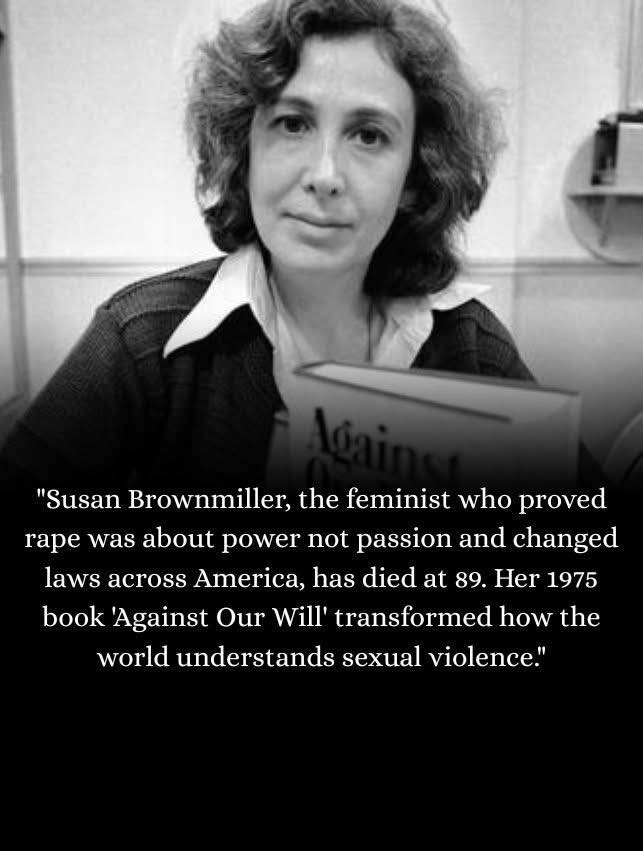
"Susan Brownmiller, the feminist who proved rape was about power not passion and changed laws across America, has died at 89. Her 1975 book 'Against Our Will' transformed how the world understands sexual violence."
May 15, 1935, Brooklyn, New York. Susan Brownmiller was born into a world that would try to silence women who spoke about sexual violence. She would spend her life making sure that silence ended.
Brownmiller started as an actress, drawn to theater and storytelling. But by the late 1960s and early 1970s, she'd transitioned to journalism and activism, becoming a pivotal voice in the women's liberation movement that was reshaping America.
In 1975, she published a book that would change everything: "Against Our Will: Men, Women and Rape."
Before Brownmiller, the prevailing narrative about rape was comfortable for everyone except victims. Rape was seen as a crime of passion—an uncontrollable sexual urge, a misunderstanding, something women provoked by dressing wrong or being in the wrong place.
Brownmiller demolished that myth with 472 pages of research, history, and unflinching analysis.
Her thesis was revolutionary and, to many, shocking: rape wasn't about sex. It was about power. It was a deliberate tool of violence and intimidation used throughout history to subjugate and control women.
She traced rape through human history, starting with ancient Babylon and analyzing its systematic deployment as a weapon of war. She wrote, provocatively: "Man's discovery that his genitalia could serve as a weapon to generate fear must rank as one of the most important discoveries of prehistoric times, along with the use of fire."
That comparison—rape to the discovery of fire—was calculated to offend. And it did. But it also forced people to confront the scope and deliberateness of sexual violence across millennia.
Her most controversial assertion came early in the book: "Rape is nothing more or less than a conscious process of intimidation by which all men keep all women in a state of fear."
That sentence—"all men...all women"—enraged critics who said she was painting all men as potential rapists. Brownmiller never backed down. She was making a systemic argument: rape functioned socially to keep women afraid, whether or not every individual man participated.
The book was translated into more than a dozen languages. It became required reading in women's studies programs. And critically, it catalyzed real legal change.
Within years of its publication, states across America began rewriting their rape laws. Marital rape—previously legal in most states because husbands had "conjugal rights" to their wives' bodies—was criminalized. Many jurisdictions abolished the "corroborating witness rule," which had made rape convictions nearly impossible because it required a witness beyond the victim's testimony.
Rape shield laws were passed to prevent defense attorneys from attacking victims' sexual histories in court. The reforms weren't perfect, and implementation varied, but "Against Our Will" provided the intellectual foundation for these changes.
Susan Brownmiller didn't just write about sexual violence. She confronted the broader culture that commodified and objectified women's bodies.
In what became a famous moment, she appeared on a talk show with Hugh Hefner, founder of Playboy magazine. She told him she looked forward to "the day that you are willing to come out here with a cottontail attached to your rear end," just like the Playboy bunnies who served drinks at his clubs wearing demeaning costumes.
It was a perfect encapsulation of her approach: direct, confrontational, refusing to let powerful men evade accountability with charm or deflection.
She continued writing throughout her life. "Femininity" (1984) examined how cultural constructions of femininity constrained women. "In Our Time: Memoir of a Revolution" (1999) reflected on the women's movement she'd helped build.
She taught. She lectured. She remained an unapologetically outspoken advocate into her eighties.
Like many pioneering feminists, Brownmiller's later years brought tensions with younger generations. Some of her views on victim responsibility and personal safety generated controversy among feminists who felt she was placing too much burden on women to prevent their own victimization.
But her fundamental insight—that rape is about power, that it's a tool of social control, that it must be fought systematically—remained her legacy.
The final lines of "Against Our Will" captured her lifelong philosophy: Women must "fight back" to "redress the imbalance and rid ourselves and men of the ideology of rape."
#RadicalFeminism #RadFem #Feminism #Feminist #SecondWaveFeminism #RapeCulure #Rape #SexualAssault #Susan Brownmiller,