Not all taxes are created equal. 🧵
Many Christians treat the passages in the New Testament that outline the good and just purpose of taxes and the Christian duty to pay them as if they were an absolute defense of all taxes everywhere.
Spoiler alert: they aren't.
However well-meaning their intent, this is a naive, eisegetical, rationally-fraught nightmare of a way to read literature in general, much less the Bible, and threatens to throw humanity (especially the poor) to the lions in the name of obedience to God.
The context of Jesus' words about taxes matters. Jesus was asked whether the Jewish residents of Jerusalem were responsible for paying tribute to Caesar. That tribute consisted of a day's wage, which (based on an average salary of $45k) would amount to $123.29 today.
When Jesus advocated giving to Caesar that which belonged to Caesar, he advocated recognizing the authority and protection that Caesar provided them by paying tribute to him, a tribute of approximately 1/365th of the wealth they would earn in a year.
Modern readers, armed with Bibles that feature the word "tribute" translated flatly as "taxes," instinctively interpret this to mean that Jesus' words (in addition to their contextual meaning) also require that modern Christians should pay whatever taxes that come down the pike, regardless of how they come. Rather than a specific way to fund and recognize the particular, legitimate, God-appointed/defined duties of magistrates, they essentially become blank checks to fund the tyrannical tantrums of narcissists.
The idea that Jesus' defense of the legitimacy of paying a 0.028% tax could be used to justify paying a seemingly limitless percentage of one's income is insane. The context of Bible passages matters.
So, what level of tribute/tax is Biblically legitimate and/or defensible?
This valid question can only be consistently and sensibly answered once several other orienting and anchoring questions have been answered first.
- What are people, what are they for, and how do we know?
- What is government, what is it for, and how do we know?
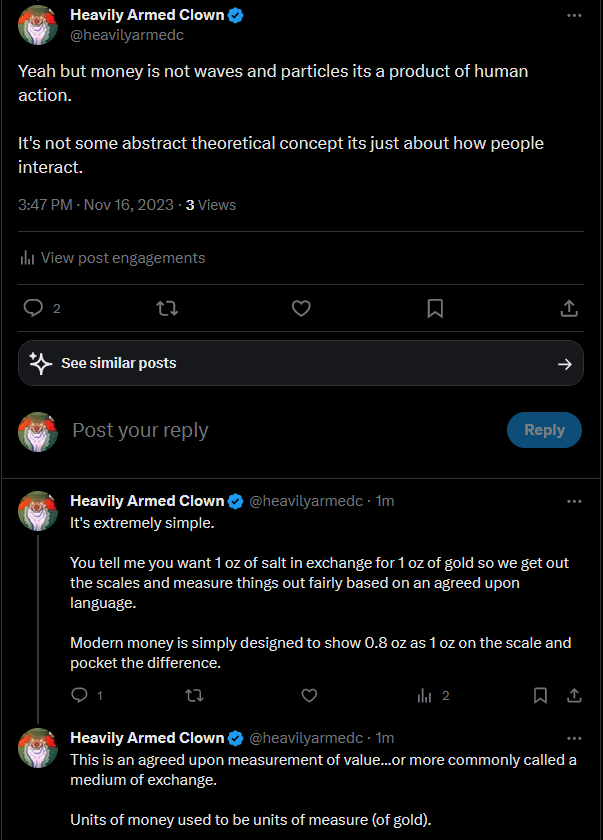
- What is money, what is it for, and how do we know?
- What is life, what is it here for, and how do we know?
- What is freedom, where does it come from, and how do we know?
- What is death, where does it come from, and how do we know?
By what standard?
The world is at a point of definitional crisis. All the systems that have historically provided feedback to help us ground and orient ourselves in the world are being called into question. These definitional questions help us unpack where things begin, where they end, and to what end they exist. They seem impractical, but in reality, philosophical questions like those above are the most practical questions that can be asked because they shape everything we think, believe, say, and do. Utilitarians want to slough off the need for such conversations in the name of urgency: "We don't have time to consider these difficult and divisive questions; we need action NOW!"
There is obviously a time for decisive action, but if you never take time to orient yourself and critically examine the grounding of the intuitive, "obvious" beliefs you have about the world and the way it works, you will eventually find yourself (to quote Francis Beckwith) with feet firmly planted in thin air. The same roots that give a plant life keep it from being dragged around, and when uprooted for too long, the plant will necessarily die.
If you content yourself with answers to those foundational existential questions grounded in positivism, then you lose a principled basis to object to (for instance) even the most comprehensive tax power grabs.
Here's a test: if a government wrote into law that every citizen had to pay a 100% tax on all they owned, how should a Christian respond?
What if the law was 90%? 80?
These aren't simple thought exercises; tax rates in the US are already as high as 37%. In France, that number has climbed as high as 45%. Japan, Finland, and several others hover around 56%, and (as of 2021) the Ivory Coast had the highest tax rates in the world for their highest earners at a tax rate of 60%. Think about what this means: citizens of the Ivory Coast are forced to surrender close to 2/3 of the fruit of their productive capacity to the State. Asking about the prospect of 80%-100% tax rates isn't far off.
Think about the logic of an 80%-100% tax: That you possess life (primarily or entirely) to establish and sustain the will and reign of an earthly kingdom.
We live in a society that has, for generations, in the name of pragmatism, toleration, and liberalism, surrendered definitional authority to an antinomian mob of antihumanists. Rather than the freedom, vitality, and stability we were promised, we have become slaves of coddled, indulgent children, egomaniacal women, and self-regarding, all willing to sacrifice anyone and anything upon the altar of their own comfort in pursuit of an atomized and undefined "freedom," "change" and "progress."
These leaders know the price of everything and the value of nothing. Their "wisdom" and "freedom" have repeatedly subjected the world to unparalleled debt and endless wars. They have consistently demonstrated a willingness to submit themselves and others to horrors that would make Goebbels blush in exchange for and in pursuit of absolute autonomy. This is literally the oldest trick in The Book.
The reason that the Bible can speak of the goodness of taxes is that it was written both by and to people who were "too foolish" to fall for the "obvious truth" that we can print our way to prosperity and bend reality to our will by putting colored pictures of dead men on special paper. They were "too stupid" to comprehend that image-bearers of the Almighty God would willingly surrender half of their productive compensation to a government that (for example) creates money out of thin air to send to impoverished countries to "aid" them in snuffing out the lives of their children.
Life and prosperity issue from self-denying work. Death precedes resurrection, and there is no shortcut.
We ought to gladly pay legitimate taxes with grateful hearts but abhor, cry out against, and fight many other taxes/tributes, especially when they are sought by a murderous gang of warmongering vampires sucking the life and productive capacity out of billions of our children and grandchildren that haven't even been born yet through deficit spending.
This is not a new phenomenon. Francis Schaeffer once said, "If there is no God above the State, then the State is God." Wicked, power-drunk rulers have always tried to weaponize the Bible to enslave ordinary people's consciences into blind submission to their every whim.
For as long as there have been Christians, they have refused to bow the knee to tyrannical rulers. "We must obey God rather than man." But this refusal is done for the same two reasons that motivate everything Christians do: love for God and love for neighbor.
It isn't loving or kind to God or neighbor to indulge the fantasies of would-be demigods. We live in a world of scarce resources, and to pretend otherwise subsidizes their delusions of grandeur.
There is a God above the State. The tribute He seeks isn't your money but you. This isn't a tribute sought by a ruler who needs your money for a vanity project. It's the logical response based on the provision of the Heavenly Father, who lovingly made you, the world, and everything in it. If Caesar's protection and provision warranted a day's wage, how much is warranted for His divine provision and protection of life, much less eternal life? The life stewarded to you exists to further His kingdom and purposes and thus cannot be completely at the disposal of a rival king.