A short story about letting go, Bitcoin, and fate.
How did this happen ???
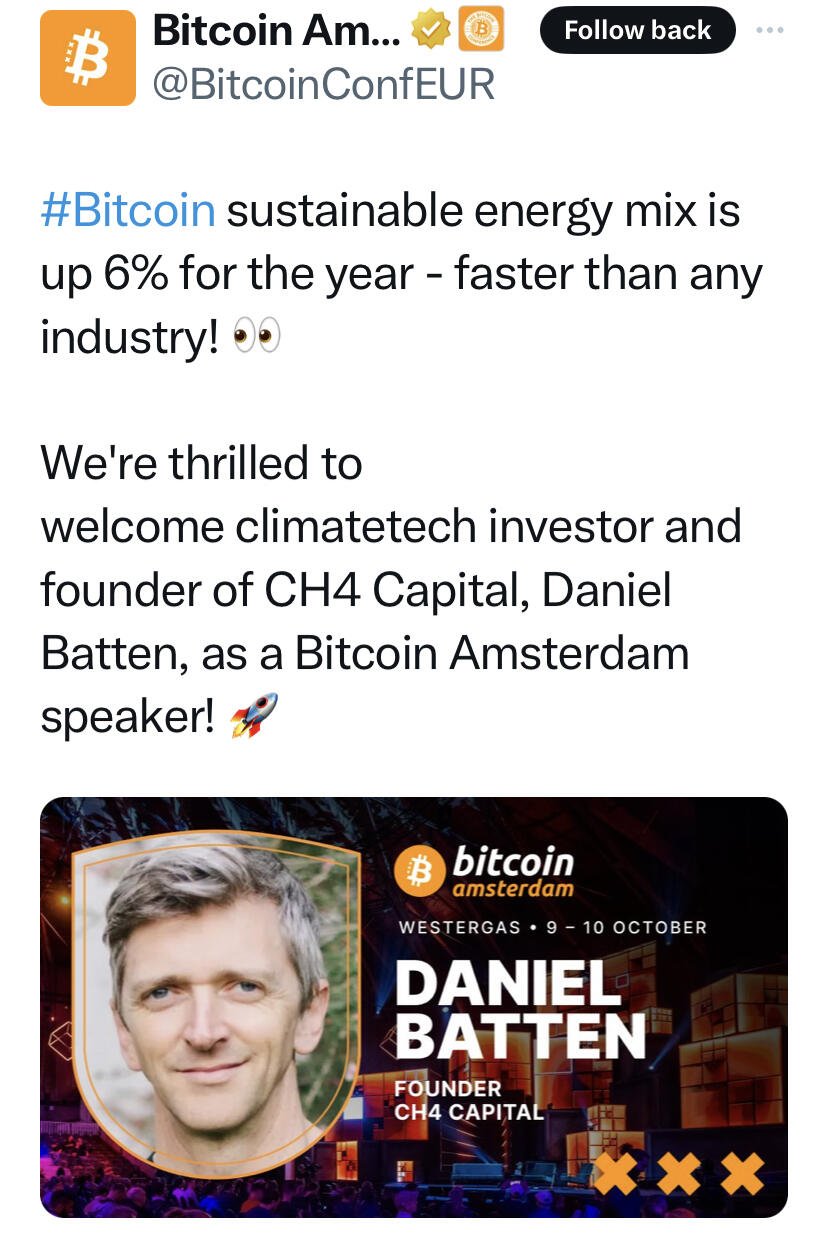
Today, I'm living in Costa Rica, consulting to some of the world's top Bitcoin companies, asked to speak at conferences around the world on Bitcoin mining, and regarded as one of the key forces behind the narrative shift on Bitcoin and the environment.
Til now, I've not shared the story of how this happened.
My ego would love to say "I planned it", or say it was because of some special unique qualities in me. Neither are true. Sure I'm pretty good at analysing data. I'm also pretty good at communicating it back to people in a way that's meaningful.
But there are people much better at both of those things than me. So here's what really happened.
It was lock-down 3.0, 2020. Unable to go anywhere or do much, I went on an online meditation retreat. During that retreat I got an insight "reconnect with your friend Willy".
I did. It turned out in the 5 years since we'd chatted, he'd become a globally respected Bitcoin analyst. We chatted like no time had passed. I asked how he'd made the shift from running tech companies to researching Bitcoin. He shared his story "I had 2 months spare, and a burning question about Bitcoin, and I just kept researching it until I got the answer."
Because of that, this happened. It was early 2022. Bitcoin was getting hammered in the press for its environmental impact. It was reported to have been banned in China, and Telsa had ditched it, both citing environmental concerns. I held a small amount, and was on the point of ditching it too.
But just before I did, I had a chance conversation with Vlatko, an environmentalist entrepreneur who'd started a climatetech company I'd invested in. He suggested I research it deeper before making the decision.
As I sat down to meditate that evening, Willy's words invaded my tranquility "I had 2 months spare, and a burning question about Bitcoin, and I just kept researching it until I got the answer."
That's when the second insight came: I needed to do the same.
I cleared my diary and did something I'd never done: I researched for no other purpose than to get an answer. I worked long hours. I didn't eat much. I lost weight. I hunted down every piece of data I could about renewable energy, how grids worked, climate change, methane mitigation, Bitcoin mining, Bitcoin mining economics. I read the articles for and against Bitcoin.
Then I spoke to renewable energy engineers, people actually doing Bitcoin mining, climate scientists, and grid experts. I extrapolated trendlines. I drew charts. I tested theories. I questioned sources.
Everything led to the same conclusion: Bitcoin mining, as with other disruptive technologies in their first years, had been poorly understood (and on occasions gaslit), yet it would likely follow the same trend as solar to become a net positive to the environment.
In fact not only that, it had the potential to become the most fast-acting form of climatetech the world had seen. All the other technologies we were investing in would have an impact after 2030. But this could have a substantial positive impact immediately on reducing methane emissions and building out the grid renewably.
Then something unexpected happened: the week after I finished my research, GreenpeaceUSA kicked off an environmental campaign against Bitcoin.
As a subscriber to Greenpeace, and someone who'd participated in actions with them shoulder to shoulder I was surprised. So I read the logic behind their campaign to see what they had discovered that I might have missed.
My heart sank.
They quoted studies that had been debunked, and were taking a one-sided view. It was clear they had not done even 5% of the research I just had, but rather had relied for the most part on some questionable accounts written by mainstream journalists, and the work of a certain central bank employee who’s models I had found lacked scientific integrity.
I felt this strong intuitive voice inside me say “you should write a response”. Logically I didn’t see any point. I had no active followers to speak of. And the last time I’d used Twitter was a decade ago where I would regularly get one “like” per ten tweets if I was lucky.
So I wrote a response on Twitter. I pointing out the errors in GreenpeaceUSA’s messaging. That one tweet changed everything. The post received over 600,000 views. I was asked to appear on two podcasts, and I was instantly connected to a global community of environmentalists, climate scientists, philosophers and renewable energy experts I didn’t know existed who, like me, had researched Bitcoin really thoroughly and realized it was an environmental net-positive.
There was one thing that sat uncomfortably with me though. Bitcoin was, or seemed to be, using a disproportionately high amount of fossil fuel. This made me reluctant to advocate too strongly for Bitcoin mining. But then, another intuition came: a very precise intuition “The Cambridge model that everyone relies on is not factoring in offgrid mining. That’s causing it to overstate how much fossil fuel Bitcoin uses.”
Yes, it wasn’t brilliant analysis, or research. It was a simple intuition I had that I followed. I still remember sharing “the Cambridge model does not factor in offgrid mining” with a twitter group I was part of. It was an out-of-character thing for me to say.
I had no evidence for this statement. But I shared it nonetheless. And thank goodness I did. A day later, a member of that group said “You’re right”.
He’d trawled through the Cambridge website and found in the fineprint of their methodology section an acknowledgement that offgrid mining was excluded. But not only that, they also excluded “methane mitigation”.
I was amazed. Buoyed by the fact my intuition had been accurate, I decided to do something crazy, that I never would have done if I’d known how much work was involved.
I decided to build a ground-up transparent model of Bitcoin mining, which used their data as a starting point, but addressed their inaccuracies.
This work required me to hunt down as many bitcoin mining companies as I could and validate their hashrate, power consumption and renewable energy mix. There was no shortcut, just a huge amount of phonecalls, surveys, emails and cross-validation.
Along the way, I made other discoveries about Bitcoin mining, how it was helping stabilize grids, reducing electricity costs through monetizing wasted renewable energy and just how much methane it was mitigating too.
I spent the bulk of each day for two years building the model and publishing what I was finding on Twitter. The response was overwhelming.
I was invited to speak at conferences and write articles. Michael Saylor started quoting my research. Leaders in the industry invited me to their podcasts. I had to start turning down ⅔ of all conference invitations, and podcast invitations. It was amazing, yet at the same time it meant that for two years I received very little income.
This was supposed to take two months, not two years. This was crazy. While I was flattered by the level of outreach, I couldn’t feed a family on podcast invites. And I hadn’t been looking for new coaching clients for ages, so while the work I was doing was some of my best ever, that lack of new outreach meant my business naturally started to atrophy. What was I supposed to do? My intellect was screaming "stop working for free". Yet I kept on doing more unpaid work, with most of my time split between Bitcoin research, and running volunteer breathing and meditation programs and followups for the The Art of Living.
Again my intuition, which was virtually yelling at me so as to be heard above my intellect, kept cajoling and encouraging: “Keep going. Don’t stop”
Eventually I finished, and to my great surprise, the model is now used in preference to Cambridge’s model by most institutions now, including numerous AI engines!
The shock is not that people find merits in the model: I know it is a more accurate model to Cambridge’s. My surprise is that so many other people would adopt it over such an established institution. I still don’t know how this happened.
Along the way, I’d also realized that my third climate tech fund had to involve Bitcoin mining on landfills: my research was showing me that the emissions mitigated per dollar invested were crazy: 45x more emission reducing than investing in solar infrastructure, and capable of good yields for wholesale investors also.
Problem was, I was in the wrong country for international business. With my business partners in the States, and landfill projects in LATAM, it was time to move. My wife was incredibly supportive, and my daughters were up for the adventure, so we relocated to Costa Rica.
Then the miraculous happened: my two worlds started to collide. A single tweet asking for some advice from the community on twitter led to the unintended, yet much appreciated, consequence of work offers within the bitcoin ecosystem.
I was offered an advisory role at a large publicly listed mining company, a research role at another company, and a job helping create a Bitcoin mining video to be sent to regulators the world round. Then Lisa Hough said to me “you’ve got a gift coaching people. Have you thought of coaching Bitcoin companies?” Remarkably I hadn’t. Yet it was so obvious.
One tweet later, a number of founders of Bitcoin companies enrolled to get coaching on gaining investment, growing their company, or navigating the challenges that come with running your own tech firm.
I don’t know what will happen next. I had no plan when I started all this, and I still don’t - other than to keep listening to the intuitive pull, and to keep meditating so that the stray messages get filtered out so I can hear that voice clearly.
But I have felt another intuition: “Bitcoin price is being suppressed because Sovereign Wealth Funds can’t adopt it. They can’t adopt it because their ESG investment committees are blocking it. You should talk to them and help them change their minds.”
Again I did some research, and again this intuition was right. A youtube video of Kevin O’Leary on What Bitcoin Did randomly appeared on my Youtube list that same night. I watched in awe as Kevin O’Leary confirmed every word of this intuition, and then some.
So apparently I’m going to start talking to Sovereign Funds and Pension Funds? I have no idea when and how. But that’s not my business to try and figure out. And any ideas I could figure out would be inferior to the divine plan.
I’m simply listening to a wisdom higher than my own, and beyond what I could have done through my intellect or my experiences. When president Nayib Bukele who has performed a social and economic miracle in El Salvador was interviewed recently he was asked about his economic plan for his country. With a twinkle in his eye he smiled and said “First, seek God’s wisdom”.
I found myself nodding my head. I knew what he meant. Whatever name we give to the power beyond us, we are not the doer, and knowing this opens us up to receive ideas beyond the conception of the rational mind.
So, content not knowing the path ahead but trusting it’ll be great, that’s what I try to do each day.