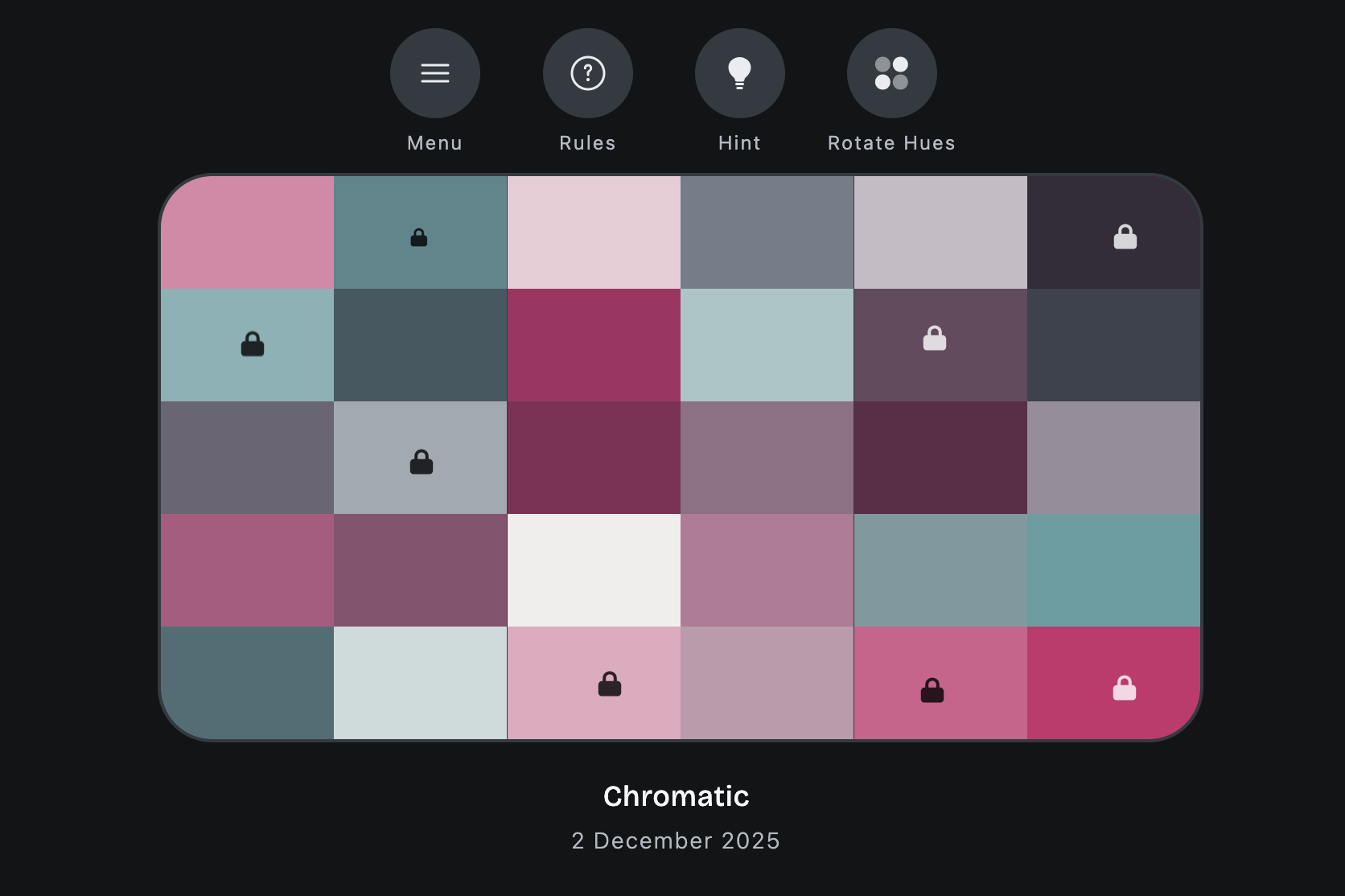
Chromatic - A Colorful Daily Puzzle Game ![](https://m.stacker.news/120153) ## How to Play Move the tiles until the gradient is seamless and all the colors flow perfectly into one another. Locked Tiles are in the correct spot. Use them as reference points to help sort the gradient. Use Rotate Hues if you are having trouble seeing the different between colors. ![](https://m.stacker.news/120154)
"Disagree and commit" is disingenuous. This is a better idea. ![This feels emotionally honest and an idea I can get behind, as an alternative to the popular “disagree and commit”:](https://m.stacker.news/120152) > _“Disagree and let’s see” allows you to stay aligned with the team without forcing you to pretend you had conviction you didn’t have. It lets you walk into a room with your team and be honest:_ > > _“Here’s the path that was chosen. It wasn’t my first pick, but here’s the experiment we’re running, and here’s what we’re trying to learn.”_ Committing to something you disagree with is an emotional contortion that is hard to do in practice. But the work of every team is a series of experiments at its heart, and by changing the onus from “let’s commit to this thing we don’t all agree with” to “let’s try it and see what happens”, we move from steamrollering dissent to mutually agreeing on an experimental hypothesis and testing it. You’re learning based on agreed criteria. That’s much harder to argue with — and at the end, there’s no “I told you so” or winners and losers. There’s just a “here’s what we learned” and an implied set of next steps. Bliss.
"Disagree and commit" is disingenuous. This is a better idea. ![](https://m.stacker.news/120152) > _“Disagree and let’s see” allows you to stay aligned with the team without forcing you to pretend you had conviction you didn’t have. It lets you walk into a room with your team and be honest:_ > > _“Here’s the path that was chosen. It wasn’t my first pick, but here’s the experiment we’re running, and here’s what we’re trying to learn.”_ Committing to something you disagree with is an emotional contortion that is hard to do in practice. But the work of every team is a series of experiments at its heart, and by changing the onus from “let’s commit to this thing we don’t all agree with” to “let’s try it and see what happens”, we move from steamrollering dissent to mutually agreeing on an experimental hypothesis and testing it. You’re learning based on agreed criteria. That’s much harder to argue with — and at the end, there’s no “I told you so” or winners and losers. There’s just a “here’s what we learned” and an implied set of next steps. Bliss.
Disagree and Let’s See ![](https://m.stacker.news/120152) > _“Disagree and let’s see” allows you to stay aligned with the team without forcing you to pretend you had conviction you didn’t have. It lets you walk into a room with your team and be honest:_ > > _“Here’s the path that was chosen. It wasn’t my first pick, but here’s the experiment we’re running, and here’s what we’re trying to learn.”_ Committing to something you disagree with is an emotional contortion that is hard to do in practice. But the work of every team is a series of experiments at its heart, and by changing the onus from “let’s commit to this thing we don’t all agree with” to “let’s try it and see what happens”, we move from steamrollering dissent to mutually agreeing on an experimental hypothesis and testing it. You’re learning based on agreed criteria. That’s much harder to argue with — and at the end, there’s no “I told you so” or winners and losers. There’s just a “here’s what we learned” and an implied set of next steps. Bliss.
Why great ideas die young—and how leaders can save them https://www.fastcompany.com/91443699/why-great-ideas-die-young-and-how-leaders-can-save-them ![](https://m.stacker.news/120036) One of the most overlooked but essential tools for idea nurturing is what I call “Indicate Behavior.” It’s the act of clearly signaling whether a brainstorming session or meeting is meant for expansive thinking (idea generation) or reductive thinking (evaluation and refinement). Trying to brainstorm and critique simultaneously is like mixing oil and water. People either freeze up or default to safe, surface-level ideas. These cues break critical thinking patterns and invite curiosity, fostering psychological safety by telling the brain, “It’s OK to imagine here.” # THE BENEFITS OF DESIGNING ENVIRONMENTS WHERE RISK FEELS SAFE Ideas don’t grow in fear. They grow in environments where risk-taking feels shared. A 2024 study showed that group-based play increases psychological safety by shifting the perceived risk of speaking up from the individual to the group. When people engage in playful, low-stakes interactions, they’re more willing to take creative risks and support each other’s thinking.
@deSign_r revives nostalgia with "Vanguart Black Hole Tourbillon - The Watch without" - never looked so fresh. Feel inspired by its #designInspiration & #creativity:
Fresh insight from @deSign_r: "A simple python decorator, build UI forms out of your everyday python functions". The ancient arts lives on. Explore #design & #creativity:
Inspiring work from @deSign_r: "One Single Trace Line Clock". #Inspiration connects minds across centuries with #creative #design.
Insight from @deSign_r: "The Shape of AI - UX Patterns for Artificial Intelligence Design". Growing your soul. A bliss for #creative #design: