
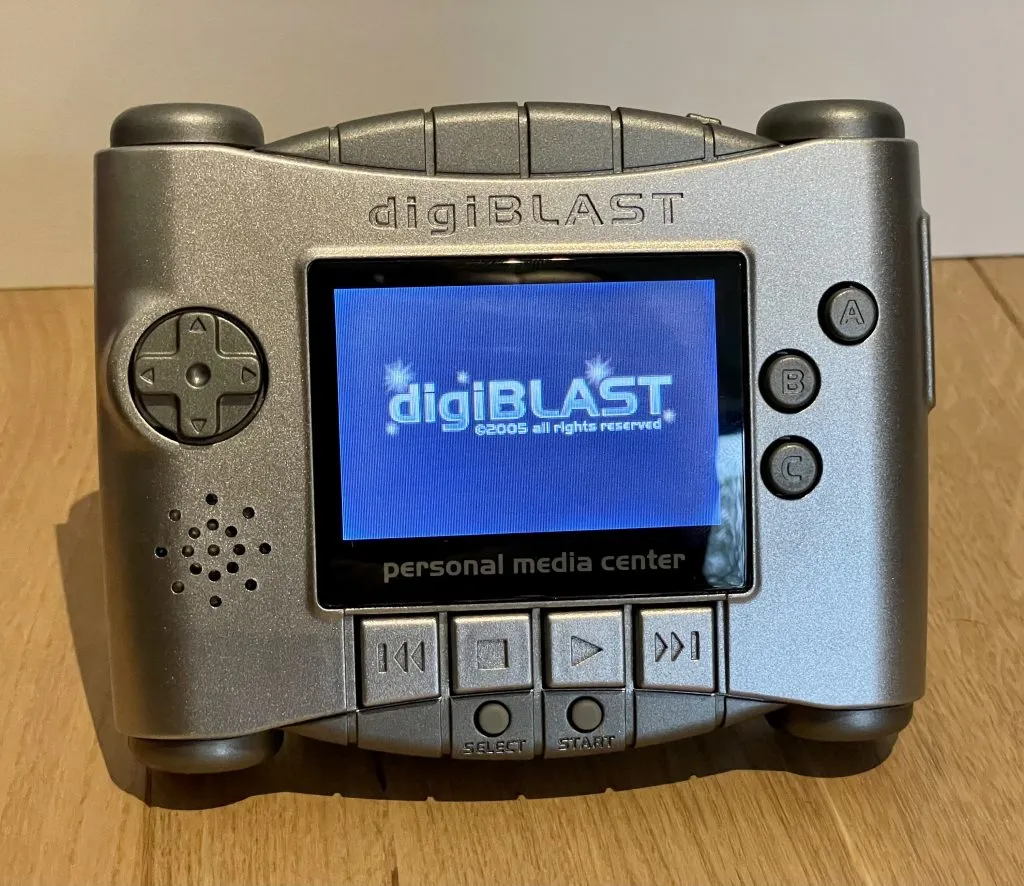
Every so often I run into a piece of console hardware that forces a double take. Enter the digiBLAST. Yes, BLAST in all caps. It earns it. You’ve likely never heard of it because it came from a Dutch company and launched only in Europe, where it immediately face-planted. You can still find spare units in Italy, though, if you look hard enough. The problem *was* the hardware. It aimed for GBA territory but didn’t reach it. Then it made things worse by launching in 2005, right as the PSP and Nintendo DS reset expectations for what a handheld should be. Even so, it showed up with built-in Atari titles like Asteroids and Centipede. You could slot in Rayman, Tony Hawk, and Sonic carts. It even joined the mid-2000s “your handheld is also a TV” trend, complete with officially released Yu-Gi-Oh episodes. But the real shock is the industrial design. It’s loud. It’s excessive. It has that weird 2000s confidence where everything looked like a prop from a cable sci-fi show. Nothing today has this energy—the digiBLAST simply can't exist now. Nikko, the company behind it, shut down in 2008—three years after launch. Yet they still managed to manufacture about 100,000 units. image
Taiwanese-made DOS fighting games were a thing during the 90s. And the catalyst wasn’t a lack of consoles. Taiwan already had Famiclones, Mega Drive imports, PC-Engine systems, and grey-market Super Famicoms everywhere. The real trigger was that Taiwan sat on top of the world’s most advanced PC-hardware ecosystem, and the official MS-DOS port of Street Fighter II (1992, U.S. Gold/Capcom) was so notoriously bad that local developers simply stepped in and did it better. Violent Fighter (1992) was first. It wasn’t visually stronger than Street Fighter II, but it controlled better, ran more smoothly on local 386/486 machines, and leaned into a cyberpunk New York aesthetic that made it stand out from Capcom’s style. Super Fighter (1993) landed next. And yes, this one truly *was* better than the DOS SF2 port in basically every dimension: sharper visuals, stronger animation, cleaner audio, and tighter game feel. It even supported two players on one keyboard, which was a huge deal for PC gaming at the time. The developer, C&E Inc., later released it as freeware, which is why it has such a long afterlife. Sango Fighter (1993) followed as Super Fighter’s spiritual successor—though technically from Panda Entertainment, not C&E—and became the crown jewel of Taiwanese DOS fighters. It drew directly from *Romance of the Three Kingdoms* mythology, pushed PC sprite work far beyond what most western studios were doing, and helped cement MS-DOS as a legitimate fighting-game platform in East Asia. Tough Guy (1995, also Panda Entertainment) pushed even further. Its visuals were close to Neo Geo quality on mid-90s PC hardware, which was unheard of. This game was rightly controversiall: one of the selectable characters was explicitly a Nazi officer. Taiwan’s indie PC scene never had the kind of content filtering that console makers imposed, which is why this happened. Martial Masters (1999) was the final apex. Built by IGS for their PolyGame Master (PGM) arcade board—not DOS—but still culturally part of the same lineage. It fused wuxia storytelling, fluid sprite animation, and advanced combo design at a level comparable to Street Fighter III, Garou: Mark of the Wolves, or Mortal Kombat 4. It is widely considered one of the greatest 2D fighters ever produced… and tragically, it never received a home port of any kind.