Today in Labor History November 30, 1803: The Balmis Expedition left Spain to vaccinate millions against smallpox in Spanish America and Philippines. The mission lasted from 1803 to 1806. The Spanish brought smallpox to the Americas, decimating the indigenous populations. Edward Jenner pioneered the vaccine in 1798. Variolation had already been in use for centuries in Africa, China and India, but was less safe and effective. At the time of the Balmis Expedition, about 400,000 Europeans died each year from smallpox, which is caused by the Variola virus. And it was the cause of one-third of all cases of blindness in Europe. In the 1770s, a smallpox epidemic wiped out 30% of the Indigenous peoples of the Puget Sound region. And overall, some historians estimate that smallpox wiped out over 90% of all indigenous people of the Americas, in one of the largest genocides in history.
Balmis brought 22 orphaned boys on the expedition, whom he infected with cowpox, to use as carriers of the disease. Infection with live cowpox, which was much milder than smallpox, gave lifelong immunity to the deadlier disease. In Cuba, he picked up three enslaved girls to use as additional carriers.
The Balmis expedition was both the first international vaccination program ever and the first international public health campaign. It was certainly not the last. The campaign to wipe out smallpox was ultimately successful in 1980, when the disease was declared eradicated. The WHO smallpox eradication program cost hundreds of millions of dollars and involved hundreds of thousands of people to reach the most remote villages in the world. The U.S. was the largest contributor to the program, but has recouped that investment every 26 days since in terms of money no longer spent on smallpox vaccinations and in the costs of incidence.
The last known case of smallpox was in a journalist from the UK, who most likely contracted the virus from a local research facility. Since then, it has become impossible to contract the virus naturally, since there is no longer any virus circulating in any human population, the first and only human virus to reach this status. For this reason, they stopped giving the smallpox vaccine to people, since the chances of dying from the disease are now 0%, which is lower than the extremely low risk of dying from the vaccine. It is also the reason the WHO recommended destroying all remaining laboratory stocks of the virus (i.e., to prevent a lab leak and the reintroduction of the deadly virus). All known supplies were, in fact, destroyed, except for two remaining stockpiles: one in the USSR (now Russia) and one in the CDC in the U.S. The WHO also bans the genetic engineering of the Variola virus. However, in 2002, researchers at NIH have synthesized Vaccinia virus, a close relative of Variola. In 2016, researcher synthesized horsepox, which had previously been extinct.
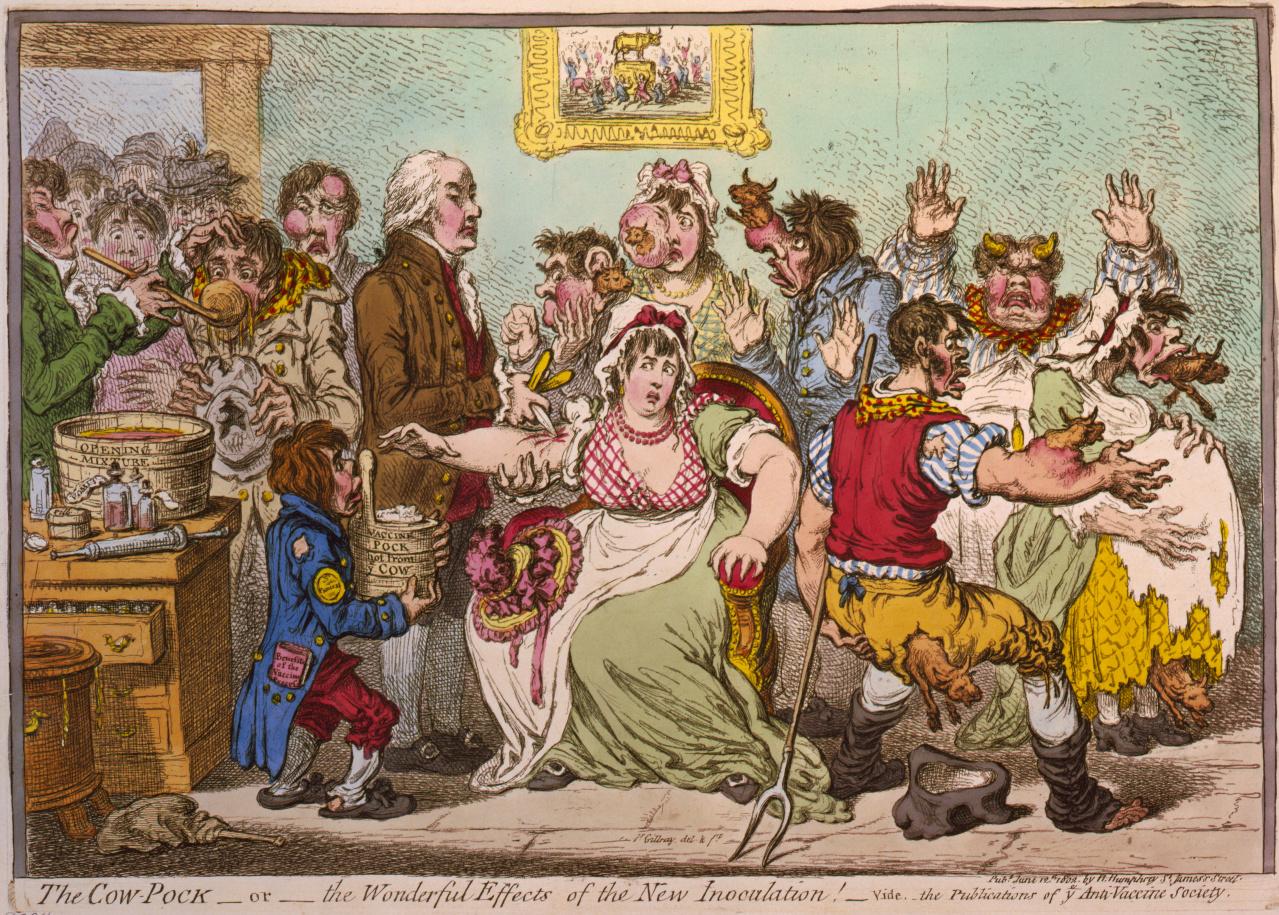
As with the covid vaccine, there was intense resistance to early smallpox vaccination programs. And as with vaccine resistance today, much of it was based on ignorance and conspiracy theories. The idea of scoring the flesh and introducing lymph from an infected animal seemed unsanitary. Some felt it was against “god’s will” since it was combining animal with human. Others were skeptical of its efficacy, believing the disease was caused by decay in the atmosphere, rather than germs that one could be immunized against. Or they simply were ignorant of how immunity worked and couldn’t understand how the immune system could be trained to block germs from making them sick. And there were those who opposed compulsory vaccination as a violation of their privacy rights. Anti-vaccination leagues grew in the UK and U.S. in the 1800s following compulsory smallpox vaccination laws. However, unlike Covid and Influenza, vaccination against Variola conferred nearly 100% lifelong immunity to the deadly disease, preventing both illness and death, as well as the spread of the disease.
#vaccine #vaccination #publichealth #genocide #indigenous #smallpox #spain #colonialism #slavery #exploitation #consent #who #cdc #covid