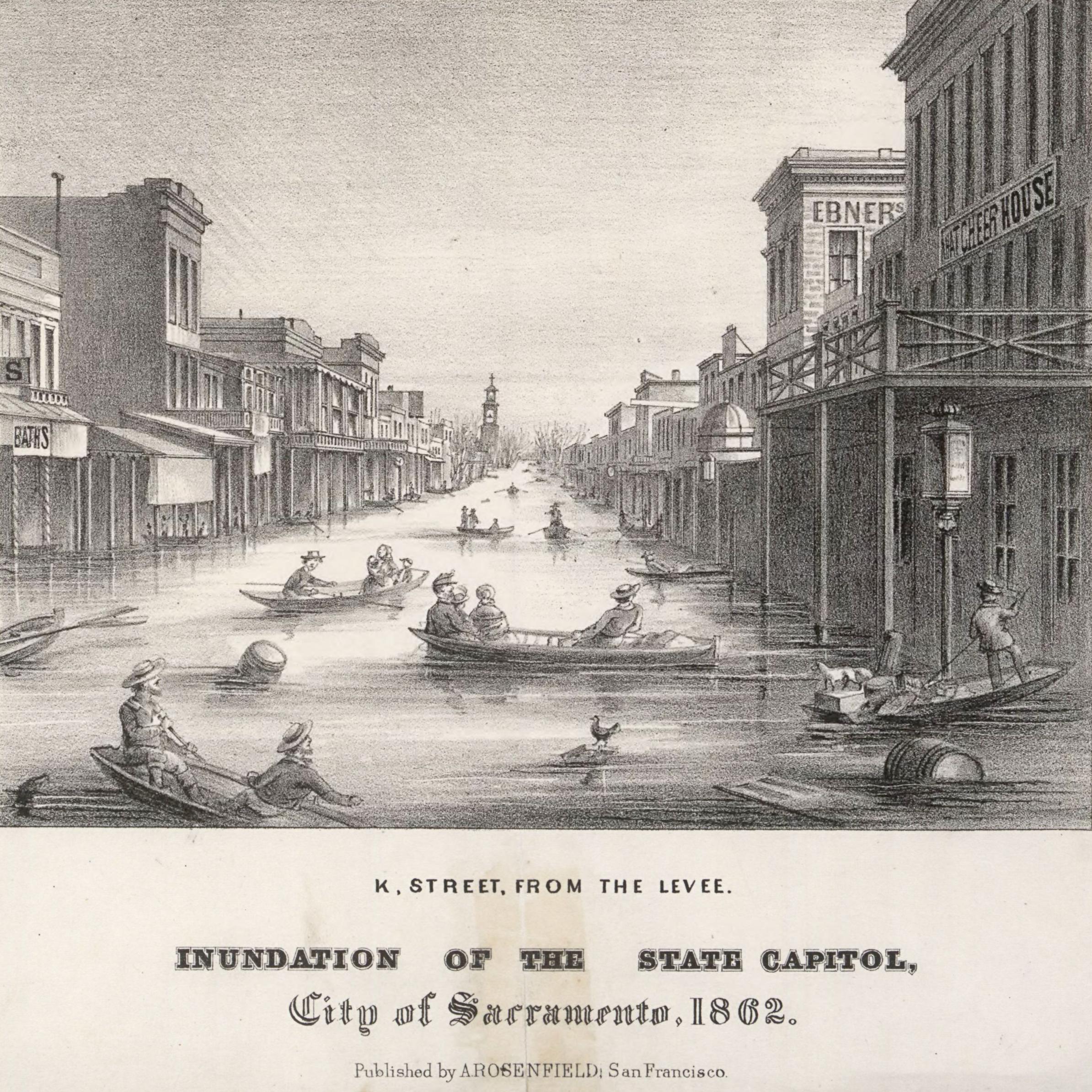
As the Atmospheric River season begins on the U.S. west coast, I thought I’d repost my article: "Worse Than the Big One," for those who haven’t already read it. It’s about the Great Flood of 1862, caused by nonstop Atmospheric Rivers that lasted more than 40 days straight, the worst natural disaster to hit the west in the last 160 years, inundating much of the land, from Oregon to San Diego. The San Joaquin Valley became a vast inland sea, 300 miles long and 20 miles wide. The state capital in Sacramento was under water for six months, forcing the government to relocate to San Francisco. 33% of California’s state property was destroyed, along with one in every eight private homes. Thousands of people died, possibly up to 1% of California’s entire population. And while floods of this magnitude used to happen every 200 years or so, models generated by Daniel Swain and researchers at UCLA’s Department of Atmospheric and Oceanic Sciences found that they will now happen roughly every 65 years, due to the effects of climate change. Swain also predicts a 20% increase in the intensity of these megastorms, meaning the next one could be far more devastating.
The event also influenced the course of wars. In New Mexico Territory, for example, the flooded Rio Grande impeded the California Column as it attempted to cut off the retreating Confederate Army of New Mexico, allowing them to escape into Texas. And in California’s Owens Valley, it brought the Paiutes, who were on the brink of starvation because the storms had decimated the wild game they relied on, into conflict with ranchers, who were trespassing on their lands to graze their herds. Over 200 Native Americans died in the Owens Valley Indian War (1862-1867), along with roughly 60 members of the California Militia.
Even without the effects of climate change, the consequences of a megaflood today would be much more serious than they were in 1862, when California had only 500,000 residents. Today there are hundreds of communities and large cities just in the vulnerable Central Valley, with a combined population of 6.5 million people living there. The Sacramento area, alone, is home to more than one million people, while Fresno has over 500,000 people, and Bakersfield has nearly 400,000 residents. The Central Valley includes the flood plains of two major rivers, the Sacramento and the San Joaquin, as well as many smaller rivers that drain down from the Sierra Nevada mountains.
And it’s not just a threat to Californians, either. Another flood like the one in 1862 would have a dire effect on the availability and cost of food for everyone in the U.S. The Central Valley comprises less than 1% of all U.S. farmland, yet it produces 25% of the nation’s food supply, including 90% of the broccoli, carrots, garlic, celery, grapes, tangerines, and plums, as well as 40% of the lettuce, cabbage, oranges, peaches and peppers, and over 20% of the milk. That is $46 billion worth of food annually, double the next most agriculturally productive state in the U.S.
You can read the full article here:

Michael Dunn
Worse Than the Big One: California’s Coming Megaflood - Michael Dunn
Share via: Facebook Twitter LinkedIn More When people think of California and natural disasters, they usually think of earthquakes, wildfires and d...
#workingclass #LaborHistory #atmosphericriver #bombcyclone #weather #ClimateChange #inflation #food #flood #california #indigenous #mexican #disaster