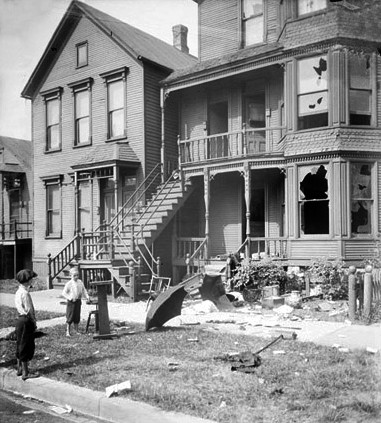
Today in Labor History July 27, 1919: Riots erupted in Chicago when a black youth on a raft crossed an unseen "color line" at the 29th Street Beach. He was drowned by rock-throwing whites. Tensions escalated quickly when a white police officer prevented a black cop from arresting the perpetrator. 38 people eventually died in the riots that followed, and which continued until August 3. Up to 2,000 lost their homes. White gangs attacked black neighbors and workers trying to get to and from work. Black civilians organized to resist and protect each other, while the Chicago Police turned a blind eye to white on black violence. The riots were ended by the deployment of 6,000 national guards. This was just one of over 36 white supremacist pogroms against black communities that broke out across the U.S. in the year after World War I. The deadliest of these pogroms occurred in Elaine, Arkansas, where up to 240 African Americans were massacred by racists.
In the years leading up to WWI, hundreds of thousands of southern African Americans moved north to get away from segregation, lynchings, political disenfranchisement, and for better economic opportunities. Between 1916 and 1919, the African American population of Chicago increased 148% from 44,000 to 109,000. Another 20,000 poor, southern whites also moved to Chicago at this time. Most of these newcomers (black and white) moved to the Southside, which had been inhabited by poor whites, predominantly Irish. And this led to competition for housing and jobs. Irish gangs were major instigators of the violence. They even tried to provoke Eastern European communities into join them by donning black face and burning down Lithuanian and Polish homes in the Back of the Yards neighborhood.
While these same racial tensions continued for decades, there was a significant period of activist solidarity and organizing between poor whites and poor blacks in the late 1960s and early 1970s, when the Young Patriots worked together with the Black Panthers and Young Lords. @jamestracy and @AmySonnie write brilliantly of this history in their book, “Hillbilly Nationalists, Urban Race Rebels, and Black Power: Community Organizing in Radical Times” (2011).
#workingclass #LaborHistory #chicago #racism #riots #police #massacre #chicago #poverty #solidarity #irish #segregation #lynching #BlackMastadon #blackpanthers #younglords #youngpatriots #immigration #diaspora