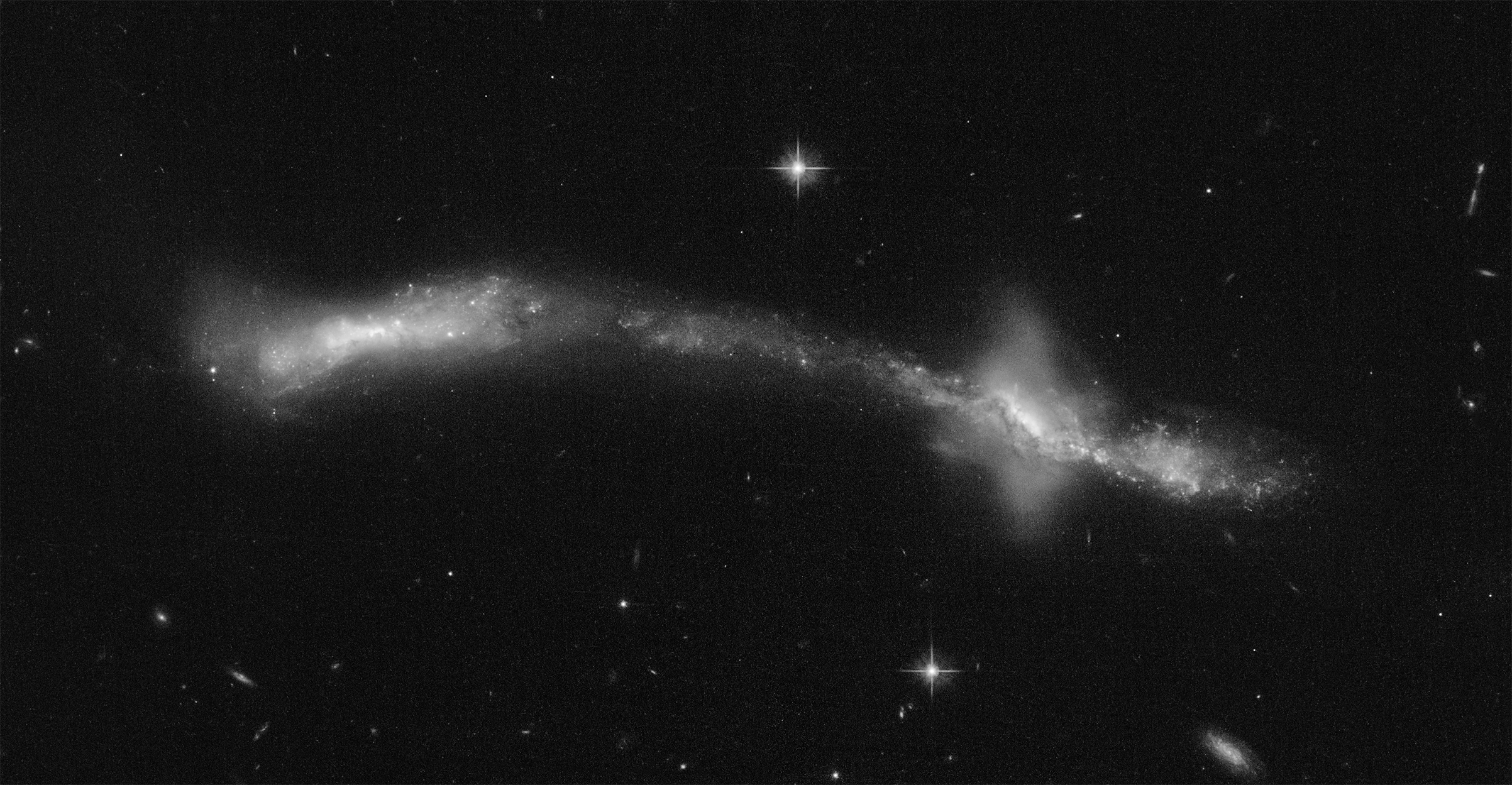
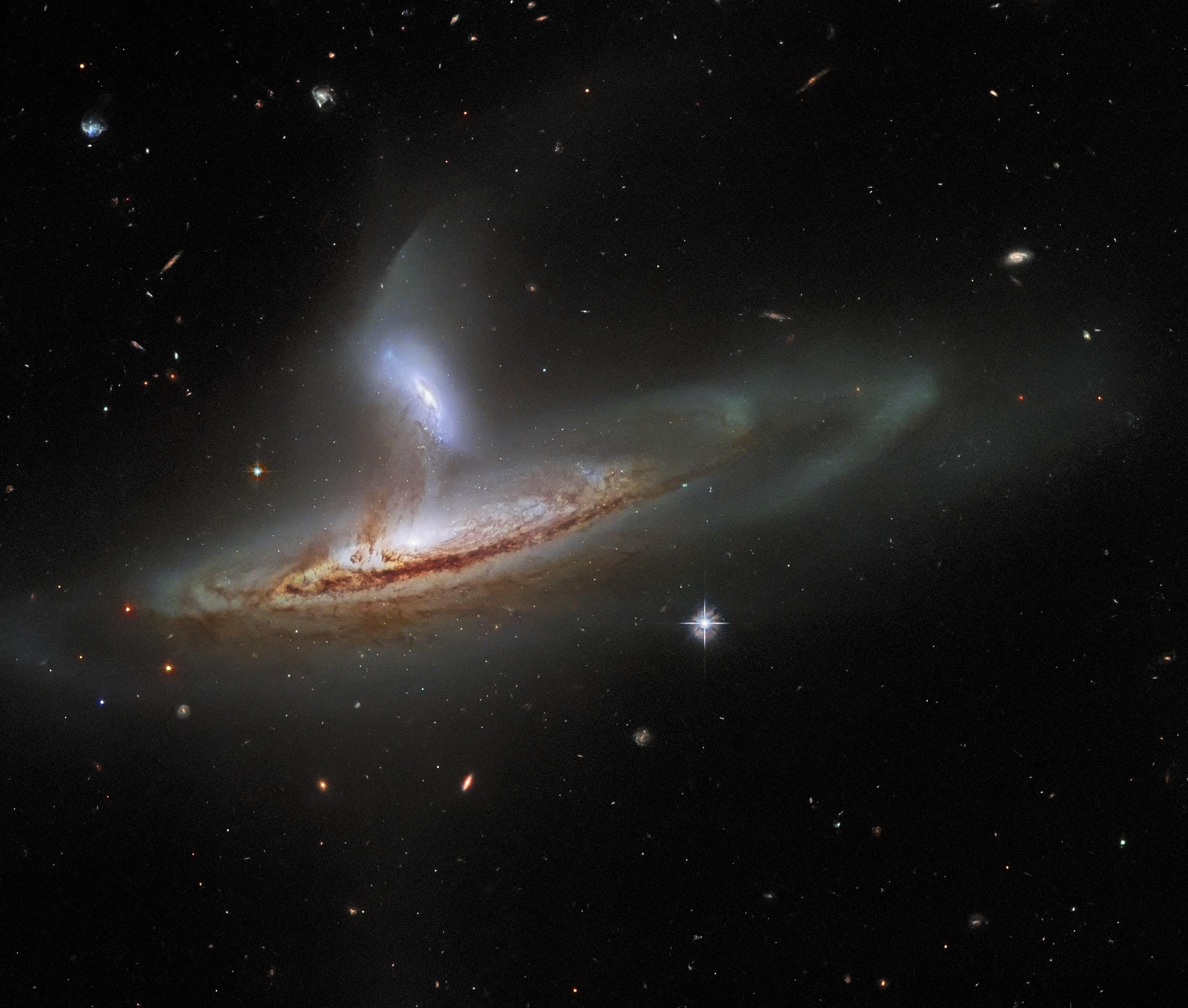
Hubble Space Telescope image of Arp 23, also known as NGC 4618. NGC 4618 is a single-armed barred spiral galaxy. It has a diameter of about a third that of the Milky Way. Its unusual shape may come from gravitational interactions with a neighboring galaxy NGC 4625, which is just out of frame. Credit: ESA, NASA, I. Karachentsev Source: #ArpGalaxy #Galaxy #Space #Astronony #Hubble image
Hubble and Spitzer image of Arp 148, also known as Mayall's Object. The thick clouds of dusty material in the edge-on galaxy (left) glow brightly in the infrared wavelengths of light seen by Spitzer (red), while starlight dominates the visible light from Hubble (blue and green). The edge-on galaxy likely crashed through its companion, creating a ring and triggering a burst of star formation. Credit: NASA, JPL-Caltech, STScI Source: #ArpGalaxy #Galaxy #Space #Astronony image
Gran Telescopio Canarias image of Arp 84, also known as NGC 5394 and NGC 5395. This interacting pair is sometimes called the "Heron Galaxy". The larger spiral, NGC 5395 forms the body and wing of the heron and the smaller, two-armed NGC 5394 forms the neck, head, and beak of the bird. Credit: GTC, IAC Source: https://www.gtc.iac.es/multimedia/imageGallery.php #ArpGalaxy #Galaxy #Space #Astronony image
Kitt Peak image of Arp 78, also known as NGC 772. One of NGC 772’s spiral arms is particularly prominent. This is likely due to gravitational interactions with its companion galaxy NGC 770, the small elliptical galaxy in the center near the top of the frame. The interactions left NGC 772's bottom arm elongated and asymmetrical. Credit: KPNO, NOIRLab, NSF, AURA, A. Block Source: #ArpGalaxy #Galaxy #Space #Astronony image
Kitt Peak National Observatory image of Arp 18, also known as NGC 4088. NGC 4088 is an asymmetric spiral galaxy, located about 40 million light years away. Credit: KPNO, NOIRLab, NSF, AURA, Bonnie Fisher, Mike Shade, Adam Block Source: #ArpGalaxy #Galaxy #Space #Astronony image
Kitt Peak image of Arp 286, also known as NGC 5560, NGC 5566, and NGC 5569. The three galaxies in this triplett are gravitationally interacting. NGC 5566 is the large spiral in the center. The small blue spiral galaxy to the bottom left is NGC 5569. The spiral galaxy to the top left is NGC 5560. Its distorted shape is likely due to interactions with NGC 5569. Credit: NOIRLab, NSF, AURA, T.A. Rector, H. Schweiker Source: #ArpGalaxy #Galaxy #Space #Astronony image
Hubble image of Arp 204, also known as UGC 8454. This is likely at least two interacting galaxies connected by a long tidal tail. Encounters between the galaxies have distorted their shapes, making a somewhat puzzling mess. Credit: NASA, ESA, STScI, J. Dalcanton, Judy Schmidt Source: https://www.flickr.com/photos/geckzilla/48370370147/in/album-72157629527315128 #ArpGalaxy #Galaxy #Space #Astronony image
Hubble and NuStar image of Arp 299, also known as NGC 3690. NuSTAR data overlaid on a Hubble image of the interacting galaxy pair show the galaxy on the right has an active supermassive black hole. It is accreting the surrounding gas and glowing brightly in X-rays. Credit: NASA, JPL-Caltech, GSFC Source: https://www.nustar.caltech.edu/image/nustar150108c #ArpGalaxy #Galaxy #Space #Astronony image
Hubble image of Arp 282, also known as NGC 169 and NGC 169A. Both NGC 169 (bottom) and NGC 169A (top) have actively accreting supermassive black holes in their centers. The two galaxies are interacting, creating delicate streams of stars, gas and dust that visibly link the pair. Credit: ESA/Hubble & NASA, J. Dalcanton, Dark Energy Survey, DOE, FNAL/DECam, CTIO/NOIRLab/NSF/AURA, SDSS, J. Schmidt Source: #ArpGalaxy #Galaxy #Space #Astronony #Hubble image