On-boarding to @Angor today, to which we will receive our prize from a podium hackathon finish at #BH2025 Love the fact that a project is created as part of an OP_RETURN code in an actual bitcoin UTXO The prize wil be released to us in tranches, if we don't claim, it's time locked and returnable to the investor Our access key is literally our 12 words Smooth!!! https://hub.angor.io/project/angor1q4heck5tf6svq7x8jp5twak329xtv9805xppvq5
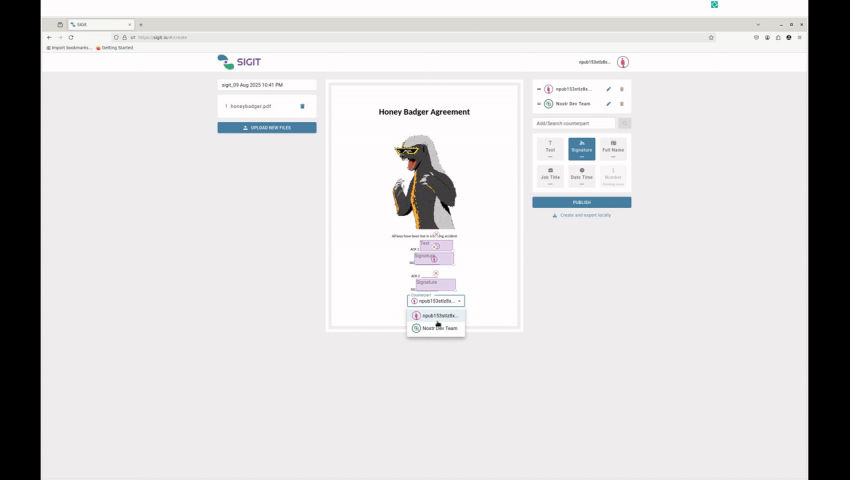
We are participating in the HoneyBadger Hackathon, sponsored by Angor! Below is our first ever demo video #BH2025
v2.0.7 is now available - this fixes some issues using the offline flow, and makes it possible to verify an unencrypted SIGit from the homepage, without signing in Nostr works great without internet, or relays 😎
All counterparty signatures, plus the creation of the SIGit itself, are timestamped (OTS) on the Bitcoin blockchain Irrefutable proof that an agreement was signed on a particular date
SIGit v2.0.6 is now released! A SIGit is composed of multiple regular files (e.g. original files, template.json), unpublished nostr events (e.g. signed create and sign events) and published nostr events (e.g. notification gift wraps, app data). For performance and reliability, all these files are zipped, encrypted, and loaded to blossom. For even better performance, to avoid downloading the zip and fetching / processing nostr events each time - the underlying files are also cached in the local browser file cache, the IndexedDB - files repository. Each time SIGit needs one of these building blocks it first checks the local cache. On cache miss, we check the original decrypted source in cache. If we can't find that, then we download the zip from blossom and decrypt the contents. Finally, if the blossom zip is missing on the blossom server(s), we fetch the original app data (30078) event and re-process (and publish) all the source events again. In this release, we improved the stability of the above process.
v2.0.4 is now released - mostly minor refactoring, but we also made each sigit id partially visible so you can tell when signing 30078 requests, which sigit they relate to sigit ids are a hash of the create event id and the user npub, so it is not possible to correlate events as an outside observer
v2.03 now released with a bunch of improvements to the OTS generation process Timestamps are generated for the create event and each sign event Each timestamp has 3 states - pending, upgraded, verified
v2.02 is released - fixes an issue where the last remaining pdf in a draft sigit could not be deleted, and applies some client side logic to handle the case where relays sometimes do not send an EOSE message